
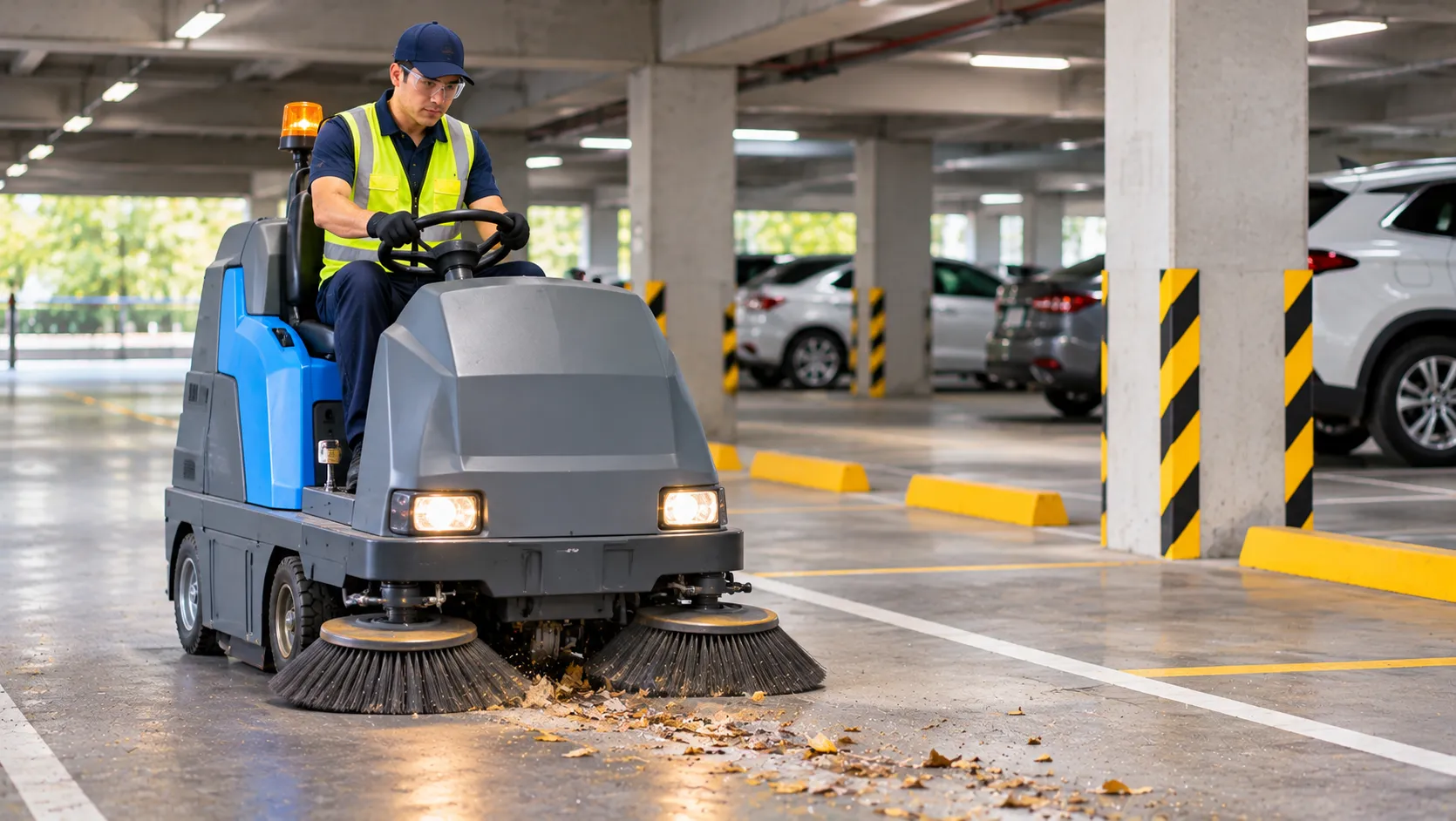
Quick Answer: Why Does Mechanical Car Park Sweeping Save Money?
Mechanical car park sweeping saves money by increasing cleaning productivity, reducing manual labour requirements and controlling debris before it contributes to more expensive maintenance problems. Powered sweeping equipment can cover large parking areas more efficiently than manual sweeping alone, making it particularly valuable for shopping centres, warehouses, commercial buildings and multi-storey parking facilities.
The main cost-saving benefits include:
- Reduced labour hours for large-area cleaning.
- Lower cleaning costs per square metre where mechanisation is suitable.
- Reduced accumulation of abrasive sand, grit and sediment.
- Improved protection of concrete and coated surfaces.
- Reduced potential for debris-related drainage blockages.
- Less dirt transferred into building entrances and indoor floors.
- Reduced dependence on intensive corrective cleaning.
- Shorter cleaning windows and more predictable maintenance budgets.
A scheduled sweeping program combined with targeted manual cleaning, spill management and periodic deep cleaning can provide better long-term value than relying entirely on reactive maintenance.
Commercial car parks experience continuous exposure to vehicle traffic, weather, tyre residue, litter and airborne contamination. Without an effective maintenance program, these materials gradually accumulate across parking bays, ramps, pedestrian walkways and drainage channels.
For property owners and facility managers, the challenge is not simply keeping parking areas clean. It is maintaining acceptable presentation and operational standards without allowing recurring cleaning expenses to become unnecessarily high.
Mechanical sweeping addresses this challenge by using powered equipment to collect loose contaminants across larger areas. When integrated into a professional commercial car park cleaning program, it can help businesses improve productivity, manage maintenance expenditure and protect frequently used property assets.
What Is Mechanical Car Park Sweeping?
Mechanical car park sweeping involves using powered equipment to collect loose debris from parking facilities. Depending on the machine, rotating brushes, suction systems, dust filters and integrated collection hoppers help remove contaminants from accessible paved surfaces.
Unlike traditional broom sweeping, mechanical equipment consolidates debris collection into a more continuous process, reducing the need for repeated manual handling.
| Equipment Component | Function | Operational Benefit |
|---|---|---|
| Main Sweeping Brush | Collects loose surface debris | Efficient cleaning coverage |
| Side Brushes | Moves accessible edge debris towards the collection path | Improved kerb cleaning |
| Collection Hopper | Stores collected rubbish and sediment | Less frequent manual waste handling |
| Vacuum System | Assists debris and ordinary dust collection on suitable machines | Improved collection efficiency |
| Dust Filtration | Helps control particles released during sweeping | Reduced redistribution of ordinary dust |
| Powered Drive System | Moves equipment across parking surfaces | Reduced physical sweeping workload |
Mechanical sweeping is generally most effective in accessible areas with sufficient operating space. Manual detailing remains necessary around obstacles, stairs, wheel stops and confined corners.
7 Ways Mechanical Car Park Sweeping Reduces Maintenance Costs
1. Lower Manual Cleaning Labour Requirements
Manually sweeping thousands of square metres requires considerable time because cleaners must repeatedly gather, collect and transport debris.
Mechanical equipment allows an operator to collect loose contaminants across larger accessible areas during each cleaning session.
This can reduce the number of labour hours allocated to broad-area sweeping and allow cleaning personnel to focus on tasks that require detailed attention, such as:
- Cleaning around structural columns.
- Removing rubbish from stairwells.
- Maintaining pedestrian entrances.
- Cleaning parking bay edges.
- Reporting pavement damage and spills.
- Maintaining lift lobby transition areas.
2. Increased Cleaning Productivity
Cleaning productivity refers to the amount of usable surface area cleaned within a given period. Mechanical sweepers can increase productivity where parking layouts allow efficient equipment movement.
Faster cleaning may also make it easier to complete scheduled maintenance during quieter operating periods.
3. Reduced Exposure to Abrasive Contaminants
Sand, gravel and grit can contribute to surface abrasion when repeatedly moved across concrete, asphalt and protective floor finishes by vehicle tyres.
Removing these materials regularly helps limit unnecessary abrasive exposure, supporting the broader maintenance of pavement and protective coatings.
4. Reduced Potential for Drainage Blockages
During rainfall, loose leaves, litter and sediment can migrate towards drainage grates and stormwater channels.
Routine sweeping helps collect these materials before they accumulate around drainage infrastructure, potentially reducing some avoidable maintenance callouts.
5. Less Intensive Corrective Cleaning
Loose contamination becomes more difficult to remove when repeatedly compacted by vehicles or mixed with moisture and oily residues.
Scheduled sweeping helps control removable debris before additional treatments, such as machine scrubbing or pressure cleaning, become necessary.
6. Reduced Dirt Transfer Into Buildings
Customers, employees and visitors can carry grit and dust indoors on footwear, trolley wheels and mobility equipment.
Cleaner parking surfaces may reduce the quantity of external contamination entering reception areas, shopping centres, lift lobbies and commercial offices.
7. More Predictable Maintenance Budgets
A planned sweeping schedule allows property managers to allocate recurring maintenance expenditure more effectively.
Rather than waiting for substantial contamination buildup or cleanliness complaints, businesses can budget for routine servicing and reserve additional expenditure for condition-based deep cleaning.
| Cost-Saving Mechanism | Immediate Benefit | Potential Long-Term Benefit |
|---|---|---|
| Mechanical Labour Efficiency | Reduced sweeping hours | Lower recurring cleaning expenditure |
| Increased Surface Coverage | Faster cleaning completion | Improved service productivity |
| Abrasive Debris Removal | Less loose grit on surfaces | Reduced avoidable surface wear |
| Drainage Protection | Less debris around grates | Potentially fewer blockage-related callouts |
| Preventative Cleaning | Reduced contamination accumulation | Less dependency on corrective treatment |
| External Dirt Control | Cleaner building transition areas | Potential indoor cleaning efficiencies |
| Scheduled Maintenance | Consistent cleaning coverage | More predictable operating budgets |
Mechanical Sweeping vs Manual Car Park Cleaning
Manual sweeping remains appropriate for detailed work and smaller parking facilities. However, mechanical sweeping can offer better productivity across extensive, unobstructed surfaces.
| Comparison Factor | Manual Sweeping | Mechanical Sweeping |
|---|---|---|
| Best Application | Small or obstructed areas | Medium to large parking facilities |
| Labour Requirements | Generally higher for large areas | Potentially lower for accessible surfaces |
| Cleaning Speed | Dependent on individual worker output | Higher potential area coverage |
| Equipment Cost | Relatively low | Higher equipment investment or service cost |
| Waste Collection | Separate manual collection | Integrated collection on suitable equipment |
| Dust Management | Dependent on cleaning technique | Filtration and dust suppression options |
| Confined Areas | Highly adaptable | May require manual follow-up |
| Physical Workload | Repetitive manual sweeping | Reduced broad-area manual workload |
| Large-Site Scalability | Additional labour or time required | Equipment capacity supports larger areas |
| Long-Term Cost Efficiency | Suitable for smaller facilities | Potential advantage for frequently cleaned large facilities |
For many properties, the most economical solution combines mechanical sweeping for open areas with manual cleaning for detailed locations.
How Much Money Can Mechanical Car Park Sweeping Save?
The financial benefit depends on the property's sweepable area, cleaning frequency, actual labour rates, equipment costs and achievable cleaning productivity.
Consider a hypothetical commercial car park with 6,000 square metres of accessible parking surface that requires cleaning twice per week.
| Cost Factor | Manual Cleaning | Mechanical Cleaning |
|---|---|---|
| Total Cleaning Area | 6,000 m² | 6,000 m² |
| Assumed Coverage Rate | 500 m²/hour | 2,000 m²/hour |
| Broad-Area Sweeping | 12 hours | 3 hours |
| Additional Manual Detailing | Included in assumed rate | 1 hour |
| Total Labour Per Visit | 12 hours | 4 hours |
| Assumed Labour Cost | $45/hour | $45/hour |
| Total Labour Cost | $540 | $180 |
| Equipment and Operating Allocation | $20 | $140 |
| Total Cost Per Visit | $560 | $320 |
| Annual Cleaning Visits | 104 | 104 |
| Estimated Annual Cost | $58,240 | $33,280 |
| Illustrative Annual Savings | $24,960 | |
| Illustrative Cost Reduction | 42.9% | |
Important: This comparison uses hypothetical Australian dollar amounts, excluding GST, to demonstrate how cleaning productivity can influence annual maintenance costs. These figures are not Corporate Cleaning Services® quotations, measured performance results or guaranteed savings. Actual costs depend on site conditions, labour arrangements, equipment requirements and service inclusions.
How to Calculate Car Park Sweeping Costs Per Square Metre
Cost per square metre provides a useful way to compare cleaning arrangements across properties of different sizes.
Cleaning Cost Per Square Metre = Total Cleaning Cost ÷ Total Area Cleaned
Using the hypothetical cost comparison above:
| Measurement | Manual Sweeping | Mechanical Sweeping |
|---|---|---|
| Cleaning Cost Per Visit | $560 | $320 |
| Area Cleaned | 6,000 m² | 6,000 m² |
| Cost Per Square Metre | $0.093 | $0.053 |
| Annual Labour Hours | 1,248 hours | 416 hours |
| Illustrative Annual Labour Hours Saved | 832 hours | |
Facility managers should compare equivalent cleaning coverage, quality standards and waste disposal requirements when evaluating costs.
How Mechanical Sweeping Helps Protect Car Park Surfaces
Parking surfaces are exposed to different forms of contamination that can influence maintenance requirements. Regular removal of loose debris helps control one component of surface deterioration.
| Surface Type | Common Maintenance Concern | Benefit of Regular Sweeping |
|---|---|---|
| Unsealed Concrete | Dirt accumulation and abrasion | Removes loose abrasive material |
| Sealed Concrete | Scratching and protective finish wear | Limits accumulated grit |
| Asphalt | Sediment and surface debris | Supports routine pavement maintenance |
| Epoxy-Coated Floors | Coating scratches and contamination | Reduces exposure to loose abrasive particles |
| Decorative Paving | Visible debris and sediment | Maintains surface presentation |
| Painted Parking Lines | Obscured markings and abrasion | Supports marking visibility |
| Pedestrian Walkways | Loose grit and litter | Improves surface housekeeping |
Mechanical sweeping cannot repair cracked concrete, deteriorated asphalt or failed protective coatings. Existing surface damage should be documented and referred for appropriate maintenance.
Brush materials and equipment settings must also be compatible with the pavement finish to avoid unnecessary surface damage.
Preventing Debris-Related Drainage Problems
Blocked drainage systems can create operational challenges, particularly in basement car parks, sloped parking areas and commercial facilities exposed to heavy rainfall.
Loose debris collecting around drainage grates can interfere with surface water movement. Routine sweeping helps remove accessible materials before they enter drainage Infrastructure.
| Common Debris | Potential Drainage Problem | Preventative Action |
|---|---|---|
| Leaves | Obstructed surface grates | Scheduled leaf collection |
| Sand and Grit | Sediment accumulation | Routine sweeping |
| Plastic Packaging | Blocked drainage openings | Regular litter collection |
| Paper and Cardboard | Wet debris buildup | Prompt waste removal |
| Organic Matter | Decomposition and odours | Frequent cleaning of affected areas |
| Small Stones | Accumulation in drainage channels | Mechanical collection where suitable |
Scheduled sweeping should be combined with drainage inspections and professional drainage maintenance where necessary. Surface cleaning does not remove existing internal pipe blockages.
Mechanical Sweeping vs Pressure Cleaning vs Floor Scrubbing
Mechanical sweeping is one component of a comprehensive car park maintenance program. Different contaminants require different cleaning methods.
| Comparison Factor | Mechanical Sweeping | Pressure Cleaning | Mechanical Scrubbing |
|---|---|---|---|
| Primary Purpose | Loose debris collection | Deep surface cleaning | Adhered grime removal |
| Typical Contamination | Dust, sand, leaves and litter | Embedded dirt and treated residues | Traffic films and surface grime |
| Water Usage | None or limited | Generally higher | Controlled water application |
| Oil Removal | Not suitable as a standalone method | May assist after appropriate treatment | May assist with compatible degreasers |
| Surface Drying | Usually unnecessary when dry sweeping | Water recovery or drying may be required | Recovery systems can reduce residual moisture |
| Maintenance Role | Routine preventative cleaning | Periodic corrective cleaning | Scheduled surface maintenance |
| Typical Waste | Collected solid debris | Contaminated wastewater | Recovered cleaning solution |
Where parking surfaces develop persistent grime, vehicle stains or oily deposits, professional commercial pressure cleaning services can complement routine sweeping through surface-appropriate treatment.
Using the correct cleaning method helps avoid unnecessary water consumption, excessive treatment costs and damage caused by unsuitable equipment.
What Mechanical Sweeping Can and Cannot Remove
| Contamination Type | Suitable for Mechanical Sweeping? | Additional Treatment |
|---|---|---|
| Loose Sand | Yes | Usually none |
| Small Gravel | Yes, within equipment limits | Manual collection for larger pieces |
| Dry Leaves | Yes | Targeted edge cleaning |
| Food Packaging | Yes, where machine-compatible | Manual litter collection |
| Ordinary Surface Dust | With suitable filtration | Additional dust control where required |
| Broken Glass | Equipment-dependent | Safe targeted collection |
| Oil Spills | No | Spill recovery and degreasing |
| Chewing Gum | No | Surface-compatible specialist treatment |
| Tyre Marks | No | Compatible scrubbing or pressure cleaning |
| Embedded Grime | Limited effectiveness | Mechanical scrubbing or deep cleaning |
| Hazardous Dust | Not with ordinary sweeping equipment | Specialist assessment and suitable controls |
Cleaning teams should identify contamination before selecting machinery. Sweeping liquid spills or unidentified hazardous material can spread contamination and increase corrective cleaning costs.
Which Commercial Properties Benefit Most from Mechanical Sweeping?
Mechanical sweeping is particularly useful for properties where extensive parking areas, repetitive vehicle movements and frequent debris accumulation create ongoing maintenance requirements.
| Property Type | Common Contamination | Primary Maintenance Benefit |
|---|---|---|
| Shopping Centres | Litter, packaging and traffic debris | Consistent presentation across large parking areas |
| Commercial Office Buildings | Leaves, sand and dust | Predictable scheduled maintenance |
| Multi-Storey Car Parks | Vehicle dust and grit | Efficient cleaning across accessible levels |
| Basement Car Parks | Accumulated dust and sediment | Improved routine debris management |
| Warehouses | Pallet fragments and packaging | Improved cleaning productivity |
| Distribution Centres | Vehicle and logistics-related debris | Reduced broad-area cleaning labour |
| Hotels | Visitor litter and road debris | Improved arrival experience |
| Hospitals | Vehicle-related contamination | Consistent external housekeeping |
| Strata Properties | Resident vehicle debris and leaves | Efficient shared-area maintenance |
| Industrial Facilities | Operational debris and sediment | Improved large-area cleaning coverage |
Choosing the Right Mechanical Sweeping Equipment
Equipment selection directly influences cleaning productivity. A large machine may provide excellent coverage in an open-air car park but perform poorly in a basement facility with narrow ramps and restricted turning areas.
Walk-Behind Sweepers
Walk-behind machines are appropriate for smaller parking facilities, pedestrian routes and locations where manoeuvrability is important.
Ride-On Sweepers
Ride-on machines can improve coverage across extensive parking areas and reduce the manual walking required during cleaning operations.
Vacuum-Assisted Sweepers
Vacuum-assisted equipment combines mechanical collection with suction, which may improve the capture of suitable ordinary dust and smaller debris.
Battery-Powered Sweepers
Battery-powered machinery produces no combustion exhaust at the point of operation and may be appropriate for selected enclosed parking environments.
| Equipment Type | Suitable Environment | Selection Consideration |
|---|---|---|
| Walk-Behind Sweeper | Small and medium facilities | Operator walking requirements |
| Compact Ride-On Sweeper | Accessible parking levels | Entry height and turning clearance |
| Large Ride-On Sweeper | Extensive open parking areas | Space and mobilisation requirements |
| Vacuum-Assisted Sweeper | Selected ordinary dusty environments | Filtration suitability |
| Battery-Powered Sweeper | Selected basement and enclosed facilities | Battery runtime and charging arrangements |
| Engine-Powered Sweeper | Suitable outdoor facilities | Fuel, emissions and noise controls |
The appropriate machine should be selected following an assessment of floor conditions, access restrictions, gradients, ventilation and contamination types.
Learn more about equipment selection in our guide to essential commercial cleaning equipment.
How Regular Sweeping Reduces Indoor Cleaning Requirements
External and internal property maintenance are closely connected. Dirt from commercial car parks can be transported inside buildings through vehicle tyres, shoes, shopping trolleys and mobility equipment.
This creates additional cleaning requirements in reception areas, pedestrian entrances and other high-traffic interior spaces.
| Building Area | Transferred Contamination | Potential Benefit of External Sweeping |
|---|---|---|
| Building Entrances | Sand and grit | Reduced loose dirt accumulation |
| Lift Lobbies | Dust from parking levels | Cleaner transition areas |
| Shopping Centre Floors | Trolley and footwear debris | Reduced external contamination loading |
| Entrance Matting | Road sediment | Potential reduction in trapped debris |
| Carpeted Offices | Abrasive particles | Reduced exposure to tracked-in grit |
| Warehouse Entrances | Tyre-related contamination | Improved overall floor housekeeping |
Mechanical sweeping should complement existing entrance matting, indoor vacuuming and hard-floor maintenance rather than replace these activities.
Reducing Water and Cleaning Product Consumption
Many routine car park contaminants can be collected without washing the entire surface. Dry mechanical sweeping removes suitable loose debris with little or no process water, depending on the equipment.
This may reduce the need for unnecessary broad-area washing and associated wastewater recovery.
| Maintenance Method | Relative Water Requirement | Recommended Use |
|---|---|---|
| Dry Mechanical Sweeping | Low or none | Loose debris and suitable sediment |
| Dust-Suppressed Sweeping | Equipment-dependent | Selected ordinary dusty surfaces |
| Targeted Spot Cleaning | Localised water use | Small affected surface areas |
| Mechanical Scrubbing | Controlled water use | Adhered dirt and residue |
| Pressure Cleaning | Generally higher water use | Compatible deep-cleaning applications |
Reducing unnecessary wet cleaning can also help minimise drying time, cleaning-related access restrictions and wastewater management requirements.
However, environmental performance depends on responsible equipment operation, suitable debris collection and compliance with applicable waste and stormwater requirements.
Maintaining Car Parks Without Disrupting Business Operations
Busy commercial properties cannot always close their entire car park for maintenance. Cleaning schedules must balance access requirements with safe machinery operation.
Mechanical sweeping may allow accessible zones to be cleaned within shorter maintenance windows, provided appropriate traffic controls are established.
| Cleaning Arrangement | Best Application | Operational Benefit |
|---|---|---|
| Early Morning Cleaning | Retail and office properties | Cleaning before peak arrivals |
| Evening Cleaning | Commercial workplaces | Reduced parking occupancy |
| Overnight Cleaning | Selected large facilities | Extended low-traffic maintenance window |
| Sequential Level Cleaning | Multi-storey car parks | Limits closures to designated areas |
| Zone-Based Cleaning | Large commercial parking facilities | Maintains access to unaffected sections where safe |
| Condition-Based Servicing | Variable-traffic properties | Allocates cleaning resources where needed |
Cleaning during quieter operating periods can improve equipment access, although any after-hours labour premiums should be included in cost comparisons.
How Often Should Commercial Car Parks Be Mechanically Swept?
The most cost-effective sweeping frequency is determined by actual contamination levels, vehicle traffic, surrounding landscaping, weather conditions and property presentation requirements.
| Property Type | Illustrative Inspection Frequency | Suggested Sweeping Frequency |
|---|---|---|
| Busy Shopping Centre | Daily | Daily to several times weekly |
| Public Multi-Storey Car Park | Daily | Several times weekly to weekly |
| Commercial Office Complex | Daily to weekly | Weekly or as required |
| Warehouse Parking Facility | Daily | Weekly or more frequently when needed |
| Distribution Centre | Daily | Daily to weekly |
| Hotel Parking Facility | Daily | Several times weekly to weekly |
| Hospital Car Park | Daily | According to site requirements |
| Strata Car Park | Weekly | Weekly to monthly |
| Low-Traffic Commercial Facility | Weekly | Fortnightly to monthly |
These frequencies are illustrative starting points for maintenance planning. They are not mandatory cleaning intervals and should be adjusted according to inspections and changing site conditions.
Example Preventative Car Park Maintenance Schedule
A comprehensive maintenance program should combine routine debris removal with inspections, targeted corrective cleaning and periodic service reviews.
| Maintenance Interval | Recommended Activity | Maintenance Objective |
|---|---|---|
| Daily | Inspect traffic routes and pedestrian areas | Identify immediate hazards |
| Daily or Weekly | Mechanical sweeping of accessible surfaces | Control recurring debris accumulation |
| Weekly | Manual cleaning around kerbs and columns | Maintain inaccessible areas |
| Weekly | Inspect drainage grate surroundings | Identify accessible debris obstructions |
| Monthly | Inspect contamination hotspots | Identify changing cleaning requirements |
| Monthly | Review pavement and line markings | Identify repair requirements |
| Quarterly | Assess scrubbing and pressure cleaning needs | Plan condition-based deep cleaning |
| Every Six Months | Review protective surface condition | Support asset maintenance planning |
| Annually | Review cleaning productivity and costs | Improve maintenance budgeting |
| After Significant Weather Events | Inspect affected parking areas when safe | Address changed debris and drainage conditions |
Is Outsourcing Mechanical Sweeping More Cost-Effective?
Purchasing mechanical sweeping equipment may be suitable for facilities with frequent cleaning requirements and sufficient internal resources. However, equipment ownership involves ongoing expenses beyond the initial purchase price.
Outsourcing allows property managers to evaluate cleaning as an agreed service expense rather than managing dedicated equipment directly.
| Cost or Responsibility | In-House Sweeping | Outsourced Sweeping |
|---|---|---|
| Equipment Purchase | Upfront capital requirement | Generally managed by contractor |
| Equipment Storage | On-site space required | Often managed externally |
| Operator Training | Employer responsibility | Contractor-managed competency |
| Equipment Repairs | Direct owner expense | Generally contractor responsibility |
| Replacement Brushes and Filters | Recurring ownership expense | Generally included in agreed service pricing |
| Energy and Fuel | Direct operating expense | Subject to service agreement |
| Equipment Depreciation | Relevant to ownership | No direct machinery depreciation |
| Service Scheduling | Managed internally | Agreed with service provider |
| Equipment Breakdown | Owner arranges contingency | Depends on contract provisions |
| Quality Assurance | Internal inspections | Defined service performance requirements |
For properties where sweeping machinery would remain unused for much of the week, outsourcing may provide a more economical alternative to purchasing equipment.
When comparing potential providers, review our guide on how to choose a commercial cleaning company for additional contractor selection considerations.
Hidden Costs of Owning Mechanical Sweeping Equipment
Facility managers assessing equipment ownership should consider the entire equipment lifecycle.
| Ownership Expense | Budget Consideration |
|---|---|
| Equipment Purchase | Initial capital investment |
| Finance Costs | Applicable interest and repayment costs |
| Replacement Brushes | Wear-related consumable expenditure |
| Filter Replacement | Maintaining dust collection performance |
| Battery Replacement | Potential lifecycle expense |
| Fuel and Electricity | Recurring energy consumption |
| Preventative Maintenance | Scheduled servicing costs |
| Unexpected Repairs | Unplanned maintenance expenses |
| Equipment Storage | Dedicated suitable storage space |
| Operator Training | Initial and ongoing training requirements |
| Insurance | Relevant machinery and liability coverage |
| Equipment Downtime | Replacement cleaning arrangements |
| Waste Disposal | Collection and disposal expenditure |
Workplace Safety During Mechanical Car Park Sweeping
Although mechanical sweeping can improve routine housekeeping, powered cleaning machinery introduces operational hazards that require appropriate management.
Commercial car parks contain moving vehicles, pedestrians, restricted visibility areas, ramps and structural obstacles. Sweeping must therefore be planned around site-specific traffic and equipment risks.
| Operational Hazard | Potential Risk | Recommended Control |
|---|---|---|
| Moving Vehicles | Collisions | Traffic separation and approved access controls |
| Pedestrian Movement | Contact with machinery | Designated cleaning exclusion zones |
| Restricted Visibility | Collision around columns | Site-specific movement procedures |
| Steep Parking Ramps | Equipment instability | Confirm manufacturer gradient limits |
| Mechanical Brushes | Contact and entanglement | Maintain guards and operating procedures |
| Airborne Dust | Worker and public exposure | Suitable filtration and dust controls |
| Engine Exhaust | Exposure to combustion emissions | Appropriate equipment and ventilation assessment |
| Sharp Debris | Cuts and puncture injuries | Approved collection and disposal procedures |
| Unknown Spills | Contamination spread | Isolate, report and arrange appropriate treatment |
Cleaning activities should follow applicable Australian WHS or OHS obligations, equipment operating instructions and site-specific procedures.
Read more about commercial cleaning safety standards when planning property maintenance activities.
Hazardous contamination: Ordinary mechanical sweepers must not be assumed suitable for asbestos, respirable crystalline silica, combustible dust or unidentified hazardous materials. These contaminants require specialist assessment and appropriate controls.
Common Mistakes That Increase Car Park Cleaning Costs
| Maintenance Mistake | Potential Cost Impact | Recommended Solution |
|---|---|---|
| Relying Only on Manual Sweeping | Excessive labour across large areas | Assess mechanical cleaning suitability |
| Using Oversized Machinery | Unnecessary equipment costs | Match equipment to the property layout |
| Cleaning During Peak Traffic | Delays and restricted coverage | Schedule low-occupancy service windows |
| Ignoring Edge Cleaning | Recurring debris accumulation | Include targeted manual detailing |
| Neglecting Equipment Maintenance | Breakdowns and reduced performance | Implement preventative servicing |
| Using Incorrect Brushes | Potential coating or surface damage | Select compatible sweeping components |
| Ignoring Drainage Hotspots | Potential corrective maintenance costs | Include drainage-area inspections |
| Sweeping Oil Spills | Contamination spread | Use approved spill recovery processes |
| Overcleaning Low-Traffic Areas | Unnecessary recurring expenditure | Adjust schedules using inspection results |
| Choosing Contractors on Price Alone | Incomplete service or additional fees | Compare total scope and service quality |
What Determines the Cost of Professional Car Park Sweeping?
Mechanical sweeping costs vary between commercial properties. A large unobstructed parking area may achieve a lower cleaning cost per square metre than a smaller facility containing multiple ramps, columns and restricted access points.
| Pricing Factor | Influence on Service Cost |
|---|---|
| Total Sweepable Area | Determines required cleaning coverage |
| Number of Parking Levels | Affects equipment movement and mobilisation |
| Parking Layout | Influences operating productivity |
| Contamination Levels | Determines cleaning and disposal requirements |
| Equipment Selection | Influences operating expenses |
| Cleaning Frequency | Determines recurring service requirements |
| Operating Hours | May influence labour rates |
| Manual Detailing Requirements | Adds targeted labour allocation |
| Access Restrictions | May increase completion time |
| Waste Disposal | Depends on collected material |
| Additional Cleaning Treatments | May include degreasing or deep cleaning |
A site-specific assessment provides a more meaningful estimate than applying a generic square metre cleaning rate to every property.
How Facility Managers Can Measure Sweeping Cost Savings
Financial benefits should be assessed using actual service records rather than theoretical equipment coverage alone.
| Performance Indicator | Measurement | Business Benefit |
|---|---|---|
| Cleaning Cost Per Square Metre | Total cost divided by completed area | Compares service efficiency |
| Labour Productivity | Cleaning area divided by total labour hours | Identifies productivity improvements |
| Service Completion Rate | Completed visits compared with scheduled visits | Measures reliability |
| Cleaning Quality | Post-service inspections | Maintains agreed presentation standards |
| Corrective Cleaning Events | Number and cost of additional treatments | Measures reactive maintenance demand |
| Drainage Maintenance Events | Reported obstructions and work orders | Identifies recurring drainage concerns |
| Access Restriction Duration | Time each cleaning zone remains unavailable | Supports operational planning |
| Annual Maintenance Expenditure | Total actual cleaning and maintenance costs | Supports budget decisions |
When comparing performance before and after mechanisation, account for changes in cleaning scope, traffic levels, seasonal conditions and property occupancy.
Commercial Car Park Sweeping Checklist
| Maintenance Requirement | Complete |
|---|---|
| Measure the total sweepable area. | ? |
| Identify all parking levels and access restrictions. | ? |
| Assess pavement materials and protective coatings. | ? |
| Identify recurring contamination hotspots. | ? |
| Assess hazardous material concerns. | ? |
| Select suitable sweeping equipment. | ? |
| Confirm machinery clearance and ramp compatibility. | ? |
| Confirm operator competency. | ? |
| Establish vehicle and pedestrian traffic controls. | ? |
| Schedule cleaning during appropriate operating periods. | ? |
| Inspect equipment before use. | ? |
| Assess filtration and ordinary dust control requirements. | ? |
| Sweep accessible parking bays and traffic lanes. | ? |
| Manually detail corners and inaccessible areas. | ? |
| Inspect drainage grate surroundings. | ? |
| Identify oil spills requiring separate treatment. | ? |
| Report pavement and line-marking damage. | ? |
| Manage collected waste appropriately. | ? |
| Complete post-service quality inspections. | ? |
| Record actual cleaning hours and completed coverage. | ? |
| Review additional deep-cleaning requirements. | ? |
| Monitor recurring maintenance expenditure. | ? |
| Adjust service frequency using inspection results. | ? |
Frequently Asked Questions About Mechanical Car Park Sweeping
Why does mechanical car park sweeping save money?
Mechanical sweeping can reduce manual labour requirements, increase cleaning coverage and control loose contamination before additional corrective treatment becomes necessary.
Is mechanical sweeping cheaper than manual sweeping?
Mechanical sweeping may be more economical for large, accessible facilities. Manual cleaning can remain more cost-effective for small or heavily obstructed areas.
How much does mechanical car park sweeping cost?
Costs depend on parking area size, contamination levels, equipment selection, cleaning frequency and access requirements. A site-specific quotation is recommended.
How often should commercial car parks be swept?
High-traffic properties may require sweeping daily or several times weekly. Lower-traffic facilities may require weekly, fortnightly or condition-based cleaning.
What can a mechanical car park sweeper remove?
Suitable equipment can collect loose sand, grit, litter, leaves and selected ordinary dust. Machine capacity and filtration determine the materials that can be collected safely.
Can mechanical sweeping remove oil stains?
No. Mechanical sweeping is intended primarily for loose debris. Oil contamination requires approved spill recovery procedures and compatible degreasing treatments.
Can mechanical sweeping reduce pavement maintenance costs?
Regular removal of loose abrasive material can support pavement maintenance by reducing unnecessary grit exposure. It does not repair structural damage or guarantee longer surface life.
Does mechanical sweeping prevent drainage blockages?
Sweeping can reduce the accumulation of accessible loose debris around drainage points. However, it does not replace drainage inspections or professional drain cleaning.
Can mechanical sweepers clean underground car parks?
Yes, where equipment dimensions, emissions, ventilation, gradients and site-specific operating conditions permit safe use.
Are mechanical sweepers suitable for epoxy-coated floors?
Suitable sweepers may be used on epoxy-coated floors when brush materials, operating settings and surface conditions are compatible.
Does mechanical sweeping reduce water consumption?
Dry mechanical sweeping may reduce unnecessary water usage by collecting loose debris without washing the entire surface. Some machines use limited water for dust suppression.
Can mechanical sweeping replace pressure cleaning?
No. Mechanical sweeping removes loose contaminants, while pressure cleaning addresses selected embedded dirt and persistent surface contamination.
How long does mechanical car park sweeping take?
Cleaning duration depends on surface area, equipment productivity, obstacles, parked vehicles, debris levels and manual detailing requirements.
Can car park sweeping be completed after hours?
Yes. Subject to access, safety arrangements and contractor availability, sweeping can be scheduled during quieter business periods.
Does mechanical sweeping eliminate manual cleaning?
No. Manual cleaning remains necessary around columns, stairwells, wheel stops, confined areas and locations inaccessible to machinery.
What are the environmental benefits of mechanical sweeping?
Mechanical sweeping can collect loose sediment and rubbish before it spreads into surrounding areas or drainage systems. Dry sweeping may also reduce unnecessary water use.
Can sweeping reduce indoor commercial cleaning costs?
Cleaner external surfaces may reduce the quantity of dirt carried indoors, potentially supporting more efficient indoor floor maintenance.
Is it better to outsource mechanical car park sweeping?
Outsourcing may be more economical for businesses that do not require frequent use of dedicated sweeping machinery. The decision should consider total ownership costs and comparable service quotations.
Can mechanical sweeping support multi-site property maintenance?
Yes. A coordinated service arrangement can help property managers establish consistent cleaning requirements, maintenance schedules and service reporting across multiple facilities.
How can I calculate mechanical sweeping savings?
Compare the annual costs of equivalent manual and mechanical cleaning programs, including labour, equipment, waste disposal, service frequency and additional detailing requirements.
Does regular sweeping improve car park safety?
Removing suitable loose debris supports better housekeeping and may reduce certain avoidable hazards. Regular inspections, traffic management and prompt spill response remain essential.
Can mechanical sweeping remove hazardous construction dust?
Ordinary mechanical sweepers should not be used for suspected hazardous construction dust without specialist assessment and appropriate equipment.
What is the best cleaning program for a commercial car park?
A condition-based program combining mechanical sweeping, manual detailing, prompt spill management, inspections and scheduled deep cleaning can provide more effective long-term maintenance.
Reduce Long-Term Maintenance Costs with Professional Car Park Cleaning
Mechanical car park sweeping provides a practical opportunity for commercial property managers to improve cleaning productivity, reduce unnecessary labour requirements and maintain parking facilities more consistently.
When combined with targeted surface treatments, drainage inspections and appropriate operational controls, preventative cleaning can help businesses manage recurring maintenance expenditure more effectively.
Corporate Cleaning Services® offers tailored parking facility maintenance across commercial, retail, industrial and strata properties in Australia. Available services include debris collection, floor scrubbing, stain treatment, scheduled cleaning and surface maintenance.
Each cleaning program can be developed around the property's layout, surface conditions, traffic patterns, access requirements and agreed maintenance standards.
Spend Less on Reactive Car Park Maintenance
Maintain cleaner parking facilities, improve cleaning efficiency and establish a preventative maintenance schedule suited to your commercial property.
Talk to Corporate Cleaning Services® about a customised car park cleaning program that supports your operational requirements and maintenance budget.
Request a Free QuoteCall 1800 032 032 to discuss your commercial car park cleaning requirements.