
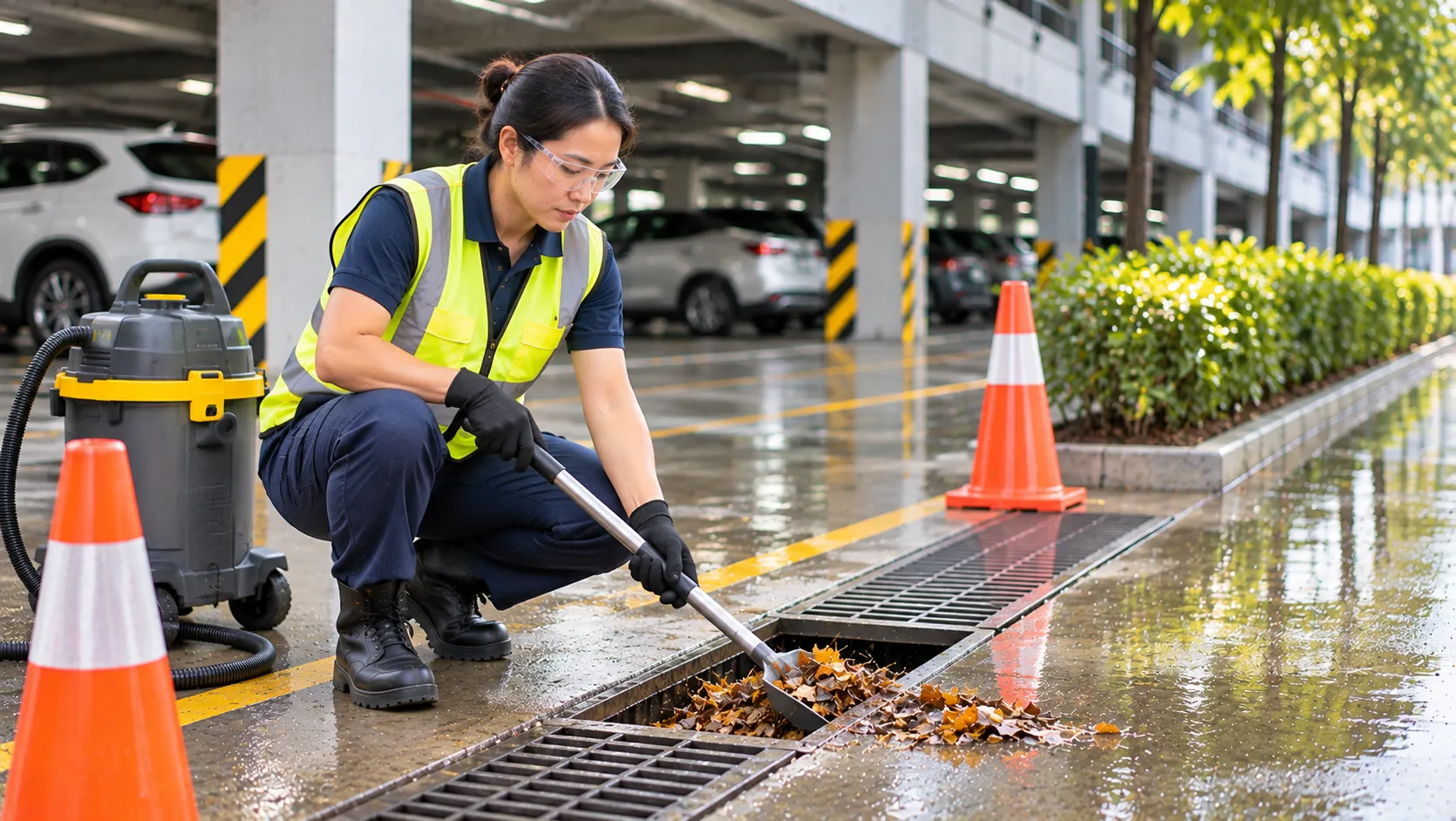
Quick Answer: Why Is Stormwater Drain Cleaning Important for Commercial Car Parks?
Regular stormwater drain cleaning helps commercial car parks maintain effective rainfall drainage, reduce avoidable flooding, control pollution, protect pavement surfaces and minimise unexpected maintenance expenditure.
Car parks accumulate leaves, sediment, rubbish, oil, tyre particles and other contaminants that can obstruct drainage infrastructure or enter stormwater networks during rainfall.
An effective preventative drainage maintenance program should include:
- Routine mechanical sweeping of parking bays and traffic lanes.
- Removal of accessible debris around stormwater drainage grates.
- Regular inspection of drainage inlets and surface water pathways.
- Prompt recovery of oil, fuel and other vehicle fluid spills.
- Additional drainage-area cleaning before periods of heavy rainfall.
- Specialist servicing of stormwater pits, underground pipes and sediment traps.
- Controlled recovery and disposal of contaminated cleaning wastewater.
- Reporting recurring water pooling, damaged grates and suspected drainage defects.
- Documenting maintenance activities and reviewing drainage performance.
Combining routine commercial car park cleaning with specialist drainage maintenance helps property managers maintain more reliable drainage systems and reduce preventable operational disruptions.
Commercial car parks contain extensive concrete, asphalt and paved surfaces that limit natural rainfall absorption. During wet weather, large volumes of runoff may need to travel through drainage channels, stormwater grates, collection pits and underground infrastructure.
When these systems become obstructed by sediment, leaves, litter and vehicle-related contamination, stormwater may accumulate across parking bays, pedestrian walkways, building entrances and loading areas.
The consequences extend beyond temporary inconvenience. Poor drainage can contribute to surface deterioration, business interruptions, environmental pollution and unexpected maintenance costs.
Integrating professional commercial car park cleaning services into a preventative stormwater maintenance program helps address contamination before it reaches drainage infrastructure.
1. How Stormwater Drainage Systems Work in Commercial Car Parks
Stormwater drainage systems collect rainfall runoff and direct it towards an approved discharge, storage, infiltration or treatment system. Their configuration depends on property design, local environmental conditions, drainage capacity and planning requirements.
Commercial car parks typically incorporate several interconnected drainage components.
| Drainage Component | Primary Function | Common Maintenance Concern |
|---|---|---|
| Stormwater Grates | Allow surface runoff to enter collection systems | Leaves, litter and debris obstruction |
| Linear Drainage Channels | Collect water across paved surfaces | Sediment accumulation |
| Collection Pits | Receive runoff before downstream conveyance | Accumulated sediment and waste |
| Underground Drainage Pipes | Transport stormwater through the property | Blockages, roots or structural damage |
| Sediment Traps | Capture selected suspended and settled material | Reduced storage capacity |
| Gross Pollutant Traps | Intercept larger pollutants before downstream discharge | Accumulated litter and organic material |
| Oil-Water Separators | Separate certain free oils from collected water | Accumulated oil and sediment |
| Detention Systems | Temporarily store runoff and manage discharge rates | Reduced capacity and outlet obstruction |
| Basement Drainage Pumps | Remove collected water where gravity drainage is insufficient | Mechanical or electrical failure |
| Vegetated Swales | Convey and potentially treat stormwater runoff | Sediment accumulation and vegetation issues |
Each component requires an appropriate maintenance approach. Cleaning accessible surface grates is different from entering drainage pits, servicing pumps or clearing underground pipes.
2. Why Commercial Car Parks Are Susceptible to Drainage Problems
Unlike landscaped areas, conventional commercial parking surfaces are largely impermeable. Rainfall therefore generates surface runoff that must be managed through engineered drainage systems.
Continuous vehicle movement also introduces contaminants that can migrate towards stormwater inlets.
| Car Park Condition | Effect on Stormwater | Potential Maintenance Issue |
|---|---|---|
| Large Impermeable Surfaces | Increased surface runoff | Greater demand on drainage infrastructure |
| High Vehicle Turnover | Increased traffic-related contamination | Oil and sediment accumulation |
| Nearby Landscaping | Leaves, mulch and soil entering paved areas | Blocked drainage grates |
| Heavy Delivery Traffic | Tracked-in grit and road sediment | Drainage pit sediment accumulation |
| Waste Collection Areas | Loose rubbish and potential liquid contamination | Polluted stormwater runoff |
| Low-Lying Parking Bays | Water naturally collects at lower elevations | Persistent water pooling |
| Basement Parking | Limited gravity drainage in some structures | Dependence on drainage collection and pumping systems |
| Nearby Construction | Increased airborne and tracked-in sediment | Accelerated drainage contamination |
A drainage maintenance program should reflect the property's specific contamination sources rather than relying on a uniform cleaning schedule.
3. Common Materials That Block Commercial Stormwater Drains
Drainage obstructions often develop gradually as loose materials accumulate around inlets, within collection pits and throughout drainage infrastructure.
| Contaminant | Typical Source | Potential Impact |
|---|---|---|
| Leaves | Trees and surrounding landscaping | Obstructed drainage grates |
| Sand and Soil | Vehicle tyres, gardens and construction activities | Sediment accumulation |
| Plastic Packaging | Discarded customer and employee waste | Blocked inlets and downstream pollution |
| Food Wrappers | Retail and hospitality customers | Litter accumulation |
| Cigarette Butts | Pedestrian activity | Fine litter contamination |
| Grass Clippings | Grounds maintenance | Organic material accumulation |
| Mulch | Adjacent garden beds | Drainage channel obstruction |
| Small Stones and Gravel | Roadways and damaged surfaces | Reduced drainage pit capacity |
| Oil and Grease | Vehicle fluid leaks | Pollution and contaminated sediment |
| Tyre and Brake Particles | Vehicle wear | Fine particulate and chemical contamination |
| Construction Debris | Nearby building and repair activities | Accelerated blockage formation |
Regular removal of loose contamination from parking surfaces reduces the amount of material available to enter stormwater systems during rainfall.
4. Reduce the Risk of Car Park Flooding
Flooding is one of the most disruptive potential consequences of inadequate drainage maintenance. Even where stormwater infrastructure has adequate design capacity, accumulated debris can restrict the movement of runoff.
Water may then accumulate across vehicle circulation routes, parking bays and pedestrian access areas.
| Flood-Prone Area | Potential Consequence | Preventative Maintenance Focus |
|---|---|---|
| Car Park Entrances | Restricted vehicle access | Clear drainage channels and monitor runoff |
| Building Entrances | Water ingress into occupied areas | Maintain nearby drainage inlets |
| Basement Ramps | Water flowing towards underground parking levels | Maintain collection channels and arrange pump inspections |
| Loading Docks | Delivery interruptions | Remove surrounding debris and sediment |
| Pedestrian Crossings | Restricted access and increased slip risks | Monitor drainage and surface condition |
| Accessible Parking Bays | Reduced accessibility | Prioritise drainage along access routes |
| Lift and Stairwell Entrances | Water entering building infrastructure | Maintain surrounding drainage pathways |
| Electrical Infrastructure Areas | Potential electrical hazards | Escalate water accumulation promptly |
Important: Drain cleaning cannot guarantee flood prevention. Flooding may also result from extreme rainfall, inadequate drainage capacity, high groundwater, pump failure, damaged pipes or downstream network constraints. Repeated flooding requires specialist investigation.
5. Understand How Much Stormwater a Commercial Car Park Can Generate
Large paved areas can generate substantial runoff even during relatively short rainfall events.
A simplified runoff calculation can help facility managers understand the importance of maintaining drainage infrastructure.
Estimated runoff volume (litres) = Rainfall depth (mm) × Catchment area (m²) × Assumed runoff coefficient.
The following examples assume a 5,000 m² car park and an illustrative runoff coefficient of 0.9.
| Rainfall Depth | Car Park Area | Estimated Runoff Volume |
|---|---|---|
| 5 mm | 5,000 m² | 22,500 litres |
| 10 mm | 5,000 m² | 45,000 litres |
| 20 mm | 5,000 m² | 90,000 litres |
| 30 mm | 5,000 m² | 135,000 litres |
| 50 mm | 5,000 m² | 225,000 litres |
| 75 mm | 5,000 m² | 337,500 litres |
| 100 mm | 5,000 m² | 450,000 litres |
In this example, just 20 mm of rainfall could generate approximately 90,000 litres of runoff. Maintaining unobstructed collection points is therefore an important part of managing rainfall across extensive parking surfaces.
Calculation note: These are simplified volume estimates, not hydraulic design calculations. Actual runoff depends on surface characteristics, rainfall intensity, infiltration, storage, site gradients and other factors. Drainage capacity must be assessed by appropriately qualified professionals.
6. Improve Pedestrian and Vehicle Safety
Standing water can conceal surface defects, obscure parking markings and affect pedestrian and vehicle movement. When water combines with oil, sediment or organic material, surface conditions may become more hazardous.
| Drainage-Related Hazard | Potential Safety Impact | Recommended Response |
|---|---|---|
| Standing Water | Slips and restricted access | Investigate drainage and manage affected areas |
| Oil Mixed with Rainwater | Reduced surface traction | Approved spill containment and recovery |
| Wet Leaves | Slippery pedestrian surfaces | Regular organic debris removal |
| Obscured Potholes | Vehicle damage or pedestrian trips | Restrict affected areas and arrange repairs |
| Damaged Drain Covers | Trip, wheel or fall hazards | Secure the area and arrange replacement |
| Flooded Access Routes | Restricted movement and accessibility | Establish safe alternative routes |
| Water Near Electrical Equipment | Potential electrical exposure | Keep clear and obtain authorised assessment |
| Uncontrolled Water Across Ramps | Reduced vehicle traction | Manage traffic and investigate drainage performance |
Routine cleaning should operate alongside traffic management, surface maintenance, hazard reporting and other applicable workplace safety controls.
7. Protect Asphalt, Concrete and Paved Surfaces
Prolonged water accumulation can contribute to deterioration in certain parking surfaces, particularly where cracks, damaged joints or existing waterproofing defects allow moisture penetration.
The extent of deterioration depends on pavement construction, drainage design, traffic loading and environmental exposure.
| Surface Material | Potential Drainage-Related Problem | Maintenance Priority |
|---|---|---|
| Asphalt | Water penetration through damaged pavement | Maintain drainage and report cracks |
| Unsealed Concrete | Moisture absorption and persistent contamination | Remove debris and investigate prolonged pooling |
| Sealed Concrete | Moisture entering damaged protective finishes | Monitor sealant and surface condition |
| Interlocking Pavers | Sediment accumulation or loss of joint material | Use surface-compatible cleaning methods |
| Waterproofed Parking Decks | Water penetration through defective membranes | Keep drains clear and report leakage |
| Epoxy-Coated Floors | Possible deterioration associated with moisture and coating defects | Maintain drainage and follow coating instructions |
Effective drainage maintenance supports surface protection by reducing avoidable water accumulation. Existing pavement defects and structural problems require separate professional assessment.
8. Prevent Stormwater Pollution from Commercial Car Parks
Rainfall can carry contaminants from commercial parking areas into downstream stormwater systems, infiltration infrastructure, rivers, wetlands and coastal environments.
Unlike wastewater systems designed to receive approved sewage or trade waste, stormwater networks may discharge into the environment without conventional wastewater treatment.
| Pollutant | Typical Car Park Source | Potential Environmental Impact |
|---|---|---|
| Petroleum Hydrocarbons | Vehicle oil and fuel leaks | Water and sediment contamination |
| Heavy Metals | Vehicle wear and infrastructure deterioration | Accumulation in receiving environments |
| Suspended Sediment | Soil, dust and road grit | Increased water turbidity |
| Plastic Waste | Discarded packaging | Persistent environmental litter |
| Organic Debris | Leaves and vegetation | Potential nutrient enrichment |
| Cleaning Chemicals | Uncontrolled washing activities | Chemical contamination |
| Food Waste | Retail and hospitality activities | Organic pollution and pest attraction |
| Tyre Wear Particles | Vehicle movement | Particulate and chemical contamination |
Research published by the Western Australian Government has identified petroleum hydrocarbons, metals, nutrients and other contaminants in stormwater and associated sediments from urban catchments that include roads and public car parks.
Further information is available through the Western Australian Government's stormwater contamination research.
9. Understand the Difference Between Stormwater and Sewer Drainage
One of the most important environmental responsibilities for commercial property operators is understanding where their property's drains discharge.
| Drainage System | Primary Purpose | Important Restriction |
|---|---|---|
| Stormwater Drainage | Manage rainfall runoff | Do not discharge cleaning wastewater or waste chemicals |
| Sanitary Sewer | Convey approved sewage for treatment | Commercial wastewater may require specific approval |
| Trade Waste System | Receive approved commercial or industrial wastewater | Subject to applicable discharge conditions |
| Oil-Water Separation System | Provide treatment for selected oil-contaminated water | Does not automatically authorise downstream discharge |
| Stormwater Infiltration System | Allow appropriately managed runoff to infiltrate into the ground | Must be protected against unsuitable contaminants |
| Wastewater Recovery Tank | Temporarily store collected wastewater | Contents require approved disposal arrangements |
Facility managers should maintain current drainage plans and confirm discharge locations before undertaking wet cleaning or contamination removal activities.
Where drain identification is uncertain, wastewater should be contained and recovered rather than discharged.
10. Use Mechanical Sweeping as the First Line of Drainage Protection
Mechanical sweeping helps intercept loose contaminants before rainfall transports them towards stormwater drainage systems.
Removing material at its source can reduce avoidable sediment and litter accumulation within drainage infrastructure.
| Sweeping Activity | Targeted Contamination | Drainage Benefit |
|---|---|---|
| Broad-Area Mechanical Sweeping | Loose grit and ordinary debris | Reduces material available for runoff transport |
| Kerb-Line Sweeping | Sediment collected around edges | Reduces migration into nearby inlets |
| Manual Edge Cleaning | Debris near columns and wheel stops | Addresses areas inaccessible to larger machinery |
| Leaf Collection | Organic material from surrounding trees | Reduces grille obstruction |
| Loading Area Sweeping | Packaging and tracked-in sediment | Limits contamination around service-area drains |
| Pre-Storm Surface Cleaning | Available loose contaminants | Reduces potential wash-off during rainfall |
Sweepers should collect debris rather than move it towards stormwater grates. Equipment selection should consider dust control, pavement condition, traffic management and the type of material being collected.
11. Manage Oil and Fuel Contamination Before Rainfall
Commercial parking facilities frequently experience minor vehicle fluid leaks. If left untreated, contaminants may spread across parking surfaces or enter stormwater systems during rainfall.
| Contamination Type | Primary Concern | Recommended Management |
|---|---|---|
| Engine Oil | Hydrocarbon pollution and slippery surfaces | Approved containment, absorption and recovery |
| Diesel | Environmental contamination and fire-related risks | Activate applicable spill response procedures |
| Petrol | Flammable vapours and environmental risks | Restrict access and obtain appropriate emergency assistance |
| Transmission Fluid | Persistent oily residue | Compatible spill recovery methods |
| Coolant | Chemical contamination | Follow product-specific spill procedures |
| Unidentified Vehicle Fluid | Unknown chemical hazards | Restrict access and arrange assessment |
| Suspected Battery Electrolyte | Potentially hazardous chemical exposure | Keep clear and obtain specialist assistance |
Routine cleaning teams should only manage spills within their training, authorisation and available safety controls. Larger, hazardous or unidentified spills require the property's emergency response procedures.
Spill residues must not be washed into stormwater drainage systems.
12. Coordinate Pressure Cleaning with Stormwater Protection
Pressure cleaning can remove adhered grime, traffic residue and suitable surface stains from commercial car parks. However, the process may generate wastewater containing sediment, oil, cleaning chemicals and other contaminants.
Without appropriate controls, wet cleaning can transfer pollution from the parking surface directly into drainage infrastructure.
| Cleaning Stage | Recommended Environmental Control |
|---|---|
| Site Assessment | Identify drainage inlets, discharge routes and sensitive areas |
| Pre-Cleaning | Collect loose rubbish, sediment and recoverable contamination |
| Drainage Protection | Use risk-assessed protection and containment arrangements |
| Chemical Selection | Choose products compatible with the surface and waste management plan |
| Surface Cleaning | Control water application and prevent uncontrolled runoff |
| Wastewater Collection | Recover contaminated cleaning water using suitable methods |
| Waste Disposal | Use approved disposal or treatment arrangements |
| Final Inspection | Confirm drainage protection is removed and normal drainage restored safely |
Professional commercial pressure cleaning services should be planned around surface compatibility, contamination levels, water recovery and the property's drainage infrastructure.
Environmental responsibility: Biodegradable cleaning products are not automatically suitable for stormwater discharge. Cleaning wastewater must still be contained and managed through approved disposal arrangements.
13. Differentiate Routine Drainage-Area Cleaning from Specialist Drain Servicing
Commercial cleaners and specialist drainage contractors perform different but complementary maintenance activities.
Understanding these responsibilities helps property managers establish appropriate service agreements and avoid assigning hazardous technical tasks to unsuitable personnel.
| Maintenance Activity | Commercial Cleaning Team | Specialist Drainage Contractor |
|---|---|---|
| Surface Sweeping | Routine responsibility | Generally not required |
| Accessible Grate-Surround Debris Removal | Within approved cleaning scope | Where technical access is required |
| Parking Surface Degreasing | Within approved cleaning scope | Where specialist contamination treatment is required |
| Visible Drainage Defect Reporting | Identify and report observations | Investigate technical causes |
| Internal Stormwater Pit Cleaning | Not routine general cleaning | Specialist responsibility |
| Underground Pipe Clearing | Not routine general cleaning | Specialist responsibility |
| CCTV Drain Inspection | Not routine general cleaning | Specialist responsibility |
| Vacuum Extraction from Pits | Requires specialist capability | Appropriately equipped contractor |
| Pump Repairs and Testing | Report visible issues | Qualified technical personnel |
| Drainage System Redesign | Outside cleaning scope | Qualified drainage or civil engineering professionals |
Routine cleaners should not remove heavy drain covers, enter drainage pits or undertake confined-space work unless specifically trained, authorised and operating under all required safety arrangements.
14. Compare Commercial Stormwater Drain Cleaning Methods
Different drainage maintenance methods address different types of contamination and infrastructure problems.
| Cleaning Method | Suitable Application | Key Consideration |
|---|---|---|
| Manual Surface Debris Collection | Accessible external grate surrounds | Maintain safe access and traffic separation |
| Mechanical Sweeping | Large parking surfaces and traffic lanes | Collect rather than redistribute debris |
| Mechanical Scrubbing | Compatible surfaces with adhered contamination | Recover contaminated cleaning water |
| Controlled Pressure Cleaning | Suitable concrete and paved surfaces | Prevent uncontrolled wastewater discharge |
| Specialist Vacuum Extraction | Accumulated sediment in collection pits | Requires suitable equipment and disposal arrangements |
| Specialist Drain Jetting | Selected underground drainage obstructions | Requires assessment and downstream contamination controls |
| CCTV Drain Inspection | Investigation of recurring internal drainage problems | Diagnostic rather than cleaning method |
| Specialist Separator Servicing | Accumulated oil and sediment | Follow equipment specifications and waste requirements |
The correct method depends on drainage design, contamination type, access conditions and the underlying cause of the problem.
15. Maintain Drainage Systems in Multi-Storey Car Parks
Multi-storey parking facilities introduce additional challenges because runoff may travel through drainage infrastructure located above occupied areas or other parking levels.
Blocked drainage points can contribute to water accumulation on elevated decks and potentially worsen existing waterproofing defects.
| Parking Level | Typical Drainage Challenge | Maintenance Priority |
|---|---|---|
| Rooftop Parking Decks | Direct rainfall and organic debris accumulation | Maintain drainage inlets and monitor waterproofing conditions |
| Intermediate Parking Levels | Runoff from exposed areas and vehicle contamination | Monitor drainage channels and surface cleanliness |
| Ground-Level Parking | Tracked-in sediment and weather exposure | Regular sweeping and drainage-area inspection |
| Basement Parking | Possible dependence on pumped drainage | Coordinate specialist sump and pump servicing |
| Access Ramps | Concentrated runoff travelling between levels | Maintain accessible drainage channels |
| Pedestrian Entrances | Water migration into internal building areas | Maintain clear access and nearby collection points |
Persistent leakage between parking levels should be referred to qualified building or waterproofing specialists rather than treated solely as a cleaning issue.
16. Protect Underground Car Parks from Water Accumulation
Underground car parks may rely on collection sumps and drainage pumps where water cannot discharge effectively through gravity alone.
Routine surface cleaning can reduce loose debris entering drainage systems, but reliable underground drainage also requires appropriate technical maintenance.
Facility managers should consider the following requirements:
- Maintain clean approaches to basement drainage channels.
- Monitor recurring water accumulation near entry ramps.
- Arrange specialist inspection of drainage sumps.
- Schedule pump servicing according to manufacturer requirements.
- Ensure pump alarms and relevant monitoring systems are maintained.
- Review emergency response arrangements for basement flooding.
- Refer persistent dampness or groundwater ingress for assessment.
- Keep electrical equipment and public access areas protected from flooding.
Flooded basement areas should not be entered until electrical, structural and other relevant hazards have been assessed and access has been declared safe by authorised personnel.
17. Manage Drainage Around EV Charging Stations
Electric vehicle charging infrastructure introduces additional electrical safety considerations when stormwater drainage becomes ineffective.
Water accumulation near charging stations, cables, electrical enclosures and associated equipment requires prompt reporting and appropriate assessment.
| EV Charging Area Concern | Recommended Maintenance Response |
|---|---|
| Debris Around Nearby Drainage Grates | Remove accessible debris using approved housekeeping methods |
| Water Pooling Near Charging Stations | Restrict affected access as appropriate and notify the operator |
| Damaged Charging Cables | Keep clear and report for authorised electrical assessment |
| Wet Cleaning Around Charging Infrastructure | Prevent spray and uncontrolled runoff contacting electrical equipment |
| Persistent Drainage Problems | Arrange qualified drainage and electrical assessments where required |
| Flooded Electrical Equipment | Keep people away and activate applicable emergency procedures |
General cleaning personnel should not attempt electrical isolation, repairs or inspection of internal charging equipment unless appropriately qualified and authorised.
18. Adjust Drainage Maintenance for Australian Weather Conditions
Australia's diverse climate means commercial car park drainage maintenance requirements can vary significantly between regions.
| Region or Weather Condition | Typical Drainage Challenge | Maintenance Strategy |
|---|---|---|
| Perth and South-West Western Australia | Winter rainfall following drier periods | Increase pre-winter preparation and runoff pathway checks |
| Brisbane and South-East Queensland | Intense thunderstorms and heavy rainfall events | Schedule appropriate pre-storm and post-storm inspections |
| Tropical Northern Australia | Wet-season rainfall and storm debris | Complete seasonal drainage preparation before high-rainfall periods |
| Sydney and Eastern Coastal Areas | Heavy rainfall events and exposed urban catchments | Maintain condition-based drainage inspection programs |
| Melbourne and Temperate Urban Areas | Variable rainfall and seasonal leaf accumulation | Adjust sweeping and drainage checks according to conditions |
| Adelaide and Southern Regions | Sediment accumulation during dry periods | Increase preparation before expected seasonal rainfall |
| Dry Inland Areas | Windblown sediment and occasional intense runoff | Prioritise sediment control and pre-rainfall inspections |
| Coastal Properties | Windblown debris and corrosion-related deterioration | Monitor grate condition and maintain regular debris collection |
Maintenance requirements should be based on actual local weather patterns, property exposure, drainage design and historical performance.
19. Prepare Commercial Car Parks Before Heavy Rainfall
Pre-storm maintenance provides an opportunity to remove available contamination and identify visible drainage problems before rainfall increases demand on the drainage system.
Pre-Rainfall Preparation Checklist
- Sweep parking bays and traffic circulation lanes.
- Collect leaves around accessible stormwater inlets.
- Remove litter from kerb lines and landscaping boundaries.
- Inspect accessible drainage grates for visible damage.
- Check known water pooling locations.
- Recover existing oil and vehicle fluid spills appropriately.
- Arrange specialist pit servicing where sediment accumulation is suspected.
- Confirm required pump maintenance has been completed.
- Review access restrictions for known flood-prone areas.
- Confirm emergency contact and escalation procedures.
Maintenance should be completed while conditions remain safe. Workers should not undertake exposed drainage cleaning during dangerous storms, flooding or lightning.
20. Conduct Post-Storm Drainage Inspections
Heavy rainfall may redistribute debris, introduce new sediment or reveal previously unnoticed drainage problems.
Once conditions are safe, facility managers should arrange appropriate visual inspections of affected parking areas.
| Post-Storm Observation | Possible Issue | Recommended Action |
|---|---|---|
| Leaves Covering Drainage Grates | Surface obstruction | Arrange safe debris removal |
| New Sediment Deposits | Runoff transporting soil or grit | Collect material and investigate its source |
| Persistent Water Pooling | Possible blockage or insufficient drainage | Investigate through appropriate maintenance personnel |
| Damaged Drain Covers | Physical impact or infrastructure deterioration | Restrict access and arrange repairs |
| Visible Oil Sheen | Possible petroleum contamination | Activate applicable contamination response procedures |
| Water Entering Buildings | Drainage overflow or building defects | Arrange technical assessment and corrective action |
| Unusual Pavement Settlement | Possible underlying support or drainage defects | Restrict affected areas and obtain qualified assessment |
| Basement Pump Alarms | Possible pump or drainage system fault | Notify authorised technical personnel |
21. Recognise Early Warning Signs of Stormwater Drain Problems
Identifying emerging drainage problems before major rainfall events can help reduce unexpected maintenance requirements.
| Warning Sign | Potential Cause | Required Response |
|---|---|---|
| Slow Surface Drainage | Partial obstruction or drainage capacity issue | Inspect accessible inlets and arrange investigation if persistent |
| Recurring Puddles | Surface gradient problems or restricted drainage | Document locations and investigate |
| Overflowing Drainage Grates | Downstream obstruction or hydraulic constraint | Arrange specialist assessment |
| Persistent Unpleasant Odours | Organic contamination or other drainage issues | Investigate the underlying cause |
| Visible Sediment Around Inlets | Excessive sediment movement | Increase upstream debris collection |
| Damaged or Displaced Grates | Vehicle impact or component deterioration | Secure the area and arrange repairs |
| Repeated Basement Flooding | Possible pump, capacity or drainage problems | Arrange specialist investigation |
| Water Emerging Through Pavement | Possible underground infrastructure or groundwater issues | Refer for technical assessment |
| Unusual Pavement Cracking | Possible surface or underlying structural problems | Document and escalate |
| Persistent Water Leakage Between Parking Levels | Possible drainage or waterproofing defects | Arrange qualified building assessment |
Repeated drainage issues should not be treated through increasingly frequent cleaning alone. Technical investigation may identify a problem that routine maintenance cannot resolve.
22. Establish a Risk-Based Stormwater Drain Maintenance Schedule
Stormwater drainage maintenance frequency should reflect parking usage, surrounding vegetation, sediment exposure, weather patterns and drainage system design.
| Maintenance Activity | Illustrative Frequency | Responsible Personnel |
|---|---|---|
| General Litter Collection | Daily or as required | Cleaning team |
| Visual Drainage-Grate Checks | Daily to weekly | Site or cleaning personnel |
| Mechanical Car Park Sweeping | Daily to weekly | Cleaning contractor |
| Accessible Drainage-Area Debris Removal | Weekly or when accumulation is identified | Approved cleaning personnel |
| Oil Spill Recovery | As identified | Authorised spill response personnel |
| Kerb-Line and Channel Surface Cleaning | Weekly to monthly | Cleaning contractor |
| Drainage Condition Review | Monthly | Facility management |
| Specialist Pit and Sediment Trap Inspection | According to asset condition and maintenance plan | Drainage specialist |
| Oil-Water Separator Servicing | According to manufacturer and discharge requirements | Approved specialist |
| Drainage Pump Servicing | According to equipment requirements | Qualified technical personnel |
| Pre-Storm Drainage Assessment | Before relevant forecast rainfall events, where practical | Site and maintenance personnel |
| Post-Storm Inspection | After significant rainfall, when safe | Site and maintenance personnel |
| Underground Pipe Investigation | When recurring problems or defects are suspected | Drainage specialist |
| Maintenance Program Review | Annually or following significant incidents | Facility management |
Maintenance frequency: These intervals are illustrative recommendations, not mandatory nationwide Australian drainage maintenance standards. Actual schedules should follow site risks, asset specifications, contractual requirements and applicable local obligations.
23. Tailor Stormwater Maintenance to Different Commercial Properties
Different property types generate different contamination patterns and operational risks.
| Property Type | Typical Drainage Concern | Maintenance Priority |
|---|---|---|
| Shopping Centres | High vehicle turnover, litter and food packaging | Frequent sweeping and drainage-grate inspections |
| Office Buildings | Concentrated weekday traffic and vehicle leaks | Scheduled cleaning around occupancy patterns |
| Hospitals | Continuous access requirements | Maintain drainage without compromising essential access |
| Warehouses | Heavy vehicle sediment and loading-area contamination | Targeted sweeping and runoff management |
| Industrial Facilities | Potential chemical and hydrocarbon contamination | Risk-assessed pollution prevention |
| Hotels and Resorts | Visitor presentation and landscaped-area debris | Regular surface cleaning and organic debris removal |
| Airports and Transport Facilities | Extensive paved areas and continuous traffic | Coordinated maintenance and traffic management |
| Residential Strata Properties | Basement drainage and vehicle fluid leaks | Routine cleaning supported by technical servicing |
| Educational Facilities | Seasonal vegetation debris and concentrated peak usage | Schedule maintenance around operating hours |
| Government Buildings | Access restrictions and operational requirements | Site-specific maintenance planning |
24. Understand Australian Environmental and Workplace Safety Responsibilities
Commercial stormwater management requires attention to environmental protection, workplace safety, approved wastewater disposal and the property's applicable drainage responsibilities.
Requirements may differ between Australian states, territories, local councils and water authorities.
| Responsibility Area | Practical Consideration |
|---|---|
| Environmental Protection | Prevent inappropriate releases of pollutants into stormwater systems |
| Workplace Health and Safety | Manage risks associated with cleaning activities and drainage hazards |
| Trade Waste Requirements | Obtain relevant approval before discharging commercial wastewater |
| Waste Disposal | Handle collected sediment and contamination through suitable disposal arrangements |
| Confined-Space Safety | Restrict entry to appropriately trained and authorised specialist personnel |
| Traffic Management | Separate cleaning workers from moving vehicles |
| Drainage Infrastructure Ownership | Confirm responsibility for private and public drainage components |
| Incident Reporting | Follow applicable notification procedures for pollution and safety incidents |
| Maintenance Documentation | Retain appropriate service and inspection records |
The City of Belmont's business stormwater guidance provides an example of local requirements for preventing commercial wastewater and pollutants from entering the environment.
Property managers outside this jurisdiction should obtain guidance from their relevant environmental regulator, local council and water authority.
25. Maintain Safe Cleaning Operations Around Stormwater Drains
Stormwater drainage areas can expose maintenance personnel to moving vehicles, contaminated materials, unstable covers, open pits and potentially hazardous atmospheres.
| Maintenance Hazard | Potential Consequence | Recommended Control |
|---|---|---|
| Moving Vehicles | Worker collision | Traffic separation and approved work zones |
| Heavy Drain Covers | Manual handling or crush injuries | Specialist handling procedures and suitable equipment |
| Open Drainage Pits | Falls and unauthorised access | Secure barriers and specialist access controls |
| Confined Spaces | Hazardous atmospheres or engulfment | Formal confined-space risk assessment and required entry controls |
| Contaminated Sediment | Chemical or biological exposure | Risk-assessed handling and disposal procedures |
| Sharps and Unknown Waste | Puncture or contamination injuries | Approved collection procedures by trained personnel |
| Wet Surfaces | Slips and falls | Access restrictions and suitable cleaning methods |
| Heavy Rainfall | Rapid water accumulation | Stop unsafe exposed maintenance activities |
| Electrical Infrastructure | Potential electrical hazards | Maintain safe separation and arrange authorised assessment |
| High-Pressure Cleaning Equipment | Injection injuries and uncontrolled spray | Competent operators and appropriate equipment controls |
Personal protective equipment should be selected through a task-specific risk assessment and used alongside more effective controls such as isolation, access restrictions and appropriate equipment selection.
26. Maintain Drainage Without Interrupting Commercial Operations
Car park drainage maintenance does not always require closure of the entire facility. Routine cleaning can often be coordinated around parking demand and designated work zones.
| Scheduling Strategy | Suitable Application | Operational Benefit |
|---|---|---|
| Early Morning Cleaning | Retail and office parking facilities | Reduced vehicle occupancy |
| After-Hours Cleaning | Properties with predictable operating hours | Improved access to drainage locations |
| Zone-Based Maintenance | Large commercial car parks | Limits restrictions to affected areas |
| Level-by-Level Cleaning | Multi-storey parking structures | Maintains access to unaffected levels where safe |
| Combined Cleaning Visits | Properties requiring sweeping and drainage-area housekeeping | Reduces repeated mobilisation |
| Scheduled Specialist Servicing | Drainage pits and underground infrastructure | Allows planned access restrictions |
| Weather-Based Maintenance | Outdoor parking facilities | Supports preventative rainfall preparation |
Maintenance plans should preserve safe emergency access, accessible parking arrangements, pedestrian movement and essential vehicle circulation.
27. How Preventative Drainage Maintenance Can Reduce Costs
Reactive drainage maintenance may involve emergency contractor mobilisation, additional surface cleaning, parking restrictions and corrective work following water accumulation.
Preventative maintenance creates more predictable service requirements and may reduce avoidable emergency expenditure.
The following hypothetical annual cost comparison demonstrates how a planned approach could affect commercial car park maintenance budgets.
| Annual Maintenance Expense | Reactive-Focused Program | Preventative-Focused Program |
|---|---|---|
| Routine Surface Sweeping | $6,000 | $9,000 |
| Drainage-Area Cleaning | $1,500 | $3,000 |
| Planned Specialist Drainage Servicing | $2,000 | $4,000 |
| Emergency Drainage Callouts | $8,000 | $2,000 |
| Corrective Flood-Related Cleaning | $6,000 | $1,500 |
| Additional Sediment Removal | $4,500 | $1,500 |
| Total Annual Cost | $28,000 | $21,000 |
| Illustrative Annual Savings | $7,000 | |
| Illustrative Cost Reduction | 25% | |
| Illustrative Five-Year Savings | $35,000 | |
Financial example: All figures are hypothetical Australian dollar amounts excluding GST. They are not Corporate Cleaning Services® prices, measured customer outcomes or guaranteed savings. The five-year example assumes unchanged annual costs and excludes inflation, major infrastructure repairs and changes in weather or operating conditions.
Actual financial benefits should be evaluated using property-specific maintenance records, service quotations and incident histories.
28. Measure Stormwater Drainage Maintenance Performance
Facility managers can track drainage-related performance indicators to determine whether preventative cleaning is addressing recurring contamination and maintenance problems.
| Performance Indicator | Measurement Method | Management Benefit |
|---|---|---|
| Blocked Drain Incidents | Number of recorded obstructions | Identifies recurring drainage problems |
| Water Pooling Reports | Location and frequency of reported pooling | Highlights drainage hotspots |
| Emergency Drainage Callouts | Number and cost of unscheduled contractor visits | Measures reactive maintenance demand |
| Sweeping Completion Rate | Completed services against planned visits | Evaluates routine maintenance reliability |
| Collected Debris Volume | Consistent recorded waste collection measurements | Tracks contamination accumulation patterns |
| Spill Response Time | Time between notification and authorised response | Supports contamination management |
| Drainage-Related Parking Closures | Number and duration of access restrictions | Measures operational disruption |
| Specialist Maintenance Completion | Completed technical servicing against schedule | Supports infrastructure maintenance planning |
| Pollution Incidents | Recorded environmental incidents | Supports review of pollution prevention controls |
| Annual Maintenance Expenditure | Combined planned and corrective service costs | Supports budget planning |
Performance data should be interpreted alongside rainfall severity, changes in parking usage, nearby construction activity and any modifications to drainage infrastructure.
29. Common Stormwater Drain Maintenance Mistakes
| Maintenance Mistake | Potential Consequence | Recommended Alternative |
|---|---|---|
| Cleaning Only After Flooding | Increased reactive maintenance requirements | Implement preventative cleaning schedules |
| Sweeping Debris into Drains | Internal contamination and obstruction | Collect and remove debris from the property |
| Pressure Washing Without Runoff Control | Stormwater contamination | Contain and recover cleaning wastewater |
| Ignoring Small Oil Spills | Pollution migration during rainfall | Implement prompt approved spill recovery |
| Assuming All Drains Lead to Sewer | Unauthorised wastewater discharge | Confirm drainage system destinations |
| Neglecting Pre-Storm Inspections | Unidentified drainage obstructions | Schedule appropriate rainfall preparation |
| Ignoring Recurring Water Pooling | Delayed identification of infrastructure defects | Arrange technical investigation |
| Using Untrained Personnel for Pit Cleaning | Serious safety risks | Engage appropriately qualified specialists |
| Failing to Maintain Sediment Traps | Reduced collection capacity | Arrange condition-based specialist servicing |
| Neglecting Pump Maintenance | Potential basement drainage failure | Follow technical servicing schedules |
| Ignoring Damaged Drain Covers | Pedestrian and vehicle hazards | Restrict access and arrange repairs |
| Failing to Document Maintenance | Recurring problems may go unidentified | Maintain service and inspection records |
30. Commercial Car Park Stormwater Maintenance Checklist
Property managers can use the following checklist to review their existing preventative drainage maintenance arrangements.
| Maintenance Requirement | Complete |
|---|---|
| Maintain an updated property drainage plan. | ? |
| Identify all accessible stormwater drainage inlets. | ? |
| Confirm stormwater discharge destinations. | ? |
| Distinguish stormwater drains from sewer and trade waste systems. | ? |
| Confirm ownership and maintenance responsibilities. | ? |
| Identify known water pooling locations. | ? |
| Establish a routine mechanical sweeping schedule. | ? |
| Include kerb lines and parking bay edges. | ? |
| Remove accessible debris around drainage grates. | ? |
| Monitor sediment accumulation near collection points. | ? |
| Establish approved oil spill response procedures. | ? |
| Maintain suitable spill response equipment. | ? |
| Prevent cleaning wastewater entering stormwater drains. | ? |
| Establish approved wastewater disposal arrangements. | ? |
| Inspect accessible drainage areas before expected heavy rainfall. | ? |
| Arrange safe post-storm inspections. | ? |
| Report damaged or displaced drainage covers. | ? |
| Investigate persistent water pooling. | ? |
| Arrange specialist stormwater pit servicing. | ? |
| Arrange sediment trap maintenance where installed. | ? |
| Maintain oil-water separation systems where installed. | ? |
| Arrange required basement drainage pump servicing. | ? |
| Protect drainage areas around EV charging infrastructure. | ? |
| Establish suitable traffic management procedures. | ? |
| Restrict unauthorised entry into drainage pits. | ? |
| Maintain appropriate contractor competency records. | ? |
| Document drainage-related incidents. | ? |
| Review emergency maintenance expenditure. | ? |
| Maintain current emergency contact procedures. | ? |
| Review and update the preventative maintenance program annually. | ? |
31. What Determines Commercial Stormwater Drain Maintenance Costs?
Maintenance costs depend on the parking facility's size, drainage configuration, contamination levels and technical servicing requirements.
| Pricing Factor | Influence on Maintenance Costs |
|---|---|
| Total Car Park Area | Determines surface cleaning coverage |
| Number of Drainage Inlets | Influences inspection and accessible cleaning requirements |
| Drainage System Complexity | Affects specialist servicing requirements |
| Accumulated Sediment | Influences recovery and disposal requirements |
| Oil and Chemical Contamination | May require specialised handling and waste disposal |
| Basement Infrastructure | May require pumping and specialist access arrangements |
| Vehicle Occupancy | Affects access and cleaning productivity |
| After-Hours Servicing | May influence labour expenditure |
| Emergency Callout Requirements | May increase mobilisation costs |
| Specialist Inspection Equipment | Increases technical investigation requirements |
| Waste Disposal Classification | Influences treatment and disposal charges |
| Maintenance Frequency | Determines recurring service expenditure |
Property managers should compare quotations using clearly defined scopes that distinguish routine surface cleaning, accessible drainage-area housekeeping and specialist technical maintenance.
32. Choose the Right Commercial Cleaning and Drainage Maintenance Providers
An effective stormwater maintenance program may require coordination between commercial cleaning contractors, drainage specialists, facility managers and qualified technical personnel.
| Selection Criteria | What Property Managers Should Verify |
|---|---|
| Commercial Car Park Experience | Experience cleaning comparable parking environments |
| Defined Service Scope | Clear inclusions, exclusions and contractor responsibilities |
| Cleaning Equipment | Equipment suitable for the property's access and surface conditions |
| Environmental Controls | Appropriate runoff, wastewater and waste management procedures |
| Traffic Management | Suitable worker and vehicle separation arrangements |
| Specialist Drainage Capability | Relevant qualifications, equipment and authorisations where required |
| Spill Response Procedures | Defined capabilities and emergency escalation arrangements |
| Inspection and Reporting | Clear procedures for identifying and reporting visible defects |
| Scheduling Flexibility | Ability to coordinate maintenance around parking operations |
| Insurance Coverage | Current insurance appropriate to the contracted activities |
| Quality Assurance | Documented service standards and corrective processes |
| Long-Term Maintenance Support | Ability to adapt routine services to changing property conditions |
Frequently Asked Questions About Commercial Car Park Stormwater Drain Cleaning
Why is stormwater drain cleaning important for commercial car parks?
Regular maintenance helps maintain drainage performance, reduce avoidable water accumulation, control pollution and minimise unexpected cleaning and maintenance requirements.
What causes stormwater drains to become blocked?
Common causes include accumulated leaves, litter, sediment, soil, mulch, organic material and downstream infrastructure problems.
How often should commercial stormwater drains be cleaned?
Frequency depends on drainage design, contamination levels, surrounding vegetation, rainfall patterns and property usage. Busy facilities may require frequent surface checks supported by condition-based specialist servicing.
Can regular car park sweeping prevent blocked drains?
Mechanical sweeping can reduce the amount of loose debris available to enter drainage infrastructure. It cannot prevent every blockage or correct underground defects.
Can blocked stormwater drains cause car park flooding?
Yes. Obstructed drainage inlets and pipes can restrict water movement and contribute to localised flooding, particularly during heavy rainfall.
Does drain cleaning guarantee that a car park will not flood?
No. Flooding may also result from extreme rainfall, insufficient drainage capacity, pump failure, groundwater conditions or downstream network limitations.
What is the difference between stormwater drains and sewer drains?
Stormwater drains manage rainfall runoff, while sewer systems convey approved wastewater for treatment. They are not interchangeable disposal systems.
Can pressure washing wastewater enter stormwater drains?
Contaminated cleaning wastewater should not be discharged into stormwater drainage systems. It must be managed through appropriate containment, recovery and approved disposal arrangements.
Are biodegradable cleaning products safe to discharge into stormwater drains?
No. A biodegradable product is not automatically approved for stormwater discharge, particularly when cleaning wastewater contains oil, sediment or other contaminants.
How can oil contamination affect stormwater systems?
Oil carried by runoff can contaminate drainage sediment, waterways, wetlands and other receiving environments. Prompt spill recovery helps reduce this risk.
What is a stormwater sediment trap?
A sediment trap is a drainage component designed to collect selected sediment before water moves downstream. Accumulated material must be removed through appropriate servicing.
What is a gross pollutant trap?
A gross pollutant trap is designed to intercept selected larger contaminants, such as litter and organic debris, before they travel further through the stormwater network.
Do commercial car parks require oil-water separators?
Requirements depend on property design, contamination risks, planning approvals and applicable regulations. Not every commercial parking facility requires the same treatment infrastructure.
Can oil-water separators remove every type of vehicle fluid?
No. Conventional oil-water separators are designed for particular forms of contamination and cannot reliably remove all dissolved or emulsified substances.