
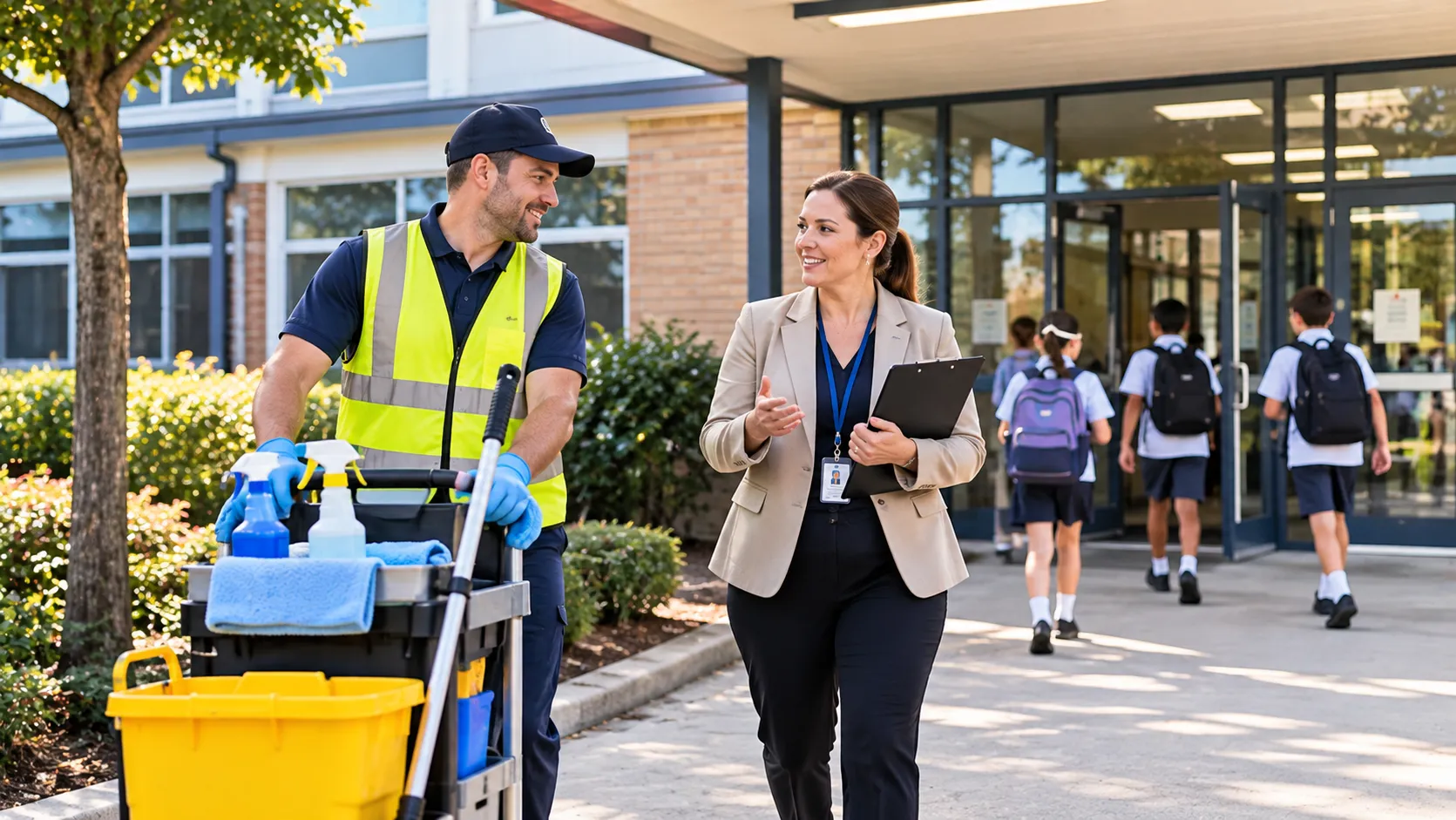
Quick Answer: Why Do Schools Need Commercial-Grade Cleaning Programs?
Schools need commercial-grade cleaning programs because high student occupancy, frequently touched surfaces, shared bathrooms, large floor areas and food service facilities create cleaning demands that basic or occasional cleaning cannot consistently address.
An effective commercial school cleaning program includes:
- Daily classroom and communal area cleaning.
- Regular bathroom servicing and consumable checks.
- Risk-based high-touch surface cleaning.
- Appropriate infection prevention procedures.
- Commercial cleaning equipment suited to different surfaces.
- Safe cleaning chemical handling and storage.
- Cross-contamination prevention measures.
- School holiday deep cleaning.
- Additional cleaning after school events.
- Trained personnel, documented schedules and quality inspections.
Commercial-grade cleaning does not mean using stronger chemicals. It means applying professional cleaning methods, suitable products, equipment, staffing and quality management systems tailored to the school's facilities and operational requirements.
Schools are among the most demanding environments to maintain. Classrooms, bathrooms, libraries, sports facilities, canteens and communal spaces may be used by hundreds or thousands of students, teachers, administrative staff and visitors throughout the school week.
This constant activity generates significant amounts of dirt, dust, rubbish, moisture and surface contamination. Without a structured cleaning program, individual tasks can be missed, hygiene standards may become inconsistent and maintenance problems can accumulate throughout the school term.
Professional school and university cleaning services provide a systematic approach to maintaining educational facilities through planned cleaning schedules, appropriate equipment, trained personnel and ongoing quality monitoring.
Whether managing a primary school, secondary school, private college or multi-building university campus, a commercial-grade cleaning program should reflect how each facility is actually used.
1. Why School Cleaning Is Different From Standard Office Cleaning
Although schools and offices share features such as desks, bathrooms, kitchens and communal areas, educational environments generally experience different occupancy patterns, activities and cleaning challenges.
Students move between classrooms, participate in physical activities, use shared learning materials and frequently transition between indoor and outdoor spaces.
| Cleaning Factor | School Environment | Typical Office Environment |
|---|---|---|
| Daily Occupancy | Potentially hundreds or thousands of students and staff. | Generally more predictable occupancy. |
| Shared Surfaces | Frequent contact across multiple age groups and classes. | Moderate to high contact. |
| Floor Traffic | Heavy throughout corridors, entrances and classrooms. | Generally more controlled. |
| Bathroom Usage | Frequent use throughout the school day. | Usually more predictable. |
| Food Areas | Canteens, dining halls and outdoor eating areas. | Staff kitchens and break rooms. |
| Outdoor Contamination | Mud, soil, grass, leaves and moisture frequently tracked indoors. | Typically less significant. |
| Specialist Facilities | Science laboratories, workshops, gyms and art rooms. | Usually limited. |
| Cleaning Windows | Before, during and after school hours. | Often outside standard business hours. |
| Child Safety | Additional consideration for students, access and chemical safety. | Primarily adult workplace considerations. |
| Holiday Deep Cleaning | Can be scheduled around school term breaks. | Usually scheduled around business operations. |
While standard office cleaning services provide a useful foundation for administrative areas, educational facilities require additional consideration for student activities, shared spaces and specialist learning environments.
2. What Is a Commercial-Grade School Cleaning Program?
A commercial-grade school cleaning program is a documented system that establishes how cleaning activities are planned, performed, monitored and improved across an educational facility.
Rather than relying on individual workers to identify which areas need attention, a structured program assigns tasks according to occupancy, surface types, contamination risks and facility requirements.
| Program Component | Purpose |
|---|---|
| Site-Specific Cleaning Specifications | Define the areas and activities included within the cleaning scope. |
| Cleaning Frequencies | Determine when individual cleaning tasks should be completed. |
| Approved Cleaning Products | Support safe and appropriate chemical use. |
| Commercial Cleaning Equipment | Match cleaning equipment to surfaces and facility size. |
| Staff Responsibilities | Identify who is responsible for each cleaning activity. |
| High-Touch Surface Procedures | Prioritise frequently contacted surfaces. |
| Waste Management | Establish appropriate rubbish collection and segregation practices. |
| Infection Prevention | Manage contamination and support environmental hygiene. |
| Spill Response | Establish procedures for unexpected contamination and hazards. |
| Periodic Deep Cleaning | Address tasks that require additional time or specialist equipment. |
| Quality Inspections | Monitor cleaning outcomes against agreed specifications. |
| Corrective Actions | Address missed tasks, recurring problems and service deficiencies. |
A structured cleaning program should be reviewed whenever enrolment levels, school facilities, room usage or operational requirements change.
3. Australian School Cleaning and Safety Requirements
Australian educational facilities operate within a range of workplace safety, public-health, food safety and child protection requirements.
Applicable obligations depend on the school type, jurisdiction, activities undertaken and cleaning arrangements.
| Framework or Requirement | Relevance to School Cleaning |
|---|---|
| Work Health and Safety or Occupational Health and Safety Legislation | Management of hazards affecting workers, students and visitors. |
| State and Territory Education Department Policies | Cleaning specifications, contractor requirements and school procedures where applicable. |
| Working with Children Requirements | Screening obligations for applicable workers and contractor roles. |
| Australian Food Standards Code | Cleaning and sanitising requirements for applicable food service operations. |
| Hazardous Chemical Requirements | Safe chemical handling, labelling, storage and safety documentation. |
| Public-Health Guidance | Appropriate responses to communicable diseases and contamination risks. |
| Waste Management Requirements | Appropriate collection, segregation and disposal of waste materials. |
| Accessibility Requirements | Maintaining safe and unobstructed access to school facilities. |
| ISO 9001 Quality Management Systems | Supports documented processes, quality monitoring and continual improvement. |
Corporate Cleaning Services® operates an ISO 9001-certified quality management system, supporting documented cleaning procedures, ongoing risk assessment and service quality management.
Important: There is no single cleaning frequency or universal cleaning checklist that applies to every Australian school. Schools should establish their requirements according to applicable legislation, education department policies, contractual obligations and site-specific risk assessments.
4. Identify High-Priority Cleaning Areas Across the School
Different school environments present different levels of contamination, traffic and maintenance requirements.
A risk-based cleaning program helps allocate cleaning resources according to how each space is used rather than applying the same level of cleaning throughout the campus.
| School Area | Indicative Cleaning Priority | Key Cleaning Focus |
|---|---|---|
| Student Bathrooms | High | Sanitary fixtures, floors, touchpoints and consumables. |
| School Canteens | High | Food-related surfaces, floors and waste areas. |
| Classrooms | High | Desks, floors, bins and shared surfaces. |
| First Aid Rooms | Risk-Based | Designated surfaces and contamination management. |
| Science Laboratories | Activity Dependent | Approved environmental surfaces and specialist procedures. |
| Food Technology Rooms | High | Food preparation areas and approved equipment surfaces. |
| Sports Facilities | Moderate to High | Floors, change rooms and shared equipment. |
| Libraries | Moderate | Shared desks, seating, floors and touchpoints. |
| Corridors | High During Peak Use | Floor traffic, rubbish and handrails. |
| Entrances | High During Wet Weather | Tracked-in dirt, moisture and slip hazards. |
| Staff Offices | Routine | Workstations, shared amenities and floors. |
| Storage Areas | Scheduled | Dust, accessible floors and housekeeping. |
Actual priorities should be reviewed according to student numbers, age groups, room usage and identified risks.
5. Give High-Touch Surfaces Regular Attention
Students and staff frequently touch the same surfaces throughout the day. These shared contact points can become contaminated even when they appear visually clean.
High-touch surfaces should be included within the school's cleaning specification, with frequencies determined according to usage and contamination risks.
| High-Touch Surface | Typical Location | Cleaning Consideration |
|---|---|---|
| Door Handles | Classrooms, bathrooms and entrances. | Include in scheduled routine cleaning. |
| Desk Surfaces | Classrooms and study areas. | Clean accessible surfaces according to use. |
| Light Switches | Throughout the school. | Use surface-compatible cleaning methods. |
| Handrails | Stairs, ramps and corridors. | Prioritise frequently contacted sections. |
| Tap Handles | Bathrooms and kitchens. | Include in scheduled amenity cleaning. |
| Toilet Flush Controls | Student and staff bathrooms. | Include in bathroom hygiene procedures. |
| Computer Keyboards | Computer laboratories and libraries. | Follow equipment-compatible cleaning instructions. |
| Shared Learning Devices | Classrooms and learning hubs. | Clean according to agreed responsibilities. |
| Library Desks | Libraries and study spaces. | Adjust cleaning according to student use. |
| Canteen Counters | Food service facilities. | Apply appropriate cleaning or sanitising procedures. |
| Sports Equipment | Gyms and physical education areas. | Follow manufacturer and school instructions. |
| Water Fountain Controls | Communal areas and outdoor facilities. | Use appropriate cleaning procedures for drinking-water fixtures. |
6. Maintain Classrooms Consistently Throughout the School Term
Classrooms are central to educational operations and typically represent a significant portion of the school's routine cleaning workload.
Classroom cleaning should address visible dirt, shared contact points, rubbish and floor contamination while respecting teaching materials and student belongings.
| Classroom Cleaning Task | Typical Frequency Consideration |
|---|---|
| Empty General Waste Bins | Daily or according to usage. |
| Remove Visible Rubbish | Daily and as required. |
| Clean Accessible Desks | According to agreed classroom schedules. |
| Vacuum Carpeted Areas | According to floor traffic and soil levels. |
| Clean Hard Floors | Routine and as required. |
| Clean High-Touch Surfaces | According to contact frequency and identified risks. |
| Clean Classroom Sinks | According to usage. |
| Spot Clean Visible Marks | As required. |
| Dust Accessible Furniture | Scheduled according to the cleaning specification. |
| Detailed Furniture Cleaning | Periodic or during term breaks. |
| Clean Under Movable Furniture | Periodic and where accessible. |
Teachers and cleaning personnel should have clear arrangements regarding desk clearance, classroom resources and items that must not be moved during cleaning.
7. Apply Different Procedures to Specialist Learning Environments
School facilities can contain specialist equipment, tools, chemicals, electrical devices and learning materials that require cleaning methods different from those used in general classrooms.
| Specialist Room | Cleaning Consideration | Important Precaution |
|---|---|---|
| Science Laboratories | Approved floors and environmental surfaces. | Do not handle unknown chemicals or laboratory materials. |
| Art Rooms | Paint residue, dust and approved work surfaces. | Use methods suitable for the materials involved. |
| Computer Laboratories | Furniture, floors and approved equipment surfaces. | Avoid inappropriate moisture exposure. |
| Food Technology Rooms | Floors, approved benches and food-related surfaces. | Follow relevant food hygiene arrangements. |
| Music Rooms | Furniture, floors and shared environmental surfaces. | Do not clean specialist instruments without authorisation. |
| Technical Workshops | Designated floors and accessible surfaces. | Follow machinery, dust and hazardous material procedures. |
| First Aid Rooms | Approved environmental surfaces. | Follow infection prevention and waste procedures. |
| Special Education Classrooms | Shared surfaces and approved learning equipment. | Consider accessibility, sensory needs and individual requirements. |
| School Theatres | Seating, aisles and approved surfaces. | Protect specialist lighting and audio equipment. |
Specialist room cleaning responsibilities should be agreed with teachers, laboratory personnel, facility managers and other relevant staff. Cleaning contractors should not handle hazardous materials or specialised equipment outside their authorised responsibilities.
8. Prioritise School Bathroom Hygiene
School bathrooms experience repeated use throughout the day, particularly during recess, lunch breaks and transitions between lessons.
Insufficient bathroom cleaning can result in unpleasant conditions, contaminated surfaces, depleted consumables and increased maintenance concerns.
| Bathroom Cleaning Task | Recommended Approach |
|---|---|
| Toilets and Urinals | Clean routinely and disinfect where required. |
| Toilet Seats | Address frequently contacted surfaces. |
| Flush Controls | Include in high-touch cleaning. |
| Washbasins | Remove residue and visible contamination. |
| Tap Handles | Clean according to usage. |
| Mirrors | Remove visible marks and residue. |
| Cubicle Doors | Clean handles, locks and accessible surfaces. |
| Bathroom Floors | Remove contamination and manage slip hazards. |
| Soap Dispensers | Clean and check agreed supply levels. |
| Toilet Paper Dispensers | Check consumables according to servicing arrangements. |
| Sanitary Waste Containers | Service according to approved waste arrangements. |
| Accessible Grab Rails | Maintain hygiene and report damaged fixtures. |
| Waste Bins | Empty and clean according to requirements. |
Why Bathroom Inspections During School Hours Matter
An after-hours clean may not fully address bathroom conditions throughout a busy school day.
Depending on occupancy and facility requirements, additional daytime servicing may include:
- Checking soap and toilet paper supplies.
- Responding to water spills.
- Removing visible rubbish.
- Addressing contamination.
- Checking bathroom accessibility.
- Reporting blocked toilets or damaged fixtures.
- Completing additional cleaning where required.
These checks should be coordinated with appropriate student privacy, supervision and access procedures.
9. Maintain Hygienic Canteens and Food Service Areas
School canteens, dining halls and food technology rooms require cleaning arrangements that support safe food handling in addition to general facility hygiene.
Cleaning responsibilities should be clearly divided between food service personnel and the school's environmental cleaning team.
| Food Service Area | Cleaning Requirement | Typical Responsibility |
|---|---|---|
| Food Preparation Benches | Cleaning and sanitising as required. | Food service personnel or authorised workers. |
| Dining Tables | Remove food residue and clean surfaces. | Assigned canteen or cleaning personnel. |
| Canteen Floors | Remove food debris, residue and spills. | According to the agreed cleaning scope. |
| Cooking Equipment | Equipment-specific cleaning procedures. | Trained food service personnel. |
| Appliance Handles | Routine high-touch surface cleaning. | Assigned personnel. |
| Food Storage Areas | Maintain cleanliness and appropriate housekeeping. | Food service personnel. |
| Kitchen Sinks | Remove residue and maintain hygiene. | Assigned personnel. |
| Waste Collection Areas | Remove waste and address contamination. | According to service agreements. |
| Outdoor Dining Areas | Remove rubbish, food residue and visible spills. | Assigned cleaning or grounds personnel. |
Where a school operates a regulated food business, cleaning and sanitising procedures should meet applicable Australian food safety requirements.
Food-contact surfaces must not be treated with unsuitable cleaning products or equipment previously used in contaminated areas without appropriate controls.
10. Understand the Difference Between Cleaning, Disinfection and Sanitising
Using the appropriate cleaning process is more important than automatically applying disinfectants or stronger chemicals throughout a school.
| Cleaning Process | Purpose | Typical School Application |
|---|---|---|
| Routine Cleaning | Removes dirt, dust, residue and organic material. | Desks, furniture, floors and environmental surfaces. |
| Disinfection | Inactivates relevant microorganisms under specified conditions. | Designated surfaces requiring additional infection-control measures. |
| Sanitising | Reduces microorganisms to levels appropriate for the intended application. | Food-contact surfaces where required. |
| Deep Cleaning | Provides detailed attention beyond routine cleaning. | Periodic furniture, flooring and difficult-to-access areas. |
| Enhanced Cleaning | Provides additional cleaning and disinfection controls. | Identified contamination risks or infectious disease outbreaks. |
Where disinfection is necessary, surfaces generally need to be cleaned first unless an appropriate combined product is used according to its instructions.
Cleaning personnel should follow manufacturer requirements regarding dilution, contact time, surface compatibility, ventilation and protective equipment.
11. Use Appropriate Cleaning Methods for Different Flooring Materials
School campuses often contain multiple flooring materials. Each material requires cleaning methods appropriate to its construction, finish, condition and manufacturer requirements.
Incorrect cleaning methods can damage floor finishes, leave residue, increase slip risks or shorten the useful life of flooring assets.
| Flooring Material | Routine Cleaning | Periodic Maintenance |
|---|---|---|
| Carpet | Vacuuming and spot cleaning. | Extraction or appropriate restorative cleaning. |
| Vinyl | Dust removal and suitable damp cleaning. | Machine cleaning or finish maintenance where appropriate. |
| Ceramic Tiles | Routine cleaning and soil removal. | Detailed grout and surface cleaning. |
| Timber | Manufacturer-compatible cleaning with moisture control. | Approved surface maintenance. |
| Concrete | Sweeping or suitable mechanical cleaning. | Detailed cleaning according to surface finish. |
| Sports Flooring | Suitable dust and soil removal. | Manufacturer-approved specialist maintenance. |
| Rubber Flooring | Approved routine cleaning. | Suitable machine or detailed cleaning. |
| Laminate Flooring | Controlled-moisture cleaning. | Maintenance according to manufacturer instructions. |
| Entrance Matting | Frequent soil and moisture removal. | Detailed mat cleaning or replacement as required. |
Professional commercial cleaning services can help schools establish surface-specific maintenance programs that reflect flooring types, traffic patterns and operational requirements.
12. Control Dirt and Moisture at School Entrances
School entrances are a major pathway for outdoor dirt, dust, mud, leaves and moisture entering classrooms and corridors.
Managing contamination at the entrance can reduce the amount of soil carried throughout the building and simplify routine floor maintenance.
| Entrance Cleaning Challenge | Recommended Control |
|---|---|
| Tracked-In Mud | Maintain entrance mats and complete additional soil removal. |
| Rainwater | Increase monitoring and manage wet-floor hazards. |
| Dust and Sand | Use suitable sweeping or vacuuming methods. |
| Leaves and Outdoor Debris | Remove debris from accessible entrance areas. |
| Saturated Entrance Mats | Clean, dry or replace mats when required. |
| Heavy Student Traffic | Schedule additional attention around peak usage periods. |
| Loose or Damaged Mats | Report or address trip hazards. |
| Obstructed Access Routes | Maintain safe access for students, staff and visitors. |
Wet-weather cleaning arrangements should be flexible enough to address sudden changes in floor conditions throughout the school day.
13. Clean Libraries and Shared Learning Spaces
Modern schools increasingly use collaborative learning environments where multiple classes and student groups share furniture, equipment and resources throughout the day.
These spaces may require additional attention because their occupancy and usage patterns differ from traditional classrooms.
| Shared Learning Space | Cleaning Priorities |
|---|---|
| Libraries | Study desks, accessible shelving, seating and floors. |
| Computer Rooms | Furniture, touchpoints and approved equipment surfaces. |
| Learning Hubs | Shared tables, collaborative workspaces and seating. |
| Multipurpose Rooms | Floors, accessible furniture and waste removal. |
| Study Areas | Desks, chair surfaces and commonly touched points. |
| Resource Rooms | Accessible surfaces and general housekeeping. |
| Meeting Rooms | Tables, seating and shared environmental surfaces. |
| Student Breakout Spaces | Furniture, rubbish removal and floor maintenance. |
Cleaning activities should be coordinated with staff to avoid damaging educational resources, confidential materials or electronic equipment.
14. Maintain Sports Facilities and Physical Education Areas
Gymnasiums, change rooms, indoor courts and sports facilities generate cleaning requirements associated with physical activity, moisture, equipment sharing and heavy floor traffic.
| Sports Facility | Routine Cleaning | Additional Consideration |
|---|---|---|
| Gymnasium Floors | Dust and soil removal. | Use manufacturer-compatible methods. |
| Indoor Sports Courts | Remove contamination and visible debris. | Protect specialist floor finishes and traction. |
| Change Rooms | Clean floors, seating and touchpoints. | Manage moisture and ventilation concerns. |
| Showers | Wet-area cleaning. | Address residue and slip hazards. |
| Sports Equipment | Clean approved shared surfaces. | Follow equipment-specific instructions. |
| Bleachers and Seating | Remove rubbish and clean accessible surfaces. | Additional attention after sporting events. |
| Storage Rooms | Dust and floor maintenance. | Maintain clear access around equipment. |
| Fitness Rooms | Clean approved equipment contact points. | Follow agreed equipment cleaning responsibilities. |
Sports floors should not be treated with inappropriate waxes, chemicals or machinery that could affect the intended performance of the surface.
15. Maintain Staff Rooms and Administrative Facilities
Teachers, administrative personnel and school management also require clean and comfortable working environments.
Staff facilities can generally follow commercial workplace cleaning principles while remaining integrated into the school's broader cleaning specification.
| Staff Area | Cleaning Focus |
|---|---|
| Administrative Offices | Accessible furniture, floors, bins and touchpoints. |
| Reception Areas | Visitor-facing surfaces, seating and presentation. |
| Staff Rooms | Tables, chairs and shared surfaces. |
| Staff Kitchens | Benches, sinks and designated appliance surfaces. |
| Meeting Rooms | Furniture and shared contact points. |
| Photocopy Rooms | Accessible surfaces, floors and waste removal. |
| Staff Bathrooms | Sanitary facilities and consumable checks. |
| Records and Storage Rooms | Approved environmental surfaces without disturbing documents. |
16. Select Cleaning Products That Are Appropriate for Schools
Commercial-grade cleaning is not defined by chemical strength. The most suitable cleaning product is one that is appropriate for the surface, contamination level, intended task and people using the environment.
Product selection is particularly important in schools where younger children, students with asthma, allergies or sensory sensitivities may be present.
| Product Selection Factor | Good Practice |
|---|---|
| Surface Compatibility | Use products suitable for the material being cleaned. |
| Cleaning Effectiveness | Select products appropriate to the contamination involved. |
| Correct Dilution | Follow manufacturer instructions. |
| Disinfectant Contact Time | Follow the specified application and contact conditions. |
| Safety Data Sheets | Maintain access to required safety information. |
| Chemical Labelling | Ensure products remain correctly identified. |
| Fragrance Considerations | Consider suitable lower-fragrance alternatives where appropriate. |
| Ventilation | Follow product instructions and site safety procedures. |
| Chemical Storage | Restrict unauthorised access and follow storage requirements. |
| Environmental Considerations | Consider suitable products that reduce unnecessary environmental impacts. |
Cleaning chemicals must not be stored in unlabelled containers or beverage bottles. Workers should never mix cleaning chemicals unless the procedure is specifically authorised by the manufacturer.
17. Prevent Cross-Contamination Across the School
Cleaning equipment can transfer contamination between bathrooms, classrooms, kitchens and communal spaces if it is not appropriately managed.
A documented equipment separation system helps cleaning personnel identify which tools should be used in designated environments.
Example School Cleaning Colour-Coding System
| Example Colour | Designated Area | Purpose |
|---|---|---|
| Red | Toilets and designated sanitary areas. | Separates bathroom cleaning equipment. |
| Blue | Classrooms, offices and general areas. | Supports routine environmental cleaning. |
| Green | Kitchens and designated food areas. | Separates food-area cleaning equipment. |
| Yellow | Designated higher-risk areas. | Supports additional contamination controls. |
These colours are illustrative rather than a universal mandatory school cleaning standard.
Additional cross-contamination prevention practices include:
- Following established clean-to-dirty cleaning sequences.
- Keeping bathroom cleaning equipment separate from classroom equipment.
- Replacing contaminated cloths and mop heads appropriately.
- Performing hand hygiene between tasks.
- Changing protective equipment when required.
- Separating clean and used equipment during storage.
- Cleaning and drying reusable equipment after use.
- Maintaining dedicated food-area cleaning tools.
18. Use Commercial Cleaning Equipment Suited to Campus Size
Large educational facilities can require substantial cleaning resources. Appropriate commercial equipment can improve cleaning consistency and help workers manage extensive floor and surface areas efficiently.
| Cleaning Equipment | Typical Application | Operational Benefit |
|---|---|---|
| Commercial Vacuum Cleaners | Classrooms, offices and libraries. | Efficient removal of accumulated floor soil. |
| Microfibre Cleaning Systems | Furniture and environmental surfaces. | Supports controlled surface cleaning. |
| Commercial Mop Systems | Bathrooms and hard-floor areas. | Supports routine floor maintenance. |
| Automatic Floor Scrubbers | Suitable corridors and large hard-floor areas. | Efficient mechanical cleaning. |
| Carpet Extraction Equipment | Approved carpeted areas. | Supports periodic deeper cleaning. |
| Wet and Dry Vacuums | Appropriate wet-area and spill applications. | Supports controlled liquid and debris removal. |
| Floor Maintenance Machines | Compatible flooring materials. | Supports scheduled surface maintenance. |
| Cleaning Trolleys | Movement of equipment and supplies. | Organises cleaning resources. |
| Extendable Dusting Equipment | Approved elevated surfaces. | Improves access to scheduled dusting areas. |
Equipment selection should reflect building layouts, surface compatibility, worker safety, noise levels and the presence of students.
19. Protect Student Safety During Cleaning Activities
Cleaning activities must be planned to minimise risks to students, teachers, visitors and cleaning personnel.
Schools should consider cleaning equipment access, chemical exposure, student supervision, contractor access and the timing of activities.
| Cleaning-Related Hazard | Recommended Control |
|---|---|
| Wet Floors | Use appropriate access controls and manage drying times. |
| Electrical Leads | Prevent obstruction of walkways and access routes. |
| Cleaning Chemicals | Maintain secure storage and appropriate handling. |
| Unattended Cleaning Equipment | Store equipment away from unauthorised student access. |
| Noisy Cleaning Machinery | Schedule activities to reduce disruption to learning. |
| Blocked Emergency Exits | Maintain clear evacuation and access routes. |
| Contractor Access | Follow school identification, security and access procedures. |
| Occupied Bathrooms | Follow appropriate privacy and student access arrangements. |
| Elevated Cleaning Tasks | Apply appropriate working-at-height controls. |
| Hazardous Contamination | Restrict access and escalate to trained personnel. |
| Damaged Fixtures | Report identified maintenance and safety concerns. |
Schools should also verify that cleaning contractor screening arrangements meet applicable state or territory working with children requirements and school policies.
20. Establish Effective Spill Response Procedures
Spills are common in educational environments and can occur during meals, classroom activities, sporting events and specialist lessons.
Different contaminants require different response procedures. Cleaning personnel should understand which incidents fall within their responsibilities and when specialist assistance is required.
| Spill Type | Response Consideration |
|---|---|
| Water | Address promptly and manage slip hazards. |
| Food or Drink | Remove residue using appropriate surface-compatible methods. |
| Mud and Soil | Remove contamination using suitable floor cleaning procedures. |
| Paint and Craft Materials | Use methods suitable for the material and surface involved. |
| Blood | Follow approved blood and body-fluid procedures. |
| Vomit | Apply approved infection prevention and contamination procedures. |
| Urine or Faeces | Follow appropriate bodily fluid cleaning procedures. |
| Laboratory Chemicals | Escalate to designated personnel and follow chemical safety procedures. |
| Unknown Substances | Restrict access and seek appropriate identification before handling. |
| Broken Glass or Sharps | Follow approved collection, handling and escalation arrangements. |
Potentially hazardous spills should only be managed by appropriately trained and authorised personnel using the school's established procedures.
21. Establish Enhanced Cleaning During Illness Outbreaks
Schools may experience periods of increased communicable illness, particularly when students and staff share classrooms, bathrooms and communal facilities.
Depending on the illness involved and applicable public-health guidance, schools may need to adjust their normal cleaning arrangements.
| Cleaning Control | Routine Operations | Enhanced Cleaning |
|---|---|---|
| Cleaning Frequency | Established school cleaning schedule. | Increase where identified risks require it. |
| High-Touch Surfaces | Routine scheduled attention. | Additional attention to designated surfaces. |
| Disinfectant Selection | Products appropriate to routine tasks. | Products suitable for the identified infectious agent. |
| Shared Equipment | Normal equipment cleaning procedures. | Additional cleaning where required. |
| Bathroom Servicing | Routine cleaning and inspections. | Increased servicing according to risks. |
| Cleaning Equipment | Established equipment separation. | Additional dedicated equipment where appropriate. |
| Protective Equipment | Task-specific requirements. | Adjusted according to applicable precautions. |
| Cleaning Documentation | Routine completion records. | Additional reporting and verification where needed. |
Environmental cleaning forms only one part of communicable disease management. Schools should also follow relevant public-health advice, hand hygiene, ventilation and illness-management procedures.
22. Separate Daily Cleaning From Periodic Deep Cleaning
Not every cleaning activity needs to be performed daily. Separating routine tasks from periodic work enables schools to allocate labour and specialist equipment more efficiently.
| Daily or Routine Cleaning | Periodic Deep Cleaning |
|---|---|
| Empty classroom waste bins. | Detailed cleaning of waste containers. |
| Vacuum classrooms and offices. | Carpet extraction where required. |
| Clean bathrooms. | Detailed bathroom surface and grout cleaning. |
| Clean high-touch surfaces. | Detailed cleaning of less frequently accessed areas. |
| Clean accessible hard floors. | Specialist floor maintenance. |
| Remove visible rubbish. | Detailed storage-area cleaning. |
| Clean communal areas. | Detailed furniture cleaning. |
| Spot clean accessible marks. | Scheduled wall and partition cleaning. |
| Address spills. | Restorative cleaning where appropriate. |
| Clean designated touchpoints. | Scheduled high-level dust removal. |
| Spot clean accessible glass. | Detailed window cleaning. |
23. Use School Holidays for Intensive Deep Cleaning
School holidays and term breaks provide an opportunity to complete cleaning activities that are difficult to undertake while classrooms and facilities are occupied.
Reduced occupancy can allow cleaning teams to access larger floor areas, move approved furniture and use specialist equipment with less disruption.
| Holiday Cleaning Activity | Purpose |
|---|---|
| Carpet Deep Cleaning | Remove accumulated soil using suitable carpet cleaning methods. |
| Detailed Hard-Floor Cleaning | Address accumulated dirt and scheduled maintenance requirements. |
| High-Level Dusting | Remove dust from approved elevated surfaces. |
| Detailed Classroom Cleaning | Address surfaces not routinely accessible during term. |
| Furniture Cleaning | Maintain approved desks, chairs and shared furniture. |
| Window Cleaning | Remove accumulated marks and improve presentation. |
| Detailed Bathroom Cleaning | Address accumulated residue and difficult-to-access surfaces. |
| Storage Area Cleaning | Remove accumulated dust and accessible debris. |
| Gymnasium Floor Maintenance | Complete suitable specialist floor care. |
| Cleaning Under Movable Furniture | Access areas commonly obstructed during term. |
| Post-Maintenance Cleaning | Remove suitable dust and debris following approved maintenance work. |
Holiday cleaning should be planned before each term break so that labour, specialist equipment, products and access arrangements can be coordinated.
24. Plan Additional Cleaning Around School Events
Educational facilities frequently operate outside normal teaching hours. School events can increase occupancy, rubbish generation, bathroom usage and floor traffic.
| School Event | Additional Cleaning Consideration |
|---|---|
| School Assemblies | Seating, floor areas and rubbish removal. |
| Parent Information Nights | Reception, meeting areas and bathroom presentation. |
| School Performances | Auditoriums, seating and public amenities. |
| Sports Carnivals | Change rooms, bathrooms and waste collection. |
| School Fairs | Food-related areas, rubbish and heavily used surfaces. |
| Graduation Ceremonies | Presentation cleaning before and after the event. |
| Community Meetings | Shared facilities and visitor-accessible areas. |
| Holiday Programs | Adjusted cleaning schedules for occupied facilities. |
| Examinations | Desk surfaces, floors and allocated examination spaces. |
Cleaning contracts should include clear arrangements for requesting additional services, confirming event-specific responsibilities and adjusting schedules when necessary.
25. Example Commercial School Cleaning Schedule
A practical school cleaning schedule should include routine, periodic and event-related tasks. Cleaning frequencies should be reviewed against actual facility usage.
| School Area | Daily or Routine Cleaning | Weekly or Scheduled Cleaning | Periodic or Holiday Cleaning |
|---|---|---|---|
| Classrooms | Floors, bins and designated touchpoints. | Detailed accessible surfaces. | Carpets, furniture and less accessible areas. |
| Bathrooms | Fixtures, floors and consumable checks. | Additional detailed cleaning. | Detailed grout and surface maintenance. |
| Corridors | Floor cleaning and rubbish removal. | Detailed edges and accessible surfaces. | Specialist floor maintenance. |
| Libraries | Floors and shared surfaces. | Accessible shelving and furniture. | Detailed furniture and floor cleaning. |
| Canteens | Agreed floors and environmental surfaces. | Detailed designated areas. | Additional approved cleaning. |
| Staff Areas | Routine workplace cleaning. | Detailed accessible surfaces. | Furniture and flooring maintenance. |
| Gymnasiums | Floors and designated touchpoints. | Additional detailed cleaning. | Specialist floor maintenance. |
| Entrances | Soil removal and wet-weather checks. | Detailed entrance surfaces. | Matting and detailed floor maintenance. |
| Windows | Spot cleaning where required. | Designated accessible glass. | Scheduled full window cleaning. |
| High-Level Surfaces | Visible issues where safely accessible. | According to agreed requirements. | Scheduled high-level dusting. |
| Storage Areas | Address visible contamination as required. | Accessible housekeeping tasks. | Detailed scheduled cleaning. |
Scheduling note: These frequencies provide an example framework. Actual school cleaning schedules should be established according to occupancy, contamination risk, surface types, applicable school policies and agreed cleaning specifications.
26. Train Cleaning Personnel for Educational Environments
School cleaning personnel should receive instruction appropriate to the facilities, equipment, cleaning products and activities within their responsibilities.
| Training Area | Purpose |
|---|---|
| Site Induction | Understanding school-specific access and safety procedures. |
| Environmental Cleaning | Performing appropriate routine cleaning activities. |
| Infection Prevention | Recognising and managing relevant contamination risks. |
| Chemical Safety | Safe product selection, storage and handling. |
| Equipment Operation | Using commercial cleaning equipment appropriately. |
| Cross-Contamination Prevention | Maintaining equipment separation and cleaning sequences. |
| Child Safety Awareness | Following applicable school access and safeguarding procedures. |
| Personal Protective Equipment | Selecting and using appropriate protection. |
| Spill Response | Managing authorised spills and escalating hazards. |
| Waste Management | Following approved waste handling arrangements. |
| Emergency Procedures | Understanding site-specific reporting and evacuation requirements. |
| Quality Reporting | Documenting completed tasks and reporting service issues. |
Training should be reviewed when cleaning products, equipment, school requirements or worker responsibilities change.
27. Benefits of a Structured Commercial School Cleaning Program
A documented cleaning program provides benefits beyond visual presentation. It creates a framework for hygiene management, resource planning, asset maintenance and service accountability.
| Benefit | How a Structured Cleaning Program Helps |
|---|---|
| Consistent Cleaning Standards | Tasks are scheduled rather than left to individual judgement. |
| Improved Environmental Hygiene | Frequently used areas receive appropriate attention. |
| Reduced Contamination Opportunities | Appropriate cleaning procedures help manage contamination transfer. |
| Student and Staff Comfort | Supports pleasant and well-maintained learning environments. |
| Better Resource Allocation | Staff, equipment and products can be matched to facility requirements. |
| Accountability | Cleaning responsibilities and completion expectations are clearly defined. |
| Asset Protection | Different materials receive suitable maintenance. |
| Operational Flexibility | Additional services can be planned around events. |
| Safer Cleaning Practices | Workers follow documented safety and product procedures. |
| Improved Quality Monitoring | Cleaning performance can be inspected against agreed specifications. |
| Professional Presentation | Maintains welcoming facilities for students, parents and visitors. |
| Long-Term Maintenance Planning | Periodic cleaning can be coordinated throughout the school year. |
Professional cleaning supports a healthier learning environment, although cleaning alone cannot prevent all illness or guarantee improvements in student attendance or academic performance.
28. Conduct Regular Cleaning Quality Inspections
Effective school cleaning contracts should include clear quality assurance processes rather than relying solely on whether facilities appear clean from a distance.
Regular inspections help identify missed activities, recurring contamination, maintenance concerns and cleaning frequencies that no longer meet operational requirements.
| Inspection Area | What to Check |
|---|---|
| Classrooms | Floors, accessible desks, rubbish and designated touchpoints. |
| Bathrooms | Sanitary fixtures, floor conditions and consumables. |
| Canteens | Agreed cleaning outcomes and visible contamination. |
| Corridors | Floor cleanliness, rubbish and access hazards. |
| Libraries | Furniture, floors and shared surfaces. |
| Sports Facilities | Floor condition and agreed cleaning activities. |
| Cleaning Equipment | Condition, maintenance and storage. |
| Chemical Storage | Labelling, security and safety documentation. |
| Waste Management | Appropriate rubbish removal and segregation. |
| Cleaning Records | Completion of scheduled activities where records are required. |
| Staff Feedback | Recurring issues and changing facility requirements. |
| Corrective Actions | Whether identified deficiencies have been addressed. |
Inspection findings should be communicated to the appropriate personnel, with clear responsibilities and timeframes for resolving identified issues.
29. Commercial School Cleaning Checklist
The following checklist provides a practical framework for monitoring routine school cleaning activities.
| Cleaning Requirement | Complete |
|---|---|
| Classroom bins emptied. | ? |
| Classroom floors cleaned. | ? |
| Accessible desks and tables cleaned. | ? |
| Required high-touch surfaces cleaned. | ? |
| Classroom sinks cleaned where applicable. | ? |
| Student bathrooms serviced. | ? |
| Staff bathrooms serviced. | ? |
| Soap and paper supplies checked. | ? |
| Bathroom floors checked for hazards. | ? |
| Corridors and walkways cleaned. | ? |
| Library and shared learning areas maintained. | ? |
| Staff rooms and offices completed. | ? |
| Canteen and dining-area tasks completed. | ? |
| Gymnasium and sports-area tasks completed. | ? |
| School entrances checked. | ? |
| Entrance matting maintained. | ? |
| Visible rubbish removed. | ? |
| Spills and contamination addressed. | ? |
| Accessible routes kept clear. | ? |
| Cleaning equipment separated appropriately. | ? |
| Cleaning chemicals stored securely. | ? |
| Reusable cleaning equipment maintained. | ? |
| Cleaning and maintenance issues reported. | ? |
| Cleaning records completed where required. | ? |
Checklists should support staff training, supervision and quality monitoring rather than replace these activities.
30. Common School Cleaning Mistakes to Avoid
| Common Mistake | Potential Consequence | Recommended Improvement |
|---|---|---|
| Using the Same Schedule Throughout the School | Higher-use areas may receive insufficient attention. | Establish risk-based cleaning frequencies. |
| Focusing Only on Visible Dirt | Frequently touched surfaces may be overlooked. | Include designated touchpoints. |
| Cleaning Bathrooms Only After School | Consumables and hygiene conditions may deteriorate during the day. | Consider additional daytime inspections. |
| Incorrect Chemical Use | Reduced effectiveness or increased exposure risks. | Follow manufacturer and safety instructions. |
| Using Bathroom Equipment in Classrooms | Increased cross-contamination risk. | Establish equipment separation. |
| Applying One Floor Cleaning Method Everywhere | Potential surface damage or poor cleaning outcomes. | Use surface-specific methods. |
| Neglecting Holiday Deep Cleaning | Detailed cleaning requirements can accumulate. | Schedule periodic maintenance in advance. |
| Ignoring School Events | Normal cleaning resources may be insufficient. | Include event-related cleaning arrangements. |
| Leaving Chemicals Accessible to Students | Potential accidental exposure. | Maintain secure storage. |
| Unclear Cleaning Responsibilities | Tasks may be missed or duplicated. | Document responsibility for each cleaning activity. |
| Inadequate Equipment Maintenance | Reduced performance or contamination transfer. | Maintain cleaning equipment appropriately. |
| Insufficient Quality Inspections | Recurring cleaning problems may remain unresolved. | Establish inspection and corrective action procedures. |
31. What Determines the Cost of Commercial School Cleaning?
The cost of professional school cleaning varies depending on campus size, student occupancy, cleaning frequency, building conditions and the agreed scope of services.
A small primary school may require a significantly different cleaning arrangement from a large secondary school or university campus with specialist learning facilities.
| Cost Factor | Impact on Cleaning Requirements |
|---|---|
| Campus Size | Influences the total area requiring cleaning. |
| Number of Students | Can influence bathroom usage, rubbish and floor traffic. |
| Number of Buildings | Affects staff coordination and movement between facilities. |
| Number of Bathrooms | Influences sanitary cleaning and consumable servicing. |
| Cleaning Frequency | Determines the number of scheduled servicing activities. |
| Flooring Materials | Influences equipment, products and specialist maintenance. |
| Specialist Learning Facilities | May require additional procedures or authorised cleaning arrangements. |
| Daytime Cleaning Requirements | Can increase staffing and service coverage requirements. |
| School Holiday Cleaning | May require additional labour and specialist equipment. |
| Event Cleaning | Depends on event frequency and cleaning scope. |
| Cleaning Consumables | Depends on supply arrangements and usage. |
| Quality Assurance Requirements | Includes supervision, inspections and reporting. |
A site-specific cleaning quotation provides a more accurate basis for budgeting than a generic per-classroom or per-square-metre estimate that does not account for actual facility requirements.
32. When Should Schools Consider Outsourcing Cleaning Services?
Professional commercial cleaning can be particularly useful when an educational facility requires greater staffing capacity, specialist equipment, consistent procedures or additional quality management support.
Schools may benefit from reviewing their current cleaning arrangements when:
- Cleaning standards vary significantly between buildings.
- Bathrooms require additional servicing during school hours.
- Existing staff cannot consistently complete scheduled tasks.
- Student enrolment or campus size increases.
- New classrooms or specialist facilities are introduced.
- Floor maintenance requires commercial equipment.
- Holiday deep cleaning is difficult to complete internally.
- School events generate additional cleaning demand.
- Recurring cleaning complaints remain unresolved.
- Cleaning schedules and responsibilities are not clearly documented.
- Additional supervision and quality inspections are required.
- The school requires coordinated cleaning across multiple campuses.
Outsourcing should be based on the school's operational requirements, existing resources and clearly defined service expectations.
33. How to Choose a Commercial School Cleaning Company
Selecting a professional school cleaning company requires more than comparing prices. School administrators and facility managers should assess experience, equipment, staffing arrangements, safety practices and the contractor's ability to maintain agreed service standards.
| Selection Criteria | What to Verify |
|---|---|
| Educational Facility Experience | Experience cleaning schools, colleges or similar institutions. |
| Site-Specific Cleaning Programs | Ability to customise schedules around school requirements. |
| Staff Training | Competencies appropriate to assigned cleaning activities. |
| Worker Screening | Applicable working with children and school access requirements. |
| Commercial Equipment | Availability of equipment suitable for campus size and surfaces. |
| Bathroom Servicing | Ability to meet occupancy-related cleaning requirements. |
| Cross-Contamination Controls | Documented equipment separation and cleaning procedures. |
| Chemical Safety | Appropriate product selection and safety documentation. |
| Holiday Deep Cleaning | Ability to coordinate periodic specialist cleaning. |
| Flexible Scheduling | Capacity to work around lessons, examinations and events. |
| Quality Management | Documented inspectio
Back to News & Tips
Get an Express QuoteThere is a Commercial Cleaning Centre near you!
Contact
Townsville
Contact
Mackay
Contact
Cairns
Contact
Brisbane
Contact
Gold Coast
Contact
Sunshine Coast
Contact
Gladstone
Contact
Rockhampton
Contact
Melbourne
Contact
Sydney
Contact
Canberra
Contact
Adelaide
Contact
Perth
Contact
Darwin
Contact
Hobart
Contact
London (UK)
Contact
Anchorage (USA) |