
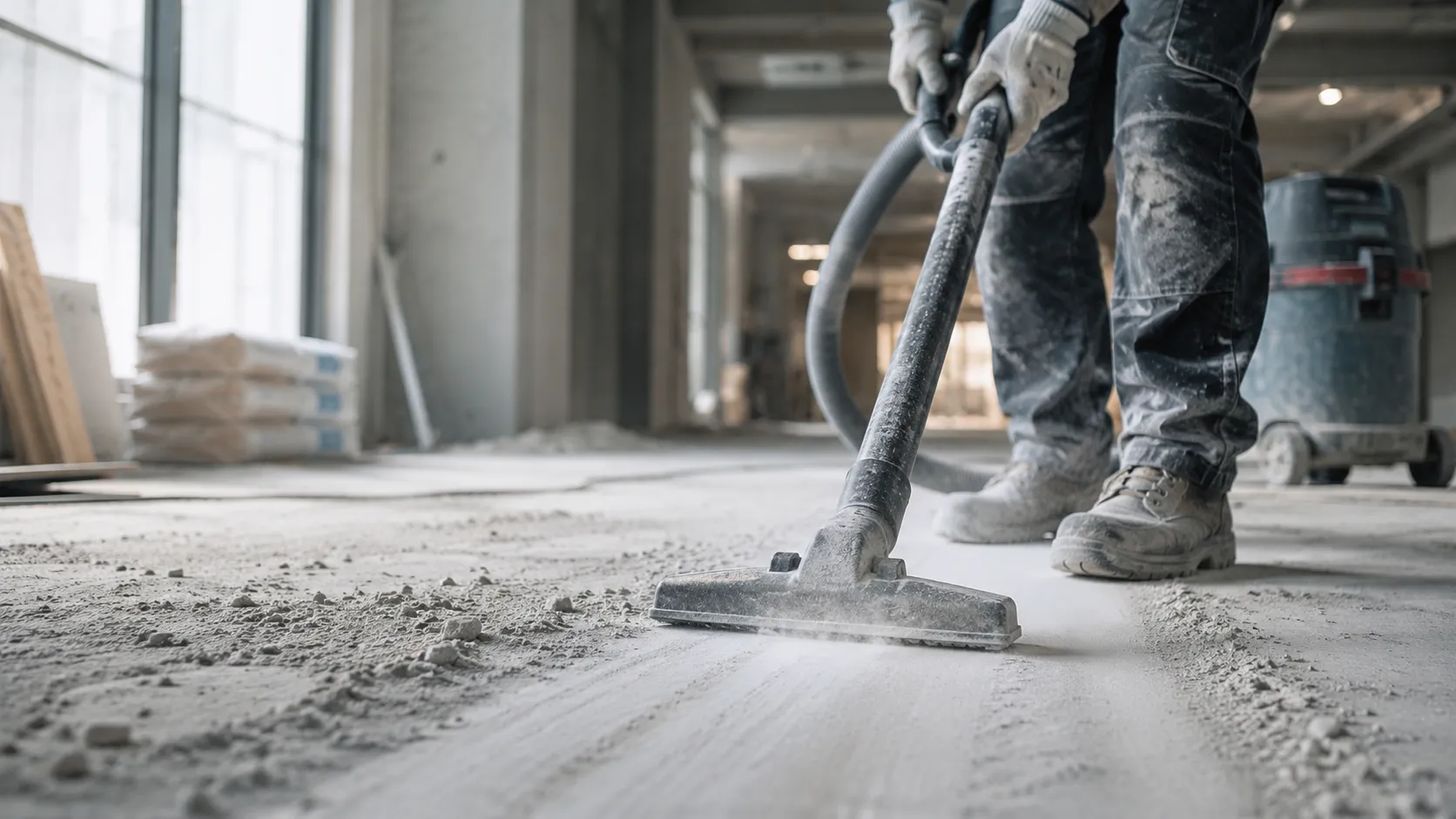
Why Professional Silica Dust Cleanup Is Essential After Construction
22nd April 2026
Construction and renovation projects often leave behind more than visible debris. One of the most significant hazards is silica dust, a fine particulate created when materials such as concrete, brick, stone and tiles are cut, drilled, polished or ground.
Although the construction work may be complete, microscopic silica particles can remain suspended in the air or settle on surfaces throughout the building. For businesses, schools, healthcare facilities, warehouses, strata properties and other commercial buildings, thorough cleanup is essential before occupants return.
Standard cleaning methods are rarely sufficient. Professional post-construction cleaning uses specialised equipment and controlled processes to remove fine dust without spreading it into previously unaffected areas.
Quick Answer
Silica dust cleanup requires professional cleaning because respirable crystalline silica particles are too fine for ordinary sweeping and domestic vacuuming. These methods can disturb settled dust and release it back into the air. Professional commercial cleaners use HEPA-filtered equipment, wet cleaning methods, containment procedures and systematic cleaning processes to remove visible debris and microscopic particles before a renovated workplace is occupied.
What Is Silica Dust?
Silica is a naturally occurring mineral found in many construction materials, including:
- Concrete
- Cement
- Brick
- Stone
- Tiles
- Mortar
- Quartz
- Sand
When these materials are cut, drilled, polished, demolished or ground, they can release respirable crystalline silica into the air. Unlike ordinary household dust, these particles are microscopic and may remain airborne before eventually settling on floors, fixtures, equipment and other surfaces.
Why Is Silica Dust a Serious Workplace Hazard?
Silica dust is more than a housekeeping issue. Because respirable particles are extremely small, they can travel deep into the lungs when inhaled.
Repeated or prolonged exposure to respirable crystalline silica has been associated with serious health conditions, including:
- Silicosis
- Chronic obstructive pulmonary disease
- Lung cancer
- Kidney disease
- Reduced lung function
- Persistent respiratory irritation
Exposure to high dust concentrations may also irritate the eyes, nose, throat and respiratory system. Businesses completing construction, refurbishment or fit-out projects should therefore prioritise thorough workplace cleaning before reopening affected areas.
Why Regular Cleaning Is Not Enough
Post-renovation cleaning involves more than sweeping visible debris from the floor. Ordinary cleaning methods may redistribute fine silica dust instead of safely removing it.
Common mistakes include:
- Dry sweeping construction dust
- Using domestic vacuum cleaners
- Dusting without suitable filtration
- Cleaning only visibly dusty surfaces
- Ignoring vents and accessible ventilation components
- Reopening the area before the final clean is complete
These practices can disturb settled particles and allow them to become airborne again. A professional cleaning plan uses controlled methods to clean the affected area from top to bottom while reducing cross-contamination.
Professional Silica Dust Cleaning Methods
Experienced commercial cleaning services use equipment and procedures designed for demanding workplace environments. The exact process should be based on the building layout, the work completed, the amount of contamination and any site-specific safety requirements.
Specialised Cleaning Equipment
Equipment used during a silica dust cleanup may include:
- Commercial HEPA-filtered vacuum cleaners
- Air scrubbers with suitable filtration
- Negative air machines where appropriate
- Microfibre cleaning systems
- Wet cleaning equipment
- Sealed waste containers
- Appropriate personal protective equipment
HEPA-filtered equipment is designed to capture extremely fine particles that ordinary vacuum filters may not contain effectively.
Controlled Cleaning Sequence
Professional cleaners generally work through the affected space in a planned sequence. This helps prevent cleaned areas from being contaminated again.
- Assess the affected rooms and surrounding areas.
- Confirm access, hazards and site requirements.
- Isolate the cleaning zone where necessary.
- Remove larger construction debris safely.
- Vacuum ceilings, walls, fixtures and other elevated surfaces.
- Clean furniture, cabinetry, ledges and fittings.
- HEPA vacuum and wet-clean floors.
- Inspect the area and complete any required follow-up cleaning.
- Remove cleaning waste using appropriate disposal procedures.
Regular Cleaning vs Professional Silica Dust Cleanup
| Cleaning Factor | Regular Cleaning | Professional Silica Dust Cleanup |
|---|---|---|
| Primary purpose | Routine appearance and hygiene | Removal of fine construction dust and settled contamination |
| Vacuum equipment | Standard commercial or domestic equipment | Commercial HEPA-filtered equipment |
| Cleaning coverage | Frequently used and visibly dirty areas | Floors, walls, ceilings, ledges, fixtures, tracks and accessible vents |
| Dust control | Limited containment measures | Containment, controlled sequencing and filtered equipment |
| Suitable timing | Ongoing workplace maintenance | After cutting, grinding, demolition, refurbishment or construction |
Silica Dust Can Travel Beyond the Work Area
Fine construction dust rarely remains where the cutting, grinding or demolition took place. Air movement, foot traffic, equipment and ventilation systems can carry particles into neighbouring rooms and shared areas.
A comprehensive cleaning inspection may cover:
- Walls and ceilings
- Floors and floor edges
- Skirting boards
- Doors and door frames
- Windows and window tracks
- Cabinets and shelving
- Light fittings
- Office furniture and equipment
- Accessible HVAC vents
- Air returns and duct openings
- Electrical fixtures
- Storage and utility areas
Without a systematic cleaning process, hidden dust may be disturbed later and continue circulating throughout the property.
Preventing Cross-Contamination
Preventing silica dust from spreading is one of the most important parts of post-construction cleaning. This is particularly relevant when renovation work takes place beside occupied offices, retail areas, healthcare rooms or other operational spaces.
Professional cleaning teams may use:
- Temporary containment barriers
- Restricted access to the cleaning zone
- Controlled entry and exit points
- Negative air pressure systems where suitable
- HEPA air filtration
- Top-to-bottom cleaning sequences
- Sealed waste handling procedures
- Separate equipment for contaminated and cleaned areas
Containment requirements vary between sites. The cleaning contractor should assess the building and coordinate with the principal contractor, facility manager or other responsible parties before work begins.
Protecting Indoor Air Quality
Indoor air quality may remain affected after construction work has finished. Visible debris may be gone while microscopic dust remains on surfaces or continues moving through the building.
Professional silica dust cleanup can help by:
- Removing settled fine particles
- Reducing dust that may become airborne again
- Cleaning accessible ventilation grilles and components
- Reducing the transfer of dust into unaffected rooms
- Preparing the premises for further assessment or occupancy
This level of cleaning is particularly important in offices, schools, childcare centres, retail stores, aged care facilities and medical environments. Specialist medical cleaning may also be required where stricter hygiene and infection-control procedures apply.
Supporting Workplace Safety and Compliance
Australian workplaces have responsibilities to identify and manage risks associated with hazardous airborne contaminants. Cleaning should form part of the broader silica dust control plan rather than being treated as a replacement for dust suppression, extraction, isolation or other controls used during construction.
An experienced cleaning provider can support the process through:
- Site-specific cleaning plans
- Hazard and access assessments
- Appropriate equipment selection
- Suitable personal protective equipment
- Controlled dust removal procedures
- Safe waste handling
- Cleaning inspections and documentation where required
Where exposure monitoring, air testing or clearance verification is required, this should be arranged with a suitably qualified occupational hygienist or other competent professional.
When Should Professional Silica Dust Cleanup Be Scheduled?
Professional cleanup should be considered after work involving:
- Concrete cutting
- Core drilling
- Brick and masonry cutting
- Tile cutting or removal
- Floor grinding
- Concrete polishing
- Demolition
- Stone fabrication
- Foundation repairs
- Commercial renovations
- Office fit-outs
- Wall and floor alterations
Even a relatively small project can distribute fine dust across a large area. Cleaning should be scheduled after dust-producing work is complete and before employees, customers, students, patients or other occupants return.
Benefits of Professional Silica Dust Cleanup
| Benefit | Why It Matters |
|---|---|
| Improved indoor cleanliness | Removes fine dust from surfaces before the premises reopen |
| Reduced exposure risk | Helps minimise unnecessary contact with settled and airborne particles |
| More thorough coverage | Addresses visible surfaces and commonly overlooked dust traps |
| Specialist equipment | Uses HEPA-filtered vacuums and appropriate dust-control methods |
| Ventilation protection | Reduces loose dust around accessible vents and air returns |
| Efficient project handover | Helps prepare the property for inspection, furnishing or reopening |
| Asset protection | Reduces abrasive dust build-up on flooring, furniture and equipment |
How Businesses Can Minimise Silica Dust During Construction
Professional cleaning is an important final step, but businesses and contractors should also manage dust while the work is underway.
Good practices may include:
- Using wet cutting or grinding methods where suitable
- Selecting tools with integrated dust extraction
- Isolating construction zones from occupied areas
- Restricting access to dust-producing work areas
- Maintaining suitable ventilation and extraction
- Cleaning progressively throughout the project
- Avoiding dry sweeping or compressed-air cleaning
- Following site-specific workplace safety procedures
- Scheduling a professional final clean immediately after the work
Combining prevention, containment and specialist cleaning provides more effective protection than relying on a final clean alone.
Maintenance After Silica Dust Cleanup
After the specialist cleanup is complete, the property may require additional monitoring and routine cleaning. This is especially important if construction continues in another part of the building.
Businesses can help maintain the premises by:
- Replacing HVAC filters in accordance with manufacturer recommendations
- Damp-dusting surfaces instead of dry dusting
- Using suitable HEPA-filtered vacuums
- Monitoring ledges, vents and other dust collection points
- Cleaning high-traffic and high-touch areas regularly
- Maintaining barriers around any continuing construction work
- Scheduling regular office cleaning services
- Arranging periodic deep cleaning after future renovations
Common Silica Dust Cleaning Mistakes
Using Household Vacuum Cleaners
Why it happens: Domestic vacuums are readily available and appear convenient.
Potential consequence: Equipment without suitable filtration may fail to contain fine dust and can release particles back into the room.
How to avoid it: Use properly maintained commercial HEPA-filtered equipment operated by trained personnel.
Dry Sweeping Construction Dust
Why it happens: Sweeping may appear to be the quickest way to remove visible debris.
Potential consequence: Fine particles can become airborne and spread into other parts of the property.
How to avoid it: Use HEPA vacuuming and appropriate wet cleaning methods rather than dry sweeping.
Cleaning Only Visible Surfaces
Why it happens: Dust on hidden or elevated surfaces is easy to overlook.
Potential consequence: Particles may later fall from fittings, ledges, vents or cabinetry and contaminate cleaned areas.
How to avoid it: Follow a top-to-bottom cleaning plan that includes ceilings, walls, fixtures, window tracks, cabinetry and floor edges.
Reopening the Workplace Too Soon
Why it happens: Businesses often need to resume operations quickly after a renovation.
Potential consequence: Employees, customers and visitors may enter before the fine dust has been thoroughly removed.
How to avoid it: Allow enough time for the complete professional clean, inspection and any site-specific clearance requirements.
Ignoring Ventilation Components
Why it happens: Vents, return-air grilles and other components are often out of sight.
Potential consequence: Loose dust may be redistributed when the ventilation system operates.
How to avoid it: Include accessible ventilation components in the cleaning scope and arrange specialist HVAC inspection where necessary.
Why Professional Cleaning Benefits Businesses
Improved Workplace Hygiene
Professional cleaning removes fine particles from areas that routine cleaners may not normally cover, helping restore a cleaner workplace after disruptive construction work.
Better Protection for Employees and Visitors
Removing settled construction dust before reopening helps reduce unnecessary exposure for employees, contractors, customers, students, patients and other building users.
A More Professional Presentation
Dust-free floors, windows, fixtures and work areas create a better first impression when clients, staff and visitors return to the renovated premises.
Reduced Ongoing Cleaning Requirements
Removing fine dust properly during the initial cleanup can prevent it from repeatedly settling on desks, shelving, floors and equipment over the following weeks.
Protection for Commercial Assets
Construction dust can collect inside equipment and act as an abrasive material on flooring, furniture and other finishes. Prompt removal helps protect the organisation's investment in its property and workplace assets.
Choosing a Professional Cleaning Provider
Before appointing a contractor, ask how the cleaning team will manage fine construction dust and prevent contamination from spreading.
Important questions include:
- Does the provider have experience with commercial construction cleaning?
- Will the team complete a site assessment before quoting?
- What type of HEPA-filtered equipment will be used?
- How will occupied or previously cleaned areas be protected?
- Are the cleaners trained for the site and cleaning tasks?
- What personal protective equipment will be required?
- How will contaminated cleaning waste be contained?
- Will accessible vents, ledges and elevated fixtures be included?
- Can the provider coordinate with builders and facility managers?
- What inspection or cleaning documentation can be supplied?
Properties with extensive contamination or higher-risk occupants may also require specialist advice beyond the cleaning scope.
Final Thoughts
Silica dust is a significant hazard that can remain after construction, renovation and demolition projects. Because the particles are microscopic, they may spread beyond the immediate work zone and settle throughout the building after visible debris has been removed.
Professional cleaning provides the specialised equipment, controlled techniques and systematic processes needed to address fine construction dust properly. Whether you are managing an office refurbishment, healthcare facility upgrade, retail fit-out, industrial project or strata renovation, a planned final clean should be completed before normal occupancy resumes.
Corporate Cleaning Services® provides tailored construction and industrial cleaning services for commercial properties across Australia. Arrange a site inspection or request a cleaning quote to discuss the appropriate cleaning scope for your project.
Frequently Asked Questions
Is silica dust dangerous after construction?
Yes. Fine respirable silica particles may remain airborne or settle on surfaces after construction work is completed. Disturbing the dust through sweeping, walking or ordinary vacuuming can release it back into the air. The affected area should be cleaned using suitable equipment and procedures before normal occupancy resumes.
Can an ordinary vacuum cleaner remove silica dust?
Ordinary domestic vacuum cleaners may not have the filtration or sealed construction required to contain very fine dust. Using unsuitable equipment can allow particles to pass through the filter or escape from the vacuum. Commercial HEPA-filtered equipment should be selected, operated and maintained appropriately for the cleaning task.
What equipment is used for professional silica dust cleanup?
Professional cleaners may use commercial HEPA-filtered vacuums, air scrubbers, negative air machines, microfibre systems, wet cleaning equipment and sealed waste containers. The team should also use personal protective equipment suitable for the assessed risk and the conditions at the property.
How long can silica dust remain in the air?
The time depends on particle size, air movement, ventilation and site conditions. Very fine particles may remain suspended after the work has stopped, while other particles settle on surfaces and can become airborne again when disturbed. This is why both air movement and settled dust must be considered in the cleaning plan.
Can silica dust affect HVAC systems?
Yes. Fine dust can collect around vents, grilles, returns and other ventilation components. If contamination enters the system, particles may be redistributed when it operates. Accessible components should be included in the cleaning scope, while internal ductwork may require assessment by an appropriately qualified HVAC or hygiene specialist.
Should an office be professionally cleaned after renovation?
Professional cleaning is recommended when the renovation involves cutting, drilling, grinding or removing concrete, stone, tiles, brick or other silica-containing materials. A structured final clean helps remove dust from workstations, flooring, fittings, windows and overlooked surfaces before employees and visitors return.
Can silica dust spread into other rooms?
Yes. Dust can move through open doorways, foot traffic, tools, equipment, air currents and ventilation systems. Containment barriers, controlled access, suitable extraction and planned cleaning sequences can help reduce the transfer of particles into neighbouring rooms.
Is professional cleaning necessary after a small renovation?
The appropriate response depends on the materials, tools, dust controls and amount of contamination involved. Even small jobs can release fine dust if concrete, tiles, stone, brick or mortar are cut or ground. A site assessment can help determine whether specialist post-construction cleaning is required.
Does professional cleaning replace silica exposure controls?
No. Cleaning is only one part of silica risk management. Dust should also be controlled at its source using methods such as wet cutting, on-tool extraction, isolation and restricted access. Professional cleanup addresses dust left behind but does not replace the controls required while the work is being completed.
Which cleaning services may be required after construction?
The scope may include construction cleaning, HEPA vacuuming, wet surface cleaning, hard floor maintenance, commercial window cleaning and detailed cleaning of offices, amenities and common areas. The cleaning program should be tailored to the property, construction activity and level of contamination.