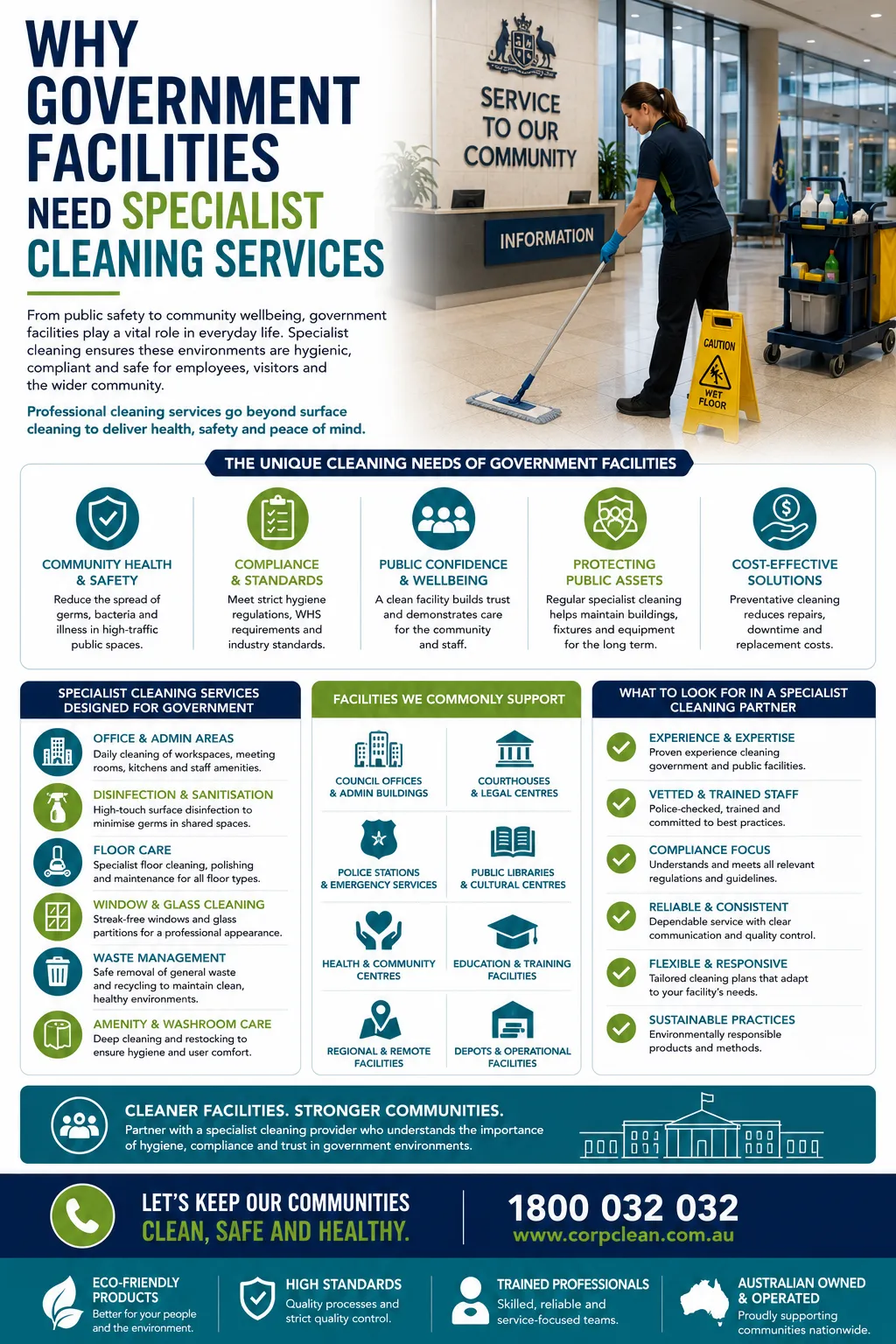
Why Government Facilities Need Specialist Cleaning Services
3rd June 2026
Government facilities must remain clean, safe, secure and accessible while serving employees, contractors, visitors and members of the public. Unlike many standard commercial properties, these buildings often combine high foot traffic, sensitive work areas, public-facing services, strict access controls and extended operating hours.
Council offices, courthouses, police stations, libraries, community centres, administrative buildings, transport facilities and emergency services sites all have different cleaning requirements. A generic cleaning checklist is rarely enough to manage these environments effectively.
Specialist government facility cleaning services provide structured programs designed around the building’s purpose, occupancy, security procedures, public access and operational risks. This guide explains why government buildings require experienced cleaning providers and what organisations should consider when developing a cleaning contract.
Quick Answer
Government facilities need specialist cleaning services because they combine high public use, strict security procedures, diverse facility types, workplace safety requirements and demanding presentation standards. The most effective service is based on a detailed site assessment, documented cleaning scope, trained staff, appropriate security checks, quality assurance and flexible scheduling around public operations.
Why Government Facility Cleaning Is Different
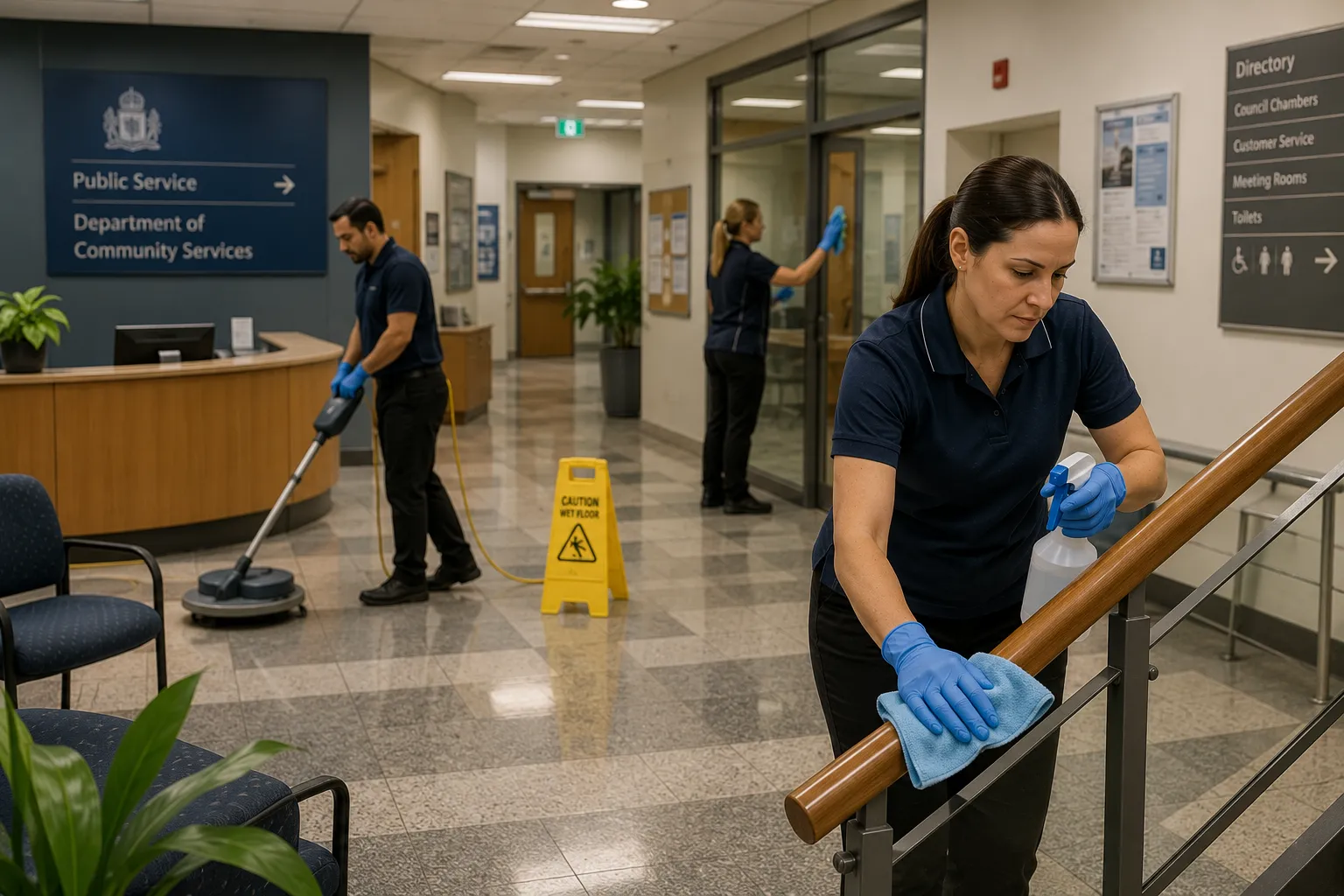
Government buildings are not all used in the same way. A council customer service centre has different priorities from a courthouse, police station, public library or emergency services building.
However, many government facilities share common challenges, including:
- High daily foot traffic
- Large public waiting areas
- Shared amenities
- Public service counters
- Sensitive workspaces
- Restricted-access rooms
- Confidential information
- Multiple departments within one building
- Extended operating hours
- High expectations for presentation
- Complex procurement and reporting requirements
- Strict access and security procedures
Cleaning providers must understand these operational conditions before assigning staff or developing a service schedule.
Supporting Public Health and Workplace Hygiene
Government facilities are used by people from a wide range of backgrounds throughout the day. Employees may work in the same building every day, while visitors enter for appointments, services, hearings, training, meetings or community activities.
Without regular cleaning, shared areas can quickly accumulate:
- Dust
- Dirt
- Food residue
- Rubbish
- Fingerprints
- Surface contamination
- Moisture
- Unpleasant odours
- Tracked-in soil
- Allergens
A structured commercial cleaning program helps maintain a healthier and more comfortable environment for employees and visitors.
Routine cleaning may include:
- Vacuuming carpets
- Sweeping and mopping floors
- Emptying rubbish bins
- Cleaning bathrooms
- Cleaning staff kitchens
- Dusting furniture
- Wiping public counters
- Cleaning waiting areas
- Spot-cleaning glass
- Sanitising high-touch surfaces
Cleaning should be based on the actual use of each area rather than applying one frequency throughout the building.
Cleaning High-Touch Surfaces
Government buildings contain many surfaces that are touched repeatedly during the day.
Common high-touch points include:
- Door handles
- Lift buttons
- Handrails
- Light switches
- Reception desks
- Public service counters
- Self-service kiosks
- Shared telephones
- Meeting room controls
- Bathroom fixtures
- Kitchen appliance handles
- Access panels
- Security gates
- Touchscreens
- Shared desks
These areas may need more frequent attention than general surfaces. High-touch cleaning should be listed clearly in the cleaning scope rather than assumed to be included in routine dusting.
Cleaning and Disinfection
Cleaning and disinfection are separate processes.
Cleaning removes dust, dirt, residue and organic material. Disinfection uses an appropriate product to reduce microorganisms on a surface after it has been cleaned.
For disinfectants to work properly, cleaning staff must follow:
- Product directions
- Correct dilution requirements
- Surface compatibility guidance
- Safety data sheets
- Required contact times
- Personal protective equipment requirements
Not every surface requires frequent disinfection. The cleaning program should prioritise bathrooms, shared service areas, kitchens, touchpoints and other high-use locations.
Maintaining Clean Public Amenities
Public bathrooms are one of the most visible measures of facility cleanliness.
Government building washrooms may experience heavy use and require multiple checks throughout the day.
Typical cleaning tasks include:
- Cleaning toilets
- Cleaning urinals
- Sanitising sinks
- Wiping taps
- Polishing mirrors
- Disinfecting touchpoints
- Emptying bins
- Mopping floors
- Restocking soap
- Restocking toilet paper
- Restocking paper towels
- Reporting leaks or damage
The cleaning contract should clarify who supplies consumables and how stock levels are monitored.
Busy customer service centres, libraries, courts and transport facilities may require daytime washroom attendants or scheduled checks between full cleaning visits.
Supporting Security and Confidentiality
Security is one of the most important differences between government cleaning and standard commercial cleaning.
Cleaning personnel may enter areas containing:
- Confidential records
- Personal information
- Sensitive equipment
- Restricted files
- Security systems
- Evidence
- Protected workspaces
- Staff-only areas
- Controlled-access rooms
Cleaning providers must follow the facility’s access and confidentiality procedures.
Depending on the site, requirements may include:
- Background checks
- Police checks
- Security clearances
- Staff identification
- Confidentiality agreements
- Restricted key access
- Sign-in and sign-out procedures
- Escort arrangements
- Approved cleaning times
- Prohibited areas
- Incident reporting
These requirements should be established before staff are assigned to the site.
Key and Access Management
Government cleaning often occurs outside standard operating hours, making access control essential.
The provider may need to manage:
- Keys
- Access cards
- Alarm codes
- Electronic entry systems
- Secure storage areas
- Restricted lifts
- Locked offices
- Visitor registration
- After-hours entry points
A clear key management process should explain:
- Who is authorised to hold keys
- Where keys are stored
- How access is recorded
- What happens if a key or card is lost
- How staff changes are managed
- Who should be contacted during an access issue
Poor access management can create significant security risks.
Flexible Cleaning Around Public Operations
Government facilities must often remain open while cleaning takes place.
A cleaning provider may need to work around:
- Customer service hours
- Court sessions
- Council meetings
- Public events
- Training programs
- Election activities
- Library opening hours
- Community bookings
- Emergency service operations
- Shift-based employees
Available scheduling options may include:
- Early-morning cleaning
- Daytime cleaning
- After-hours cleaning
- Overnight cleaning
- Weekend cleaning
- Public holiday services
- Event cleaning
- Emergency cleaning
- Day porter services
The cleaning schedule should reduce disruption while ensuring high-use areas remain presentable throughout the day.
Daytime Cleaning and Porter Services
Some facilities benefit from having cleaners present during operating hours.
A daytime cleaner or porter may manage:
- Bathroom checks
- Spill response
- Bin removal
- Entrance cleaning
- Public area tidying
- High-touch surface cleaning
- Consumable restocking
- Meeting room resets
- Emergency cleaning requests
This approach is useful in high-traffic facilities where one overnight visit is not enough to maintain standards.
Emergency Cleaning Response
Government buildings may occasionally require urgent cleaning after:
- Spills
- Accidents
- Flooding
- Vandalism
- Public events
- Biohazard incidents
- Plumbing failures
- Severe weather
- Building damage
- Unexpected increases in occupancy
The service agreement should explain:
- How emergency requests are submitted
- Available response hours
- Expected response times
- Additional charges
- Escalation contacts
- Specialist service limitations
Not every cleaner is trained or equipped to manage hazardous contamination. These incidents may require specialist contractors and site-specific controls.
Compliance with Workplace Health and Safety Requirements
Government cleaning contractors should operate under documented workplace health and safety procedures.
These may cover:
- Chemical handling
- Chemical storage
- Safety data sheets
- Equipment inspection
- Personal protective equipment
- Wet floor signage
- Manual handling
- Electrical safety
- Ladder use
- Hazard reporting
- Incident reporting
- Waste handling
- Emergency procedures
Higher-risk tasks may require Safe Work Method Statements or additional controls.
Examples include:
- High-access window cleaning
- Pressure cleaning
- Work near traffic
- Cleaning plant rooms
- Cleaning industrial environments
- Work around operational equipment
- Confined or restricted spaces
The provider should be able to explain how risks are assessed and managed.
Trained and Supervised Cleaning Staff
Cleaning quality depends on staff training, supervision and consistency.
Government cleaning personnel may need training in:
- Correct chemical use
- Surface compatibility
- Colour-coded cleaning systems
- Cross-contamination prevention
- Equipment operation
- Security procedures
- Confidentiality
- Waste handling
- Hazard reporting
- Incident response
- Customer interaction
- Site-specific requirements
Training should be completed before employees work independently.
The provider should also have procedures for:
- Supervising cleaners
- Briefing replacement staff
- Managing absences
- Updating site instructions
- Recording training
- Conducting performance reviews
- Correcting repeated service issues
Cleaning Different Types of Government Facilities
Government cleaning services must be adapted to the purpose and risk profile of each site.
| Facility Type | Common Cleaning Priorities | Special Considerations |
|---|---|---|
| Council offices | Entrances, counters, meeting rooms, washrooms and floors | Council meetings, public access and event support |
| Courthouses | Courtrooms, waiting areas, screening zones and public amenities | Strict access controls, secure cleaning windows and confidential areas |
| Police and emergency services facilities | Operational areas, public counters, amenities and staff facilities | Around-the-clock operations, restricted areas and higher security |
| Libraries | Carpets, desks, computer touchpoints, bathrooms and meeting rooms | Quiet cleaning methods and care around books and archives |
| Community centres | Multi-use rooms, floors, kitchens, bathrooms and waste | Evening events, weekend use, food service and room changes |
| Public service offices | Service counters, waiting areas, self-service machines and bathrooms | Steady public traffic and frequent touchpoint cleaning |
| Transport facilities | Floors, bathrooms, litter, touchpoints and external areas | Extended operating hours and cleaning around public movement |
| Education and training facilities | Classrooms, shared equipment, libraries, bathrooms and common areas | Cleaning frequency aligned with class schedules and occupancy |
Council Offices
Council facilities may include customer service counters, administrative offices, meeting rooms, council chambers, kitchens, bathrooms and public waiting areas.
Cleaning priorities may include entrance presentation, counter cleaning, meeting room resets, washroom checks, floor maintenance, high-touch surface cleaning and event support.
Courthouses
Courthouses contain public areas, courtrooms, holding areas, administrative offices, interview rooms and secure sections.
Cleaning plans may need to address strict access controls, court schedules, screening areas, high public traffic, confidential workspaces and secure cleaning windows.
Police and Emergency Services Facilities
Police stations and emergency services buildings may operate around the clock.
Cleaning may need to accommodate shift workers, secure areas, operational rooms, staff amenities, public counters, emergency response and restricted access.
Some areas may require specialist procedures beyond standard office cleaning.
Libraries
Libraries combine public spaces, computer areas, children’s sections, study rooms, staff offices, bathrooms and meeting areas.
Cleaning may include dust control, carpet maintenance, table cleaning, public computer touchpoints, quiet cleaning methods, bathroom servicing and event cleaning.
Cleaning around books, archives and sensitive materials requires care.
Community Centres
Community centres may host classes, meetings, sporting activities, events and public programs.
Cleaning schedules may need to account for frequent room changes, food service, evening events, weekend use, children’s activities, high floor traffic and additional waste.
Public Service Offices
Customer-facing service centres often experience steady visitor traffic.
Cleaning priorities may include service counters, waiting areas, queue systems, self-service machines, seating, entrance glass, bathrooms and high-touch surfaces.
Transport Facilities
Transport-related buildings may require frequent floor cleaning, public bathroom maintenance, graffiti removal, litter collection, pressure cleaning and extended-hours service.
The cleaning provider must work safely around public movement and operational activity.
Education and Training Facilities
Government-run training centres and education facilities may require cleaning of classrooms, lecture rooms, shared equipment, bathrooms, kitchens, offices, libraries and common areas.
Cleaning frequency should reflect class schedules and occupancy.
Routine Government Facility Cleaning Services
A government facility cleaning plan may include:
- Vacuuming carpets
- Sweeping floors
- Mopping floors
- Dusting accessible surfaces
- Emptying bins
- Cleaning bathrooms
- Cleaning kitchens
- Wiping public counters
- Cleaning waiting areas
- Cleaning meeting rooms
- Spot-cleaning glass
- High-touch surface cleaning
- Consumable restocking
- Reporting damage or maintenance issues
The exact scope should be documented by area and frequency.
Specialist Cleaning Services
Government buildings may also require periodic services outside routine cleaning.
These can include:
- Carpet steam cleaning
- Low-moisture carpet cleaning
- Hard floor stripping and sealing
- Floor polishing
- Machine scrubbing
- Upholstery cleaning
- Window cleaning
- High-access window cleaning
- Pressure cleaning
- Graffiti removal
- High-level dusting
- Tile and grout cleaning
- Post-construction cleaning
- End-of-lease cleaning
- Detailed sanitation
- External cleaning
These services should be scheduled as part of a preventative maintenance program rather than arranged only when surfaces become heavily soiled.
Carpet Cleaning
Government offices, libraries, courthouses and public service centres often contain large carpeted areas.
Regular vacuuming removes loose soil, but periodic carpet cleaning may be needed to address:
- Embedded dirt
- Traffic lanes
- Spills
- Stains
- Odours
- General dullness
The cleaning method should suit the carpet type, installation, occupancy and available drying time.
Hard Floor Maintenance
Hard floors in entrances, corridors, bathrooms, service areas and public halls may experience heavy wear.
Maintenance may involve:
- Routine sweeping
- Damp mopping
- Machine scrubbing
- Buffing
- Burnishing
- Polishing
- Stripping and resealing
- Grout cleaning
The provider should select chemicals and machinery based on the flooring material. Incorrect treatment can damage protective coatings or create a slippery surface.
Window and Glass Cleaning
Government buildings may contain:
- Entry glass
- Internal partitions
- Service counter glass
- External windows
- High-level glazing
- Skylights
- Glass doors
Routine cleaning may focus on fingerprints and visible marks, while external and high-access windows may be placed on a periodic schedule.
Higher-risk access work should be completed by appropriately trained personnel using suitable equipment and procedures.
Pressure Cleaning and External Areas
External cleaning may be required for:
- Paths
- Entrances
- Concrete areas
- Loading zones
- Courtyards
- Car parks
- Bin areas
- Building facades
- Public seating
The cleaning method should be appropriate for the surface and surrounding environment.
Pressure cleaning should be managed carefully around public access, drainage, electrical equipment, vehicles and landscaping.
Graffiti Removal
Government and public facilities may be frequent targets for graffiti.
Prompt removal can help maintain presentation and discourage repeated vandalism.
The provider should consider:
- Surface type
- Paint or coating
- Cleaning chemical
- Test areas
- Wastewater controls
- Public access
- Environmental requirements
Aggressive cleaning can damage porous or painted surfaces, so the method should be selected carefully.
Post-Construction Cleaning
Refurbishments, fit-outs, repairs and public works may leave behind:
- Fine dust
- Packaging
- Adhesive residue
- Paint marks
- Plaster dust
- Construction debris
- Dirty glass
- Dust inside cabinets
- Floor residue
Post-construction cleaning should be completed before the area reopens.
Hazardous construction dust may require specialist cleaning controls and should not be treated as ordinary commercial cleaning.
Waste Management Support
Government facilities may produce several waste streams, including:
- General waste
- Recycling
- Paper
- Food waste
- Confidential documents
- Batteries
- E-waste
- Sanitary waste
The cleaning provider’s responsibilities should be defined clearly.
Cleaners may be responsible for collecting and transferring waste, but staff should still place items in the correct streams. Confidential records and regulated waste may require separate authorised processes.
Eco-Friendly Government Cleaning
Many government organisations have sustainability, waste reduction and procurement goals.
Cleaning providers may support these goals by using:
- Concentrated products
- Refillable chemical systems
- Reusable microfibre cloths
- Accurate dilution controls
- Low-toxicity products where suitable
- Water-efficient equipment
- Energy-efficient machinery
- Reduced single-use plastic
- Responsible waste separation
- Environmentally preferable products
Sustainability should not come at the expense of safety or hygiene. Products must still be suitable for the surface, task and facility requirements.
Improving Indoor Air Quality
Indoor air quality depends on ventilation, HVAC maintenance, occupancy, moisture, building materials and external conditions.
Cleaning supports indoor environmental quality by reducing:
- Dust
- Loose fibres
- Allergens
- Carpet soil
- Surface debris
- Waste odours
Useful practices include:
- Regular vacuuming
- Damp dusting
- Cleaning entrance mats
- Removing waste promptly
- Cleaning accessible vents
- Addressing moisture
- Cleaning high-level dust where required
Cleaning should support, not replace, mechanical ventilation and building maintenance.
Asset Protection and Long-Term Maintenance
Government buildings contain valuable flooring, furniture, fixtures, equipment and finishes.
Routine cleaning and periodic maintenance can help protect:
- Carpets
- Vinyl flooring
- Tile
- Stone
- Timber surfaces
- Upholstery
- Glass
- Doors
- Reception counters
- Washroom fittings
Dirt, grit, spills, moisture and unsuitable chemicals can shorten the life of these materials.
A preventative cleaning program can reduce the need for premature restoration or replacement.
Maintaining Public Confidence
Cleanliness affects how people perceive public organisations.
A clean, orderly facility communicates:
- Professionalism
- Reliability
- Respect for the public
- Attention to detail
- Responsible facility management
Dirty bathrooms, stained floors, overflowing bins or neglected public counters may reduce confidence in the organisation, even when the service being provided is unrelated to cleaning.
Quality Assurance for Government Cleaning Contracts
Government cleaning contracts often require clear evidence that work has been completed.
Quality assurance may include:
- Cleaning checklists
- Supervisor inspections
- Digital service records
- Site audits
- Corrective action reports
- Client review meetings
- Performance reporting
- Photo documentation where appropriate
- Complaint tracking
- Key performance indicators
- Dedicated contract management
The provider should explain:
- How often inspections occur
- Who completes them
- How results are recorded
- How missed tasks are corrected
- How recurring issues are escalated
- How performance is reviewed
A quality assurance process should identify problems early rather than relying solely on complaints.
Service Continuity and Replacement Staff
Government facilities need reliable cleaning even when regular staff are absent.
Ask the provider:
- How absences are covered
- How replacement cleaners are selected
- Whether replacement staff have the required clearances
- How site instructions are communicated
- How security access is managed
- Whether supervisors check replacement work
Unbriefed replacement staff can create cleaning, security and access problems.
Choosing a Government Cleaning Provider
A suitable provider should demonstrate experience, systems and resources appropriate for public-sector facilities.
Relevant Experience
Look for experience cleaning:
- Government offices
- Council buildings
- Public service centres
- Courthouses
- Libraries
- Community facilities
- Emergency services buildings
- Education facilities
- High-security workplaces
Experience alone is not enough, but it can indicate familiarity with public access, security, reporting and contract requirements.
Appropriate Insurance
Request evidence of insurance suitable for the work being performed.
This may include:
- Public liability insurance
- Workers compensation arrangements
- Property damage cover
- Insurance relevant to specialist services
Documents should be current and reviewed before the contract begins.
Staff Screening and Security
Confirm:
- Required background checks
- Security clearance procedures
- Identity verification
- Confidentiality requirements
- Access approval
- Staff replacement procedures
- Key and card management
The provider should not assign unapproved personnel to restricted areas.
Detailed Cleaning Scope
The cleaning scope should identify:
- Every area included
- Tasks by area
- Cleaning frequency
- Rotational tasks
- Daytime services
- Periodic cleaning
- Consumable responsibilities
- Exclusions
- Security procedures
- Reporting requirements
- Quality assurance expectations
Avoid relying on broad descriptions such as “complete facility cleaning”.
Transparent Pricing
The proposal should explain whether pricing includes:
- Labour
- Supervision
- Equipment
- Cleaning chemicals
- Consumables
- Specialist services
- Waste disposal
- After-hours work
- Weekend work
- Public holiday work
- Emergency call-outs
- Reporting
- Travel
This allows decision-makers to compare providers fairly.
Contract Management
Large or multi-site contracts may require a dedicated account or contract manager.
This person may coordinate:
- Staff
- Scheduling
- Security requirements
- Quality inspections
- Performance reporting
- Additional services
- Complaints
- Site changes
- Contract reviews
Clear contract management helps prevent communication gaps.
Questions to Ask Before Appointing a Provider
- What experience do you have with government facilities?
- Which facility types have you cleaned?
- What security checks can your staff complete?
- How are keys and access cards managed?
- How are replacement cleaners approved?
- What tasks are included in the scope?
- Which tasks are excluded?
- How many labour hours are allocated?
- How are staff trained?
- How are cleaners supervised?
- What insurance do you hold?
- What safety systems are in place?
- How are quality inspections completed?
- How are service issues reported?
- How quickly are missed tasks corrected?
- Can you provide daytime cleaning?
- Can you respond to emergencies?
- What specialist services are available?
- How is contract performance reported?
- Can you provide relevant references?
Clear answers help identify whether the provider can meet operational, security and service requirements.
Common Mistakes to Avoid
Choosing Based Only on Price
Why it happens: Cleaning contracts are often reviewed as a cost-reduction opportunity.
Potential consequence: Insufficient labour hours, inconsistent service, limited supervision and excluded tasks.
How to avoid it: Compare staffing, labour allocation, security procedures, quality assurance, experience and service coverage.
Using a Generic Cleaning Scope
Why it happens: A standard specification is easier to issue across several sites.
Potential consequence: The scope may not reflect public traffic, secure rooms, washroom use, facility type or operating hours.
How to avoid it: Develop site-specific schedules and task frequencies.
Failing to Confirm Security Requirements
Why it happens: Security arrangements are discussed after the contract begins.
Potential consequence: Delays, unauthorised access, lost keys or unsuitable staff assignments.
How to avoid it: Define clearances, access, identification and key management requirements during procurement.
Underestimating Daytime Cleaning Needs
Why it happens: The contract focuses only on after-hours cleaning.
Potential consequence: Public bathrooms, bins, entrances and waiting areas deteriorate during the day.
How to avoid it: Assess whether porter services or scheduled daytime checks are needed.
Ignoring Periodic Maintenance
Why it happens: Routine cleaning receives most of the budget and attention.
Potential consequence: Carpets, floors, glass, upholstery and external areas deteriorate.
How to avoid it: Include planned specialist cleaning in the annual maintenance schedule.
Accepting Weak Quality Assurance
Why it happens: The provider promises regular inspections without explaining the process.
Potential consequence: Problems continue without documentation or corrective action.
How to avoid it: Require inspection frequencies, reporting methods, escalation procedures and performance measures.
Failing to Plan for Replacement Staff
Why it happens: The regular team performs well, so absence coverage is not reviewed.
Potential consequence: Unapproved or poorly briefed cleaners attend secure sites.
How to avoid it: Confirm that replacement staff meet the same training and security requirements.
Treating Every Facility the Same
Why it happens: One provider manages several government sites under a single contract.
Potential consequence: A library, courthouse, office and emergency services site receive unsuitable task frequencies.
How to avoid it: Use site-specific scopes within the broader contract.
Signs a Government Cleaning Program Needs Review
The service may need to be reviewed if you notice:
- Repeated public complaints
- Persistent bathroom odours
- Overflowing bins
- Dust in offices and public areas
- Dirty service counters
- Smudged entry glass
- Missed touchpoints
- Declining carpet or floor condition
- Frequent staff changes
- Security procedure breaches
- Poor communication
- Unresolved corrective actions
- Incomplete reporting
- Regular emergency cleaning requests
The solution may involve changing the schedule, increasing labour hours, improving supervision or updating the cleaning scope.
Benefits of Specialist Government Cleaning
Consistent Cleaning Standards
Documented procedures, trained staff, supervision and quality checks support consistent outcomes across the facility.
Healthier Environments
Regular cleaning removes dust, rubbish, food residue, dirt and surface contamination from shared areas.
Improved Public Presentation
Clean entrances, counters, bathrooms, floors and waiting areas support public confidence.
Better Security Management
Experienced providers understand that cleaning access must be controlled and documented.
Flexible Service Delivery
Specialist providers can schedule services around public opening hours, court sessions, events and shift operations.
Reduced Management Burden
A well-managed contract reduces the time facility teams spend handling complaints, staffing gaps, supplies and specialist maintenance.
Longer Asset Life
Regular maintenance helps protect flooring, carpets, furniture, glass and fixtures.
Better Reporting
Structured reporting makes it easier to monitor performance, address issues and demonstrate contract compliance.
Maintenance Tips Between Cleaning Visits
Employees and facility users can support the cleaning program by:
- Reporting spills promptly
- Using the correct waste bins
- Keeping food in designated areas
- Avoiding blocked corridors
- Reporting leaks
- Reporting damaged fixtures
- Keeping confidential materials secured
- Following access procedures
- Reporting graffiti or vandalism
- Keeping work surfaces reasonably accessible
Facility managers should also:
- Maintain adequate entrance matting
- Review consumable stock
- Repair leaking taps and toilets
- Service HVAC systems
- Update access lists
- Review cleaning frequency after operational changes
- Include specialist services in annual planning
Final Thoughts
Government facilities require specialist cleaning because they combine public access, workplace operations, security restrictions, high hygiene expectations and diverse building types. A standard commercial cleaning package may not provide enough detail, flexibility or control for these environments.
An effective government cleaning program should be based on a thorough site assessment, clear task schedules, appropriate security checks, trained staff, reliable supervision, flexible service hours and measurable quality assurance.
Routine cleaning, washroom servicing, high-touch surface cleaning, waste management, floor care and public area maintenance form the foundation of the service. Periodic carpet cleaning, window cleaning, pressure cleaning, graffiti removal, hard floor maintenance and post-construction cleaning help protect the facility over the longer term.
Corporate Cleaning Services® provides tailored cleaning programs for government offices, public facilities and other complex commercial environments. To discuss your facility requirements, arrange a site assessment or request a customised government cleaning quote.
Frequently Asked Questions
Why do government buildings need specialist cleaning?
Government buildings often combine high public traffic, secure areas, sensitive information, extended operating hours and strict safety requirements. Specialist cleaners are better equipped to manage these conditions.
What does government facility cleaning include?
It may include office cleaning, bathroom cleaning, kitchen cleaning, public area cleaning, waste removal, high-touch surface cleaning, floor care, window cleaning and specialist maintenance services.
Do cleaners need security checks?
Some government facilities require police checks, background screening, identity verification or formal security clearances. Requirements depend on the site and contract.
Can government cleaners work after hours?
Yes. Services may be scheduled early in the morning, after hours, overnight, on weekends or on public holidays. Access and security arrangements must be documented.
How often should public bathrooms be cleaned?
Frequency depends on visitor numbers and opening hours. Busy public facilities may require several checks and servicing visits throughout the day.
What is a day porter service?
A day porter or daytime cleaner maintains public areas during operating hours, responding to spills, bins, washrooms, consumables and urgent cleaning needs.
Are eco-friendly cleaning options available?
Yes. Providers may use refillable products, reusable microfibre systems, water-efficient equipment, low-toxicity chemicals and waste reduction methods where suitable.
What specialist services may government facilities need?
Common services include carpet cleaning, floor stripping and sealing, window cleaning, high-level cleaning, pressure cleaning, graffiti removal, upholstery cleaning and post-construction cleaning.
How is cleaning quality monitored?
Quality may be monitored through checklists, supervisor inspections, digital reporting, site audits, corrective action records, performance reviews and client meetings.
What should government organisations look for in a cleaning provider?
Look for public-sector experience, trained staff, suitable insurance, security procedures, health and safety systems, detailed service scopes, flexible scheduling and reliable quality assurance.