
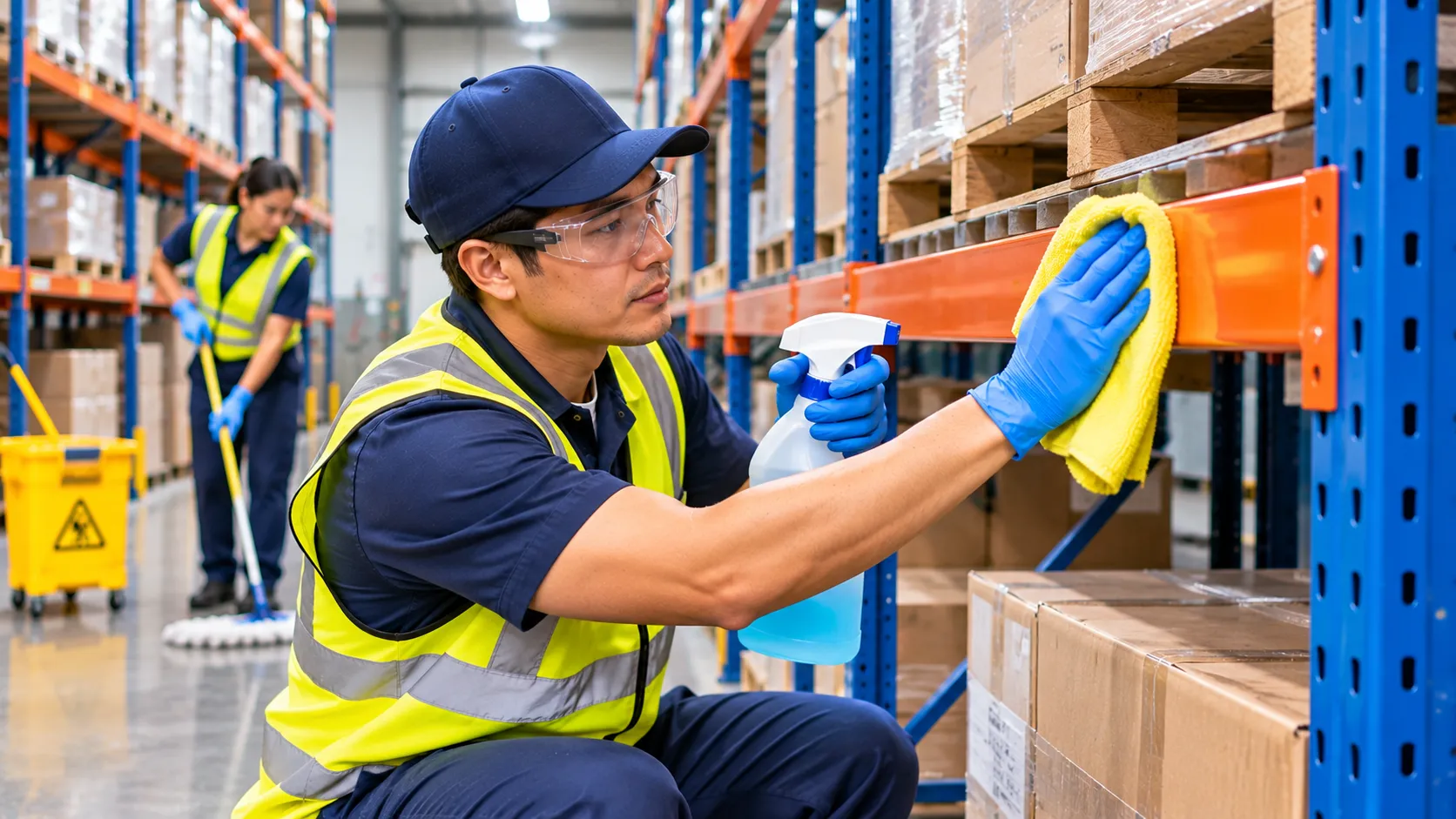
Quick Answer: Why Is Warehouse Racking Cleaning Important?
Warehouse racking cleaning helps maintain workplace safety, protect stored inventory, reduce contamination, improve housekeeping and make visible structural damage easier to identify. Dust, packaging debris, spills and product residues can accumulate on rack beams, shelves, uprights and elevated storage structures when these areas are excluded from routine cleaning programs.
An effective warehouse racking cleaning program should include:
- Regular cleaning of accessible shelves, beams and uprights.
- Removal of packaging waste around rack bases.
- Scheduled high-level dust removal.
- Safe coordination with forklift operations.
- Prompt spill management.
- Protection of stored products during cleaning.
- Reporting visible rack damage and corrosion.
- Documented cleaning schedules and quality checks.
- Appropriate working-at-height controls.
- Integration with formal racking inspection and maintenance programs.
Although there is no universal legally prescribed warehouse racking cleaning interval across Australia, appropriate housekeeping helps businesses manage their broader workplace health and safety obligations.
Warehouse cleaning programs often concentrate on floors, loading docks, staff amenities, offices and dispatch areas. However, one of the largest and most frequently overlooked structures within a warehouse is the storage racking itself.
Warehouse racking can extend several metres above floor level, accommodate substantial quantities of inventory and remain in continuous use throughout the year. Over time, dust, damaged packaging, pallet fragments and product residues can accumulate in areas that are rarely accessed during normal operations.
These contaminants can create housekeeping problems, conceal visible damage, attract pests and compromise product cleanliness.
Incorporating racking into a structured warehouse cleaning program helps facility managers address these overlooked areas while supporting safer storage, inventory protection and operational efficiency.
1. Why Warehouse Racking Cleaning Matters
Warehouse racking is a central part of storage and distribution operations. Unlike warehouse floors, which are generally included in routine cleaning schedules, elevated storage structures may remain untouched for extended periods.
Regular cleaning provides several operational and safety-related benefits.
| Cleaning Benefit | Operational Impact |
|---|---|
| Improved Housekeeping | Reduces accumulated dust, packaging waste and unwanted materials. |
| Better Inspection Visibility | Makes certain visible signs of damage easier to identify. |
| Inventory Protection | Helps reduce exposure to dust, moisture and product residues. |
| Pest Prevention | Reduces accessible food residues and potential pest harbourage. |
| Safer Access | Supports clearer rack bases, aisles and designated pedestrian areas. |
| Contamination Management | Helps manage unwanted material across storage zones. |
| Asset Protection | Supports identification of corrosion, coating damage and recurring moisture. |
| Operational Efficiency | Maintains more organised picking and replenishment environments. |
Cleaning is not a structural assessment of the racking. However, it can support the broader maintenance and inspection program by improving visibility and accessibility.
2. What Accumulates on Warehouse Racking?
The type and quantity of contamination depend on the warehouse environment, product categories, packaging materials, ventilation and frequency of stock movement.
| Contaminant | Common Location | Potential Risk |
|---|---|---|
| Dust | Shelves, beams and upper structures. | Product contamination and reduced visibility. |
| Cardboard Fragments | Picking locations and rack bases. | Obstructions and housekeeping concerns. |
| Plastic Stretch Wrap | Pallet positions and aisles. | Trip hazards or interference with equipment. |
| Broken Pallet Pieces | Lower rack levels and storage floors. | Trip hazards and equipment interference. |
| Product Residues | Shelves and pallet positions. | Hygiene concerns and pest attraction. |
| Liquid Spills | Storage levels and warehouse floors. | Slip hazards, contamination and product damage. |
| Cobwebs | Upper rack structures and corners. | Poor housekeeping and accumulation of debris. |
| Loose Labels | Picking and inventory identification areas. | Confusion and contamination. |
| Moisture | Rack bases, shelves and cold storage areas. | Potential corrosion and packaging deterioration. |
| Loose Objects | Elevated beams and storage platforms. | Potential falling-object hazards. |
Facilities handling food, pharmaceuticals, dangerous goods or sensitive products may require additional contamination controls and specialist cleaning procedures.
3. Is Warehouse Racking Cleaning a Legal Safety Requirement in Australia?
Australian businesses should maintain safe workplaces and manage hazards associated with storage systems, workplace traffic, falling objects, access and housekeeping.
While there is no universal requirement specifying that every warehouse rack must be cleaned at a particular interval, cleaning may be an important control within a facility's workplace safety management program.
Relevant considerations include applicable work health and safety or occupational health and safety legislation, manufacturer instructions, industry requirements and Australian Standards.
| Safety Consideration | Relevance to Warehouse Racking Cleaning |
|---|---|
| Workplace Housekeeping | Managing debris, contamination and unnecessary obstructions. |
| Safe Workplace Access | Maintaining designated pedestrian routes and access areas. |
| Falling Objects | Managing risks associated with loose materials stored at height. |
| Working at Height | Controlling fall risks during elevated cleaning activities. |
| Mobile Plant Safety | Separating cleaning personnel from forklift movements. |
| Plant and Structural Maintenance | Supporting accessibility and visibility for inspections. |
| Hazardous Chemicals | Managing cleaning chemicals and contaminated materials safely. |
| Fire Safety | Preventing cleaning activities from obstructing fire-protection systems. |
| Food Safety | Supporting applicable contamination and pest-management controls. |
Businesses should consult their relevant state or territory regulator to determine which workplace safety requirements apply to their operations.
4. Understanding Australian Pallet Racking Safety Standards
Warehouse operators should maintain applicable steel storage racking systems according to manufacturer instructions and relevant standards.
AS 4084.2:2023, Steel Storage Racking Part 2: Operation and Maintenance, is an important reference for applicable racking systems.
WorkSafe Victoria's pallet racking guidance recommends regular inspections and a formal inspection by a competent person every 12 months for the standard selective pallet racking covered by its guidance.
Cleaning activities should be coordinated with inspection programs without replacing technical assessments of structural condition, load capacity or rack integrity.
| Activity | Primary Purpose | Responsible Party |
|---|---|---|
| Routine Racking Cleaning | Remove approved contamination and debris. | Trained cleaning personnel. |
| Hazard Reporting | Communicate visible damage and unsafe conditions. | Employees and contractors. |
| Routine Safety Checks | Monitor storage conditions and visible concerns. | Designated warehouse personnel. |
| Formal Racking Inspection | Assess racking condition and identify required corrective actions. | Competent racking inspector. |
| Structural Repairs | Restore damaged components according to approved requirements. | Appropriately competent and authorised personnel. |
Important: A clean warehouse rack is not necessarily a structurally safe rack. Cleaning observations do not replace formal inspections, load assessments or manufacturer-approved maintenance.
5. Warehouse Racking Components That Require Cleaning Attention
Cleaning specifications should identify the particular rack components and surrounding areas included in the approved service scope.
| Racking Component | Common Cleaning Requirement | Safety Consideration |
|---|---|---|
| Uprights | Remove accessible dust and surface contamination. | Avoid impact and report visible damage. |
| Horizontal Beams | Remove approved dust and loose debris. | Do not disturb beam connections. |
| Shelf Decking | Remove product residue and packaging debris. | Protect inventory and avoid overloading. |
| Mesh Decking | Remove accessible accumulated material. | Do not remove or modify decking. |
| Rack Footplates | Maintain clean, accessible surrounding areas. | Protect anchors and structural connections. |
| Upright Protectors | Remove surrounding debris. | Do not relocate protective components. |
| End-of-Aisle Barriers | Clean approved external surfaces. | Maintain their protective function. |
| Bracing | Remove accessible surface dust. | Report visible deformation without adjusting components. |
| Load Capacity Signs | Maintain readable surfaces. | Do not remove or alter information. |
| Upper Rack Structures | Perform scheduled high-level dust removal. | Use approved access and exclusion controls. |
6. Cleaning Requirements for Different Warehouse Racking Systems
Warehouse storage systems vary considerably in design, accessibility and operating requirements.
A cleaning method suitable for conventional selective pallet racking may not be appropriate for automated or high-density storage systems.
| Racking System | Cleaning Priority | Special Consideration |
|---|---|---|
| Selective Pallet Racking | Accessible beams, uprights and rack bases. | Coordinate cleaning with forklift traffic. |
| Double-Deep Racking | Less accessible storage locations. | Coordinate cleaning with stock removal. |
| Drive-In Racking | Storage lanes and accessible structural surfaces. | Control access and mobile plant movements. |
| Cantilever Racking | Accessible arms, bases and surrounding floors. | Account for projecting components and stored materials. |
| Pallet Flow Racking | Approved accessible storage surfaces. | Protect rollers and moving mechanisms. |
| Push-Back Racking | Accessible external surfaces. | Technical components require authorised procedures. |
| Longspan Shelving | Picking shelves and product storage surfaces. | Protect stock and manage manual handling. |
| Mezzanine Storage | Storage platforms, shelving and access areas. | Maintain edge protection and safe access. |
| Automated Storage Systems | Approved external and accessible areas. | Follow system-specific isolation and access requirements. |
| Cold Storage Racking | Moisture, residue and contamination management. | Control condensation, ice and temperature-related risks. |
Cleaning personnel should never enter automated storage areas, restricted storage lanes or hazardous equipment zones without the required controls and authorisation.
7. Include Warehouse Racking in a Documented Cleaning Schedule
Racking should be incorporated into the facility's overall cleaning specification rather than addressed only when visible contamination becomes significant.
Cleaning frequency should consider:
- Warehouse operating hours.
- Daily inventory movements.
- Product picking frequency.
- Packaging waste generation.
- Airborne dust levels.
- Environmental moisture.
- Stored product characteristics.
- Pest-management requirements.
- Warehouse design and storage height.
- Applicable hygiene and safety requirements.
- Results of previous cleaning inspections.
Example Warehouse Racking Cleaning Schedule
| Frequency | Suggested Cleaning Task | Primary Objective |
|---|---|---|
| Each Shift | Report spills, damaged packaging and obvious hazards. | Early identification of operational concerns. |
| Daily | Remove accessible packaging waste and aisle debris. | Maintain safe and organised work areas. |
| Weekly | Clean approved lower-level rack surfaces. | Control routine contamination. |
| Monthly | Perform detailed cleaning of designated accessible storage areas. | Address gradual dust accumulation. |
| Quarterly | Review cleaning coverage and recurring contamination. | Improve cleaning effectiveness. |
| Periodically | Conduct planned high-level cleaning where required. | Manage elevated dust and debris. |
| During Stock Rotation | Clean previously obstructed pallet and shelf positions. | Maintain normally inaccessible storage areas. |
| As Required | Respond to spills, damaged products and unusual contamination. | Control immediate risks. |
These frequencies are examples rather than universal regulatory requirements. Actual schedules should be established through site-specific assessment.
8. Keep Warehouse Rack Bases Clean and Accessible
Rack bases are particularly susceptible to contamination because of their proximity to forklift operations, pallet movements and floor-cleaning activities.
Common materials accumulating around rack bases include:
- Broken pallet timber.
- Cardboard fragments.
- Plastic wrapping and strapping.
- Dust and production debris.
- Loose product packaging.
- Spilled liquids.
- Damaged or discarded labels.
| Rack Base Area | Cleaning Priority |
|---|---|
| Upright Footplates | Remove surrounding debris without disturbing fixings. |
| Rack Protectors | Maintain clean surrounding surfaces. |
| Under-Rack Areas | Remove accessible debris using approved methods. |
| End-of-Aisle Areas | Prevent accumulation of discarded packaging. |
| Pedestrian Access Points | Maintain designated access routes. |
| Adjacent Warehouse Floors | Manage dust, spills and loose materials. |
Mechanical floor-cleaning equipment should be operated carefully around racking to prevent accidental impacts with uprights, guards and structural components.
9. Never Climb Warehouse Racking During Cleaning
Warehouse racking is designed to support stored goods within specified operating limits. It is not designed to serve as a ladder or elevated work platform.
Cleaning personnel must not improvise access by climbing beams, standing on pallets, using shelving as steps or positioning themselves on unstable stored materials.
| Unsafe Practice | Safer Alternative |
|---|---|
| Climbing rack uprights or beams. | Use an approved access method. |
| Standing on stored pallets. | Use suitable work equipment designed for personnel access. |
| Using stacked cartons to gain height. | Arrange appropriate access equipment. |
| Reaching excessively from an unstable position. | Reassess the task and access requirements. |
| Being lifted on ordinary forklift forks or pallets. | Use personnel access equipment specifically approved for the task. |
| Entering restricted storage areas without permission. | Coordinate access with warehouse management. |
Where elevated access is necessary, the selected method should follow the site's risk assessment, equipment requirements and applicable workplace safety obligations.
10. Plan High-Level Warehouse Racking Cleaning Safely
Dust often accumulates on upper rack beams, roof structures, pipework, lighting fixtures and other elevated surfaces.
Without periodic cleaning, this material may eventually settle onto stored products, handling equipment and working areas.
High-level cleaning requires additional planning because of the risks associated with elevated access, falling objects and active warehouse operations.
| High-Level Cleaning Consideration | Recommended Control |
|---|---|
| Working at Height | Select suitable access methods through risk assessment. |
| Falling Debris | Establish appropriate exclusion controls below the work area. |
| Mobile Equipment | Coordinate with warehouse traffic management procedures. |
| Stored Products | Protect or relocate inventory where required. |
| Access Equipment | Use equipment appropriate to the task and working environment. |
| Overhead Services | Avoid interference with electrical and fire-protection systems. |
| Worker Competency | Ensure personnel have relevant training and authorisation. |
| Emergency Arrangements | Establish task-appropriate emergency and rescue procedures. |
Where suitable, cleaning from ground level using approved equipment can reduce the need for elevated access. Other tasks may require specialist access equipment and appropriately trained personnel.
11. Coordinate Racking Cleaning With Forklift Traffic
Forklifts, reach trucks, order pickers and pallet trucks operate throughout many warehouse facilities.
Cleaning personnel working between racks may be exposed to moving equipment, restricted visibility and changing inventory movements.
Warehouse cleaning arrangements should align with the facility's traffic management plan.
| Operational Situation | Potential Cleaning Control |
|---|---|
| Busy Picking Aisles | Schedule cleaning during approved low-traffic periods. |
| Active Forklift Routes | Apply effective pedestrian and mobile plant separation. |
| High-Level Cleaning | Establish suitable exclusion zones. |
| Mechanical Floor Cleaning | Coordinate equipment movements with warehouse operations. |
| Stock Replenishment | Avoid conflicting cleaning and material handling activities. |
| Loading Dock Activity | Coordinate access with dispatch and receiving teams. |
| Emergency Cleaning | Communicate the hazard and restrict access where required. |
Signs and high-visibility clothing may assist with safety, but they should not be relied upon as substitutes for effective separation where vehicle interaction risks remain.
Further information is available in Safe Work Australia's warehouse traffic management guide.
12. Remove Loose Debris and Prevent Falling-Object Hazards
Discarded packaging, damaged pallet fragments and loose materials can collect on elevated storage structures.
These materials may become dislodged during stock movements or cleaning activities, potentially creating hazards for workers below.
| Loose Material | Potential Concern | Cleaning Response |
|---|---|---|
| Cardboard Fragments | Dust and falling debris. | Remove from approved accessible areas. |
| Plastic Wrapping | Loose material and equipment interference. | Collect without disturbing stored loads. |
| Broken Pallet Timber | Potential falling objects and sharp fragments. | Report damaged pallets and arrange safe removal. |
| Loose Products | Potential falling inventory. | Refer to authorised warehouse personnel. |
| Damaged Cartons | Potential product release. | Report for appropriate stock handling. |
| Unidentified Objects | Unknown material or access hazards. | Report and assess before removal. |
Cleaning personnel should not disturb unstable stock or attempt to retrieve inaccessible materials using improvised methods.
13. Respond to Spills on Warehouse Racking Promptly
Leaks from stored containers can contaminate multiple rack levels before reaching the warehouse floor.
Depending on the substance, contamination may affect packaging, stored goods, metal surfaces and nearby inventory.
| Spill Type | Potential Impact | Response Consideration |
|---|---|---|
| Water | Wet floors and packaging damage. | Identify the source and manage moisture. |
| Food Products | Contamination and pest attraction. | Follow approved hygiene procedures. |
| Oil or Lubricants | Slip hazards and surface contamination. | Use suitable spill-management procedures. |
| Cleaning Chemicals | Exposure and material compatibility concerns. | Refer to product information and site procedures. |
| Industrial Chemicals | Potential chemical exposure or damage. | Engage appropriately trained personnel. |
| Unknown Substances | Unidentified health and safety risks. | Restrict access and escalate for assessment. |
Warehouse Spill Response Considerations
- Report the spill through the designated site procedure.
- Identify the substance where this can be done safely.
- Restrict access when required.
- Assess whether specialist spill-response personnel are needed.
- Protect nearby inventory from further contamination.
- Use approved cleaning equipment and protective measures.
- Manage affected stock and contaminated waste appropriately.
- Report any visible damage to the racking.
- Investigate recurring leaks or spills.
Unknown or hazardous substances must not be handled by general cleaning personnel without appropriate training, assessment and authorisation.
14. Choose Suitable Warehouse Racking Cleaning Methods
Cleaning methods should account for rack materials, protective coatings, accessibility, contamination type and stored products.
| Cleaning Method | Typical Application | Important Consideration |
|---|---|---|
| Microfibre Wiping | Accessible beams, shelves and uprights. | Provides controlled removal of surface dust. |
| Industrial Vacuuming | Loose dust and approved dry debris. | Equipment must suit the material and environment. |
| Damp Wiping | Compatible surfaces with light residue. | Control moisture near products. |
| Approved Detergent Cleaning | Compatible surfaces with accumulated dirt. | Verify material and product compatibility. |
| Mechanical Floor Scrubbing | Warehouse aisles and rack surroundings. | Prevent contact with structural components. |
| Ground-Level High-Reach Cleaning | Suitable elevated surfaces. | Assess overhead hazards and falling debris. |
| Specialist Elevated Cleaning | Upper structures and difficult-to-access areas. | Requires appropriate access and safety controls. |
| Controlled Wet Cleaning | Approved moisture-tolerant environments. | Protect stock, electrical systems and floors. |
The selected method should remove contamination without compromising racking components, protective coatings or stored inventory.
15. Avoid Excessive Water and Unsuitable Chemicals
Large quantities of water and aggressive cleaning chemicals are not automatically suitable for warehouse storage systems.
Excess moisture may damage cardboard packaging, affect stored products, contribute to corrosion or introduce slip hazards.
| Cleaning Issue | Potential Consequence |
|---|---|
| Excessive Water | Packaging damage and moisture accumulation. |
| Uncontrolled Chemical Spraying | Contamination of nearby inventory. |
| Aggressive Cleaners | Potential damage to coatings and materials. |
| Pressure Washing | Contamination spread, water penetration and slip hazards. |
| Inadequate Drying | Persistent moisture and potential corrosion. |
| Incompatible Products | Surface deterioration or chemical exposure concerns. |
Cleaning personnel should follow product labels, Safety Data Sheets, rack manufacturer guidance and approved workplace procedures.
16. Use Cleaning as an Opportunity to Identify Visible Rack Damage
Routine cleaning personnel frequently work near rack bases, uprights and other accessible structural components.
Removing accumulated contamination may make visible damage easier to notice and report.
| Visible Warning Sign | Potential Concern | Required Response |
|---|---|---|
| Bent Uprights | Possible impact-related damage. | Report immediately for assessment. |
| Damaged Beams | Potential structural deterioration. | Follow the site's rack damage procedure. |
| Missing Safety Components | Potential connection or retention concern. | Report without attempting replacement. |
| Damaged Bracing | Possible structural damage. | Arrange assessment by competent personnel. |
| Corrosion | Potential material deterioration. | Report the affected location. |
| Damaged Rack Protectors | Reduced collision protection. | Notify warehouse management. |
| Visible Floor Fixing Damage | Potential anchorage concern. | Refer to authorised personnel. |
| Displaced Components | Possible structural or connection issue. | Keep clear and escalate. |
| Unstable Stored Products | Potential falling-object hazard. | Report and restrict access as required. |
| Unreadable Load Signs | Reduced access to important safety information. | Notify the responsible warehouse personnel. |
Cleaning staff should report observations without attempting to determine whether damaged racking remains structurally safe.
17. Never Attempt Structural Racking Repairs During Cleaning
Cleaning and structural maintenance must remain separate responsibilities.
Cleaning personnel should not independently straighten bent uprights, tighten structural fixings, reposition beams, replace safety components or remove damaged bracing.
Unauthorised adjustments could compromise the integrity of the storage system.
If suspected rack damage is identified: Stop cleaning in the affected area where continued work may be unsafe, keep clear, notify the responsible warehouse representative and follow the site's hazard escalation procedure.
Any unloading, structural assessment, repair or return-to-service decision should be managed by appropriately competent and authorised personnel.
18. Protect Stored Products During Racking Cleaning
Cleaning activities should not introduce additional contamination, moisture or chemical exposure to warehouse inventory.
| Product Category | Common Cleaning Concern | Protection Consideration |
|---|---|---|
| Packaged Food | Dust, pests and chemical contamination. | Follow approved food-storage hygiene controls. |
| Pharmaceuticals | Contamination and product integrity. | Follow applicable quality and storage procedures. |
| Electronics | Moisture and dust exposure. | Use compatible low-moisture methods where approved. |
| Textiles | Dust and chemical residues. | Protect exposed products. |
| Paper Products | Moisture damage. | Avoid uncontrolled wet cleaning. |
| Unpackaged Goods | Direct surface contamination. | Relocate or protect goods before cleaning. |
| Dangerous Goods | Chemical incompatibility and exposure. | Follow specialist storage and cleaning requirements. |
| Temperature-Sensitive Products | Exposure outside controlled conditions. | Coordinate cleaning with inventory management. |
Depending on the task, warehouse personnel may need to relocate products, temporarily close storage bays or schedule cleaning during stock rotation.
19. Integrate Racking Cleaning With Stock Rotation
Stock rotation creates an opportunity to clean shelf surfaces and pallet positions that are normally inaccessible.
Rather than attempting to clean around tightly packed inventory, warehouse managers can coordinate cleaning with planned inventory movements.
| Warehouse Activity | Cleaning Opportunity |
|---|---|
| Stock Replenishment | Clean approved empty picking locations. |
| Inventory Counts | Identify storage areas requiring cleaning. |
| Seasonal Stock Changes | Schedule detailed cleaning of vacated sections. |
| Product Relocation | Address previously obstructed storage surfaces. |
| Warehouse Reorganisation | Coordinate broader cleaning of approved areas. |
| Planned Shutdowns | Complete more extensive cleaning with reduced operational conflicts. |
Cleaning activities should be coordinated with authorised inventory handling personnel to prevent unauthorised stock movements or changes to loading arrangements.
20. Consider Fire Safety and Sprinkler Systems
Warehouse racking layouts, stored products and overhead structures may interact with the facility's fire-protection design.
Cleaning must not interfere with sprinkler heads, fire detection equipment, emergency access or other fire-safety systems.
| Fire Safety Area | Cleaning Consideration |
|---|---|
| Sprinkler Heads | Avoid impacts, obstruction and unauthorised adjustment. |
| Overhead Pipework | Do not use as an access or support point. |
| Fire Extinguishers | Maintain unobstructed access. |
| Emergency Exit Routes | Keep cleaning equipment and waste clear of designated routes. |
| Fire Detection Devices | Prevent contamination or accidental damage. |
| Storage Clearance Areas | Report apparent obstructions to responsible personnel. |
| Combustible Waste | Remove according to the site's waste and fire-risk controls. |
Required clearances should follow the facility's approved fire-protection design and applicable requirements. Cleaning personnel should never independently modify fire-protection equipment or storage arrangements.
21. Manage Warehouse Dust and Combustible Materials
Some warehouses handle products that generate combustible dust or other hazardous airborne materials.
Food powders, timber dust, certain plastics and other materials may require specialist dust-management controls.
Cleaning methods that unnecessarily disperse dust into the air can increase exposure or introduce additional risks.
| Dust Management Priority | Recommended Approach |
|---|---|
| Material Identification | Determine the nature of accumulated dust. |
| Hazard Assessment | Assess relevant exposure, fire and explosion risks. |
| Cleaning Equipment | Select equipment suitable for the assessed material. |
| Dust Dispersion | Avoid unapproved methods that spread contamination. |
| Elevated Surfaces | Include relevant accumulation areas in specialist housekeeping programs. |
| Waste Handling | Follow approved containment and disposal procedures. |
| Cleaning Frequency | Base frequency on accumulation rates and identified hazards. |
Ordinary vacuum cleaners and general cleaning equipment may be unsuitable for certain combustible or hazardous dust environments. Specialist assessment may be required.
22. Integrate Warehouse Racking Cleaning With Pest Management
Damaged packaging, food residue and neglected storage areas can provide potential food sources or harbourage for pests.
Regular cleaning can support a facility's integrated pest-management program by removing accessible contamination and improving visibility around storage areas.
| Pest-Prone Area | Cleaning Priority |
|---|---|
| Rack Bases | Remove food residue and discarded packaging. |
| Under-Rack Areas | Address accessible accumulated debris. |
| Warehouse Corners | Remove dust and unwanted materials. |
| Wall-to-Floor Junctions | Maintain visibility and cleanliness. |
| Damaged Product Areas | Report and manage leaking or exposed inventory. |
| Waste Collection Points | Prevent unnecessary accumulation of residues. |
| Long-Term Storage Areas | Schedule cleaning around inventory movements. |
| Receiving Areas | Manage packaging debris and incoming contamination. |
Possible pest activity should be reported through the site's pest-management procedures. Cleaning supports pest control but does not replace professional pest inspections or treatment.
23. Warehouse Racking Cleaning Across Different Industries
Warehouse cleaning specifications should reflect the products stored and the operational risks of each facility.
| Warehouse Type | Primary Cleaning Concern | Cleaning Priority |
|---|---|---|
| E-commerce Distribution | Cardboard, plastic and frequent packaging waste. | Picking areas and rack bases. |
| Food Warehouses | Food residue, contamination and pests. | Documented hygiene and contamination controls. |
| Cold Storage Facilities | Condensation, moisture and ice. | Temperature-compatible cleaning procedures. |
| Pharmaceutical Warehouses | Product contamination and storage integrity. | Applicable quality-system cleaning requirements. |
| Manufacturing Warehouses | Industrial dust and material residues. | Contamination-specific cleaning methods. |
| Retail Distribution Centres | Packaging debris and rapid stock turnover. | Routine housekeeping and scheduled rack cleaning. |
| Automotive Parts Warehouses | Dust, oils and component packaging. | Compatible residue removal and inventory protection. |
| Building Materials Warehouses | Dust and heavy product debris. | Safe access and appropriate dust collection. |
| Chemical Storage Warehouses | Potential hazardous substance contamination. | Specialist assessment and approved procedures. |
| Third-Party Logistics Facilities | Multiple product categories and storage requirements. | Zone-specific cleaning specifications. |
A single cleaning method or schedule may not be suitable for every storage zone within a mixed-use warehouse.
24. Document Warehouse Racking Cleaning Activities
Documented cleaning records improve accountability and help facility managers ensure storage areas receive appropriate attention.
Large warehouses may benefit from recording cleaning completion according to aisle, rack number, storage zone or inventory area.
| Record Field | Example Information |
|---|---|
| Cleaning Date | Date and time of completed service. |
| Warehouse Zone | Receiving, storage, picking or dispatch. |
| Rack Identification | Aisle number, bay number or rack reference. |
| Cleaning Task | Routine, detailed or high-level cleaning. |
| Responsible Worker | Employee or cleaning contractor identification. |
| Contamination Identified | Dust, residue, spills or packaging debris. |
| Visible Damage Observed | Recorded location and description. |
| Issue Escalation | Responsible person or incident reference. |
| Outstanding Tasks | Areas requiring additional access or specialist cleaning. |
| Supervisor Verification | Completion review where required. |
Cleaning records should remain distinct from formal rack inspection reports, even when the two systems share relevant hazard information.
25. Train Cleaning Personnel for Warehouse Hazards
Warehouse cleaning personnel need to understand the operating environment before beginning work around storage systems.
General commercial cleaning experience does not automatically establish competency for elevated cleaning, hazardous spills or restricted warehouse environments.
| Training Area | Purpose |
|---|---|
| Warehouse Site Induction | Understand facility rules and access arrangements. |
| Forklift Traffic Management | Recognise mobile plant hazards and separation controls. |
| Racking Awareness | Understand access restrictions and damage reporting responsibilities. |
| Cleaning Equipment Operation | Prevent unsafe equipment use and structural impacts. |
| Chemical Safety | Use approved cleaning products appropriately. |
| Spill Response | Recognise when contamination requires escalation. |
| Working at Height | Follow relevant access and fall-risk controls. |
| Inventory Protection | Prevent cleaning-related product contamination. |
| Emergency Procedures | Understand site-specific emergency arrangements. |
| Hazard Reporting | Communicate observed problems promptly. |
Contract cleaning teams should receive appropriate site-specific information, instruction, supervision and authorisation before undertaking their assigned duties.
26. Warehouse Racking Cleaning Checklist
Facility managers can use the following checklist when reviewing their warehouse racking cleaning program.
| Cleaning and Safety Requirement | Complete |
|---|---|
| Racking included in the documented cleaning specification. | ? |
| Cleaning frequencies established for each storage zone. | ? |
| Cleaning personnel inducted into the warehouse. | ? |
| Cleaning activities coordinated with warehouse operations. | ? |
| Required pedestrian and forklift separation established. | ? |
| Rack bases free from unnecessary debris. | ? |
| Accessible lower-level surfaces cleaned. | ? |
| Approved under-rack areas cleaned. | ? |
| Loose materials removed safely. | ? |
| Damaged packaging reported. | ? |
| Spills managed according to site procedures. | ? |
| Stored products protected during cleaning. | ? |
| Suitable cleaning chemicals selected. | ? |
| Appropriate dust collection equipment used. | ? |
| Mechanical cleaning equipment kept clear of rack components. | ? |
| High-level cleaning planned where required. | ? |
| Approved access equipment used. | ? |
| No workers climbing storage racking. | ? |
| Fire-protection equipment remains unobstructed. | ? |
| Load capacity signs remain readable. | ? |
| Visible corrosion or rack damage reported. | ? |
| Possible pest activity reported. | ? |
| Cleaning waste removed appropriately. | ? |
| Cleaning records completed. | ? |
| Outstanding issues escalated for corrective action. | ? |
This checklist supports cleaning management and does not replace site-specific risk assessments or formal structural racking inspection procedures.
27. Common Warehouse Racking Cleaning Mistakes
| Common Mistake | Potential Consequence | Better Approach |
|---|---|---|
| Cleaning only warehouse floors. | Accumulated contamination on storage structures. | Include approved rack surfaces in cleaning schedules. |
| Climbing racking. | Fall and falling-object hazards. | Use appropriate access methods. |
| Cleaning near operating forklifts without controls. | Vehicle interaction risks. | Coordinate with traffic management procedures. |
| Using excessive water. | Product damage, corrosion and slip hazards. | Use compatible cleaning methods. |
| Ignoring visible rack damage. | Potentially serious defects remain unreported. | Escalate observations promptly. |
| Attempting unauthorised repairs. | Potential structural damage. | Refer repairs to competent personnel. |
| Spraying chemicals around exposed products. | Inventory contamination. | Protect stock and control chemical application. |
| Using unsuitable dust collection equipment. | Dust exposure or other material-specific hazards. | Assess equipment suitability. |
| Neglecting elevated surfaces. | Continued accumulation of dust and debris. | Schedule approved high-level cleaning. |
| Striking racking with floor scrubbers. | Potential damage to storage structures. | Operate equipment within approved access arrangements. |
| Failing to document completed work. | Inconsistent cleaning coverage. | Maintain appropriate cleaning records. |
| Confusing cleaning with formal inspections. | Unassessed structural risks. | Maintain separate inspection and cleaning programs. |
28. Signs Your Warehouse Needs More Frequent Racking Cleaning
A cleaning schedule should be reviewed when contamination repeatedly accumulates between scheduled services or new operational risks emerge.
| Warning Sign | Recommended Action |
|---|---|
| Heavy dust accumulation between cleaning services. | Review cleaning frequency and contamination sources. |
| Repeated packaging debris around rack bases. | Increase housekeeping attention and review waste practices. |
| Dust settling on stored goods. | Assess upper structures and airborne dust sources. |
| Recurring food or product residues. | Review damaged stock and spill-management procedures. |
| Frequent pest activity. | Coordinate cleaning with pest-management specialists. |
| Persistent moisture around storage areas. | Investigate leaks, condensation or cleaning methods. |
| Obscured safety or inventory signs. | Improve cleaning attention to identification surfaces. |
| Increased warehouse throughput. | Reassess cleaning coverage and scheduling. |
| Accumulated high-level debris. | Arrange planned specialist cleaning where required. |
| Repeated cleaning inspection failures. | Review service specifications and corrective actions. |
Recurring contamination may also indicate underlying issues with packaging methods, ventilation, inventory handling or facility maintenance that cleaning alone cannot resolve.
29. Measure the Effectiveness of Your Warehouse Cleaning Program
Cleaning performance should be assessed through documented outcomes rather than relying solely on the appearance of warehouse floors.
| Performance Indicator | What It Helps Measure |
|---|---|
| Scheduled Cleaning Completion | Whether designated storage areas receive planned cleaning. |
| Cleaning Inspection Results | Performance against agreed cleanliness requirements. |
| Recurring Contamination | Storage zones requiring additional attention. |
| Reported Rack Defects | Visible observations communicated to responsible personnel. |
| Spill Response Records | Management of contamination incidents. |
| High-Level Cleaning Completion | Coverage of designated elevated surfaces. |
| Packaging Waste Accumulation | Effectiveness of routine housekeeping arrangements. |
| Inventory Contamination Incidents | Potential issues requiring operational investigation. |
| Corrective Action Completion | Whether identified cleaning deficiencies are resolved. |
Performance reviews can help facility managers refine cleaning schedules, allocate resources and identify areas requiring specialist attention.
30. What Determines the Cost of Warehouse Racking Cleaning?
Warehouse racking cleaning costs vary according to the facility size, storage system design, contamination levels and approved cleaning scope.
| Cost Factor | Impact on Cleaning Requirements |
|---|---|
| Warehouse Size | Influences the overall cleaning area and labour requirements. |
| Number of Rack Bays | Determines the volume of storage structures requiring attention. |
| Racking Height | May require additional access arrangements. |
| Contamination Levels | Heavy accumulation may increase cleaning time. |
| Racking Configuration | Influences accessibility and cleaning methods. |
| Stored Products | May require additional protection or specialist controls. |
| Cleaning Frequency | Determines ongoing labour and resource requirements. |
| Operating Hours | May require cleaning outside normal production periods. |
| High-Level Cleaning | May require specialist equipment and trained personnel. |
| Waste Management | Influences collection and disposal requirements. |
| Safety and Reporting Requirements | Determines preparation, coordination and documentation needs. |
A site-specific assessment provides a more accurate basis for determining warehouse cleaning costs than a general price per square metre alone.
31. How to Choose a Professional Warehouse Racking Cleaning Provider
Warehouse managers should select cleaning providers that understand industrial operating environments and can work within established safety procedures.
| Selection Criteria | What to Verify |
|---|---|
| Warehouse Cleaning Experience | Experience working in comparable industrial environments. |
| Safety Management | Appropriate risk-management and site-induction processes. |
| Traffic Management | Ability to coordinate with forklift and pedestrian controls. |
| Cleaning Scope | Clear identification of included rack surfaces and storage zones. |
| High-Level Cleaning Capability | Verified access equipment, competency and authorisation where required. |
| Cleaning Equipment | Suitability for the storage environment and contaminants. |
| Chemical Management | Compatibility with rack materials and stored products. |
| Flexible Scheduling | Ability to coordinate cleaning with warehouse operations. |
| Hazard Reporting | Documented processes for escalating observed concerns. |
| Quality Management | Cleaning inspections and corrective action procedures. |
| Insurance | Appropriate coverage for the agreed cleaning activities. |
| Service Documentation | Clear records of completed and outstanding cleaning tasks. |
A professional cleaning contractor should support warehouse safety arrangements without taking over structural inspection or maintenance responsibilities outside its approved scope.
Professional Warehouse and Industrial Cleaning Services Across Australia
Corporate Cleaning Services® provides commercial and industrial cleaning solutions for warehouses, logistics centres, distribution facilities, manufacturing environments and other commercial premises.
Our cleaning programs can be developed around facility-specific operating hours, storage areas, traffic movements, cleaning priorities and agreed safety requirements.
Depending on the approved scope, warehouse cleaning programs may address:
- Warehouse floors and designated aisles.
- Storage and picking areas.
- Accessible external racking surfaces.
- Rack bases and surrounding floors.
- Packaging debris and routine waste.
- Loading and dispatch areas.
- Approved periodic deep cleaning activities.
- Warehouse offices and staff amenities.
- Site-specific cleaning schedules.
- Cleaning quality inspections and reporting.
Corporate Cleaning Services® operates an ISO 9001 quality management system that supports structured service delivery, risk assessment and continual improvement.
Businesses can also explore our commercial and warehouse cleaning solutions in Perth and Melbourne.
Specialist high-level racking cleaning and restricted-access activities are subject to assessment, equipment suitability, personnel competency and agreed service specifications.
Build a Cleaner, Safer and More Efficient Warehouse
Do not let dust, packaging debris and overlooked storage areas compromise your warehouse housekeeping program.
Corporate Cleaning Services® can help develop a commercial cleaning solution aligned with your facility's operational requirements and cleaning priorities.
Request a Warehouse Cleaning QuoteSpeak with our team today on 1800 032 032.
Frequently Asked Questions About Warehouse Racking Cleaning
What is warehouse racking cleaning?
Warehouse racking cleaning involves removing approved dust, packaging debris, product residues and other contaminants from accessible storage structures, shelves, beams, uprights, rack bases and surrounding areas.
Why is warehouse racking cleaning important?
Regular racking cleaning supports housekeeping, inventory protection, contamination management, pest prevention and visibility of certain structural defects. It is an important supporting activity within broader warehouse cleaning and safety programs.
How often should warehouse racking be cleaned?
Cleaning frequency depends on warehouse activity, contamination levels, stored products, storage design and safety requirements. Accessible storage areas may require daily or weekly attention, while elevated surfaces may require scheduled periodic cleaning.
Is warehouse racking cleaning mandatory in Australia?
There is no universal legally prescribed cleaning interval for all warehouse racking. However, appropriate cleaning may help businesses fulfil broader workplace safety, housekeeping, contamination management and industry-specific obligations.
What Australian Standard applies to steel storage racking?
AS 4084.2:2023, Steel Storage Racking Part 2: Operation and Maintenance, provides relevant guidance for applicable steel storage racking systems. Businesses should confirm which standards and requirements apply to their particular storage equipment.
Does cleaning replace annual pallet racking inspections?
No. Cleaning does not assess structural integrity, load capacity or component condition in the same way as a formal inspection. WorkSafe Victoria recommends a formal inspection every 12 months by a competent person for the selective pallet racking covered by its guidance.
Can warehouse cleaning staff climb pallet racks?
No. Warehouse racking should not be used as access equipment. Elevated cleaning should use a suitable access method selected through risk assessment and performed by appropriately trained and authorised personnel.
What is high-level warehouse racking cleaning?
High-level racking cleaning involves removing accumulated contamination from designated elevated storage structures. The work requires suitable access arrangements, falling-object controls and coordination with warehouse operations.
Should warehouse racking be emptied before cleaning?
It depends on the cleaning method, accessibility and stored products. Some external surfaces can be cleaned while inventory remains in place, while deeper cleaning may require products to be relocated or protected by authorised personnel.
Can warehouse racking be pressure washed?
Only where the method is compatible with the storage system, facility and products. Pressure washing may introduce moisture, spread contamination, damage coatings or affect nearby inventory.
What should cleaners do if they notice damaged racking?
Cleaning personnel should report suspected damage promptly, keep clear of potentially unsafe areas and follow the site's hazard escalation procedure. Structural assessment and repairs should be undertaken by competent and authorised personnel.
Can cleaners repair damaged warehouse racking?
General cleaning personnel should not attempt structural repairs or unauthorised adjustments. Repairs require appropriate competency, authorisation and compliance with relevant manufacturer and engineering requirements.
Why should warehouse rack bases be kept clean?
Clean rack bases support visibility, access and housekeeping. Removing packaging fragments, loose debris and spills can help reduce obstructions around storage areas and make visible damage easier to identify.
Can warehouse racking cleaning help prevent pests?
Yes. Removing food residues, damaged packaging and accumulated waste can help reduce potential pest food sources and harbourage. Cleaning should complement professional pest-management programs.
How should warehouse racks be cleaned around food products?
Cleaning should follow the facility's food safety procedures, protect nearby products and use approved methods that control contamination, chemical exposure and moisture.
How can warehouse racks be cleaned without damaging stored goods?
Use compatible cleaning products, control moisture, prevent uncontrolled chemical spraying and arrange appropriate stock protection or relocation. Cleaning should be coordinated with inventory management personnel.
Can racking cleaning take place while a warehouse is operating?
Some cleaning activities may be completed during operating hours when appropriate controls are established. Higher-risk tasks may require restricted aisles, effective vehicle separation or scheduled cleaning periods.
What equipment is used for warehouse racking cleaning?
Depending on the task, cleaning may involve microfibre materials, suitable industrial vacuum cleaners, approved cleaning products, ground-level high-reach equipment and specialist access equipment.
Why should high-level warehouse dust be removed?
Accumulated dust may settle onto products, equipment and working areas. Periodic high-level cleaning can help manage contamination, provided appropriate access and falling-object controls are in place.
What is the best way to clean underneath pallet racking?
The appropriate method depends on accessibility, stored products and surrounding equipment. Approved accessible areas may be cleaned using suitable vacuuming or other compatible methods without disturbing structural components or entering restricted spaces.
Can warehouse cleaning damage pallet racking?
Yes. Accidental equipment impacts, incompatible chemicals, excessive moisture and unauthorised adjustments may damage rack components or protective coatings. Cleaning methods should follow approved site and manufacturer requirements.
How much does professional warehouse racking cleaning cost?
Costs depend on warehouse size, rack height, contamination levels, accessibility, cleaning frequency and specialist equipment requirements. A site assessment helps establish an accurate service quotation.
Can warehouse racking cleaning be outsourced?
Yes. Businesses can engage professional cleaning contractors for approved warehouse cleaning activities. Cleaning responsibilities, safety controls, access arrangements and reporting requirements should be clearly established before work begins.
How do I know whether my warehouse racking cleaning program is effective?
Review cleaning records, inspection results, recurring contamination, waste accumulation, reported hazards and outstanding corrective actions. Regular performance reviews can help identify where cleaning arrangements need improvement.
Make Warehouse Racking Cleaning Part of Your Workplace Safety Program
A well-maintained warehouse requires more than clean floors. Racking structures, rack bases, picking locations, elevated surfaces and less accessible storage areas deserve appropriate attention.
By establishing documented cleaning schedules, coordinating activities with warehouse operations, protecting inventory and reporting obs