
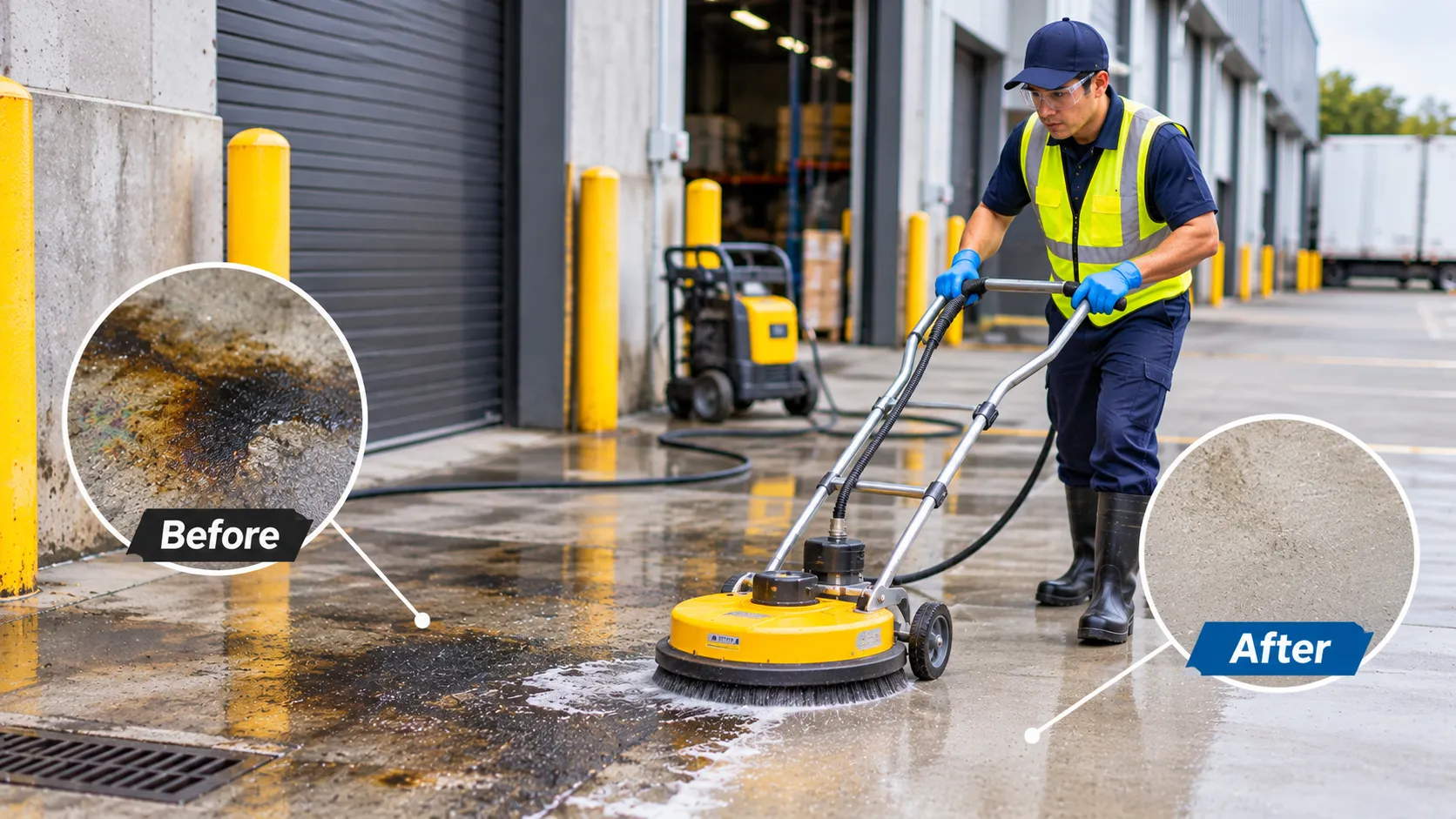
Quick Answer: What Is the Best Way to Remove Oil Stains from Commercial Concrete?
The best way to remove oil stains from commercial concrete is to contain and recover surface oil, apply a compatible commercial degreaser, loosen the remaining contamination and remove the residue using suitable mechanical cleaning or controlled pressure washing.
An effective commercial concrete oil removal process generally involves:
- Identifying the type, age and extent of oil contamination.
- Isolating the affected area from vehicles and pedestrians.
- Recovering excess oil using suitable absorbent materials.
- Assessing concrete porosity, coatings and existing damage.
- Selecting a surface-compatible industrial degreaser.
- Allowing the product to work according to manufacturer instructions.
- Using controlled agitation or compatible pressure cleaning.
- Recovering contaminated wastewater and cleaning residues.
- Inspecting the surface and repeating treatment where appropriate.
- Addressing the source of recurring oil contamination.
Fresh oil spills are generally easier to manage than established stains that have penetrated porous concrete. Older contamination may require multiple treatments, and complete colour restoration cannot always be guaranteed.
Oil stains are a persistent maintenance challenge for commercial properties, warehouses, manufacturing facilities, shopping centres, service stations and industrial workshops. Frequent vehicle movements, machinery operation and material handling can expose concrete surfaces to engine oil, hydraulic fluid, lubricants, grease and other petroleum-based contaminants.
Unlike ordinary dirt, oil can penetrate the porous structure of concrete, making established stains difficult to remove through routine washing alone. Using unsuitable cleaning products or excessive water pressure may spread contamination, damage protective coatings or produce uneven surface finishes.
Professional commercial pressure cleaning and degreasing services provide a more targeted approach to removing oily residues while considering concrete condition, operational requirements and environmental responsibilities.
1. Why Oil Stains Are Difficult to Remove from Concrete
Concrete may appear solid and impermeable, but its structure contains microscopic pores and capillaries. Oil can enter these openings, particularly when the surface is unsealed, worn or damaged.
The longer oil remains on concrete, the greater the opportunity for penetration and interaction with accumulated dirt. Weather exposure, vehicle movements and temperature changes may further complicate removal.
| Contributing Factor | Effect on Oil Contamination | Cleaning Challenge |
|---|---|---|
| Concrete Porosity | Allows oil to penetrate beneath the surface | Surface washing may leave deeper contamination |
| Prolonged Exposure | Increases opportunities for oil penetration | May require repeated treatments |
| Vehicle Traffic | Transfers oil across surrounding surfaces | Expands the affected cleaning area |
| Surface Temperature | Influences oil viscosity and cleaning conditions | Requires appropriate treatment selection |
| Dirt Accumulation | Creates heavy oily deposits | Requires more intensive cleaning |
| Damaged Sealers | Exposes underlying porous concrete | Produces uneven contamination patterns |
| Existing Cracks | Allows contamination into damaged areas | Limits the effectiveness of surface cleaning |
| Weathering | Changes the appearance of contaminated surfaces | Complete colour restoration may be difficult |
Effective oil stain removal requires more than increasing pressure washer settings. It involves selecting treatment methods that address both accessible oily residues and the characteristics of the underlying concrete.
2. Common Types of Oil Contamination on Commercial Concrete
Identifying the contaminant helps determine the correct cleaning product, equipment and waste management procedures.
| Contaminant | Common Source | Cleaning Consideration |
|---|---|---|
| Engine Oil | Cars, trucks and commercial vehicles | Compatible petroleum residue degreasing |
| Hydraulic Fluid | Forklifts, machinery and loading equipment | Containment and product-specific treatment |
| Transmission Fluid | Automotive servicing and vehicle leaks | Targeted degreasing and residue recovery |
| Industrial Lubricants | Manufacturing machinery and moving components | Industrial-grade compatible cleaning methods |
| Gear Oil | Gearboxes and heavy mechanical equipment | Treatment suited to viscous residues |
| Cooking Oil | Commercial kitchens and food delivery areas | Food-facility-approved cleaning procedures |
| Animal Fats and Grease | Food processing and hospitality operations | Compatible degreasing and hygiene controls |
| Metalworking Fluids | Engineering and machining facilities | Substance-specific assessment |
| Diesel Fuel | Transport facilities and refuelling operations | Approved spill response before surface treatment |
| Unknown Oily Substances | Unidentified industrial leaks | Identification and risk assessment before cleaning |
Important: Fuel spills, unidentified chemicals and hazardous industrial substances must be managed under the relevant site spill response procedures. Ordinary pressure washing must not be used to disperse uncontrolled hazardous spills.
3. Fresh Oil Spills vs Old Oil Stains
The age of an oil deposit significantly influences cleaning requirements. Fresh spills may remain largely accessible at the surface, while older stains may contain deeply absorbed oil and weathered residues.
| Comparison | Fresh Oil Spill | Established Oil Stain |
|---|---|---|
| Surface Condition | Wet or recently deposited oil | Darkened or persistent contamination |
| Oil Penetration | Depends on exposure and porosity | May extend beneath the surface |
| Initial Response | Immediate containment and recovery | Detailed surface assessment |
| Absorbent Materials | Useful for recovering available liquid | Limited effectiveness against absorbed residues |
| Degreasing Requirements | May require targeted treatment | Often requires more intensive treatment |
| Number of Treatments | Potentially fewer | Multiple treatments may be needed |
| Residual Discolouration | Potentially reduced through prompt action | More likely to remain after cleaning |
| Maintenance Priority | Immediate response | Scheduled corrective treatment after risk assessment |
Prompt spill management is one of the most effective preventative measures for limiting long-term concrete staining.
4. Commercial Properties Most Affected by Concrete Oil Stains
Oil contamination is particularly common in properties that accommodate vehicles, machinery, food production or heavy material handling equipment.
| Property Type | Common Oil Contamination Areas | Primary Cleaning Objective |
|---|---|---|
| Commercial Car Parks | Parking bays, ramps and vehicle entrances | Improve surface presentation and housekeeping |
| Warehouses | Forklift routes and loading areas | Control contamination transfer |
| Distribution Centres | Loading docks and truck standing areas | Maintain operational surfaces |
| Manufacturing Facilities | Machinery bases and production floors | Manage industrial residues |
| Automotive Workshops | Service bays and equipment areas | Remove recurring lubricant contamination |
| Transport Depots | Vehicle parking and maintenance areas | Control vehicle-related pollution |
| Shopping Centres | Car parks and service loading zones | Maintain customer-facing and operational areas |
| Food Manufacturing Facilities | Processing areas and goods receiving zones | Support approved hygiene procedures |
| Restaurants and Hospitality | Service yards and waste storage areas | Manage grease and organic residues |
| Construction Facilities | Equipment storage and hardstand areas | Address construction machinery contamination |
| Fleet Maintenance Facilities | Inspection and servicing areas | Maintain cleaner vehicle operating surfaces |
5. Why Removing Oil Stains Matters for Commercial Properties
Improves Workplace Housekeeping
Removing accessible oil and grease residues helps maintain cleaner working surfaces and makes newly occurring leaks easier to identify.
Supports Slip Hazard Management
Oily films can affect surface traction. Appropriate cleaning helps address one source of slip hazards, particularly around pedestrian walkways, vehicle ramps and machinery operating areas.
Protects Concrete Finishes
Surface-specific treatment helps reduce the risk of damage caused by aggressive pressure washing, incompatible solvents and repeated abrasive cleaning.
Improves Commercial Property Appearance
Dark oil stains can make otherwise well-maintained car parks, driveways and loading areas appear neglected. Targeted treatment can improve visual consistency.
Reduces Contamination Transfer
Oil can be carried into internal facilities by vehicle tyres, forklift wheels and footwear. Addressing contamination at its source can reduce repeated cleaning elsewhere.
Supports Environmental Management
Recovering oil residues and contaminated cleaning water helps limit the potential movement of pollutants into soil, drains and waterways.
Assists Preventative Maintenance
Cleaner concrete surfaces allow facility managers to identify recurring equipment leaks, worn coatings, damaged joints and other maintenance concerns more easily.
6. Assessing Concrete Before Oil Stain Removal
Before selecting a cleaning method, commercial cleaning professionals should assess the concrete surface and surrounding operating conditions.
| Assessment Area | What to Check | Why It Matters |
|---|---|---|
| Concrete Condition | Cracks, wear and deterioration | Prevents avoidable cleaning damage |
| Surface Porosity | Potential absorption characteristics | Influences treatment requirements |
| Protective Coatings | Sealer, paint or epoxy systems | Determines product compatibility |
| Stain Age | Recent or established contamination | Influences cleaning complexity |
| Stain Size | Localised or widespread deposits | Determines treatment coverage |
| Contaminant Type | Oil, grease, fuel or industrial fluid | Determines safe handling requirements |
| Drainage | Drain locations and discharge destinations | Supports wastewater management |
| Operational Activity | Pedestrian and vehicle movements | Determines cleaning restrictions |
| Previous Cleaning | Existing damage or treatment history | Helps avoid repeating unsuitable methods |
| Surface Finish | Polished, textured or decorative concrete | Protects appearance and functionality |
A discreet test treatment can help establish suitable cleaning parameters and identify potential changes in surface appearance before larger areas are cleaned.
7. Professional Methods for Removing Oil Stains from Concrete
No single cleaning method is suitable for every oil stain. Professional treatment may combine several techniques depending on contamination and surface conditions.
Absorbent Materials
Suitable commercial absorbents can recover accessible liquid oil before further cleaning begins. They are particularly useful for initial spill management.
Used absorbents must be collected and disposed of according to the characteristics of the absorbed substance and applicable waste requirements.
Commercial Degreasing Products
Industrial degreasers are formulated to assist with loosening oil and grease from compatible surfaces. Product selection depends on the contaminant, concrete condition, protective coatings and environmental requirements.
Mechanical Floor Scrubbing
Suitable scrubbers and brushes can assist with agitating cleaning solutions and lifting oily deposits from compatible industrial floors.
Cold Water Pressure Cleaning
Cold water pressure cleaning can help remove loosened residues and general surface grime after appropriate pretreatment. Water pressure alone may be insufficient for deeply established oil stains.
Hot Water Pressure Cleaning
Heat may help reduce the viscosity of certain oily residues, improving their release during cleaning. This method requires equipment and surfaces suitable for the selected temperature and pressure.
Specialist Poultice Treatment
Commercial poultice products may assist in drawing selected absorbed contaminants towards the surface. Their suitability depends on the material, stain type and product instructions.
Biological Cleaning Products
Some specialist cleaning products contain microorganisms or enzymes intended to assist with the breakdown of particular organic or hydrocarbon residues.
These products require suitable application conditions and do not eliminate the need for contamination recovery, waste assessment or appropriate environmental controls.
8. Comparing Concrete Oil Stain Removal Methods
| Cleaning Method | Best Suited To | Key Limitation |
|---|---|---|
| Commercial Absorbents | Fresh accessible oil spills | Limited against deeply absorbed oil |
| Water-Based Degreasers | Compatible general oily deposits | Effectiveness varies with contamination |
| Industrial Alkaline Degreasers | Selected heavy grease applications | Requires chemical compatibility and handling controls |
| Mechanical Scrubbing | Large compatible industrial floor areas | May not remove deeper stains independently |
| Cold Water Pressure Washing | Loosened residues and general grime | May be insufficient against heavy oil deposits |
| Hot Water Pressure Washing | Selected established oily contamination | Requires heat-compatible surfaces |
| Specialist Poultice Products | Selected localised absorbed stains | May require extended treatment periods |
| Biological Cleaning Products | Compatible organic or hydrocarbon residues | Performance depends on product and conditions |
| Combined Professional Treatment | Persistent or widespread contamination | Requires site-specific assessment |
9. How Commercial Degreasers Remove Oil from Concrete
Oil does not readily mix with water, making ordinary washing ineffective against many oily contaminants.
Commercial degreasers may contain surfactants and other ingredients that assist in loosening oil, separating it from surfaces and enabling subsequent removal.
Different formulations work through different mechanisms. Selecting an unnecessarily aggressive product may increase safety risks or damage protective finishes without producing better cleaning results.
| Degreaser Type | Potential Application | Important Consideration |
|---|---|---|
| Neutral or Mild Formulations | Light contamination and sensitive surfaces | May require additional treatment for heavy deposits |
| Alkaline Degreasers | Selected industrial oil and grease residues | Confirm compatibility with coatings and equipment |
| Water-Based Degreasers | General commercial cleaning applications | Wastewater still requires appropriate management |
| Solvent-Based Products | Specific specialist contamination | May present fire, exposure and material compatibility risks |
| Biological Formulations | Selected organic and hydrocarbon residues | Requires suitable environmental conditions |
| Food-Facility-Approved Products | Food processing and hospitality environments | Must meet facility-specific cleaning requirements |
Always follow product instructions, including concentration, contact time, temperature restrictions and relevant Safety Data Sheet requirements.
10. Professional Concrete Oil Stain Removal Process
A structured cleaning process helps ensure that contamination is addressed systematically rather than simply moved across the concrete surface.
Step 1: Inspect and Identify the Contamination
Determine the likely contaminant, affected surface area, stain age and existing concrete condition. Identify drainage points, sensitive equipment and operational hazards.
Step 2: Isolate the Affected Area
Coordinate temporary access restrictions with facility managers and establish appropriate separation from pedestrians, forklifts and vehicles.
Step 3: Recover Excess Oil
Use suitable absorbents or approved recovery equipment to collect accessible oil before applying water or cleaning products.
Step 4: Remove Loose Surface Debris
Remove compatible loose dirt, grit and packaging waste to prevent unnecessary contamination spread during wet cleaning.
Step 5: Select and Test the Cleaning Product
Choose a degreaser compatible with the contaminant and concrete finish. Complete a discreet test where appropriate.
Step 6: Apply the Approved Treatment
Apply the product according to manufacturer instructions, observing specified contact times and chemical handling requirements.
Step 7: Loosen and Recover the Contamination
Use compatible mechanical agitation, scrubbing or controlled pressure cleaning to assist with residue removal.
Step 8: Manage Contaminated Wastewater
Collect cleaning residues and wastewater using approved recovery arrangements. Prevent uncontrolled discharge into stormwater systems.
Step 9: Inspect the Treated Concrete
Assess remaining oily residues, surface condition and visual improvement. Additional treatment may be appropriate where contamination persists.
Step 10: Verify Reopening Conditions
Confirm that cleaning equipment, remaining water and accessible residues have been removed before restoring normal access in accordance with site procedures.
11. Hot Water vs Cold Water Pressure Cleaning for Oil Stains
Water temperature can influence the effectiveness of cleaning oily deposits, but heat alone does not guarantee complete removal.
| Comparison | Cold Water Pressure Cleaning | Hot Water Pressure Cleaning |
|---|---|---|
| General Dirt Removal | Suitable for many durable surfaces | Suitable for compatible surfaces |
| Fresh Oil Residues | May assist after recovery and degreasing | May assist with compatible residue removal |
| Established Grease | May require additional treatment | Heat may help loosen selected deposits |
| Heat-Sensitive Coatings | Potentially more suitable | Requires particular caution |
| Energy Consumption | No additional water heating | Requires energy for heating |
| Operator Risks | High-pressure water hazards | High-pressure water and thermal hazards |
| Wastewater Recovery | Required for contaminated runoff | Required for contaminated runoff |
| Typical Application | General surface maintenance | Selected industrial degreasing applications |
The appropriate approach depends on contaminant type, surface condition, available equipment and site safety requirements.
12. Removing Oil Stains from Different Concrete Finishes
Commercial concrete surfaces vary significantly in texture, porosity and protective treatment.
| Concrete Finish | Cleaning Consideration | Potential Risk |
|---|---|---|
| Unsealed Concrete | Assess absorbed contamination | Persistent staining and deeper penetration |
| Sealed Concrete | Use sealer-compatible products | Protective coating deterioration |
| Polished Concrete | Follow flooring maintenance specifications | Loss of gloss or surface etching |
| Epoxy-Coated Concrete | Confirm chemical and temperature compatibility | Coating softening or delamination |
| Exposed Aggregate Concrete | Protect aggregate and cement matrix | Surface erosion and uneven appearance |
| Decorative Concrete | Complete discreet compatibility testing | Colour and texture changes |
| Painted Concrete | Use approved coating maintenance methods | Paint removal or discolouration |
| Broom-Finished Concrete | Address contamination within surface texture | Uneven residue removal |
| Older or Damaged Concrete | Use conservative cleaning methods | Further deterioration of weakened areas |
| Concrete with Expansion Joints | Protect joint sealants and surrounding edges | Joint damage and water penetration |
Surface protection: Excessive water pressure or aggressive chemical treatment may permanently alter concrete finishes. Cleaning parameters should be based on the surface condition and manufacturer recommendations rather than the assumption that stronger treatment produces better results.
13. Can Old Oil Stains Be Completely Removed from Concrete?
Many established oil stains can be substantially improved through appropriate professional treatment. However, complete removal depends on how deeply the contaminant has penetrated and whether permanent surface changes have occurred.
Older stains may remain visible because of:
- Oil absorbed below the accessible surface.
- Repeated contamination over extended periods.
- Weathering and ultraviolet exposure.
- Changes to protective coatings.
- Previous chemical or mechanical damage.
- Different ageing patterns between stained and unstained concrete.
- Contamination within cracks or damaged joints.
Repeated compatible cleaning may further improve appearance. Where staining persists despite effective residue removal, a surface specialist may need to assess restoration options.
14. Why Oil Stains Sometimes Reappear After Cleaning
Concrete that contains absorbed oil may appear cleaner immediately after treatment but develop visible darkening again as the surface dries or deeper residues migrate towards the surface.
Recurring stains may also indicate that the original source of contamination has not been corrected.
| Reason for Recurring Stains | Possible Indication | Recommended Response |
|---|---|---|
| Deeply Absorbed Oil | Darkening returns after drying | Assess additional specialist treatment |
| Active Vehicle Leaks | Fresh deposits in the same location | Arrange vehicle maintenance |
| Incomplete Residue Recovery | Persistent oily surface film | Review cleaning and recovery methods |
| Contaminated Equipment Wheels | Oil marks along travel routes | Address contamination at its source |
| Damaged Concrete Sealer | Uneven staining patterns | Assess protective coating condition |
| Permanent Discolouration | Remaining colour difference without accessible oil | Consider specialist surface assessment |
Distinguishing active oily contamination from residual discolouration helps determine whether additional cleaning is necessary.
15. Removing Oil Stains from Commercial Car Parks
Commercial car parks are exposed to repeated oil drips, vehicle emissions, road grime and tyre residues. Individual stains can gradually develop into widespread contamination across parking bays and vehicle routes.
Effective car park cleaning should prioritise:
- Frequently occupied parking bays.
- Vehicle entrance and exit ramps.
- Pedestrian crossings.
- Accessible parking areas.
- Basement parking levels.
- Vehicle turning areas.
- Drainage channels and low points.
- Loading and service entrances.
| Car Park Area | Typical Contamination | Recommended Maintenance |
|---|---|---|
| Parking Bays | Engine oil and vehicle fluid drips | Targeted stain inspections |
| Vehicle Ramps | Oil films, tyre marks and grime | Regular condition assessment |
| Pedestrian Routes | Transferred oily residues | Prompt compatible cleaning |
| Basement Parking | Persistent grime and vehicle residues | Scheduled cleaning with ventilation controls |
| Drainage Points | Oil, sediment and trapped debris | Inspection and appropriate residue recovery |
| Entry and Exit Areas | Concentrated vehicle contamination | Periodic specialist cleaning |
Car park cleaning should be coordinated with vehicle access restrictions, pedestrian movement, ventilation and safe wastewater recovery.
16. Removing Oil from Warehouse and Distribution Centre Floors
Warehouses frequently use forklifts, pallet jacks and other material handling equipment that can introduce oily residues into loading areas, storage aisles and maintenance zones.
Even a small recurring hydraulic fluid leak may spread contamination across substantial floor areas through equipment movement.
| Warehouse Area | Common Oil Source | Maintenance Priority |
|---|---|---|
| Forklift Routes | Hydraulic fluids and transferred oil | High |
| Loading Docks | Trucks and material handling equipment | High |
| Equipment Maintenance Areas | Lubricants and servicing fluids | High |
| Goods Staging Areas | Transferred contamination | Medium to High |
| Storage Aisles | Equipment wheel transfer | Condition-Based |
| Vehicle Parking Areas | Recurring equipment leaks | High |
Integrating concrete degreasing into a broader industrial cleaning and floor maintenance program helps businesses manage recurring contamination while coordinating cleaning around logistics and production activities.
17. Oil Removal from Factories and Manufacturing Facilities
Manufacturing facilities may experience continuous oil and lubricant contamination around machinery, production lines and equipment servicing areas.
Cleaning requirements vary depending on production processes and the types of substances used.
| Manufacturing Area | Typical Contaminant | Cleaning Consideration |
|---|---|---|
| Machinery Bases | Lubricating oil | Coordinate with equipment isolation requirements |
| Hydraulic Equipment | Hydraulic fluid | Recover contamination and report leaks |
| Production Floors | Mixed industrial residues | Use approved facility-specific products |
| Engineering Workshops | Metalworking fluids and grease | Identify substance-specific hazards |
| Assembly Areas | Equipment lubricants | Protect components and finished products |
| Maintenance Workshops | Heavy oily residues | Combine containment and targeted degreasing |
| External Hardstands | Vehicle and machinery contamination | Manage contaminated runoff |
Cleaning should not replace machinery maintenance. Recurring leaks require investigation and correction by appropriately authorised personnel.
18. Commercial Kitchen and Food Processing Concrete Degreasing
Cooking oils, animal fats and food production residues differ from automotive oils and industrial lubricants. Cleaning methods must account for the facility's hygiene requirements and the materials being treated.
Commercial food environments should consider:
- Cleaning products approved for the intended application.
- Protection of food, packaging and food-contact equipment.
- Prevention of aerosol and wastewater contamination.
- Separation of cleaning equipment between hygiene zones.
- Suitable cleaning schedules around production activities.
- Removal of organic residues that may attract pests.
- Appropriate grease and trade waste management.
- Additional sanitising procedures where required.
Degreasing removes selected oily contamination but does not automatically establish that a surface is sanitised or compliant with a food safety management system.
19. Can Pressure Washing Alone Remove Oil Stains?
Pressure washing can remove loose dirt and some accessible contaminants, but oil frequently requires additional treatment because it does not readily dissolve in water.
Using a pressure washer without appropriate pretreatment and wastewater recovery can spread oily residues across adjacent surfaces or into drainage systems.
| Contamination Condition | Pressure Washing Alone | Recommended Approach |
|---|---|---|
| Loose Dust and Dirt | Often suitable on compatible surfaces | Routine pressure cleaning |
| Fresh Liquid Oil | May spread contamination | Contain and recover oil first |
| Light Oily Film | Variable effectiveness | Compatible targeted degreasing |
| Established Oil Stain | Frequently insufficient | Combined specialist treatment |
| Heavy Grease Buildup | May leave significant residues | Approved degreasing and agitation |
| Deeply Absorbed Oil | Limited effectiveness below the surface | Assess specialist extraction or repeated treatment |
20. Why Acid Cleaning Is Not the Right Approach for Oil Stains
Acid-based concrete cleaning products are generally used for particular mineral deposits or specialist surface preparation tasks rather than ordinary oil removal.
Acid treatment can alter the cement paste, texture and appearance of concrete. It may also damage metals, coatings and surrounding materials.
Using strong acids to treat oily contamination may introduce additional chemical hazards without addressing the underlying cleaning problem.
Oil stain removal should instead focus on suitable contaminant recovery, compatible degreasing and controlled cleaning methods.
Chemical safety: Do not mix cleaning chemicals or substitute unapproved acids, solvents or other aggressive substances for commercial degreasing products. Chemical selection must follow the applicable Safety Data Sheets, manufacturer instructions and workplace procedures.
21. Can Household Cleaning Methods Remove Commercial Oil Stains?
Household cleaning products may assist with very small, recent spills under suitable conditions. Commercial properties, however, frequently experience contamination volumes and operating risks that require a more controlled approach.
| Cleaning Approach | Potential Application | Commercial Limitation |
|---|---|---|
| Household Detergent | Small, light oily residues | May be insufficient for industrial contamination |
| Domestic Absorbent Materials | Selected minor spills | May not meet commercial spill response requirements |
| General Household Scrubbing | Small compatible surface areas | Labour-intensive for large facilities |
| Domestic Pressure Washer | Limited general surface cleaning | May lack appropriate recovery and industrial controls |
| Commercial Degreasing Equipment | Widespread or recurring oily contamination | Requires competent operators and planning |
| Professional Cleaning Program | Complex commercial and industrial environments | Requires a defined service scope |
Commercial facilities must consider worker exposure, traffic management, wastewater recovery, chemical storage and business continuity in addition to stain removal.
22. Environmental Responsibilities When Removing Oil Stains
Oil-contaminated wastewater can carry petroleum residues, detergents, sediment and other pollutants into the environment if it is not properly managed.
Commercial concrete cleaning should therefore include appropriate containment, recovery and disposal arrangements.
| Environmental Risk | Potential Impact | Recommended Control |
|---|---|---|
| Oil Entering Stormwater Drains | Waterway contamination | Prevent discharge and recover residues |
| Contaminated Cleaning Water | Pollution of drainage systems and soil | Use suitable containment and recovery |
| Used Absorbents | Secondary waste contamination | Classify and dispose of appropriately |
| Excessive Water Use | Increased wastewater volume | Select task-appropriate cleaning equipment |
| Incompatible Chemicals | Environmental and material damage | Use approved compatible products |
| Uncontrolled Fuel Spills | Fire and pollution hazards | Apply site emergency and spill procedures |
| Contaminated Soil | Potential longer-term environmental impacts | Escalate for appropriate specialist assessment |
| Unauthorised Sewer Discharge | Trade waste management concerns | Confirm applicable discharge approvals |
Australian environmental and trade waste requirements vary according to the state, territory, local water authority and nature of the contamination.
Businesses should identify applicable obligations before undertaking commercial oil removal and wastewater discharge activities.
Environmental reminder: A biodegradable degreaser does not make oil-contaminated wastewater suitable for stormwater discharge. The recovered water may still contain petroleum hydrocarbons and other substances requiring appropriate disposal.
23. Managing Work Health and Safety During Concrete Degreasing
Oil stain removal introduces temporary cleaning hazards in addition to the existing risks associated with contaminated concrete and active commercial environments.
| Cleaning Hazard | Potential Risk | Recommended Control |
|---|---|---|
| Oily Concrete | Slips and reduced traction | Isolate contaminated areas |
| Cleaning Chemicals | Skin, eye or respiratory exposure | Follow Safety Data Sheets and chemical risk controls |
| High-Pressure Water | Water jet injuries | Use competent operators and equipment-specific controls |
| Hot Water | Thermal injuries | Apply appropriate equipment and access controls |
| Moving Vehicles | Collision or crushing | Separate cleaning zones from traffic |
| Wet Surfaces | Temporary slip hazards | Restrict access until suitable for reopening |
| Electrical Equipment | Electric shock or equipment damage | Prevent incompatible water exposure |
| Hoses and Cables | Trip and entanglement hazards | Keep approved access routes clear |
| Insufficient Ventilation | Exposure to vapours or combustion products | Assess ventilation and equipment suitability |
| Manual Handling | Strain and injury | Apply suitable equipment handling controls |
Cleaning activities should be supported by site-specific risk assessments, appropriate worker competency and suitable operational controls under applicable Australian WHS or OHS requirements.
24. How to Remove Oil Stains Without Disrupting Business Operations
Warehouses, car parks and manufacturing facilities may need to remain operational throughout much of the cleaning process. Effective service planning helps minimise unnecessary closures without compromising safety.
| Scheduling Approach | Suitable Application | Operational Benefit |
|---|---|---|
| After-Hours Cleaning | Office car parks and commercial properties | Reduced interaction with customers and employees |
| Early Morning Cleaning | Retail and hospitality service areas | Treatment before peak operating periods |
| Sequential Area Cleaning | Large parking facilities and warehouses | Allows unaffected areas to remain available where safe |
| Scheduled Production Breaks | Manufacturing facilities | Coordinates cleaning with production activities |
| Planned Shutdown Cleaning | Heavy industrial contamination | Provides extended treatment access |
| Targeted Spot Cleaning | Localised recurring stains | Limits unnecessary broad-area restrictions |
| Weekend Cleaning | Facilities with reduced weekend occupancy | Minimises disruption to regular operations |
Where safe isolation cannot be achieved, the affected area must remain closed until appropriate controls are established.
25. Preventing Oil Stains with Commercial Concrete Sealers
Suitable concrete sealers can reduce the absorption of certain contaminants and potentially make future cleaning easier.
However, no protective coating should be considered a complete substitute for spill response and regular surface maintenance.
| Protective Surface Treatment | Potential Benefit | Maintenance Consideration |
|---|---|---|
| Penetrating Concrete Sealers | May reduce contaminant absorption | Oil resistance varies by formulation |
| Oil-Repellent Treatments | May improve resistance to selected oil-based contaminants | Requires material compatibility assessment |
| Film-Forming Sealers | Provides a protective surface layer | May wear under repeated vehicle traffic |
| Epoxy Coatings | Provides a cleanable protective finish | Chemical resistance varies by system |
| Polyurethane Coatings | May provide selected abrasion and chemical resistance | Requires suitable preparation and specification |
| Industrial Floor Coating Systems | Supports facility-specific surface protection | Requires specialist selection and installation |
Before applying a sealer or coating, concrete should be assessed for existing oil contamination, moisture, surface integrity and preparation requirements.
Applying a coating over inadequately prepared oily concrete may result in adhesion failure or other surface defects.
26. How to Prevent Recurring Oil Stains on Commercial Concrete
Preventative maintenance should focus on reducing contamination at its source rather than repeatedly cleaning the same affected areas.
| Prevention Strategy | Application | Potential Benefit |
|---|---|---|
| Regular Vehicle Maintenance | Commercial fleets and trucks | Reduces avoidable fluid leaks |
| Equipment Inspections | Forklifts and industrial machinery | Identifies developing leakage problems |
| Suitable Drip Trays | Authorised machinery and servicing areas | Helps contain localised leaks |
| Accessible Spill Kits | Risk-assessed contamination hotspots | Supports prompt spill response |
| Protective Concrete Treatments | Compatible concrete surfaces | May reduce oil penetration |
| Routine Floor Inspections | High-traffic commercial areas | Identifies fresh deposits promptly |
| Scheduled Degreasing | Recurring contamination areas | Limits accumulation of established deposits |
| Employee Reporting Procedures | Warehouses and production facilities | Improves response to active leaks |
| Drainage Inspections | Car parks and external hardstands | Supports environmental risk management |
| Designated Maintenance Areas | Vehicle and machinery servicing | Improves containment of servicing residues |
27. How Often Should Commercial Concrete Be Degreased?
Cleaning frequency depends on traffic levels, contaminant types, surface condition and operational requirements. Properties experiencing frequent oil leaks may require much more regular attention than low-traffic commercial sites.
| Commercial Environment | Illustrative Inspection Frequency | Suggested Degreasing Review |
|---|---|---|
| Automotive Workshop | Each shift or daily | Daily to weekly, depending on contamination |
| Manufacturing Facility | Daily or each shift | Weekly to monthly |
| High-Traffic Warehouse | Daily | Weekly to monthly |
| Transport Depot | Daily | Based on vehicle contamination levels |
| Shopping Centre Car Park | Daily to weekly | Monthly or as required |
| Office Building Car Park | Weekly | Monthly to quarterly |
| Food Processing Facility | According to facility requirements | According to approved hygiene procedures |
| Commercial Loading Dock | Daily | Weekly to monthly |
| Low-Traffic Commercial Driveway | Weekly to monthly | Condition-Based |
These frequencies are illustrative maintenance planning recommendations rather than mandatory industry-wide cleaning intervals. Fresh spills and immediate hazards should be addressed when identified.
28. Example Preventative Concrete Cleaning Schedule
| Maintenance Interval | Recommended Activity | Maintenance Objective |
|---|---|---|
| Each Shift | Check high-risk equipment areas for leaks | Identify fresh contamination |
| Daily | Inspect traffic routes and recover spills | Maintain workplace housekeeping |
| Weekly | Review recurring oil contamination hotspots | Identify targeted cleaning requirements |
| Monthly | Assess commercial degreasing requirements | Address accumulated residues |
| Quarterly | Inspect concrete and drainage condition | Identify wider maintenance issues |
| Every Six Months | Review protective coating condition | Identify potential coating maintenance |
| Annually | Evaluate cleaning performance and service scope | Improve maintenance planning |
| After Significant Spills | Apply appropriate spill response and reassessment | Manage changed contamination conditions |
29. Common Mistakes When Removing Oil Stains from Concrete
| Common Mistake | Potential Consequence | Better Approach |
|---|---|---|
| Ignoring fresh spills | Increased penetration into concrete | Implement prompt spill management |
| Pressure washing liquid oil | Contamination spread | Contain and recover oil first |
| Using excessive pressure | Concrete and coating damage | Select surface-compatible settings |
| Using strong acids for oil stains | Etching and material deterioration | Use compatible degreasing products |
| Mixing cleaning chemicals | Potential hazardous reactions | Follow approved product instructions |
| Ignoring product contact time | Reduced cleaning effectiveness | Follow manufacturer requirements |
| Applying incompatible solvents | Coating and material damage | Assess product compatibility |
| Allowing wastewater into drains | Potential environmental pollution | Establish recovery and disposal arrangements |
| Cleaning without addressing equipment leaks | Recurring oil contamination | Arrange appropriate maintenance |
| Applying sealers over oily concrete | Potential coating adhesion problems | Complete appropriate surface preparation |
| Expecting complete removal of every old stain | Unnecessary aggressive treatment | Establish realistic cleaning outcomes |
| Reopening contaminated or wet areas prematurely | Temporary safety hazards | Inspect before restoring access |
30. Evaluating Professional Oil Stain Removal Results
The effectiveness of a professional cleaning service should be assessed after the treated concrete has dried sufficiently for inspection.
Visual improvement is important, but it is not the only measure of cleaning performance.
| Performance Indicator | What Facility Managers Should Assess |
|---|---|
| Accessible Oil Residue | Whether remaining oily films require additional treatment |
| Visual Improvement | Reduction in visible staining |
| Concrete Condition | Evidence of cleaning-related surface damage |
| Protective Coatings | Changes in gloss, adhesion or appearance |
| Recurring Contamination | Whether new deposits appear after cleaning |
| Wastewater Management | Completion of agreed recovery procedures |
| Operational Disruption | Duration of temporary access restrictions |
| Cleaning Completion | Whether the agreed service scope was delivered |
| Maintenance Recommendations | Identified leaks, drainage or surface repairs |
| Future Cleaning Requirements | Whether maintenance frequency requires adjustment |
Residual discolouration does not necessarily indicate that accessible oil remains. Similarly, a visibly improved surface does not prove that all contamination has been removed or that slip resistance requirements have been achieved.
31. How Much Does Professional Concrete Oil Stain Removal Cost?
Commercial oil removal costs vary according to the treatment area, contamination severity, concrete characteristics and operational requirements.
A small area containing deeply absorbed oil may require more specialist attention than a larger surface with light, recent contamination.
| Pricing Factor | Influence on Cleaning Cost |
|---|---|
| Total Surface Area | Determines overall treatment coverage |
| Contamination Severity | Influences labour and treatment requirements |
| Age of Oil Stains | May increase the number of treatments |
| Concrete Porosity | Influences absorbed contamination removal |
| Protective Coatings | May require testing and specialist methods |
| Cleaning Product Requirements | Depends on contaminant and material compatibility |
| Equipment Requirements | Influences labour and operational arrangements |
| Wastewater Recovery | Affects containment and disposal requirements |
| After-Hours Scheduling | May influence staffing and access costs |
| Vehicle and Pedestrian Restrictions | Requires additional operational coordination |
| Recurring Maintenance Frequency | Influences ongoing service expenditure |
| Optional Surface Protection | May require separate assessment and preparation |
A site-specific cleaning assessment provides a more reliable basis for pricing than a standard square metre rate alone.
32. One-Off Oil Stain Removal vs Scheduled Degreasing
| Comparison | One-Off Oil Stain Removal | Scheduled Degreasing |
|---|---|---|
| Primary Objective | Address existing contamination | Control recurring contamination |
| Suitable Application | Established stains or occasional spills | Frequently affected commercial facilities |
| Cleaning Frequency | As required | According to an agreed program |
| Maintenance Approach | Corrective | Preventative and corrective |
| Budget Planning | Individual cleaning project | Recurring service expenditure |
| Contamination Monitoring | Project-specific inspection | Regular condition assessment |
| Operational Scheduling | Individual work arrangements | Established maintenance windows |
| Surface Appearance | Improvement following treatment | Supports more consistent presentation |
Properties experiencing extensive existing staining may benefit from an initial corrective cleaning service followed by scheduled maintenance focused on recurring hotspots.
33. Commercial Concrete Oil Removal Inspection Checklist
Facility managers can use this checklist when planning and reviewing commercial concrete degreasing services.
| Inspection or Cleaning Requirement | Complete |
|---|---|
| Oil contamination source identified. | ? |
| Affected concrete areas documented. | ? |
| Fresh spills contained and recovered. | ? |
| Recurring equipment leaks reported. | ? |
| Concrete finish identified. | ? |
| Existing cracks and damage recorded. | ? |
| Protective coatings assessed. | ? |
| Contamination age and severity assessed. | ? |
| Cleaning product compatibility confirmed. | ? |
| Relevant Safety Data Sheets available. | ? |
| Equipment suitability confirmed. | ? |
| Discreet test treatment completed where appropriate. | ? |
| Pedestrian access controls established. | ? |
| Vehicle movement restrictions coordinated. | ? |
| Drainage destinations identified. | ? |
| Wastewater containment arrangements established. | ? |
| Used absorbents collected appropriately. | ? |
| Loose debris removed. | ? |
| Approved degreasing treatment completed. | ? |
| Compatible agitation or pressure cleaning completed. | ? |
| Contaminated wastewater recovered. | ? |
| Remaining accessible oil residues assessed. | ? |
| Concrete condition inspected. | ? |
| Residual discolouration documented. | ? |
| Additional treatment requirements reviewed. | ? |
| Surface suitable for reopening confirmed. | ? |
| Maintenance concerns reported. | ? |
| Future cleaning frequency reviewed. | ? |
| Preventative surface protection options considered. | ? |
| Cleaning results documented. | ? |
This checklist supports maintenance planning but does not replace site-specific risk assessments, environmental requirements or equipment manufacturer instructions.
34. Choosing a Professional Concrete Degreasing Contractor
Commercial cleaning contractors should be evaluated based on their ability to identify contamination, protect surfaces and manage operational and environmental risks.
| Selection Criteria | What to Verify |
|---|---|
| Commercial Cleaning Experience | Experience with comparable properties and concrete surfaces |
| Industrial Degreasing Capabilities | Suitable treatment for identified contaminants |
| Surface Assessment | Ability to identify concrete finishes and existing damage |
| Equipment Suitability | Professional equipment appropriate to the task |
| Chemical Safety | Approved products and safe handling procedures |
| Worker Competency | Relevant training and operating experience |
| Wastewater Management | Suitable recovery and disposal arrangements |
| Traffic Management | Coordination with pedestrian and vehicle operations |
| Quality Assurance | Inspection and corrective treatment procedures |
| Insurance Coverage | Appropriate coverage for proposed activities |
| Service Scheduling | Ability to coordinate with commercial operating hours |
| Preventative Maintenance | Options for addressing recurring contamination |
Professional Commercial Concrete Oil Removal with Corporate Cleaning Services®
Persistent oil stains require a cleaning solution that considers more than surface appearance. Concrete condition, contaminant type, pedestrian activity and wastewater recovery all influence how treatment should be performed.
Corporate Cleaning Services® offers concrete pressure cleaning, industrial floor degreasing and maintenance solutions tailored to commercial properties throughout Australia.
Services can be customised for requirements involving:
- Commercial concrete oil stain removal.
- Industrial floor scrubbing and degreasing.
- Car park oil and grease removal.
- Warehouse floor maintenance.
- Loading bay and hardstand cleaning.
- Vehicle-related surface contamination.
- Commercial driveway pressure cleaning.
- Factory and workshop floor cleaning.
- Scheduled exterior surface maintenance.
- Concrete sealing solutions for suitable applications.
Following a site assessment, cleaning methods and service schedules can be selected to suit the property's concrete surfaces, contamination levels and operating requirements.
Restore Your Commercial Concrete Surfaces
Oil stains, grease deposits and recurring industrial contamination can affect commercial property presentation and create unnecessary maintenance challenges.
Corporate Cleaning Services® can develop a customised concrete cleaning and degreasing program suited to your warehouse, car park, manufacturing facility or commercial property.
Request a Free Commercial Cleaning QuoteCall 1800 032 032 to discuss your concrete oil stain removal requirements.
Frequently Asked Questions About Removing Oil Stains from Commercial Concrete
What is the best way to remove oil stains from commercial concrete?
The most appropriate approach generally combines recovery of accessible oil, compatible degreasing, controlled agitation or pressure cleaning and appropriate wastewater recovery. The method depends on the concrete finish and contamination type.
Can old oil stains be removed from concrete?
Many old oil stains can be substantially improved through professional treatment. Deeply absorbed contamination and permanent discolouration may prevent complete restoration.
Does pressure washing remove oil stains from concrete?
Pressure washing can assist with removing loosened oil residues, particularly after compatible degreasing. Pressure washing alone may be insufficient for established stains.
Is hot water pressure washing better for oil removal?
Hot water may assist with loosening certain oily deposits on compatible surfaces. The appropriate temperature depends on the contaminant, cleaning product and concrete finish.
Why does oil soak into concrete?
Concrete contains microscopic pores and capillaries that can allow oil to penetrate below the surface. Unsealed and damaged concrete may be particularly susceptible.
Can commercial degreasers damage concrete?
Incompatible or incorrectly applied products may damage concrete finishes, sealers and coatings. Product selection and application should follow manufacturer instructions.
Can oil stains be removed from polished concrete?
Suitable cleaning products and methods may improve oil contamination on polished concrete. Treatment must protect the surface finish and follow flooring maintenance specifications.
Can pressure washing damage sealed concrete?
Yes. Excessive pressure, unsuitable temperature or incompatible cleaning chemicals may damage protective sealers. A surface assessment is recommended.
Why do oil stains reappear after pressure cleaning?
Oil absorbed beneath the surface may migrate towards the surface again. Recurring stains can also indicate an unresolved vehicle or machinery leak.
Can an oil stain become permanent?
Some established oil stains may produce long-lasting discolouration that cannot be completely removed without specialist restoration. Results depend on the concrete and contamination history.
Should fresh oil spills be pressure washed immediately?
No. Accessible liquid oil should first be isolated, contained and recovered according to approved spill response procedures. Suitable surface cleaning may follow.
How often should commercial car parks be degreased?
Frequency depends on vehicle activity and contamination levels. Regular inspections and prompt spot treatment can be combined with scheduled specialist cleaning.
Can oil be removed from epoxy-coated concrete?
Yes, where suitable products and cleaning methods are compatible with the epoxy system. Aggressive solvents, heat or pressure may damage certain coatings.
Does acid cleaning remove oil stains?
Acid cleaning is generally intended for selected mineral deposits or specialist surface preparation. Compatible degreasers are more appropriate for ordinary oily contamination.
Can concrete sealers prevent oil stains?
Some sealers can reduce oil absorption and make subsequent cleaning easier. Their performance varies by product, application and surface condition.
Can oil-stained concrete be sealed after cleaning?
Potentially, provided the surface has been adequately prepared and meets the coating manufacturer's requirements. Remaining oil contamination may interfere with coating adhesion.
Will degreasing eliminate slip hazards?
Degreasing can help remove slippery contaminants, but it does not eliminate every slip hazard. Flooring, drainage, moisture and workplace access controls must also be considered.
Can commercial oil stain removal be completed after hours?
After-hours services may be arranged according to contractor availability, site access and operational requirements.