
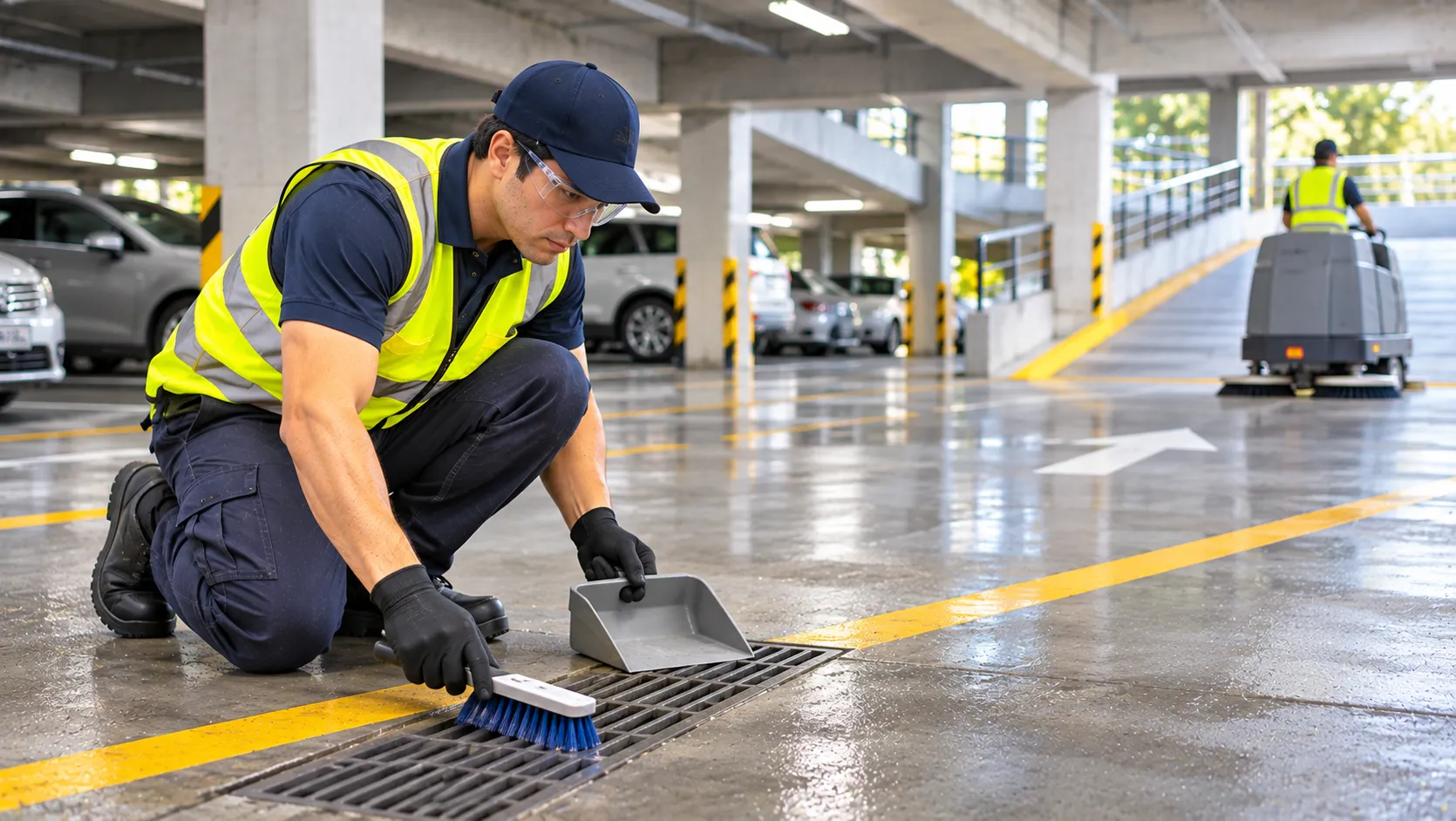
Quick Answer: How Do You Maintain a Multi-Storey Car Park Long-Term?
Long-term multi-storey car park maintenance requires scheduled mechanical sweeping, periodic surface cleaning, prompt spill removal, drainage management, structural condition monitoring and coordinated preventative maintenance across every parking level.
The most effective maintenance strategies include:
- Regularly sweeping parking bays, ramps and vehicle circulation lanes.
- Removing oil spills and vehicle fluid residues promptly.
- Scheduling suitable mechanical scrubbing and pressure cleaning.
- Keeping drainage grates and surface water pathways clear.
- Monitoring concrete cracks, surface deterioration and water ingress.
- Protecting waterproofing membranes, expansion joints and floor coatings.
- Maintaining pedestrian walkways, stairwells and lift lobbies.
- Keeping parking markings and directional signage visible.
- Coordinating technical inspections of ventilation, lighting and fire protection systems.
- Managing cleaning activities around vehicle movements and peak parking periods.
- Documenting maintenance activities and reviewing recurring service costs.
A preventative maintenance program can reduce avoidable deterioration, improve property presentation and help facility managers control long-term operating expenditure. Routine cleaning must complement, rather than replace, qualified structural and technical maintenance.
Multi-storey car parks are among the most frequently used assets within commercial properties. Shopping centres, hospitals, office complexes, airports, hotels and residential developments depend on parking facilities to provide convenient access for customers, employees, residents and visitors.
Unlike open-air parking areas, multi-storey structures contain interconnected parking decks, access ramps, drainage systems, ventilation equipment, pedestrian routes and structural components that require coordinated maintenance.
Vehicle traffic, moisture, abrasive debris, oil contamination and environmental exposure can gradually affect parking surfaces and building components. If maintenance is delayed, relatively minor housekeeping problems may develop into more expensive corrective work.
Integrating professional car park cleaning services into a wider asset maintenance strategy helps property managers maintain cleaner parking environments while supporting long-term operational performance.
1. Why Preventative Maintenance Matters for Multi-Storey Car Parks
Multi-storey car parks experience repeated vehicle loading, pedestrian movement and environmental exposure throughout their operational life. Maintenance requirements extend beyond visible cleanliness because contamination, moisture and physical damage can affect the condition of parking surfaces and associated infrastructure.
A preventative approach focuses on identifying and addressing maintenance requirements before they become more disruptive or expensive.
| Maintenance Area | Risk of Neglect | Preventative Benefit |
|---|---|---|
| Concrete Parking Decks | Contamination and avoidable surface wear | Improved surface condition monitoring |
| Vehicle Ramps | Residue accumulation and reduced traction | Better surface housekeeping |
| Drainage Systems | Water pooling and debris accumulation | Reduced avoidable drainage obstructions |
| Protective Coatings | Surface deterioration and abrasion | Improved protection against unnecessary wear |
| Pedestrian Routes | Litter, contamination and access hazards | Cleaner and more accessible walkways |
| Parking Markings | Reduced visibility | Improved driver navigation |
| Structural Components | Unreported deterioration | Earlier referral for professional assessment |
| Building Services | Unnoticed faults and obstructions | Better coordination of technical maintenance |
Routine cleaning provides opportunities to identify visible defects, although formal inspections must remain the responsibility of appropriately qualified professionals.
2. Develop a Level-by-Level Maintenance Plan
Not every level of a multi-storey car park experiences the same contamination or environmental conditions. Applying an identical cleaning schedule across every deck may result in unnecessary expenditure in low-use areas while overlooking higher-risk locations.
| Parking Level or Area | Typical Maintenance Challenges | Recommended Maintenance Focus |
|---|---|---|
| Basement Levels | Moisture, dust and limited natural ventilation | Dry cleaning, drainage monitoring and ventilation coordination |
| Ground-Level Parking | Tracked-in debris and high vehicle turnover | Frequent sweeping and spot cleaning |
| Intermediate Parking Decks | Tyre residue, grit and vehicle fluid leaks | Scheduled mechanical cleaning |
| Exposed Rooftop Decks | Rainfall, sunlight, leaves and weather exposure | Drainage management and waterproofing condition monitoring |
| Entry and Exit Ramps | Concentrated traffic and tyre deposits | Targeted cleaning and surface condition checks |
| Pedestrian Transition Areas | Tracked-in dirt and frequent foot traffic | Regular floor cleaning and litter removal |
| EV Charging Areas | Electrical infrastructure and access restrictions | Approved low-moisture environmental cleaning |
| Accessible Parking Areas | Access aisle obstructions and surface contamination | Clear routes and prompt hazard removal |
Facility managers should maintain a documented floor plan identifying cleaning zones, drainage locations, sensitive infrastructure and restricted access areas.
3. Schedule Regular Mechanical Sweeping
Mechanical sweeping is an important component of routine multi-storey car park maintenance. Suitable powered sweeping equipment collects loose debris more efficiently across larger accessible parking areas than relying exclusively on manual cleaning.
Regular sweeping helps remove:
- Sand and abrasive grit.
- Loose road sediment.
- Leaves and organic debris.
- Discarded packaging and general litter.
- Small stones within equipment collection limits.
- Ordinary surface dust using suitable filtration.
- Loose materials accumulating around kerbs and parking bays.
| Sweeping Method | Best Application | Maintenance Advantage |
|---|---|---|
| Ride-On Mechanical Sweeping | Large accessible parking decks | Efficient broad-area debris collection |
| Walk-Behind Sweeping | Smaller parking areas and restricted spaces | Improved manoeuvrability |
| Manual Sweeping | Columns, corners and wheel stops | Detailed cleaning coverage |
| Vacuum-Assisted Sweeping | Suitable dusty environments | Improved collection of ordinary fine debris |
| Targeted Litter Collection | Stairwells and pedestrian access points | Improved presentation between scheduled services |
Equipment must be compatible with parking deck load limits, ceiling clearances, ramp gradients, ventilation conditions and protective surface finishes.
4. Use Mechanical Scrubbing for Adhered Surface Contamination
Sweeping removes loose debris but cannot effectively address every form of contamination. Vehicle traffic can leave adhered grime, tyre residue and oily surface films that require additional treatment.
Mechanical floor scrubbing combines controlled cleaning solution, agitation and wastewater recovery using suitable equipment.
| Surface Problem | Typical Cause | Maintenance Approach |
|---|---|---|
| Traffic Film | Repeated vehicle movement | Compatible mechanical scrubbing |
| Adhered Dirt | Compacted debris and moisture | Controlled surface agitation |
| Light Oily Residue | Minor vehicle contamination | Approved degreasing and recovery |
| Tyre Deposits | Braking and turning movements | Surface-compatible targeted treatment |
| Pedestrian Dirt | Tracked-in external contamination | Scheduled hard-floor cleaning |
| Protective Coating Contamination | Accumulated traffic residue | Manufacturer-compatible cleaning |
Scrubbing pads, brushes and chemical concentrations should be selected according to the floor finish. Aggressive treatment can damage protective coatings and create additional maintenance costs.
5. Schedule Periodic Pressure Cleaning Where Appropriate
Pressure cleaning can help remove embedded dirt, persistent grime and appropriately treated stains from compatible car park surfaces.
However, pressure washing is not suitable for every multi-storey parking deck. Elevated structures may contain waterproofing membranes, expansion joints, electrical infrastructure and protective coatings that require specific restrictions.
| Car Park Surface | Pressure Cleaning Suitability | Important Consideration |
|---|---|---|
| Sound Unsealed Concrete | May be suitable | Adjust treatment to concrete condition |
| Sealed Concrete | Conditional | Protect sealant integrity |
| Epoxy-Coated Parking Decks | Conditional | Follow coating manufacturer instructions |
| Waterproofed Rooftop Decks | Requires specific approval | Avoid membrane damage and water penetration |
| Damaged Concrete | Assessment required | Avoid worsening deterioration |
| Expansion Joints | Restricted | Prevent damage to joint sealants |
| Painted Parking Markings | Conditional | Prevent paint removal |
| Electrical Equipment Areas | Restricted | Prevent spray, mist and runoff exposure |
Professional commercial pressure cleaning services can complement routine sweeping and scrubbing when the surface condition, drainage arrangements and building systems permit wet cleaning.
6. Remove Oil Spills Before They Become Persistent Stains
Vehicle fluid leaks are a recurring maintenance challenge in commercial car parks. Oil can penetrate porous concrete, accumulate within surface imperfections and attract additional dirt.
Prompt spill management helps limit contamination spread and may reduce the effort required for subsequent stain treatment.
| Contamination Type | Primary Concern | Recommended Response |
|---|---|---|
| Fresh Engine Oil | Slip hazard and surface penetration | Prompt approved spill containment and recovery |
| Old Oil Stains | Embedded contamination | Compatible targeted degreasing |
| Transmission Fluid | Residue spreading across surfaces | Approved fluid recovery and cleaning |
| Coolant | Chemical contamination and slippery surfaces | Follow relevant spill procedures |
| Fuel | Fire and environmental hazards | Activate applicable emergency spill controls |
| Unidentified Liquid | Unknown chemical or electrical hazards | Restrict access and arrange assessment |
| Suspected Battery Leakage | Potential hazardous chemical exposure | Keep clear and obtain specialist assistance |
Oil spills should not be washed into drainage systems. Contaminated materials and wastewater must be collected and managed under applicable environmental and waste disposal requirements.
7. Protect Concrete Parking Decks from Avoidable Surface Deterioration
Concrete parking decks are exposed to repeated vehicle loading, abrasion, moisture and chemical contamination. Surface condition depends on construction quality, structural design, protective systems and operating conditions.
Cleaning can help manage contamination but cannot correct structural defects or guarantee a longer concrete lifespan.
| Concrete Condition | Potential Concern | Maintenance Response |
|---|---|---|
| Loose Surface Grit | Abrasive exposure | Routine sweeping |
| Oil Penetration | Persistent staining | Prompt compatible stain treatment |
| Surface Dusting | Possible surface deterioration | Report and arrange assessment |
| New or Expanding Cracks | Possible movement or deterioration | Refer for professional evaluation |
| Concrete Spalling | Loss of concrete material | Restrict affected areas where necessary and escalate |
| Exposed Reinforcement | Potential corrosion and structural deterioration | Urgent qualified assessment |
| Persistent Damp Patches | Possible leakage or drainage defects | Investigate through appropriate specialists |
| White Mineral Deposits | Possible moisture movement through concrete | Identify the moisture source before treatment |
Important: Cleaning teams should not attempt to repair structural cracks, exposed reinforcement, loose overhead concrete or other potentially significant defects. These conditions require assessment by qualified building or structural professionals.
8. Monitor Expansion Joints and Movement Joints
Multi-storey car parks contain joints designed to accommodate movement associated with temperature changes, loading and other building conditions.
These joints may incorporate flexible sealants or specialised systems that prevent debris accumulation and limit water penetration.
Maintenance teams should report visible signs such as:
- Missing or deteriorated joint sealants.
- Loose material around joint edges.
- Persistent water leakage beneath joints.
- Debris restricting accessible joint surfaces.
- Damaged concrete adjacent to joints.
- Visible displacement or unusual changes in joint condition.
Cleaning methods must avoid damaging joint systems. High-pressure water, unsuitable chemicals and aggressive mechanical tools should not be applied without specific approval.
9. Maintain Waterproofing Systems and Protective Deck Coatings
Waterproofing membranes and traffic-bearing coatings help protect selected parking structures against environmental exposure and moisture penetration.
These systems may be particularly important on exposed rooftop parking decks and floors situated above occupied buildings.
| Protective System | Maintenance Objective | Cleaning Consideration |
|---|---|---|
| Concrete Sealer | Reduce surface absorption | Avoid incompatible chemicals |
| Epoxy Coating | Protect and finish concrete surfaces | Use suitable pads and brushes |
| Polyurethane Traffic Coating | Protect selected traffic-bearing surfaces | Follow manufacturer cleaning restrictions |
| Waterproofing Membrane | Limit water penetration | Avoid puncture and aggressive cleaning |
| Anti-Slip Surface Finish | Support specified traction characteristics | Prevent residue buildup and surface damage |
| Joint Sealant System | Accommodate movement and protect joints | Avoid damaging flexible materials |
Signs of coating peeling, blistering, cracking or persistent leakage should be documented and referred to the appropriate maintenance contractor.
10. Keep Drainage Systems and Surface Water Pathways Clear
Drainage problems can affect multiple levels of a parking structure. Water that accumulates on one deck may contribute to leakage, staining or maintenance concerns on the levels below.
Routine housekeeping helps prevent loose debris from accumulating around accessible drainage points.
| Drainage Component | Common Problem | Maintenance Requirement |
|---|---|---|
| Surface Drainage Grates | Leaves and litter accumulation | Routine accessible debris removal |
| Linear Drainage Channels | Sediment buildup | Scheduled cleaning and inspection |
| Stormwater Outlets | Debris obstruction | Appropriate drainage maintenance |
| Rooftop Drainage Points | Weather-related contamination | Regular checks and post-weather inspections |
| Basement Sumps | Sediment and equipment faults | Specialist assessment and servicing |
| Drainage Pumps | Mechanical or electrical failure | Qualified technical maintenance |
| Oil-Water Separators | Accumulated contaminated material | Approved specialist servicing |
Cleaning contractors can manage accessible surface debris within their approved scope. Internal pipe blockages, sump entry, pump repairs and specialist wastewater system servicing require separate arrangements.
11. Prioritise Vehicle Ramps and High-Traffic Corners
Entry ramps, exit ramps and turning areas experience concentrated tyre contact, braking forces and vehicle manoeuvring.
These areas may accumulate more rubber residue, grit and vehicle fluids than standard parking bays.
| High-Traffic Area | Typical Maintenance Concern | Recommended Action |
|---|---|---|
| Entry Ramps | Tracked-in road debris | Frequent sweeping |
| Exit Ramps | Tyre deposits and surface residue | Targeted cleaning |
| Sharp Turning Areas | Concentrated rubber marks | Compatible stain treatment |
| Payment Gate Approaches | Repeated stopping and vehicle leaks | Regular inspection and spot cleaning |
| Speed Hump Areas | Accumulated grit and obscured markings | Manual detailing and surface cleaning |
| Ramp Drainage Channels | Collected sediment and runoff | Regular accessible debris removal |
Cleaning machinery must remain within manufacturer-approved operating gradient limits. Ramp closures and traffic restrictions should be coordinated before maintenance begins.
12. Maintain Parking Markings and Directional Signage
Clear parking markings help drivers navigate complex parking structures and identify designated bays, pedestrian crossings, traffic directions and restricted areas.
Accumulated grime may obscure markings before repainting is actually necessary. Compatible cleaning can improve visibility where the underlying coating remains intact.
| Marking or Signage | Purpose | Maintenance Focus |
|---|---|---|
| Parking Bay Lines | Define parking spaces | Maintain visibility and report fading |
| Directional Arrows | Guide vehicle movement | Remove obscuring contamination |
| Pedestrian Crossings | Identify crossing locations | Maintain clear surface markings |
| Accessible Parking Symbols | Identify designated accessible bays | Maintain legibility and clear access |
| EV Charging Markings | Identify charging areas | Use compatible cleaning methods |
| Fire Access Markings | Identify restricted emergency areas | Keep visible and unobstructed |
| Height Restriction Signs | Communicate vehicle clearance limits | Protect visibility and report damage |
| Parking Level Signs | Assist visitor navigation | Remove dust and visible marks |
Cleaning does not replace repainting, traffic engineering reviews or accessibility assessments where markings no longer meet operational requirements.
13. Maintain Pedestrian Walkways, Stairwells and Lift Lobbies
Visitors often form their first impression of a commercial property before entering its main building. Parking facilities, pedestrian routes and lift lobbies strongly influence the overall arrival experience.
These areas require a different cleaning approach from broad vehicle parking decks.
| Pedestrian Area | Typical Cleaning Requirement | Maintenance Priority |
|---|---|---|
| Pedestrian Walkways | Sweeping and compatible surface cleaning | Clear access routes |
| Stairwells | Step cleaning and litter removal | Maintain unobstructed access |
| Handrails | Approved surface wiping | Routine touchpoint maintenance |
| Lift Lobbies | Hard-floor and surface cleaning | Professional presentation |
| Lift Interiors | Approved interior cleaning | Clean frequently contacted surfaces |
| Accessible Routes | Debris removal and surface maintenance | Unrestricted access |
| Emergency Exits | Housekeeping around escape routes | Maintain clear egress |
| Building Entrances | Entrance mat and floor maintenance | Reduce tracked-in contamination |
Coordinating parking facility maintenance with existing commercial cleaning services helps maintain consistent presentation across external and internal property areas.
14. Manage Dust and Air Quality in Enclosed Car Parks
Basement and enclosed parking levels may accumulate traffic-related dust and fine particles where natural ventilation is limited.
Cleaning methods that redistribute dust can create unnecessary exposure for workers and visitors. Suitable collection equipment and appropriate ventilation arrangements should be considered.
| Contamination or Air Quality Concern | Potential Source | Management Approach |
|---|---|---|
| Ordinary Surface Dust | Vehicle traffic and tracked-in particles | Suitable filtered collection equipment |
| Road Grit | Vehicle tyres and outdoor surfaces | Scheduled sweeping |
| Tyre and Brake-Related Particles | Vehicle movement | Risk-assessed collection methods |
| Combustion Exhaust | Vehicles and engine-powered equipment | Ventilation management and suitable equipment selection |
| Chemical Vapours | Cleaning products and spills | Product selection and exposure controls |
| Suspected Hazardous Dust | Construction activity or building deterioration | Specialist assessment before cleaning |
Battery-powered machinery may be appropriate for selected enclosed environments because it produces no combustion exhaust at the point of operation.
Cleaning does not replace ventilation testing, carbon monoxide monitoring or the technical servicing of mechanical ventilation systems. These activities must be arranged separately.
15. Coordinate Lighting, Ventilation and Fire Safety Maintenance
Multi-storey car parks rely on building systems that support safe operation. Routine cleaning teams may identify visible defects or obstructions, but technical maintenance must remain within authorised professional scopes.
| Building System | Cleaning Team Responsibility | Technical Maintenance Responsibility |
|---|---|---|
| Lighting | Report visibly failed or damaged fittings | Electrical inspections and repairs |
| Emergency Lighting | Keep surrounding areas clear | Required testing and servicing |
| Ventilation Grilles | Approved accessible external cleaning | Internal system maintenance and performance testing |
| Carbon Monoxide Sensors | Report visible damage or obstruction | Calibration, testing and servicing |
| Fire Extinguishers | Maintain clear surrounding access | Inspection and servicing |
| Fire Sprinklers | Avoid interference and report visible damage | Qualified fire protection maintenance |
| Security Cameras | Report visible obstruction or damage | Authorised technical servicing |
| Parking Barriers | Clean approved surrounding surfaces | Mechanical and electrical servicing |
| EV Charging Equipment | Maintain approved surrounding areas | Authorised electrical maintenance |
Building owners should establish separate technical inspection schedules based on applicable legal obligations, building requirements and manufacturer instructions.
16. Protect EV Charging Infrastructure During Car Park Cleaning
Electric vehicle charging facilities introduce additional electrical and operational considerations within multi-storey parking structures.
Cleaning teams should:
- Avoid direct water spray towards charging equipment.
- Maintain approved machinery clearances.
- Prevent sweeping brushes from contacting charging cables.
- Use manufacturer-approved methods for authorised external surfaces.
- Coordinate charging bay access with the infrastructure operator.
- Report damaged cables, enclosures and charging pedestals.
- Prevent cleaning water from accumulating around electrical equipment.
- Refer electrical faults and technical maintenance to authorised personnel.
Where equipment-specific instructions are unavailable, general cleaning should remain limited to approved surrounding non-electrical areas.
17. Remove Chewing Gum, Graffiti and Persistent Surface Marks
Publicly accessible parking structures can accumulate more than ordinary vehicle-related contamination. Chewing gum, graffiti, adhesive residues and other persistent marks can affect property presentation.
| Surface Contaminant | Common Location | Recommended Treatment |
|---|---|---|
| Chewing Gum | Walkways and lift entrances | Surface-compatible localised removal |
| Graffiti | Walls, columns and stairwells | Compatible specialist treatment |
| Adhesive Residue | Signs and painted surfaces | Approved adhesive removal |
| Rubber Scuff Marks | Walls and vehicle turning areas | Compatible targeted cleaning |
| Organic Growth | Damp external surfaces | Appropriate surface treatment and moisture investigation |
| Mineral Staining | Water-affected concrete | Identify the underlying moisture source |
Prompt treatment may help prevent contamination from becoming increasingly difficult to remove. Cleaning methods must remain compatible with paint, concrete, coatings and adjacent infrastructure.
18. Adjust Maintenance for Australian Weather and Environmental Conditions
Local environmental conditions influence car park maintenance requirements across Australia. Coastal properties, tropical regions and dry inland environments may experience different contamination and moisture patterns.
| Environmental Condition | Potential Maintenance Challenge | Recommended Adjustment |
|---|---|---|
| Coastal Conditions | Salt deposition and corrosion concerns | Approved surface cleaning and corrosion monitoring |
| Heavy Rainfall | Runoff, sediment and water pooling | Increased drainage checks |
| Dry and Windy Conditions | Dust and loose debris accumulation | Adjust sweeping frequency |
| High Humidity | Persistent moisture and organic growth | Investigate moisture sources and review cleaning needs |
| Intense Sun Exposure | Weathering of exposed coatings | Coordinate protective coating inspections |
| Seasonal Leaf Fall | Debris around drainage points | Increase targeted collection |
| Severe Storms | Flooding, debris and possible infrastructure damage | Arrange safe post-event assessment |
Environmental exposure should be incorporated into the property's overall asset maintenance plan rather than addressed only after visible deterioration occurs.
19. Maintain Car Parks Without Disrupting Daily Operations
Commercial parking facilities often operate during extended hours. Closing an entire structure for routine maintenance may be impractical, particularly at shopping centres, hospitals and transport facilities.
Sequential cleaning allows property managers to maintain designated sections while retaining access to unaffected areas where this can be achieved safely.
| Maintenance Strategy | Suitable Application | Operational Benefit |
|---|---|---|
| Level-by-Level Cleaning | Large multi-storey facilities | Limits closure to selected levels |
| Zone-Based Cleaning | Large individual parking decks | Supports phased maintenance |
| Early Morning Servicing | Retail and office buildings | Reduced parking occupancy |
| After-Hours Servicing | Commercial properties | Improved access to parking bays |
| Scheduled Ramp Closures | Targeted ramp cleaning | Controlled access during maintenance |
| Condition-Based Spot Cleaning | Localised contamination | Avoids unnecessary broad-area closures |
| Combined Maintenance Windows | Properties requiring multiple contractors | Coordinates cleaning and technical servicing |
Emergency access, pedestrian escape routes, accessible parking arrangements and vehicle circulation must remain adequately managed throughout the cleaning operation.
20. Implement Safe Traffic Management During Cleaning
Cleaning personnel working inside operational car parks face risks from moving vehicles, reversing movements, restricted sightlines and powered cleaning equipment.
Facility managers and contractors should coordinate traffic management arrangements according to applicable Australian WHS or OHS requirements.
| Operational Hazard | Potential Consequence | Recommended Control |
|---|---|---|
| Moving Vehicles | Worker or pedestrian collision | Separate cleaning activities from vehicle traffic |
| Blind Corners | Reduced visibility | Establish approved access restrictions |
| Reversing Vehicles | Unexpected vehicle movement | Coordinate work zones and traffic controls |
| Powered Sweepers | Collision with people or infrastructure | Competent operators and suitable exclusion areas |
| Wet Parking Surfaces | Slipping or reduced traction | Control moisture and restrict affected areas |
| Steep Ramps | Machinery instability | Confirm equipment suitability and gradient limits |
| Restricted Ceiling Heights | Equipment impact | Check machinery clearance |
| Electrical Infrastructure | Electrical exposure | Follow approved electrical hazard controls |
| Open Deck Edges | Fall hazards | Maintain protective barriers and approved work boundaries |
Additional guidance is available from Safe Work Australia's workplace traffic management resources.
21. Select Cleaning Equipment Suitable for Multi-Storey Structures
Large cleaning machines may offer high productivity on open parking surfaces but be unsuitable for certain multi-storey structures.
Equipment selection should account for structural loading, access restrictions and the physical characteristics of each parking level.
| Equipment Specification | Why It Matters |
|---|---|
| Operating Weight | Must remain compatible with approved deck loading limits |
| Wheel and Axle Loads | Relevant to concentrated loads on elevated structures |
| Machine Height | Determines compatibility with overhead clearances |
| Turning Radius | Affects manoeuvrability around columns |
| Ramp Capability | Determines safe operation on gradients |
| Brush and Pad Material | Influences protective surface compatibility |
| Dust Filtration | Supports appropriate ordinary dust collection |
| Power Source | Affects emissions and ventilation considerations |
| Wastewater Recovery | Supports controlled wet cleaning |
| Operating Noise | May affect nearby occupants |
Equipment should not be introduced onto elevated parking decks without confirming applicable load restrictions and access requirements. Where restrictions are uncertain, obtain appropriate engineering or building management confirmation.
22. Establish a Preventative Cleaning and Maintenance Schedule
A documented schedule helps facility managers allocate resources, coordinate contractors and identify recurring maintenance requirements.
| Maintenance Activity | Illustrative Frequency | Responsible Team |
|---|---|---|
| General Litter Removal | Daily or as required | Cleaning team |
| Visual Hazard Checks | Each operating day | Site and cleaning personnel |
| Oil Spill Response | As identified | Authorised spill response personnel |
| Mechanical Sweeping | Daily to weekly, depending on usage | Cleaning contractor |
| Stairwell and Lift Lobby Cleaning | Daily to weekly | Cleaning contractor |
| Manual Edge Detailing | Weekly or as required | Cleaning contractor |
| Accessible Drainage Grate Cleaning | Weekly and after significant weather events | Approved maintenance personnel |
| Mechanical Floor Scrubbing | Weekly to monthly, based on condition | Cleaning contractor |
| Parking Marking Condition Review | Monthly | Facility management |
| Visible Surface Condition Review | Monthly | Facility management |
| Compatible Pressure Cleaning | Quarterly to annually, where required | Cleaning contractor |
| Waterproofing Condition Assessment | According to asset maintenance plan | Qualified specialist |
| Structural Inspection | According to professional recommendations | Qualified structural professional |
| Fire Protection System Servicing | According to applicable requirements | Fire protection specialist |
| Electrical and Ventilation Servicing | According to applicable requirements | Qualified technical personnel |
| Maintenance Budget Review | Annually | Property and facility management |
Maintenance frequency: These cleaning intervals are illustrative planning recommendations rather than mandatory Australian maintenance standards. Actual frequencies should reflect parking occupancy, contamination levels, site risks, contractual requirements and professional technical advice.
23. Recognise Warning Signs Before Maintenance Problems Escalate
Routine observations can help property managers identify conditions that warrant further investigation. Maintenance teams should document visible changes without attempting to diagnose structural or technical faults.
| Warning Sign | Possible Concern | Required Response |
|---|---|---|
| Recurring Water Pooling | Drainage or surface gradient issues | Arrange drainage and surface assessment |
| Water Dripping Between Levels | Possible waterproofing or drainage defects | Refer to building maintenance specialists |
| New or Widening Concrete Cracks | Potential movement or deterioration | Qualified structural evaluation |
| Loose Overhead Concrete | Falling material hazard | Restrict access and obtain urgent assessment |
| Exposed Reinforcing Steel | Potential structural deterioration | Escalate for qualified assessment |
| Rust-Coloured Staining | Possible corrosion-related condition | Investigate through appropriate specialists |
| Peeling Floor Coatings | Protective system deterioration | Arrange coating assessment |
| Persistent Musty Odours | Possible moisture or organic contamination | Investigate underlying conditions |
| Damaged Vehicle Barriers | Reduced protective function | Restrict affected access and arrange assessment |
| Obstructed Emergency Routes | Restricted emergency access | Escalate and restore clear access safely |
| Damaged Electrical Equipment | Potential electrical hazard | Keep clear and arrange authorised assessment |
| Repeated Drainage Overflow | Possible system capacity or blockage issue | Arrange specialist drainage investigation |
Where there is a suspected immediate safety risk, routine cleaning must stop in the affected area until appropriate assessment and controls are established.
24. Compare Preventative Maintenance with Reactive Maintenance
Reactive maintenance addresses problems after contamination, deterioration or operational failures become evident. Preventative maintenance uses scheduled activities and condition monitoring to reduce avoidable problems.
| Maintenance Factor | Reactive Approach | Preventative Approach |
|---|---|---|
| Cleaning Schedule | Triggered by complaints or visible contamination | Based on planned inspections and usage |
| Oil Contamination | Treated after staining develops | Prompt spill recovery |
| Drainage Maintenance | Responds after overflow or blockage | Routine debris control and inspections |
| Surface Condition | Damage addressed after deterioration | Changes monitored and reported |
| Operational Disruption | May require unexpected closures | Scheduled maintenance windows |
| Budget Planning | Variable unplanned expenditure | More predictable recurring costs |
| Contractor Mobilisation | Urgent callouts may be necessary | Coordinated routine servicing |
| Property Presentation | Potentially inconsistent | Defined ongoing presentation standards |
A combined strategy remains necessary because preventative maintenance cannot eliminate every unexpected failure. However, planned cleaning can help reduce avoidable corrective work.
25. How Preventative Maintenance Can Reduce Annual Car Park Costs
Evaluating long-term maintenance expenditure requires more than comparing individual cleaning quotations. Facility managers should consider recurring cleaning, corrective treatments, emergency callouts and operational interruptions.
The following hypothetical example illustrates how increasing planned cleaning expenditure could reduce overall maintenance costs if it also reduces unnecessary corrective work.
| Annual Expense | Reactive-Focused Program | Preventative-Focused Program |
|---|---|---|
| Routine Sweeping | $12,000 | $18,000 |
| Scheduled Floor Scrubbing | $4,000 | $7,000 |
| Corrective Deep Cleaning | $14,000 | $5,000 |
| Emergency Cleaning Callouts | $6,000 | $2,000 |
| Drainage-Related Debris Removal | $5,000 | $2,500 |
| Additional Stain Treatments | $4,500 | $1,500 |
| Total Annual Expenditure | $45,500 | $36,000 |
| Illustrative Annual Savings | $9,500 | |
| Illustrative Cost Reduction | 20.9% | |
| Illustrative Five-Year Savings | $47,500 | |
Cost example: All figures are hypothetical Australian dollar amounts excluding GST. They are not Corporate Cleaning Services® quotations, actual customer results or guaranteed savings. The five-year calculation assumes unchanged annual costs and excludes inflation, financing costs, major structural repairs and changes in operating conditions.
Actual financial benefits should be assessed using property-specific service records and comparable maintenance scopes.
26. Reduce Environmental Impact Through Better Cleaning Practices
Multi-storey car park cleaning can generate collected sediment, solid waste and contaminated wastewater. Effective planning helps minimise unnecessary resource consumption while managing environmental risks.
| Maintenance Practice | Potential Environmental Benefit |
|---|---|
| Dry Mechanical Sweeping | Reduces unnecessary water-based cleaning |
| Targeted Spot Cleaning | Limits treatment to affected surfaces |
| Controlled Mechanical Scrubbing | Supports measured cleaning solution application |
| Wastewater Recovery | Helps prevent uncontrolled contaminated discharge |
| Correct Chemical Dilution | Reduces unnecessary product consumption |
| Regular Drainage-Area Cleaning | Limits loose debris migration |
| Appropriate Equipment Selection | May reduce emissions and unnecessary energy consumption |
| Condition-Based Maintenance | Helps avoid unnecessary cleaning treatments |
Cleaning wastewater must not be automatically discharged into stormwater systems. Disposal arrangements should be established according to local environmental requirements, trade waste conditions and the contamination involved.
27. Common Maintenance Mistakes That Increase Long-Term Costs
| Maintenance Mistake | Potential Consequence | Recommended Alternative |
|---|---|---|
| Ignoring Routine Sweeping | Excessive debris accumulation | Implement condition-based sweeping schedules |
| Using Excessive Pressure | Damage to coatings and joints | Select surface-compatible methods |
| Allowing Oil Spills to Remain | Persistent staining and contamination spread | Prompt approved spill recovery |
| Neglecting Rooftop Drainage | Water pooling and possible leakage | Routine drainage-area inspections |
| Ignoring Concrete Damage | Unaddressed deterioration | Refer defects for qualified assessment |
| Using Incompatible Chemicals | Protective finish damage | Confirm material compatibility |
| Operating Unsuitable Machinery | Equipment, surface or structural loading concerns | Assess equipment specifications |
| Cleaning During Peak Traffic | Safety risks and incomplete coverage | Coordinate maintenance windows |
| Overlooking Pedestrian Areas | Inconsistent presentation and access hazards | Include walkways and stairwells in the cleaning scope |
| Ignoring Drainage and Wastewater Controls | Environmental contamination | Establish approved recovery procedures |
| Failing to Document Defects | Delayed corrective action | Maintain inspection and reporting records |
| Selecting Contractors on Price Alone | Incomplete service or inadequate methods | Compare scope, competence and service quality |
28. Establish a Long-Term Asset Maintenance Plan
Multi-storey parking structures benefit from a maintenance plan that extends beyond routine monthly cleaning. Property managers should identify anticipated service requirements, technical assessments and longer-term capital expenditure.
| Planning Period | Maintenance Focus |
|---|---|
| Daily and Weekly | Housekeeping, spill response, sweeping and access inspections |
| Monthly | Surface condition reviews, targeted scrubbing and service quality checks |
| Quarterly | Review contamination hotspots, drainage conditions and deep-cleaning requirements |
| Annually | Review service contracts, maintenance costs and asset condition priorities |
| One to Three Years | Budget for identified surface treatments, markings and protective system maintenance |
| Three to Five Years | Review anticipated capital maintenance and refurbishment requirements |
| Longer-Term Planning | Coordinate engineering advice, structural assessments and major asset renewal |
These planning horizons are examples, not prescribed replacement or inspection intervals. Actual technical work should follow the property's asset condition, statutory obligations and professional recommendations.
29. Measure Cleaning and Maintenance Performance
Facility managers can evaluate maintenance effectiveness using documented performance indicators rather than relying exclusively on visual impressions or individual service prices.
| Performance Indicator | Measurement Method | Management Benefit |
|---|---|---|
| Cleaning Completion Rate | Completed visits against scheduled services | Measures service reliability |
| Cleaning Cost Per Square Metre | Total cleaning expenditure divided by serviced area | Compares cost efficiency |
| Emergency Cleaning Callouts | Number and cost of unscheduled visits | Identifies reactive maintenance demand |
| Drainage-Related Incidents | Recorded obstructions and overflow events | Highlights recurring problems |
| Spill Response Time | Time between reporting and authorised response | Supports hazard management |
| Cleaning Quality | Post-service inspection results | Maintains agreed presentation standards |
| Defect Reporting | Recorded observations and escalation history | Supports asset condition monitoring |
| Parking Bay Closure Time | Duration of maintenance-related access restrictions | Improves operational planning |
| Customer Complaints | Recorded cleanliness-related feedback | Identifies service improvement opportunities |
| Annual Maintenance Expenditure | Total planned and corrective maintenance costs | Supports long-term budgeting |
Performance comparisons should account for changes in visitor numbers, cleaning coverage, property occupancy and environmental conditions.
30. Multi-Storey Car Park Maintenance Checklist
Property owners and facility managers can use the following checklist when developing a site-specific maintenance program.
| Maintenance Requirement | Complete |
|---|---|
| Document all parking levels and maintenance zones. | ? |
| Identify parking deck surface materials and finishes. | ? |
| Confirm equipment weight and structural loading restrictions. | ? |
| Confirm equipment height and ramp compatibility. | ? |
| Establish routine mechanical sweeping schedules. | ? |
| Include manual cleaning around columns and corners. | ? |
| Schedule compatible floor scrubbing. | ? |
| Assess pressure cleaning suitability. | ? |
| Implement approved spill response procedures. | ? |
| Inspect accessible drainage grate surroundings. | ? |
| Arrange specialist drainage servicing where required. | ? |
| Report persistent water pooling and leakage. | ? |
| Document visible concrete defects. | ? |
| Arrange qualified structural inspections. | ? |
| Monitor visible expansion joint conditions. | ? |
| Protect waterproofing systems during cleaning. | ? |
| Review parking markings and directional signage. | ? |
| Maintain pedestrian walkways and accessible routes. | ? |
| Include stairwells and lift lobbies in the cleaning scope. | ? |
| Maintain clear emergency exit routes. | ? |
| Coordinate lighting and ventilation maintenance. | ? |
| Arrange required fire protection system servicing. | ? |
| Establish EV charging equipment protection procedures. | ? |
| Implement appropriate traffic management controls. | ? |
| Establish approved wastewater recovery arrangements. | ? |
| Schedule cleaning during suitable occupancy periods. | ? |
| Maintain records of cleaning activities and incidents. | ? |
| Review recurring maintenance expenditure. | ? |
| Evaluate contractor performance regularly. | ? |
| Update the long-term asset maintenance plan. | ? |
31. What Determines Multi-Storey Car Park Cleaning Costs?
Cleaning costs vary according to the size, complexity and condition of the parking structure. A multi-level basement facility may require different equipment and operational arrangements from a large open-air parking deck.
| Pricing Factor | Influence on Service Cost |
|---|---|
| Total Parking Area | Determines required cleaning coverage |
| Number of Parking Levels | Affects equipment movement and mobilisation |
| Vehicle Occupancy | Influences cleaning access and productivity |
| Ramp and Access Restrictions | May limit equipment options |
| Surface Condition | Determines required cleaning methods |
| Contamination Levels | Affects labour, product and disposal requirements |
| Cleaning Frequency | Determines recurring service expenditure |
| After-Hours Requirements | May influence labour costs |
| Traffic Management | May require additional personnel or access controls |
| Wastewater Recovery | Influences equipment and disposal costs |
| Protective Surface Restrictions | May require specialised cleaning methods |
| Additional Stain Treatments | Increases targeted cleaning requirements |
A site-specific quotation should identify routine cleaning inclusions, periodic treatments, access arrangements and any separately priced corrective services.
32. Choosing a Professional Multi-Storey Car Park Cleaning Contractor
Long-term maintenance arrangements should be based on the contractor's ability to deliver consistent cleaning while respecting the property's operational, structural and environmental requirements.
| Contractor Selection Criteria | What Property Managers Should Verify |
|---|---|
| Commercial Car Park Experience | Experience with comparable parking facilities |
| Equipment Suitability | Machinery compatible with site restrictions |
| Surface Cleaning Knowledge | Understanding of concrete, coatings and protective finishes |
| Traffic Management Procedures | Methods for separating cleaning activities from vehicles |
| Worker Competency | Appropriate training and machinery operation procedures |
| Environmental Controls | Responsible chemical, waste and wastewater management |
| Maintenance Scheduling | Ability to coordinate services around property operations |
| Hazard Reporting | Clear procedures for escalating visible defects |
| Quality Assurance | Documented inspections and corrective processes |
| Insurance | Relevant and current insurance coverage |
| Service Documentation | Clear reporting of completed maintenance activities |
| Long-Term Contract Flexibility | Ability to adjust services based on actual site conditions |
Professional cleaning should form part of a coordinated maintenance strategy that includes building management, structural professionals, electrical contractors, drainage specialists and fire protection service providers.
Frequently Asked Questions About Multi-Storey Car Park Maintenance
How often should a multi-storey car park be cleaned?
Busy commercial car parks may require daily housekeeping and mechanical sweeping several times per week. Lower-traffic facilities may require weekly or condition-based cleaning, depending on contamination levels and operational requirements.
What is the best way to maintain a multi-storey car park?
Combine routine mechanical sweeping, prompt spill removal, compatible surface cleaning, drainage management, defect reporting and professionally coordinated technical maintenance.
How can preventative maintenance reduce car park operating costs?
Preventative maintenance can reduce unnecessary corrective cleaning, emergency callouts and contamination accumulation. Actual savings depend on the property, service scope and operating conditions.
Can multi-storey car parks be pressure washed?
Yes, where the surface condition, waterproofing system, drainage arrangements and nearby infrastructure permit pressure cleaning. Not every parking deck is suitable for high-pressure treatment.
How often should car park concrete be pressure cleaned?
Frequency should be based on surface contamination, material compatibility and maintenance requirements. Periodic deep cleaning may be appropriate, but there is no universal interval suitable for every property.
Does mechanical sweeping help protect concrete?
Mechanical sweeping removes loose grit and abrasive debris, helping reduce unnecessary surface exposure. It does not prevent every form of concrete deterioration or replace structural maintenance.
What causes concrete deterioration in multi-storey car parks?
Potential contributing factors include environmental exposure, moisture penetration, reinforcement corrosion, repeated loading, material deterioration and defects in protective systems. Qualified assessment is required to determine the cause.
What should property managers do about cracks in parking decks?
Document visible cracks and refer them for appropriate professional assessment. New, widening or otherwise concerning cracks should not be treated as routine cleaning issues.
How can water pooling in car parks be prevented?
Routine debris removal around drainage points can help reduce avoidable obstructions. Persistent pooling may require investigation of drainage capacity, surface gradients, waterproofing or other building conditions.
Can cleaning improve the lifespan of car park coatings?
Compatible cleaning can reduce exposure to abrasive particles and persistent contamination. Coating lifespan also depends on installation quality, traffic loading, environmental exposure and manufacturer-recommended maintenance.
How should oil stains be removed from commercial parking decks?
Use approved spill recovery and surface-compatible degreasing methods. Avoid dispersing oil into drainage systems or using chemicals that may damage protective floor finishes.
Why do basement car parks require different cleaning methods?
Basement facilities may have restricted ventilation, limited access, moisture accumulation and lower overhead clearances. Equipment and cleaning methods must address these specific conditions.
Can ride-on sweepers be used on elevated parking decks?
Yes, provided equipment weight, concentrated wheel loads, dimensions and operating conditions are compatible with the property's approved structural and access restrictions.
How can car parks be cleaned without closing the entire building?
Cleaning can be coordinated through sequential level closures, zone-based maintenance and low-occupancy service windows, provided traffic, accessibility and emergency access remain appropriately managed.
What is the difference between car park sweeping and scrubbing?
Sweeping removes loose debris, while mechanical scrubbing addresses selected adhered dirt and surface residues using controlled cleaning solution and agitation.
How should exposed rooftop parking decks be maintained?
Rooftop decks require regular debris collection, drainage checks and appropriate monitoring of protective coatings, waterproofing systems and weather-related deterioration.
Can high-pressure cleaning damage waterproofing membranes?
Yes. Unsuitable pressure, chemicals or cleaning techniques can damage certain waterproofing systems. Follow manufacturer instructions and obtain specialist approval where required.
Who is responsible for structural car park inspections?
Building owners or responsible property managers should arrange inspections with appropriately qualified structural professionals according to applicable obligations and professional recommendations.
Can cleaners maintain car park ventilation systems?
Cleaners may perform authorised external housekeeping around accessible ventilation components. Internal cleaning, performance testing, repairs and technical servicing require appropriately qualified personnel.
How should EV charging areas be cleaned within multi-storey car parks?
Maintain approved surrounding surfaces using methods that prevent water, chemicals and cleaning machinery from contacting sensitive electrical infrastructure. Follow the charging operator's requirements.
Does regular car park cleaning improve safety?
Routine cleaning helps control loose debris, spills and access obstructions. It must be supported by traffic management, appropriate lighting, surface maintenance and other necessary safety controls.
How can facility managers reduce car park cleaning water consumption?
Use dry mechanical sweeping for suitable loose debris, targeted spot cleaning for localised contamination and controlled wet cleaning only where necessary.
What maintenance records should car park managers keep?
Maintain cleaning schedules, service completion records, inspection findings, defect reports, spill response records, contractor documentation and relevant technical maintenance records.
What are the most common multi-storey car park maintenance mistakes?
Common mistakes include delayed spill removal, neglected drainage, incompatible cleaning products, unsuitable pressure washing, insufficient defect reporting and relying entirely on reactive maintenance.