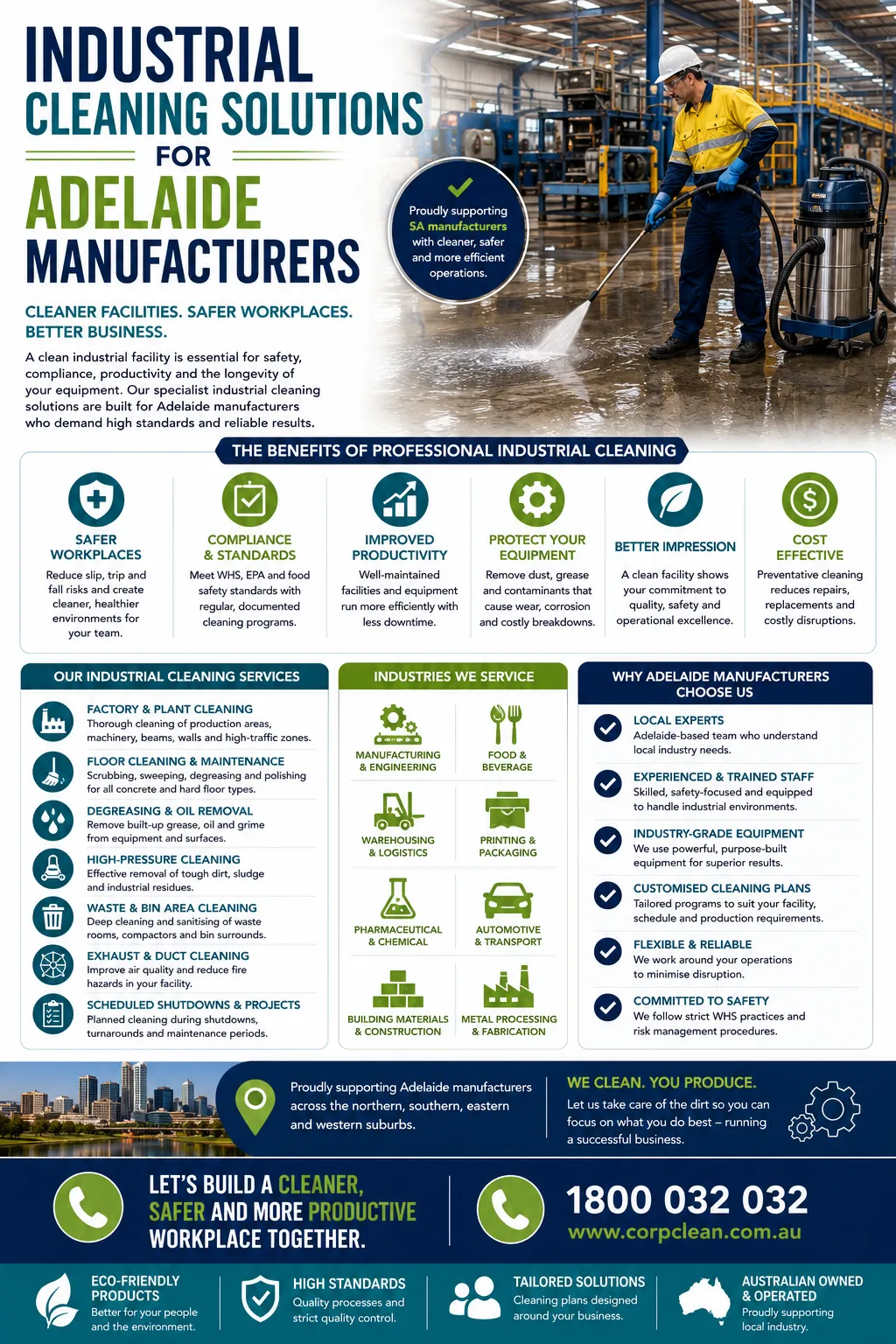
Industrial Cleaning Solutions for Adelaide Manufacturers
10th June 2026
Maintaining a clean manufacturing facility involves far more than improving its appearance. In industrial environments, effective cleaning supports workplace safety, equipment maintenance, product quality, operational efficiency and compliance with site procedures.
Production areas, engineering workshops, warehouses, loading docks, machinery zones and storage facilities can accumulate dust, grease, metal fragments, packaging waste, residues and other contaminants during normal operations. These conditions often require more robust cleaning methods than those used in offices or standard commercial properties.
For Adelaide manufacturers, a tailored industrial cleaning service can help control hazards, protect facility assets and reduce disruption to production. This guide explains what industrial cleaning may include, which areas require specialist attention and how to choose a provider with the experience and safety systems needed for manufacturing environments.
Quick Answer
Industrial cleaning for Adelaide manufacturers commonly includes factory floor scrubbing, degreasing, machinery exterior cleaning, warehouse cleaning, high-level dust removal, loading dock maintenance, spill response and production waste management. The cleaning program should reflect the facility’s processes, contaminants, machinery, flooring, operating hours and safety requirements. Experienced industrial cleaners should complete site inductions, follow documented procedures, use suitable commercial equipment and schedule work around production to minimise downtime.
What Is Industrial Cleaning?
Industrial cleaning refers to specialised cleaning performed in manufacturing plants, workshops, warehouses, processing facilities and other operational environments.
It differs from general commercial cleaning because it may involve:
- Heavy machinery
- Industrial flooring
- Oil and grease
- Production residues
- Fine dust
- Metal fragments
- High-level structures
- Operational hazards
- Restricted work zones
- Specialist chemicals
- Large floor areas
- Shutdown periods
- Site-specific safety controls
The cleaning method must suit both the contaminant and the surface being cleaned. A process that works in an office or retail property may be unsuitable or unsafe in a manufacturing facility.
Why Industrial Cleaning Matters
A poorly maintained industrial site can create operational and safety problems that extend well beyond visible dirt.
Dust, grease, debris and waste may contribute to:
- Slippery floors
- Obstructed walkways
- Reduced visibility around equipment
- Contamination of stored materials
- Difficult equipment inspections
- Poor workplace presentation
- Increased fire loading
- Damage to flooring and finishes
- Reduced employee comfort
- More demanding maintenance work
Routine industrial cleaning helps keep work areas organised and makes it easier to identify leaks, wear, damage and other maintenance concerns before they become more serious.
Supporting Workplace Safety
Manufacturing facilities often contain moving equipment, forklifts, machinery, chemicals, electrical systems and busy pedestrian areas.
Cleanliness supports safety by helping reduce:
- Slip hazards
- Trip hazards
- Waste accumulation
- Dust build-up
- Greasy walkways
- Blocked access routes
- Debris around machinery
- Contamination near workstations
Cleaning does not replace formal risk controls, equipment maintenance or workplace procedures. It forms part of a broader safety and housekeeping system.
Improving Operational Efficiency
An organised and well-maintained facility can support smoother daily operations.
Industrial cleaning may help by:
- Keeping walkways clear
- Reducing debris around work zones
- Making tools and equipment easier to access
- Improving visibility during inspections
- Supporting efficient material movement
- Reducing disruption caused by emergency clean-ups
- Maintaining clean loading and storage areas
When cleaning is planned around production, it becomes part of routine operations rather than an unexpected interruption.
Supporting Product Quality
In some manufacturing environments, cleanliness can directly affect product quality.
Dust, residue, grease, fibres, packaging debris and other contaminants may affect:
- Raw materials
- Finished products
- Packaging areas
- Storage zones
- Assembly areas
- Sensitive components
The required level of cleanliness will vary according to the industry, product, customer requirements and internal quality system.
Facilities producing food, medical products, electronics, precision components or other sensitive goods may require more controlled cleaning procedures than general manufacturing sites.
Common Cleaning Challenges in Manufacturing Facilities
Every industrial facility has different cleaning requirements.
Common challenges include:
- Oil and grease build-up
- Fine production dust
- Metal shavings
- Sawdust
- Carbon residue
- Chemical residue
- Packaging waste
- Pallet debris
- Forklift tyre marks
- Dirty loading zones
- Dust on beams and pipes
- Build-up around equipment bases
- Hard-to-access areas
- Large floor areas
- Restricted production zones
The provider should assess these conditions before recommending equipment, chemicals, staffing or service frequency.
Factory Floor Cleaning
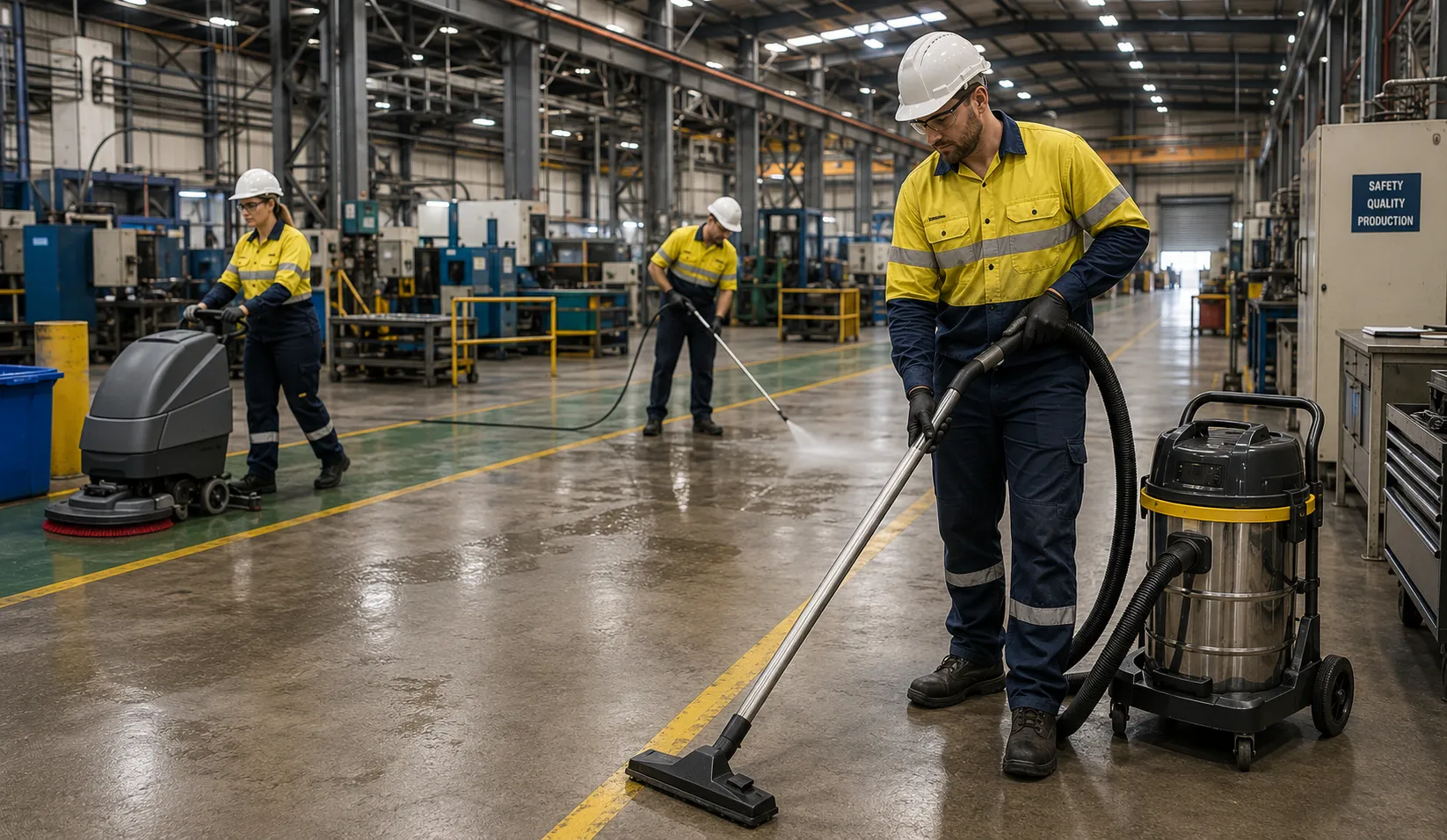
Factory floors are exposed to constant foot traffic, machinery, forklifts, pallets, spills and production debris.
Routine factory floor cleaning may include:
- Sweeping
- Dust control
- Mechanical floor scrubbing
- Degreasing
- Spot cleaning
- Spill removal
- Edge cleaning
- Cleaning around fixed equipment
- Waste collection
The method should suit the floor material and condition.
Common industrial floor surfaces include:
- Sealed concrete
- Unsealed concrete
- Epoxy coatings
- Vinyl
- Tiles
- Resin systems
- Anti-slip flooring
Incorrect chemicals or machinery may damage protective finishes, create residue or reduce slip resistance.
Mechanical Floor Scrubbing
Mechanical scrubbers are often used across large manufacturing and warehouse floors.
Depending on the machine, the process may combine:
- Cleaning solution application
- Mechanical agitation
- Soil removal
- Wastewater collection
- Floor drying
This can be more efficient than manual mopping across large areas.
The provider must consider:
- Floor condition
- Drainage
- Nearby machinery
- Pedestrian traffic
- Chemical compatibility
- Slip risk
- Wastewater disposal
Industrial Degreasing
Grease and oil can accumulate around machinery, maintenance areas, production lines, loading zones and workshop floors.
Industrial degreasing may involve:
- Targeted chemical application
- Agitation
- Mechanical scrubbing
- Controlled rinsing
- Residue recovery
- Drying
The cleaner must select a degreaser suitable for the contaminant and surface. Overly aggressive chemicals can damage coatings, seals, painted surfaces or nearby materials.
Machinery and Equipment Cleaning
Clean equipment is generally easier to inspect, maintain and operate safely.
Machinery cleaning may help remove:
- Dust
- Grease
- Oil residue
- Carbon build-up
- Production residue
- Loose debris
- Cooling system build-up
- Material deposits
The cleaning scope must distinguish between:
- External machinery cleaning
- Cleaning around machinery
- Internal equipment cleaning
- Maintenance cleaning
- Production contact surface cleaning
These tasks may require different personnel, isolation procedures, tools and approvals.
Equipment Isolation and Safety
Machinery should not be cleaned without proper controls.
Depending on the equipment and task, requirements may include:
- Shutdown
- Isolation
- Lockout and tagout
- Electrical safety checks
- Removal of stored energy
- Approval from authorised personnel
- Manufacturer instructions
- Exclusion zones
Cleaning staff should never assume machinery is safe to access merely because it is not operating.
The facility should define who is authorised to isolate equipment and confirm when cleaning may begin.
Cleaning Around Production Lines
Production lines can accumulate dust, fragments, residue and waste in difficult-to-access areas.
Cleaning may involve:
- Under-line vacuuming
- Edge cleaning
- Equipment base cleaning
- Removal of loose debris
- Cleaning guards and accessible surfaces
- Waste collection
- Floor scrubbing around work zones
The service should be scheduled to avoid interfering with production, maintenance or product handling.
Warehouse Cleaning
Warehouses experience constant stock movement, forklift traffic, pallet handling and packaging activity.
Warehouse cleaning may include:
- Floor sweeping
- Mechanical scrubbing
- Dust removal
- Racking exterior cleaning
- Loading dock cleaning
- Spill response
- Waste collection
- Entrance cleaning
- Cleaning around pallet storage
- Traffic lane maintenance
A clean warehouse supports safer movement and helps protect stored inventory from unnecessary dust and debris.
Racking and Shelving Cleaning
Dust may accumulate on warehouse racking, shelving, pipes, ledges and stored product areas.
Cleaning should be planned carefully around:
- Stock
- Pallets
- Forklifts
- Working at height
- Manual handling
- Falling debris
- Access restrictions
The provider should clarify whether stock must be removed before cleaning and who is responsible for moving it.
Loading Dock Cleaning
Loading docks are exposed to vehicles, weather, packaging waste, tyre marks, spills and constant movement.
Cleaning may involve:
- Sweeping
- Pressure cleaning where suitable
- Oil spot treatment
- Bin area cleaning
- Waste removal
- Drain cleaning where included
- Wall and door cleaning
- Line-marking area cleaning
Work must be coordinated with deliveries, forklifts and vehicle movement.
High-Level Industrial Cleaning
Dust and residue can accumulate above normal working height.
High-level areas may include:
- Ceiling beams
- Structural steel
- Pipes
- Ductwork
- Lighting fixtures
- Cable trays
- Air vents
- Roof supports
- High wall ledges
- Crane rails
If left unmanaged, this material may fall onto equipment, products, floors or work areas.
High-Level Cleaning Methods
Depending on the site, cleaners may use:
- Industrial vacuum systems
- Extension tools
- Mobile elevated work platforms
- Scissor lifts
- Specialist access equipment
- Controlled dusting methods
Working at height should be completed only by appropriately trained personnel using approved access methods.
The provider may also need:
- Safe Work Method Statements
- Equipment inspections
- Barricades
- Spotters
- Fall protection
- Site permits
Industrial Dust Control
Manufacturing activities can generate dust from:
- Cutting
- Grinding
- Sanding
- Packaging
- Timber processing
- Metalworking
- Raw material handling
- Vehicle movement
Industrial cleaning can help remove settled dust before it spreads into other areas or interferes with equipment and operations.
Suitable methods may include:
- Industrial vacuuming
- Damp wiping
- Controlled floor scrubbing
- Dust extraction support
- High-level vacuuming
- Cleaning accessible ventilation areas
Dry sweeping or compressed air may spread dust and may be unsuitable in many environments.
Hazardous and Combustible Dust
Some dusts present serious health, fire or explosion risks.
Examples may include certain:
- Metal dusts
- Timber dusts
- Plastic dusts
- Food powders
- Chemical powders
- Fibres
- Mineral dusts
Cleaning these materials requires a site-specific risk assessment and appropriately rated equipment. Standard commercial vacuum cleaners may be unsafe or ineffective.
Where hazardous or combustible dust is present, the facility should seek advice from qualified safety, hygiene, engineering or hazardous material specialists before establishing the cleaning procedure.
Silica Dust Considerations
Tasks involving concrete, stone, brick, mortar or engineered materials may generate respirable crystalline silica dust.
Ordinary sweeping or dry dusting can spread fine particles.
Cleaning methods may require:
- Suitable industrial vacuum equipment
- Controlled wet cleaning where appropriate
- Restricted access
- Appropriate respiratory protection
- Decontamination procedures
- Trained personnel
- Waste handling controls
Silica-contaminated areas should not be treated as ordinary factory cleaning.
Ventilation and Air Quality
Industrial cleaning supports workplace air quality by reducing settled dust and debris.
It may include:
- Vacuuming accessible ledges
- Cleaning accessible vent covers
- Removing dust from machinery exteriors
- Cleaning high-level structures
- Maintaining entrance areas
- Removing waste promptly
Cleaning does not replace ventilation, local exhaust systems, extraction equipment or HVAC maintenance. These systems should be inspected and serviced by appropriately qualified professionals.
Industrial Spill Response
Manufacturing facilities may experience spills involving:
- Oil
- Coolant
- Water
- Cleaning chemicals
- Raw materials
- Food products
- Paint
- Process liquids
The correct response depends on the substance.
A spill procedure should identify:
- Immediate isolation
- Personal protective equipment
- Containment
- Absorbent materials
- Recovery method
- Waste classification
- Disposal requirements
- Incident reporting
- Emergency escalation
Cleaning staff should not handle unknown or hazardous substances without appropriate training and authorisation.
Waste Management and Housekeeping
Industrial facilities may produce:
- General waste
- Packaging
- Cardboard
- Plastic wrap
- Pallet debris
- Metal offcuts
- Timber waste
- Production scrap
- Used absorbents
- Contaminated waste
- Regulated materials
The cleaning contract should define which waste streams cleaners may handle.
Some materials may require specialised collection, storage, transport or disposal. Cleaners should not be expected to classify unknown production waste without guidance from the facility.
Recycling Support
Industrial cleaning teams may support recycling by:
- Emptying designated bins
- Moving sorted materials to collection points
- Keeping recycling areas clean
- Removing packaging waste
- Reporting contamination between waste streams
The manufacturing business remains responsible for providing clear labels, suitable bins, staff training and approved disposal arrangements.
Cleaning Waste Storage Areas
Waste storage zones can develop:
- Odours
- Leaks
- Residue
- Pest activity
- Loose packaging
- Slip hazards
- Staining
Cleaning may include:
- Sweeping
- Bin exterior cleaning
- Pressure cleaning where appropriate
- Spill removal
- Drain area cleaning
- Deodorising
- Waste residue removal
The cleaning method must suit the waste type and drainage conditions.
Workshop Cleaning
Engineering and maintenance workshops often contain:
- Oils
- Metal fragments
- Tools
- Workbenches
- Vehicle parts
- Welding residue
- Grease
- Packaging
- Used absorbents
Cleaning may involve:
- Floor degreasing
- Industrial vacuuming
- Waste removal
- Bench exterior cleaning
- Spill response
- Cleaning around equipment
- High-level dust removal
The provider should understand the difference between general housekeeping and technical equipment maintenance.
Cleaning Requirements by Manufacturing Sector
| Manufacturing Environment | Common Cleaning Priorities | Special Considerations |
|---|---|---|
| Food manufacturing | Sanitation, allergen controls, production contact areas, waste and pest prevention | Food safety plans, cleaning verification and controlled chemical use |
| Automotive and engineering | Oil removal, workshop floors, machinery surrounds, parts storage and loading zones | Fuels, solvents, metal fragments, batteries and regulated waste |
| Electronics and precision manufacturing | Dust control, low-lint cleaning and sensitive assembly areas | Static control, restricted products and controlled-area procedures |
| Warehousing and distribution | Aisles, loading docks, racking exteriors, traffic lanes and waste areas | Forklift movement, stock protection and large floor areas |
| Heavy manufacturing | Degreasing, production debris, machinery exteriors and high-level cleaning | Machinery isolation, hazardous materials and specialist access equipment |
Food Manufacturing Cleaning
Food production facilities may require specialised cleaning and sanitation programs.
Potential requirements include:
- Controlled chemical use
- Food-safe products
- Contact surface procedures
- Allergen management
- Colour-coded equipment
- Defined cleaning sequences
- Verification records
- Pest prevention support
- Waste controls
- Production shutdown cleaning
Food facility cleaning should follow the site’s food safety plan, equipment instructions and applicable regulatory requirements.
General industrial cleaning experience does not automatically qualify a provider for food production work.
Automotive and Engineering Facilities
Automotive and engineering sites may require cleaning of:
- Workshop floors
- Vehicle bays
- Oil spots
- Parts storage areas
- Loading zones
- Machinery surrounds
- Staff amenities
- Offices and reception areas
Cleaning should account for oils, fuels, solvents, metal fragments, batteries and regulated waste streams.
Electronics and Precision Manufacturing
Dust and contamination may be particularly important in facilities producing:
- Electronics
- Precision components
- Optical equipment
- Medical devices
- Sensitive assemblies
These facilities may require:
- Controlled cleaning products
- Low-lint materials
- Static-control procedures
- Restricted tools
- Specialised vacuuming
- Cleanroom or controlled-area protocols
These requirements should be defined by the manufacturer and completed by appropriately trained contractors.
Scheduled Shutdown Cleaning
Planned shutdowns provide an opportunity to clean areas that are difficult to access during normal production.
Shutdown cleaning may include:
- Under-equipment cleaning
- Production line cleaning
- High-level dust removal
- Deep floor scrubbing
- Machinery exterior degreasing
- Structural cleaning
- Loading area cleaning
- Detailed waste removal
- Maintenance support cleaning
A shutdown cleaning plan should establish:
- Work areas
- Isolation requirements
- Access permissions
- Cleaning sequence
- Staffing
- Equipment
- Waste removal
- Handover procedures
- Completion deadlines
Coordination with production, maintenance, engineering and safety teams is essential.
Cleaning During Planned Maintenance
Cleaning can support maintenance by removing build-up before inspections or repairs.
It may improve access to:
- Equipment bases
- Fasteners
- Seals
- Guards
- Pipework
- Floor joints
- Service areas
The cleaning provider should not dismantle, repair or modify machinery unless specifically qualified and authorised to do so.
Emergency Industrial Cleaning
Emergency cleaning may be required following:
- Major spills
- Flooding
- Equipment failure
- Fire residue
- Storm damage
- Vandalism
- Production incidents
- Unexpected contamination
The service agreement should explain:
- Available response hours
- Expected attendance times
- Emergency contacts
- Excluded contaminants
- Equipment availability
- Additional charges
- Specialist contractor requirements
Not every cleaning company is equipped to manage hazardous, biological, chemical or fire-related contamination.
Flexible Industrial Cleaning Schedules
Manufacturing facilities may operate:
- During standard business hours
- Across two or three shifts
- Overnight
- Seven days per week
- Seasonally
- Continuously
Industrial cleaning may be scheduled:
- Before production
- After production
- Between shifts
- Overnight
- On weekends
- During maintenance windows
- During planned shutdowns
- During low-production periods
The schedule should minimise interference while allowing cleaners enough access to complete tasks safely.
Routine and Periodic Industrial Cleaning
Not every task needs to be completed at the same frequency.
| Routine Cleaning | Periodic Cleaning |
|---|---|
| Floor sweeping | Deep floor degreasing |
| Bin removal | High-level cleaning |
| Spill response | Machinery exterior deep cleaning |
| Walkway cleaning | Racking and shelving cleaning |
| Production debris removal | Pressure cleaning |
| Bathroom cleaning | Detailed warehouse cleaning |
| Kitchen and amenity cleaning | Floor sealing |
| Loading zone tidying | Shutdown cleaning |
A balanced program combines frequent housekeeping with planned detailed cleaning.
How Often Should an Industrial Facility Be Cleaned?
Frequency depends on:
- Production activity
- Contaminant type
- Floor area
- Machinery
- Traffic
- Operating hours
- Waste generation
- Product sensitivity
- Safety risks
- Customer or audit requirements
- Seasonal conditions
| Facility Area | Possible Cleaning Frequency | Typical Tasks |
|---|---|---|
| Main production floor | Daily or between shifts | Sweeping, scrubbing, spill removal and debris collection |
| Pedestrian walkways | Daily or as required | Dust removal, spot cleaning and obstruction checks |
| Warehouse aisles | Daily to weekly | Sweeping, scrubbing and packaging debris removal |
| Loading docks | Daily to weekly | Waste removal, sweeping, oil treatment and external cleaning |
| Staff amenities | Daily | Bathroom, kitchen, bin and touchpoint cleaning |
| Offices and reception | Several times per week or daily | Vacuuming, dusting, bin removal and surface cleaning |
| High-level structures | Periodically based on dust build-up | Beam, pipe, duct, light and ledge cleaning |
| Machinery exteriors | According to production and maintenance requirements | Dust, grease, residue and accessible surface cleaning |
| Waste areas | Daily or according to waste volume | Sweeping, spill removal, bin cleaning and deodorising |
| Deep floor cleaning | Monthly, quarterly or during shutdowns | Degreasing, machine scrubbing and detailed edge cleaning |
These are broad examples. A site-specific inspection is needed to determine suitable cleaning frequencies.
Workplace Health and Safety Requirements
Industrial cleaning providers should follow documented safety systems.
These may include:
- Site induction
- Hazard identification
- Risk assessment
- Safe Work Method Statements
- Personal protective equipment
- Chemical registers
- Safety data sheets
- Equipment inspection
- Manual handling procedures
- Electrical safety
- Working at height controls
- Spill procedures
- Incident reporting
- Emergency response
- Permit-to-work systems
The cleaning company should also follow the manufacturer’s site rules and any requirements relating to machinery, traffic, production zones and restricted areas.
Personal Protective Equipment
Required PPE may vary according to the task and site.
It may include:
- Safety footwear
- Gloves
- Eye protection
- Hearing protection
- High-visibility clothing
- Protective clothing
- Respiratory protection
- Hard hats
- Fall protection
PPE should be selected according to the risk assessment. It should not be used as a substitute for eliminating or controlling hazards where possible.
Chemical Safety
Industrial cleaning chemicals may be stronger or more specialised than those used in general cleaning.
The provider should manage:
- Product selection
- Chemical labelling
- Storage
- Dilution
- Safety data sheets
- Compatibility
- Personal protective equipment
- Spill procedures
- Disposal
- Staff training
Chemicals should not be mixed unless the manufacturer specifically permits it.
Equipment Used for Industrial Cleaning
Depending on the site, equipment may include:
- Ride-on floor scrubbers
- Walk-behind scrubbers
- Industrial vacuum cleaners
- Wet vacuum systems
- Sweepers
- Pressure cleaning equipment
- Steam cleaning equipment
- Extraction machines
- Degreasing equipment
- Elevated work platforms
- Spill response equipment
The equipment must be suitable for:
- The contaminant
- Floor surface
- Hazardous-area classification
- Available power
- Drainage
- Access
- Production environment
Eco-Friendly Industrial Cleaning
Industrial cleaning can support environmental goals through careful product and resource selection.
Possible measures include:
- Concentrated products
- Accurate chemical dilution
- Reusable cleaning materials
- Water-efficient machinery
- Wastewater recovery
- Reduced single-use plastic
- Recycling support
- Low-toxicity products where suitable
- Preventative maintenance of equipment
- Responsible waste disposal
Environmentally preferable methods must still be safe and effective for the contaminant being removed.
A low-toxicity cleaner may not be suitable for heavy industrial grease, hazardous residue or regulated sanitation tasks.
Wastewater Management
Some cleaning methods produce contaminated wastewater.
Depending on the site and contaminant, this water may contain:
- Oil
- Grease
- Chemicals
- Metals
- Sediment
- Detergent
- Process residue
Wastewater should not automatically be discharged into stormwater systems.
The facility and cleaning provider should understand drainage, capture, treatment and disposal requirements before cleaning begins.
Quality Assurance
Industrial cleaning should be monitored through structured quality controls.
These may include:
- Task checklists
- Supervisor inspections
- Digital reporting
- Site audits
- Photo records where appropriate
- Corrective action reports
- Client review meetings
- Cleaning logs
- Safety observations
- Performance indicators
The provider should explain:
- How work is inspected
- Who approves completion
- How missed tasks are corrected
- How recurring problems are investigated
- How service changes are documented
Cleaning Verification
Some facilities may require more than visual inspection.
Depending on the industry, verification may include:
- Surface checks
- Residue testing
- Allergen testing
- Hygiene testing
- Dust monitoring
- Client sign-off
- Audit documentation
The cleaning company should not claim compliance with testing standards unless it has the required procedures, equipment, training and records.
Choosing an Industrial Cleaning Company in Adelaide
Not every commercial cleaning provider has the systems or equipment needed for manufacturing sites.
Relevant Industrial Experience
Ask whether the provider has experience in:
- Manufacturing plants
- Engineering workshops
- Warehouses
- Food production
- Automotive facilities
- Distribution centres
- Heavy industry
- Precision manufacturing
- Multi-shift operations
Relevant experience helps the provider anticipate operational and safety issues.
On-Site Assessment
A professional quotation should usually follow a detailed site inspection.
The provider should assess:
- Production processes
- Contaminants
- Floor surfaces
- Machinery
- Storage areas
- High-level structures
- Access restrictions
- Waste streams
- Drainage
- Traffic routes
- Shutdown opportunities
- Safety procedures
A quote based only on total floor area may not reflect the complexity of the site.
Detailed Scope of Work
The cleaning scope should identify:
- Areas included
- Tasks
- Frequencies
- Cleaning methods
- Equipment
- Chemicals
- Exclusions
- Waste responsibilities
- Isolation responsibilities
- Access arrangements
- Reporting
- Emergency procedures
- Quality checks
The scope should also clarify whether machinery cleaning is limited to accessible exterior surfaces.
Trained and Supervised Staff
Ask how cleaners are trained in:
- Industrial equipment
- Chemical safety
- Machinery hazards
- Site traffic
- Spill response
- Working at height
- Waste handling
- Emergency procedures
- Site-specific rules
Replacement personnel should complete the same induction and training requirements before working independently.
Insurance
Request current evidence of appropriate insurance.
This may include:
- Public liability insurance
- Workers compensation arrangements
- Coverage relevant to specialist work
- Equipment insurance
- Property damage coverage
The level and type of insurance should suit the contract and site risks.
Scheduling and Service Continuity
Ask:
- Can the provider work around shifts?
- Are weekend and shutdown services available?
- How are staff absences covered?
- Can replacement staff meet induction requirements?
- What happens during urgent production changes?
- Is emergency cleaning available?
The provider should have enough resources to deliver the agreed service consistently.
Transparent Pricing
The quotation should explain whether the price includes:
- Labour
- Supervision
- Chemicals
- Equipment
- Travel
- Waste disposal
- Weekend work
- Night work
- Shutdown work
- Access equipment
- Emergency response
- Reporting
This helps manufacturers compare providers on the complete service rather than the headline price.
Questions to Ask Before Hiring
- What manufacturing environments have you cleaned?
- Have you worked with contaminants similar to ours?
- Which tasks are included?
- What is excluded?
- What equipment will you use?
- How are chemicals selected?
- Can your staff complete our site induction?
- How do you manage machinery isolation?
- How are staff supervised?
- What insurance do you hold?
- How are incidents reported?
- Can you work around our shifts?
- Can you provide shutdown cleaning?
- How do you manage replacement staff?
- How is quality inspected?
- How are urgent spills handled?
- What waste can your team remove?
- How is wastewater managed?
- Can you provide relevant references?
- Who will manage the account?
Clear answers can help determine whether the provider understands the demands of industrial cleaning.
Common Industrial Cleaning Mistakes to Avoid
Using a Standard Commercial Cleaning Contractor
Why it happens: The provider already cleans the offices or amenities.
Potential consequence: The contractor may lack suitable equipment, training, insurance or industrial experience.
How to avoid it: Confirm that the provider can demonstrate relevant manufacturing experience and safety systems.
Cleaning Around Active Machinery Without Proper Controls
Why it happens: Cleaning is scheduled during production to save time.
Potential consequence: Contact with moving parts, electrical hazards, entanglement or disruption to production.
How to avoid it: Define isolation, exclusion zones and authorised access before work begins.
Dry Sweeping Fine Dust
Why it happens: Sweeping is fast and familiar.
Potential consequence: Fine particles become airborne and spread across the facility.
How to avoid it: Use a dust control method suitable for the material and site risk assessment.
Using the Wrong Degreaser
Why it happens: A strong chemical is assumed to clean more effectively.
Potential consequence: Damaged coatings, residue, corrosion, fumes or unsafe surfaces.
How to avoid it: Test products, review safety data and follow manufacturer instructions.
Ignoring High-Level Dust
Why it happens: Elevated areas are difficult to inspect and access.
Potential consequence: Dust falls onto products, machinery or floors and contributes to airborne contamination.
How to avoid it: Include periodic high-level cleaning in the maintenance plan.
Failing to Define Waste Responsibilities
Why it happens: Waste removal is assumed to be part of cleaning.
Potential consequence: Hazardous or regulated materials are handled incorrectly.
How to avoid it: Identify permitted waste streams and approved disposal procedures in the contract.
Waiting for a Shutdown to Address Routine Cleaning
Why it happens: Cleaning around production is difficult.
Potential consequence: Excessive build-up, unsafe floors and more expensive shutdown work.
How to avoid it: Combine regular housekeeping with scheduled deep cleaning.
Choosing Based Only on Price
Why it happens: Industrial cleaning is viewed as a controllable overhead.
Potential consequence: Insufficient labour, unsuitable equipment, weak supervision or poor safety practices.
How to avoid it: Compare experience, methods, labour hours, safety systems, reporting and service continuity.
Signs an Industrial Cleaning Program Needs Review
The cleaning program may need adjustment if you notice:
- Persistent oil or grease
- Dust returning quickly
- Debris around machinery
- Blocked walkways
- Increasing slip incidents
- Dirty loading docks
- Poor waste area condition
- Dust on overhead structures
- Repeated production complaints
- Declining floor condition
- Missed cleaning tasks
- Incomplete reports
- Frequent emergency clean-ups
- Cleaning staff entering restricted areas
- Poor communication
The solution may involve increasing frequency, changing the method, adding specialist equipment or revising the cleaning scope.
Benefits of Professional Industrial Cleaning
Improved Workplace Safety
Removing dust, waste, spills and debris helps reduce common housekeeping hazards.
Better Equipment Visibility
Clean machinery exteriors and surrounding areas make leaks, damage and wear easier to see during inspections.
More Efficient Operations
Clean walkways, production areas, loading docks and warehouses support smoother movement and organisation.
Protection of Flooring and Assets
Routine cleaning helps reduce damage caused by grit, grease, residue and neglected spills.
More Consistent Standards
Documented procedures, trained staff, supervision and reporting provide a more reliable result than informal cleaning arrangements.
Reduced Pressure on Production Staff
Production employees can focus on their primary responsibilities rather than completing major industrial cleaning tasks without suitable equipment.
Better Workplace Presentation
A clean facility presents a more professional image to employees, customers, auditors, suppliers and visitors.
Long-Term Cost Control
Planned cleaning may reduce emergency work, premature floor restoration, excessive equipment build-up and avoidable damage.
Maintenance Tips Between Professional Cleaning Visits
Employees can support the cleaning program by:
- Reporting spills immediately
- Keeping walkways clear
- Placing waste in the correct bins
- Using designated storage areas
- Reporting leaks
- Following housekeeping procedures
- Avoiding compressed air for uncontrolled dust cleaning
- Keeping emergency equipment accessible
- Reporting damaged flooring
- Following chemical storage procedures
Facility managers should also:
- Maintain spill kits
- Label waste streams
- Review traffic routes
- Repair leaks promptly
- Maintain extraction systems
- Schedule high-level inspections
- Plan cleaning during maintenance shutdowns
- Review the cleaning scope after process changes
Why Adelaide Manufacturers Use Local Industrial Cleaning Providers
A provider operating regularly in Adelaide may offer:
- Faster site inspections
- Easier scheduling
- Local supervisors
- More responsive service
- Familiarity with industrial areas
- Support during shutdowns
- Quicker attendance for urgent cleaning
- Easier multi-site coordination
Local presence should be evaluated alongside experience, safety systems, equipment, training, insurance and service quality.
Final Thoughts
Industrial cleaning is an important part of maintaining a safe, efficient and well-organised manufacturing facility. It requires more than standard vacuuming, mopping and rubbish removal.
Adelaide manufacturers may need a combination of factory floor cleaning, industrial degreasing, machinery exterior cleaning, warehouse maintenance, loading dock cleaning, dust control, high-level cleaning, spill response and planned shutdown services.
The most effective program begins with a detailed site assessment. It should reflect production processes, contaminants, floor surfaces, machinery, waste streams, access restrictions, operating hours and workplace safety requirements.
By working with an experienced industrial cleaning provider, manufacturers can improve housekeeping, protect facility assets, support equipment inspections and maintain consistent standards without placing unsuitable cleaning responsibilities on production staff.
Corporate Cleaning Services® provides tailored industrial and commercial cleaning programs for manufacturing plants, warehouses and other operational facilities. To discuss your Adelaide site, arrange an assessment or request a customised industrial cleaning quote.
Frequently Asked Questions
What does industrial cleaning include?
Industrial cleaning may include floor sweeping and scrubbing, degreasing, machinery exterior cleaning, warehouse cleaning, loading dock cleaning, dust removal, high-level cleaning, spill response and waste area maintenance.
How is industrial cleaning different from commercial cleaning?
Industrial cleaning involves manufacturing hazards, machinery, heavier contamination, specialist equipment, larger floor areas and more detailed safety procedures than standard office or retail cleaning.
How often should a manufacturing facility be cleaned?
Frequency depends on production activity, contaminants, floor traffic, waste levels, operating hours, safety requirements and product sensitivity. Some areas may need cleaning every shift, while others are handled periodically.
Can cleaners work around active production?
Some cleaning can be completed around operations, but work near machinery may require shutdown, isolation, exclusion zones or permits. The site should define safe access procedures.
Can industrial cleaners remove oil and grease?
Yes. Suitable degreasers, scrubbers and recovery methods can be used where appropriate. The method should suit the floor, contaminant, drainage and environmental requirements.
What is high-level industrial cleaning?
High-level cleaning removes dust and residue from elevated structures such as beams, pipes, ductwork, lights, cable trays and ledges.
Can industrial cleaners handle hazardous dust?
Only when they have the appropriate training, equipment, procedures and authorisation. Hazardous or combustible dust requires a site-specific risk assessment.
Do industrial cleaners provide shutdown cleaning?
Many providers offer planned shutdown cleaning for areas that cannot be accessed during production, including under equipment, production lines, high-level structures and heavily contaminated floors.
What should manufacturers look for in an industrial cleaning company?
Look for relevant experience, trained staff, suitable equipment, insurance, strong safety systems, flexible scheduling, a detailed cleaning scope and reliable quality assurance.
Can industrial cleaning be environmentally responsible?
Yes. Providers may use accurate chemical dilution, water-efficient equipment, reusable materials, wastewater recovery and responsible waste disposal where appropriate.