Industrial Cleaning for Gladstone’s Heavy Industry
15th July 2026
Gladstone is home to a diverse industrial economy, with businesses operating across manufacturing, engineering, logistics, mining support and other heavy-industry environments.
These workplaces can present cleaning challenges that are very different from those found in conventional offices. Dust, grease, industrial debris, high-traffic floors, large warehouses, workshops and heavily used employee facilities can all require specialised attention.
The size and complexity of industrial sites also mean that simply increasing the frequency of general cleaning may not be enough. Businesses need cleaning programs designed around their facility layout, operational activities, safety requirements and working hours.
For Gladstone businesses, understanding these differences is the first step towards developing a practical industrial cleaning program.
Quick Answer: What Does Industrial Cleaning in Gladstone Include?
Industrial cleaning in Gladstone can include professional cleaning of factories, warehouses, workshops, logistics facilities, mining-support businesses and other heavy-use commercial environments.
Depending on the facility, services may include removing dust and dirt, floor scrubbing and degreasing, warehouse cleaning, designated machinery and equipment cleaning, high-pressure cleaning, staff amenity cleaning, waste removal and periodic deep cleaning.
Unlike standard office cleaning, industrial cleaning should be planned around the site's operations, hazards, access restrictions and Workplace Health and Safety (WHS) requirements.
Businesses can learn more about local commercial cleaning services in Gladstone and specialist industrial cleaning services from Corporate Cleaning Services®.
Why Heavy Industry Requires a Different Approach to Cleaning
An industrial facility can contain several very different environments within the same site.
Administrative offices may require conventional commercial cleaning, while workshops could have grease, dirt and industrial residues requiring different cleaning products and equipment.
Warehouses may contain large floor areas affected by constant movement of people, materials and equipment. Staff amenities can experience concentrated use around shift changes.
Cleaning procedures therefore need to reflect the conditions within each area.
Some common challenges include:
- Dust and industrial dirt
- Grease and grime
- Large floor areas
- High levels of foot traffic
- Warehouses and storage areas
- Workshops
- Processing environments
- Loading and logistics areas
- Busy bathrooms and showers
- Change rooms
- Lunchrooms
- Administrative offices
- Restricted operational zones
Rather than treating the entire property as a single cleaning area, businesses can develop separate cleaning procedures for different zones.
1. Managing Dust and Industrial Dirt
Dust is one of the most common cleaning challenges across industrial environments.
Activities taking place within and around a facility can cause dirt and dust to accumulate on floors, walkways, surfaces and other areas.
Vehicle and equipment movements may also contribute to dirt being brought into buildings.
Regular cleaning can help prevent excessive accumulation.
Depending on the site, this could involve:
- Sweeping
- Commercial vacuuming
- Floor scrubbing
- Mopping appropriate surfaces
- Cleaning designated surfaces
- Periodic detailed cleaning
Cleaning frequency should reflect actual site conditions.
A heavily used warehouse entrance, for example, may need attention more frequently than an administrative area with limited traffic.
2. Industrial Floor Cleaning
Floors can be one of the largest and most demanding surfaces within an industrial facility.
Factories, workshops and warehouses can have substantial floor areas exposed to workers, equipment and operational activities throughout the day.
Effective floor cleaning begins by understanding the surface and the type of contamination present.
Depending on the environment, industrial floor care can involve:
- Sweeping
- Vacuuming
- Machine scrubbing
- Degreasing
- Spot cleaning
- Mopping
- Periodic deep cleaning
Not every cleaning method is appropriate for every floor.
The condition and material of the surface, operational activities, traffic and safety considerations should all influence the cleaning method.
Professional industrial cleaning services can incorporate floor scrubbing and degreasing into a site-specific cleaning program.
3. Warehouse Cleaning
Warehouses are an important part of many industrial and logistics operations.
Large spaces, stock movement and regular activity can create ongoing dust and debris.
A warehouse cleaning program may cover approved areas such as:
- Warehouse floors
- Pedestrian walkways
- Entrances
- Dispatch areas
- Loading-related areas where appropriate
- Offices
- Staff amenities
- Shared spaces
Cleaning should be coordinated with operational activities.
For example, certain sections of a warehouse may need to be cleaned when equipment movements are reduced or when an area can be safely accessed.
This makes scheduling and communication between facility management and the cleaning contractor particularly important.
4. Workshop Cleaning
Engineering and industrial workshops can have more demanding cleaning requirements than ordinary commercial premises.
Grease, dust, dirt and operational debris may be present, while machinery and equipment can create access and safety considerations.
A workshop cleaning program should clearly identify what cleaners are authorised to clean.
This might include:
- Designated floors
- Walkways
- Approved work areas
- Staff facilities
- Offices
- Amenities
- Other agreed surfaces
Cleaning machinery or specialist equipment should only be included where it forms part of the agreed scope and appropriate procedures have been established.
The goal is to maintain the designated environment without interfering with operational activities or creating unnecessary risks.
5. Cleaning Factories and Manufacturing Facilities
Factories and manufacturing sites can have particularly varied cleaning requirements.
The appropriate approach depends heavily on what is manufactured, how the facility operates and the types of materials present.
A cleaning plan may divide the facility into areas such as:
Production-adjacent areas – Cleaning methods need to consider nearby operations and equipment.
Warehousing areas – Floors, walkways and approved surfaces may require routine attention.
Administrative areas – Offices, meeting rooms and reception spaces may require standard commercial cleaning.
Staff facilities – Bathrooms, kitchens, lunchrooms and change rooms can require regular servicing.
Because manufacturing facilities vary considerably, a site assessment should occur before cleaning procedures are established.
6. Cleaning Mining-Support Facilities
Gladstone businesses associated with mining and resources may operate workshops, logistics centres, warehouses, offices and other industrial facilities.
These sites can experience cleaning challenges associated with dust, dirt, workforce movements and heavy operational use.
A site-specific cleaning program can address different areas individually rather than applying the same procedures across the entire facility.
Corporate Cleaning Services® also provides dedicated mine site cleaning services for businesses requiring cleaning solutions designed around mining environments.
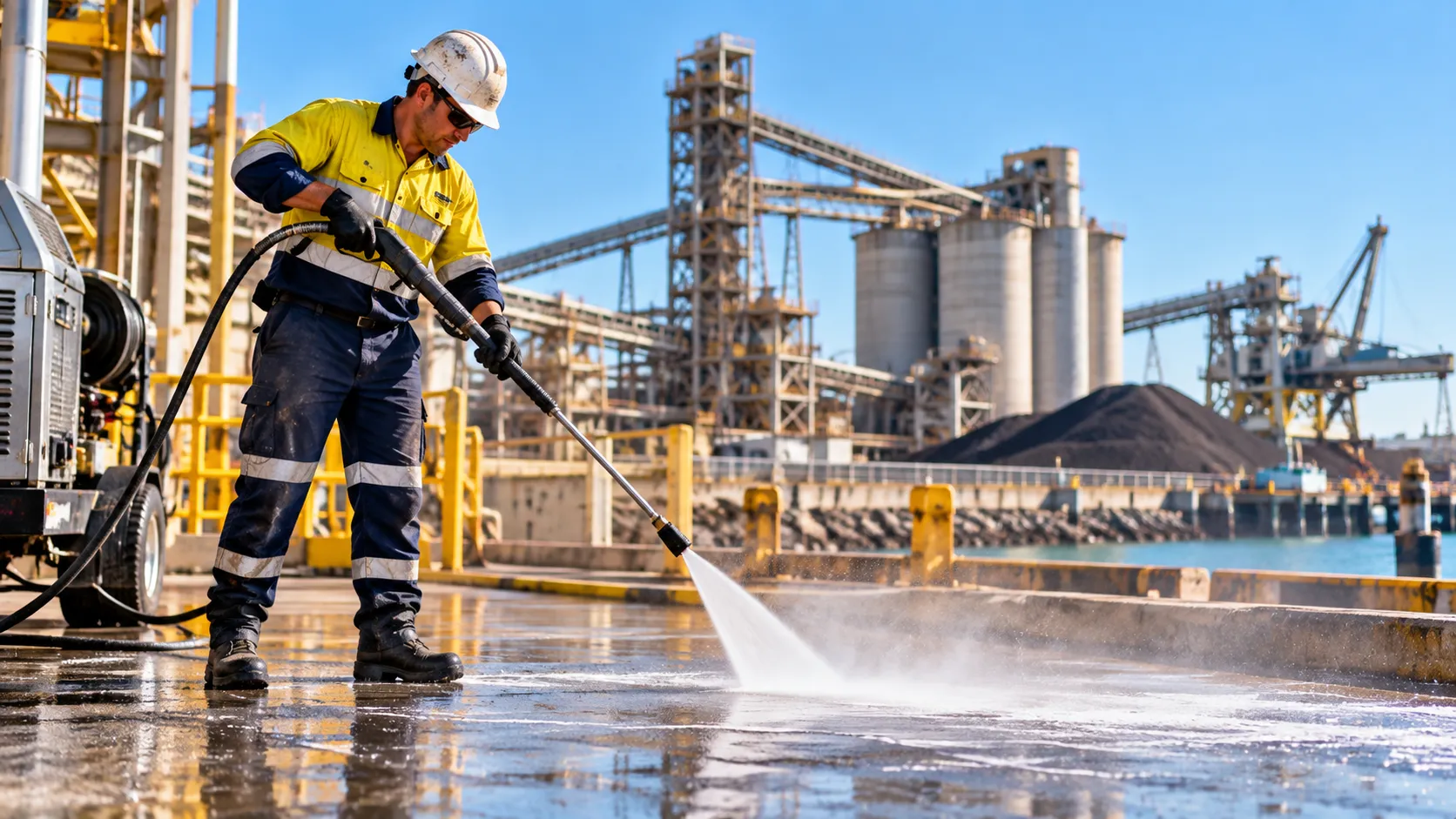
7. High-Pressure Cleaning
Some industrial surfaces and external areas can require more intensive cleaning than routine sweeping or mopping.
Where appropriate for the surface and site conditions, high-pressure cleaning can be used for selected industrial and commercial areas.
Potential applications can include certain:
- External surfaces
- Hardstand areas
- Building surrounds
- Car parks
- Other suitable hard surfaces
Pressure cleaning should be assessed according to the surface, surrounding environment and safety requirements.
Businesses requiring this type of maintenance can explore CorpClean's high-pressure cleaning services.
8. Staff Amenities in Industrial Workplaces
Industrial cleaning isn't only about production floors and warehouses.
Staff facilities can be some of the busiest parts of a heavy-industry workplace.
Large workforces and shift changes can place considerable demand on bathrooms, showers, change rooms and lunchrooms.
Bathrooms
Cleaning can include toilets, basins, taps, mirrors, floors, bins and frequently touched surfaces.
Showers
Where showers are provided, cleaning frequencies should reflect workforce numbers and usage.
Change Rooms
Change rooms may experience concentrated traffic before and after shifts.
Cleaning can cover floors, benches and other agreed surfaces.
Lunchrooms and Kitchens
Shared dining areas can require cleaning of tables, floors, sinks, benchtops, bins and agreed kitchen surfaces.
Instead of automatically servicing these areas once per day, businesses should consider when they experience their highest levels of use.
9. Cleaning Around Shift Work
Many industrial businesses operate differently from conventional nine-to-five workplaces.
Facilities may operate early mornings, evenings, overnight or across multiple shifts.
Cleaning therefore needs to fit around operational requirements.
Some areas may be easiest to clean during a shift change. Others might need to be serviced during periods of reduced activity.
A cleaning schedule should consider:
- Shift start and finish times
- Workforce numbers
- Production schedules
- Warehouse movements
- Restricted periods
- Staff break times
- Security requirements
- Safe access
This can minimise disruption while providing cleaners with appropriate access to the areas included in their scope.
10. Dividing an Industrial Facility Into Cleaning Zones
One practical way to manage a complex industrial property is to divide it into cleaning zones.
For example:
Zone 1 – Administration
Reception, offices and meeting rooms.
Zone 2 – Staff Facilities
Bathrooms, showers, change rooms, kitchens and lunchrooms.
Zone 3 – Warehouse
Approved floors, walkways and associated areas.
Zone 4 – Workshop
Designated workshop floors and approved surfaces.
Zone 5 – External Areas
Suitable entrances, hard surfaces and other agreed external areas.
Each zone can then have its own:
- Cleaning tasks
- Cleaning frequency
- Equipment
- Products
- Access procedures
- Safety requirements
This is generally more practical than applying a single generic checklist to an entire industrial property.
11. Industrial Deep Cleaning
Routine cleaning addresses ongoing requirements, but industrial facilities may also benefit from periodic detailed cleaning.
Deep cleaning can target areas or surfaces that do not necessarily require attention during every scheduled service.
Depending on the facility, this might include:
- Detailed floor cleaning
- Degreasing suitable surfaces
- Cleaning less accessible areas
- Detailed warehouse cleaning
- Periodic high-pressure cleaning
- Cleaning during planned shutdowns
The frequency should be determined by the facility's operations and condition rather than an arbitrary timetable.
12. Shutdown Cleaning
Planned shutdowns can provide an opportunity to perform cleaning that would be difficult while a facility is fully operational.
When machinery or operational areas are inactive, approved cleaning activities may be easier to coordinate.
Shutdown cleaning requires careful planning because businesses may have limited windows before normal operations resume.
Before work starts, the cleaning contractor and facility management should establish:
- Areas included
- Access arrangements
- Safety requirements
- Isolation requirements where applicable
- Cleaning tasks
- Available timeframe
- Inspection procedures
- Completion expectations
CorpClean's industrial cleaning services can include deep cleaning and shutdown cleaning where appropriate to the facility and agreed scope.
13. Safety Is Central to Industrial Cleaning
Industrial workplaces can contain hazards that are not typically encountered in conventional offices.
Cleaning staff may work around operational equipment, industrial chemicals, vehicles or restricted areas.
Cleaning programs therefore need to account for site-specific safety procedures.
Depending on the workplace, considerations may include:
- Site inductions
- Risk assessments
- Hazard identification
- Personal protective equipment
- Chemical handling
- Equipment procedures
- Restricted zones
- Sign-in requirements
- Emergency procedures
- Incident reporting
Cleaners should understand what they are authorised to do and where they are permitted to work.
CorpClean states that its industrial cleaning services incorporate WHS-focused practices, site assessments, risk identification and appropriate PPE.
14. Why Site Assessments Matter
An industrial cleaning quote based only on floor area may not capture the complexity of a facility.
Two buildings of identical size can have completely different cleaning requirements.
One might contain offices and storage space, while another includes workshops, production areas, staff showers and heavily used warehouse floors.
A site assessment can help identify:
- Facility layout
- Surface types
- High-traffic areas
- Types of soiling
- Operational zones
- Staff facilities
- Access restrictions
- Safety requirements
- Appropriate equipment
- Cleaning frequency
This information can then be used to develop a more detailed scope of work.
15. Building an Industrial Cleaning Checklist
A documented checklist gives cleaners and facility managers a common definition of what the cleaning service involves.
Instead of using vague instructions such as "clean workshop", a checklist can specify the exact areas and tasks.
For example:
Warehouse
- Sweep designated floor areas
- Clean agreed walkways
- Remove agreed waste
- Clean specified touchpoints
Staff amenities
- Clean toilets and basins
- Clean showers where applicable
- Mop floors
- Empty bins
- Replenish agreed consumables
Administration
- Vacuum or mop floors
- Empty bins
- Clean agreed surfaces
- Service kitchens and bathrooms
The checklist should reflect the facility rather than being copied from a generic commercial cleaning template.
16. Quality Control in Industrial Cleaning
Cleaning quality should be monitored over time.
This is particularly important for large facilities where multiple cleaners may work across different areas.
Quality management can include:
- Documented scopes of work
- Site-specific checklists
- Regular inspections
- Supervisor oversight
- Service reporting
- Communication with facility management
- Issue escalation
- Periodic service reviews
If an area repeatedly falls below the agreed standard, the cleaning program can then be reviewed to determine why.
Corporate Cleaning Services® states that its cleaning operations are supported by an ISO 9001-certified quality management system.
17. Reviewing Cleaning Requirements as Operations Change
Industrial sites evolve.
A facility may increase production, add employees, expand a warehouse or change its shift structure.
Each of these changes can affect cleaning requirements.
For example, increasing workforce numbers could place additional demand on:
- Bathrooms
- Showers
- Change rooms
- Lunchrooms
- Entrances
- Car parks
- Common areas
Cleaning scopes should therefore be reviewed periodically rather than remaining unchanged indefinitely.
How to Choose an Industrial Cleaning Provider in Gladstone
When comparing industrial cleaning providers, price is only one consideration.
Businesses should also consider whether the provider understands industrial environments and can develop a cleaning program around the site.
Useful questions include:
- Does the provider have industrial cleaning experience?
- Will they inspect the facility before quoting?
- How are site risks assessed?
- How are cleaners trained?
- Can cleaning be scheduled around operations?
- What equipment will be used?
- Are cleaning procedures documented?
- How is quality monitored?
- Can the scope adapt as the facility changes?
- Are appropriate insurance arrangements in place?
The answers can help businesses distinguish between generic commercial cleaning and a service designed around industrial operations.
Frequently Asked Questions About Industrial Cleaning in Gladstone
What is industrial cleaning?
Industrial cleaning is specialised cleaning for heavy-use facilities such as factories, warehouses, workshops, manufacturing plants, logistics facilities and processing sites. It can involve specialised equipment, cleaning procedures and safety requirements.
What does industrial cleaning include?
Depending on the facility, services can include floor scrubbing, degreasing, dust and dirt removal, warehouse cleaning, approved machinery or equipment cleaning, high-pressure cleaning, staff amenity cleaning, waste removal and periodic deep cleaning.
How is industrial cleaning different from office cleaning?
Industrial sites can contain larger spaces, operational equipment, heavier soiling and more complex hazards than conventional offices. Cleaning methods therefore need to reflect the facility, workflow and risk profile.
Can warehouses and workshops be professionally cleaned?
Yes. Professional industrial cleaning can cover warehouses and approved areas within workshops. The scope should clearly establish which areas cleaners can access and what tasks they are authorised to perform.
Can industrial cleaning be performed around shift work?
Yes. Cleaning schedules can be developed around operating hours and site access requirements. Different areas may require different cleaning windows depending on operational activity.
Can industrial cleaners work around machinery?
Cleaning around machinery requires careful planning. Cleaners should only work in authorised areas and follow site-specific safety, access and isolation procedures. Any machinery cleaning should be explicitly included in the agreed scope.
How often should an industrial facility be cleaned?
There is no universal schedule. Cleaning frequency depends on the facility, workforce, operating hours, traffic, activities and type of soiling. High-use staff amenities, for example, may need more frequent attention than lower-traffic administrative spaces.
Why are site assessments important for industrial cleaning?
A site assessment allows the cleaning provider to understand the facility's layout, surfaces, operational areas, access restrictions and safety considerations before developing the cleaning program.
Developing a Better Cleaning Strategy for Gladstone's Heavy Industry
Effective industrial cleaning isn't simply about cleaning a facility more often.
It requires understanding how that facility operates.
Warehouses, workshops, factories, mining-support businesses and logistics facilities can each present different challenges. Even within a single property, an administrative office may need a completely different cleaning procedure from a workshop or warehouse floor.
A stronger approach is to assess the site, divide it into appropriate cleaning zones, identify risks and high-use areas, establish suitable frequencies and document exactly what cleaners are responsible for.
For Gladstone's heavy-industry businesses, this can create a cleaning program that better reflects the realities of the workplace.
Businesses reviewing their current arrangements can learn more about industrial cleaning services or explore Corporate Cleaning Services® in Gladstone.