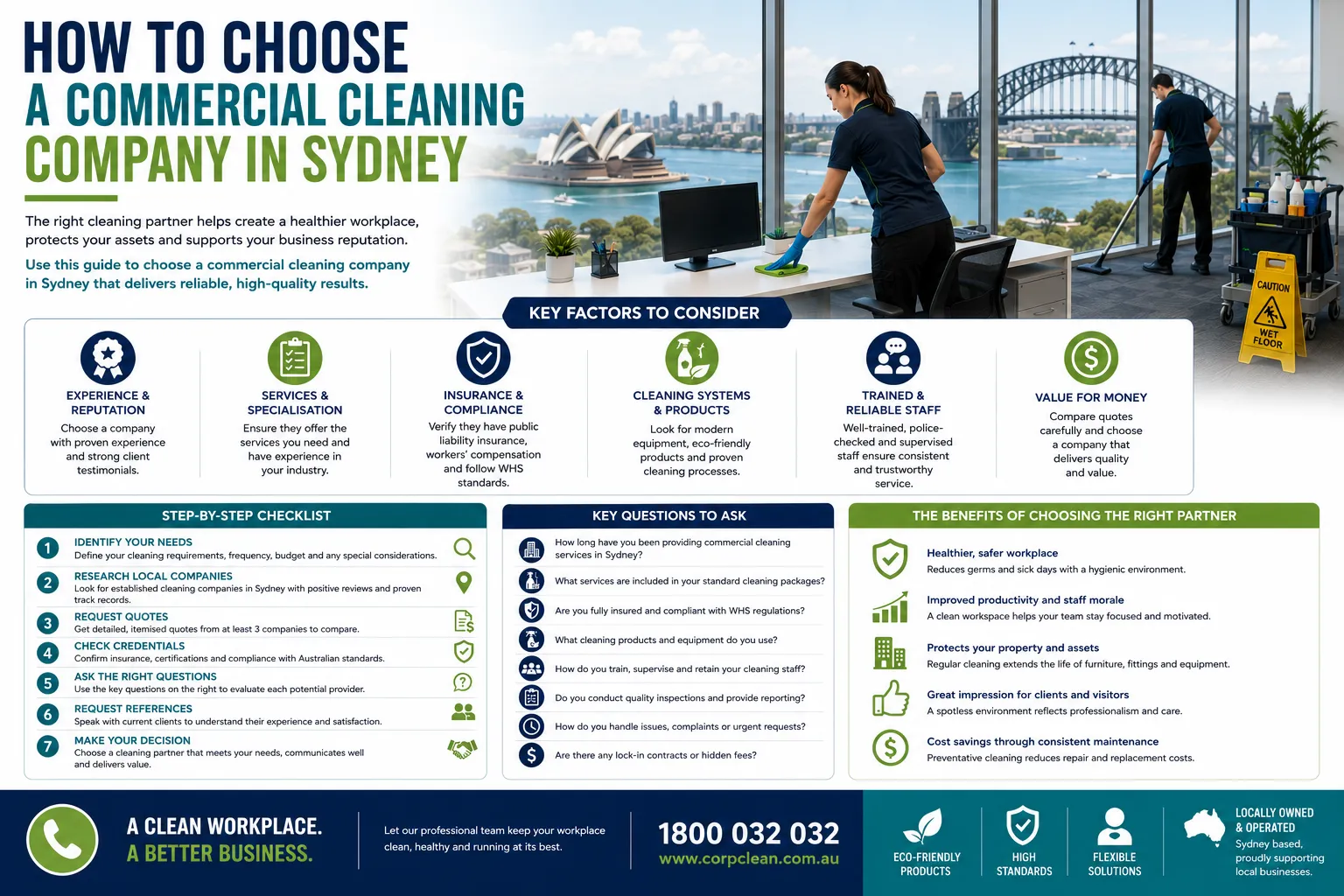
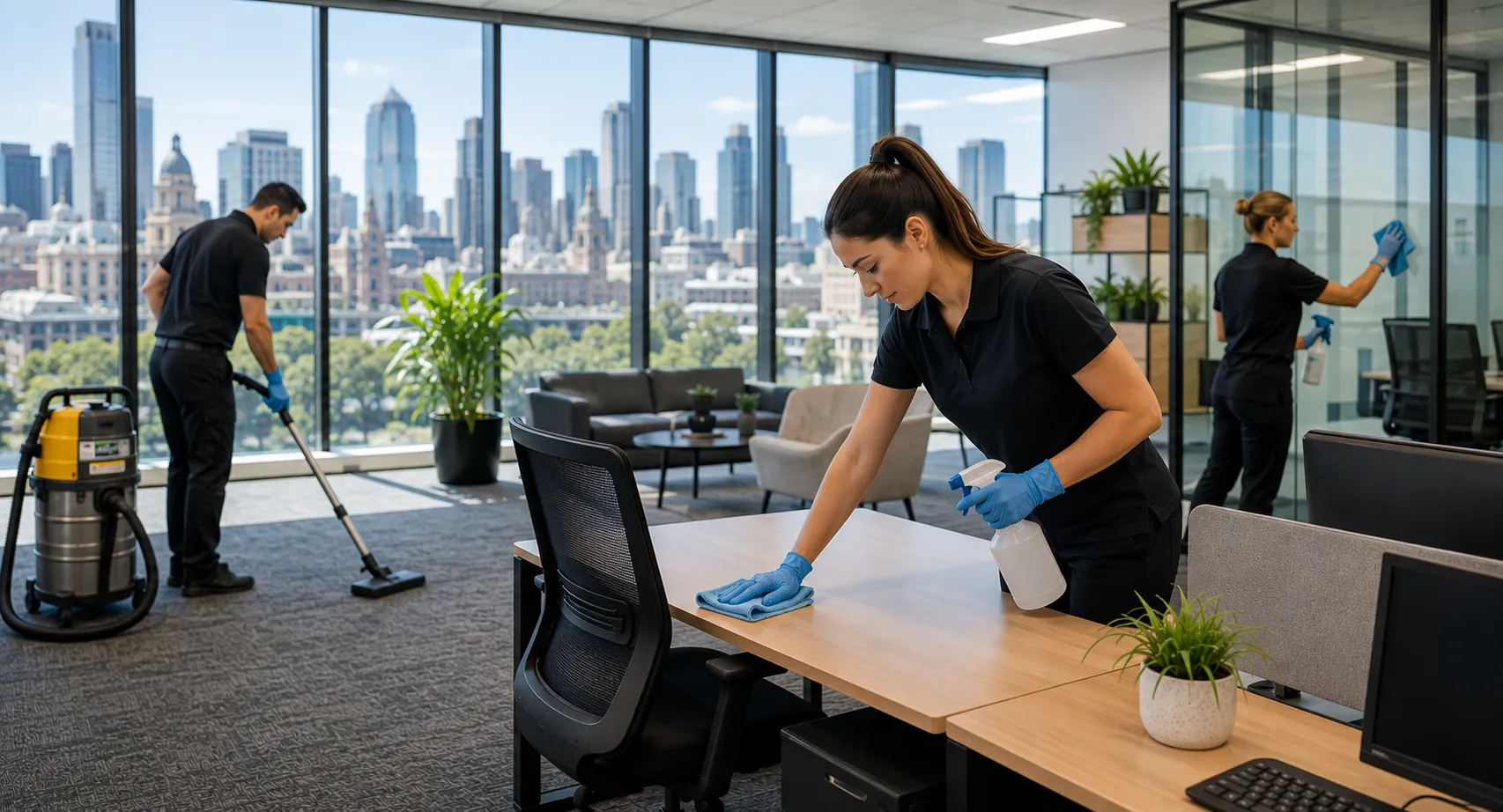
How to Choose a Commercial Cleaning Company in Sydney
20th May 2026
Choosing a commercial cleaning company is an important decision for any Sydney business. The right provider helps maintain a clean, hygienic and professional workplace while reducing the time employees and managers spend dealing with day-to-day cleaning issues.
A reliable cleaning company should do more than vacuum floors and empty bins. It should understand your premises, operating hours, industry requirements, high-traffic areas, surfaces, security procedures and expectations for ongoing service quality.
Whether you manage an office, medical practice, retail store, school, strata property, warehouse or hospitality venue, this guide explains how to assess commercial cleaners and select a provider capable of delivering consistent results.
Quick Answer
To choose a commercial cleaning company in Sydney, begin by defining the areas, tasks, frequency, operating hours and specialist services your workplace requires. Compare providers based on relevant experience, staff training, insurance, safety procedures, communication and quality assurance rather than price alone. Request an on-site assessment and a detailed written scope before signing an agreement.
Why Hiring a Professional Commercial Cleaner Matters
A clean workplace influences how employees, clients, suppliers and visitors perceive your business. Reception areas, floors, glass, washrooms, kitchens and meeting rooms can all affect the overall impression of a commercial property.
Professional commercial cleaning services also support preventative maintenance. Regular removal of dust, grit, spills, waste and surface build-up can help preserve carpets, hard floors, furniture and fixtures.
Benefits of professional commercial cleaning include:
- Improved workplace hygiene
- Cleaner shared facilities
- More consistent cleaning standards
- Better presentation for clients and visitors
- Reduced cleaning responsibilities for employees
- Longer-lasting flooring and furnishings
- Structured cleaning schedules
- Access to commercial-grade equipment and products
- Easier management of periodic deep cleaning
A professional provider should deliver a planned service rather than responding only when an area becomes visibly dirty.
Define Your Cleaning Requirements First
Before approaching cleaning companies, develop a clear picture of what your workplace requires.
Consider:
- Property size
- Number of employees
- Daily visitor numbers
- Operating hours
- Type of business
- Number of bathrooms
- Kitchen and staff facilities
- Flooring materials
- Waste volume
- High-touch areas
- Security requirements
- Areas requiring specialist cleaning
You should also determine whether cleaning can take place during business hours or needs to be completed early in the morning, after hours, overnight or on weekends.
Create a Detailed Cleaning Scope
A cleaning scope sets out the tasks the provider is expected to complete. The more detailed it is, the easier it becomes to compare quotes and monitor service quality.
A routine scope may include:
- Vacuuming carpets and entrance mats
- Sweeping and mopping hard floors
- Dusting accessible surfaces
- Emptying rubbish and recycling bins
- Cleaning and sanitising bathrooms
- Cleaning kitchens and staff rooms
- Wiping high-touch surfaces
- Cleaning reception and waiting areas
- Spot-cleaning internal glass
- Restocking agreed consumables
- Reporting maintenance concerns
Vague descriptions such as “general cleaning” may mean different things to different providers. A written checklist helps establish clear expectations for each area, task and frequency.
Identify Specialist Cleaning Services
Routine commercial cleaning may not cover every property maintenance requirement.
Depending on your premises, you may also need:
- Office cleaning
- Carpet cleaning
- Window cleaning
- Hard floor maintenance
- Tile and grout cleaning
- Upholstery cleaning
- Pressure cleaning
- High-pressure exterior cleaning
- Graffiti removal
- Post-construction cleaning
- End-of-lease cleaning
- Washroom hygiene services
- Healthcare cleaning
- Industrial cleaning
- Strata cleaning
Ask whether these services are completed by the provider’s regular team, a specialist internal division or subcontractors.
Look for Relevant Commercial Cleaning Experience
Residential and commercial cleaning are not the same. Commercial premises commonly involve larger areas, higher traffic, more complex access requirements and detailed service reporting.
Choose a provider with experience in properties similar to yours.
Relevant sectors may include:
- Corporate offices
- Medical centres
- Allied health clinics
- Schools and childcare facilities
- Retail stores
- Shopping centres
- Restaurants and hospitality venues
- Industrial facilities
- Warehouses
- Government premises
- Strata buildings
Experience in a similar environment makes it easier for a provider to anticipate common cleaning challenges and recommend suitable procedures.
Ask About Industry-Specific Procedures
Some workplaces require more detailed cleaning processes than a standard office.
Healthcare Facilities
Medical and allied health premises may need greater attention to treatment rooms, waiting areas, high-touch surfaces, washrooms and cross-contamination controls.
Education Facilities
Schools and childcare centres often require frequent cleaning of classrooms, bathrooms, shared equipment, eating areas and touchpoints.
Retail Properties
Retail cleaning may focus heavily on customer entrances, floors, glass, fitting rooms, counters and presentation during trading hours.
Industrial Sites
Warehouses and industrial facilities may require specialist equipment, dust control, machine floor scrubbing, spill procedures and cleaning around operational equipment.
Ask each provider to explain how its procedures would be adapted to your site rather than relying on a generic commercial cleaning checklist.
Confirm Insurance and Business Credentials
A reputable cleaning company should hold insurance appropriate to the services it performs.
Ask about:
- Public liability insurance
- Workers compensation arrangements
- Coverage for accidental property damage
- Insurance for specialist equipment or access work
- Relevant business registrations
- Licences required for particular services
Request current documentation rather than relying on verbal assurance. Insurance requirements may vary depending on the property, access arrangements and scope of work.
Review Workplace Safety Procedures
Commercial cleaning can involve chemicals, wet floors, electrical equipment, machinery, ladders and manual handling.
A professional provider should have procedures covering:
- Chemical handling
- Safety data sheets
- Correct product dilution
- Equipment operation
- Manual handling
- Slip and trip prevention
- Hazard reporting
- Personal protective equipment
- Incident reporting
- Emergency procedures
Safe Work Method Statements may be required for higher-risk tasks such as high-access cleaning, pressure cleaning or work around active industrial operations.
Ask How Cleaning Staff Are Trained
Cleaning quality depends heavily on the people completing the work.
Staff training should cover:
- Correct chemical selection
- Safe chemical use
- Surface compatibility
- Colour-coded cleaning systems
- Cross-contamination prevention
- Equipment operation
- Work health and safety
- Site security
- Waste handling
- Customer service
- Incident reporting
- Workplace-specific procedures
Ask whether training is completed before staff attend a site and how competence is checked over time.
Confirm How Staff Are Supervised
Training alone does not guarantee consistent service. Supervision and quality checks are needed to make sure agreed tasks continue to be completed correctly.
Find out:
- Who supervises the cleaners
- How often site inspections are completed
- Whether the team has a regular supervisor
- How new employees are introduced to the premises
- How replacement staff are briefed
- What happens when the regular cleaner is absent
- Who manages recurring service concerns
Consistent supervision can prevent small problems from becoming long-term service issues.
Ask About Police Checks and Security Procedures
Depending on your business, cleaners may have access to offices, keys, alarms, confidential areas, stock, equipment or personal information.
Ask about:
- Police checks where appropriate
- Staff identification
- Key management
- Alarm procedures
- Access codes
- Restricted areas
- Confidentiality requirements
- Lost key procedures
- Incident reporting
Security responsibilities should be documented as part of the cleaning agreement.
Evaluate the Range of Services
Choosing one company for routine and specialist cleaning can simplify property maintenance, provided the company has the required training, experience and equipment.
Services may include:
- Daily office cleaning
- Washroom cleaning
- Kitchen cleaning
- High-touch surface sanitisation
- Carpet extraction
- Low-moisture carpet cleaning
- Window cleaning
- Hard floor polishing
- Floor stripping and sealing
- Tile and grout cleaning
- Upholstery cleaning
- Pressure cleaning
- Consumable restocking
- Deep cleaning
- Post-construction cleaning
- Emergency cleaning
Compare Routine and Periodic Cleaning
| Routine Cleaning | Periodic Cleaning |
|---|---|
| Vacuuming | Carpet extraction |
| Mopping | Machine floor scrubbing |
| Bin removal | Floor stripping and sealing |
| Bathroom cleaning | High-level dusting |
| Kitchen cleaning | Upholstery cleaning |
| High-touch surface cleaning | External window cleaning |
| Reception cleaning | Pressure cleaning |
| Spot-cleaning glass | Detailed deep cleaning |
Ask the provider to recommend an annual maintenance schedule rather than focusing only on routine daily or weekly tasks.
Consider Flexible Cleaning Schedules
The cleaning schedule should fit around your operations.
Available arrangements may include:
- Daily cleaning
- Several visits per week
- Weekly cleaning
- Fortnightly cleaning
- Early-morning cleaning
- After-hours cleaning
- Overnight cleaning
- Weekend cleaning
- Public holiday cleaning
- Event cleaning
- Emergency call-outs
Cleaning outside business hours may reduce disruption, but access, alarm and security arrangements must be managed clearly.
How Often Should Your Workplace Be Cleaned?
Cleaning frequency depends on how the property is used.
Factors include:
- Staff numbers
- Customer traffic
- Property size
- Number of bathrooms
- Shared kitchens
- Waste generation
- Flooring type
- Industry
- Opening hours
- Seasonal demand
| Workplace Type | Typical Cleaning Frequency | Main Cleaning Priorities |
|---|---|---|
| Small low-traffic office | Once or twice per week | Floors, bins, kitchen and bathrooms |
| Medium office | Two to five times per week | Workstations, meeting rooms, reception and amenities |
| Large office | Daily | High-traffic areas and shared facilities |
| Retail premises | Several times per week or daily | Entrances, floors, glass and customer areas |
| Medical practice | Daily or according to site requirements | Treatment areas, bathrooms and touchpoints |
| School or childcare centre | Daily during operating periods | Classrooms, eating areas, bathrooms and shared equipment |
| Warehouse | Based on activity, dust, waste and traffic | Floors, amenities, dust and operational areas |
| Hospitality venue | Daily with task-specific cleaning throughout operations | Customer areas, bathrooms, floors and waste |
These are broad examples only. An on-site assessment is needed to determine the appropriate frequency for your business.
Ask About Environmentally Responsible Cleaning
Many Sydney businesses want to reduce waste and chemical use as part of broader environmental goals.
Ask whether the provider uses:
- Concentrated cleaning products
- Refillable chemical systems
- Reusable microfibre cloths
- Accurate dilution controls
- Low-toxicity products where appropriate
- Water-efficient equipment
- Energy-efficient machinery
- Waste separation procedures
- Reduced single-use plastic
Environmentally responsible cleaning should still meet the workplace’s safety and hygiene requirements. A product described as green may not be suitable for every surface or task.
Read Reviews Carefully
Online reviews can provide useful context, but individual ratings should not be considered in isolation.
Look for recurring comments about:
- Reliability
- Consistency
- Communication
- Attention to detail
- Staff professionalism
- Responsiveness
- Problem resolution
- Flexibility
- Long-term service quality
Also consider how the company responds to negative feedback. A professional and constructive response may indicate that service concerns are taken seriously.
Request Commercial References
For larger or more complex contracts, ask for references from businesses with similar property types, service schedules and specialist requirements.
Useful questions for references include:
- Does the company attend reliably?
- Is the cleaning standard consistent?
- Are issues resolved promptly?
- Is communication clear?
- Are replacement cleaners properly briefed?
- Has the service remained reliable over time?
Arrange an On-Site Assessment
A commercial cleaning quote should ideally be based on a site inspection.
During the assessment, the provider should review:
- Floor area
- Surface types
- Bathrooms
- Kitchens
- Access points
- Waste requirements
- High-traffic areas
- Equipment storage
- Security arrangements
- Cleaning frequency
- Specialist services
- Hazards or restrictions
Be cautious of quotes provided without enough information to estimate the labour, time and equipment required.
Understand What Is Included in the Quote
A detailed quote should explain the service rather than provide only a total price.
| Quote Item | What to Confirm |
|---|---|
| Labour | Hours per visit, number of cleaners and supervision |
| Equipment | Whether vacuums, floor machinery and specialist equipment are included |
| Cleaning products | Whether chemicals and dilution systems are included |
| Consumables | Who supplies bin liners, soap, toilet paper and hand towels |
| Quality assurance | Whether inspections, reporting and account management are included |
| Additional services | Rates for deep cleaning, specialist work and emergency call-outs |
| After-hours charges | Whether weekends and public holidays attract different rates |
Ask which services are excluded and how additional work will be approved and charged.
Compare Cleaning Hours, Not Just Visit Frequency
Two providers may both quote for five visits per week, but one may allocate significantly fewer labour hours.
Ask:
- How many hours are included per visit?
- How many cleaners will attend?
- Which tasks are completed during each visit?
- Are all areas cleaned every time?
- Are some tasks rotated?
- How much time is allocated to bathrooms and kitchens?
- Is supervision included in the labour allowance?
This information makes quote comparisons more meaningful.
Be Cautious of Unusually Low Quotes
A low quote may reflect efficiency, but it may also indicate:
- Insufficient labour hours
- Excluded tasks
- Limited supervision
- Inadequate insurance
- Poor staff retention
- Minimal training
- Unsuitable products
- Reliance on rushed work
- Additional charges not shown upfront
The lowest initial price does not always provide the lowest long-term cost. Poor cleaning may lead to complaints, damaged flooring, repeated corrective work or the need to replace the provider.
Review Contract Terms
Before signing, review:
- Contract length
- Notice period
- Cancellation terms
- Price review clauses
- Service inclusions
- Exclusions
- Payment terms
- Cleaning schedule
- Access responsibilities
- Consumable arrangements
- Damage reporting
- Complaint procedures
- Additional service approval
- Insurance requirements
Ask for clarification on vague wording and avoid entering a long-term agreement before understanding how performance issues will be handled.
Look for Quality Assurance Processes
Reliable commercial cleaning companies should have systems for monitoring their work.
These may include:
- Cleaning checklists
- Supervisor inspections
- Digital reporting
- Client review meetings
- Site audits
- Corrective action records
- Staff performance reviews
- Complaint tracking
- Photo reporting where appropriate
- Dedicated account management
Ask how frequently quality checks take place and whether results are shared with clients.
Understand How Service Issues Are Handled
Even reliable cleaning companies may occasionally miss a task. The important issue is how quickly and professionally the problem is resolved.
Ask:
- Who should be contacted?
- How quickly will the company respond?
- Will missed work be corrected?
- How are recurring issues investigated?
- Are complaints recorded?
- Who follows up with the client?
- What happens if performance does not improve?
A clear issue-resolution process helps protect the long-term working relationship.
Assess Communication and Responsiveness
Communication is particularly important when cleaners work outside normal business hours.
A dependable provider should make it easy to:
- Update cleaning instructions
- Report missed tasks
- Request additional cleaning
- Change access arrangements
- Add new areas
- Adjust the schedule
- Report a hazard
- Arrange specialist services
- Escalate recurring concerns
Be cautious if communication is slow or unclear during the quotation stage, as this may indicate how future service issues will be handled.
Ask Whether You Will Have a Dedicated Contact
A dedicated site supervisor or account manager can simplify communication.
This person may coordinate:
- Cleaning schedules
- Staff changes
- Site inspections
- Quality issues
- Additional services
- Contract reviews
- Emergency requests
- Consumable management
Knowing who is responsible prevents requests from being passed between multiple people.
Questions to Ask Before Hiring
- How long have you provided commercial cleaning services?
- Have you cleaned businesses similar to ours?
- What tasks are included in the quote?
- Which tasks are excluded?
- How many cleaning hours are allocated?
- How are staff trained?
- How are cleaners supervised?
- What insurance do you hold?
- Are police checks available where required?
- Do you use subcontractors?
- Who provides equipment and chemicals?
- Who supplies washroom consumables?
- How are quality checks completed?
- Who will manage our account?
- What happens if the regular cleaner is unavailable?
- How are service issues reported?
- How quickly are complaints addressed?
- Can the cleaning schedule be changed?
- What notice is required to end the agreement?
- Can you provide relevant commercial references?
The provider’s willingness to answer these questions clearly can indicate how transparent and organised the service will be.
Common Mistakes to Avoid
Choosing Based Only on Price
Why it happens: Businesses want to reduce operating costs.
Potential consequence: Too few cleaning hours, excluded tasks, inconsistent staffing and declining service quality.
How to avoid it: Compare the complete scope, labour allocation, supervision, equipment, insurance and quality assurance process.
Accepting a Vague Scope of Work
Why it happens: A brief service description seems easier to manage.
Potential consequence: Different expectations about desks, kitchens, consumables, glass, bins and periodic tasks.
How to avoid it: Use a detailed checklist identifying each area, task and frequency.
Failing to Check Insurance
Why it happens: Businesses assume every established company is adequately covered.
Potential consequence: Disputes or financial exposure if property is damaged or an accident occurs.
How to avoid it: Request current insurance documentation before work begins.
Overlooking Staff Training
Why it happens: Cleaning is sometimes treated as an unskilled service.
Potential consequence: Incorrect chemicals, surface damage, cross-contamination or unsafe equipment use.
How to avoid it: Ask how workers are trained, assessed and supervised.
Ignoring Communication Problems
Why it happens: The quoted price and task list receive more attention.
Potential consequence: Missed tasks and service concerns may take too long to resolve.
How to avoid it: Test the provider’s responsiveness before signing and confirm who will manage the account.
Failing to Include Periodic Cleaning
Why it happens: Businesses focus only on everyday visible cleaning.
Potential consequence: Carpet soil, floor wear, dirty windows, upholstery stains and high-level dust gradually accumulate.
How to avoid it: Add carpet cleaning, window cleaning, hard floor maintenance and deep cleaning to an annual schedule.
Not Reviewing the Service
Why it happens: Once a contract begins, the cleaning arrangement remains unchanged.
Potential consequence: The service no longer matches changes in staffing, visitor traffic, layout or operating hours.
How to avoid it: Review the scope regularly and after significant workplace changes.
Benefits of Choosing the Right Provider
Better Workplace Presentation
Clean entrances, reception areas, floors, glass, kitchens and bathrooms reinforce a professional image.
Improved Workplace Hygiene
A structured program helps remove dust, waste, food residue and surface contamination from shared areas.
Greater Employee Comfort
Employees can work in a cleaner and more orderly environment without being expected to manage substantial cleaning tasks.
More Consistent Results
Documented tasks, trained cleaners, supervision and inspections help maintain service quality.
Reduced Management Time
A responsive provider reduces the time managers spend purchasing supplies, assigning cleaning duties and dealing with recurring problems.
Protection of Property Assets
Routine cleaning and periodic maintenance can help extend the life of carpets, flooring, furniture and fixtures.
More Predictable Costs
A well-defined service agreement helps businesses budget for routine and specialist cleaning without frequent unexpected expenses.
Maintenance Tips Between Cleaning Visits
Employees should not replace professional cleaners, but simple habits can help maintain the workplace between visits.
Encourage staff to:
- Clean spills promptly
- Use the correct rubbish and recycling bins
- Keep food in sealed containers
- Wipe shared kitchen surfaces after use
- Avoid leaving dishes in sinks
- Keep desks reasonably clear
- Report leaks and damaged fixtures
- Report carpet stains promptly
- Keep corridors and floors free from clutter
- Follow workplace waste procedures
Businesses should also make sure cleaners can access the areas included in the cleaning plan.
Why Choose a Local Sydney Cleaning Company?
A local provider may offer practical benefits, including:
- Faster on-site assessments
- Familiarity with Sydney business locations
- Easier access to supervisors
- More responsive schedule changes
- Local service support
- Faster response to urgent requests
- Knowledge of local property types and access conditions
Local presence should be considered alongside experience, insurance, training, pricing and service quality. Being based nearby does not automatically guarantee better results, but it may support quicker communication and site attendance.
Warning Signs to Watch For
Be cautious if a provider:
- Refuses to provide proof of insurance
- Offers a quote without understanding the site
- Cannot explain how staff are trained
- Provides a vague scope
- Avoids questions about labour hours
- Has no quality inspection process
- Uses unclear contract terms
- Cannot explain complaint procedures
- Pressures you to sign immediately
- Provides unusually low pricing without explanation
- Communicates poorly during the quoting process
- Cannot provide relevant commercial references
One concern may have a reasonable explanation, but several warning signs suggest the provider may not be suitable.
Final Thoughts
Choosing a commercial cleaning company in Sydney requires more than comparing prices and service lists. The right provider should understand your workplace, industry, operating hours, surfaces, security requirements and cleaning priorities.
Start by defining a clear scope of work. Then compare relevant experience, staff training, insurance, safety procedures, supervision, pricing, communication, contract terms and quality assurance.
A professional on-site assessment and detailed written proposal will make it easier to identify which provider offers genuine value. By evaluating commercial cleaners carefully, your business can establish a reliable program that supports workplace hygiene, professional presentation, employee comfort and long-term property maintenance.
Corporate Cleaning Services® provides tailored cleaning programs for offices, retail properties, healthcare facilities, education sites and other commercial premises. To discuss your Sydney workplace, arrange a site assessment or request a customised commercial cleaning quote.
Frequently Asked Questions
What should I look for in a Sydney commercial cleaning company?
Look for relevant commercial experience, trained staff, appropriate insurance, transparent pricing, a detailed cleaning scope, flexible scheduling, responsive communication and documented quality assurance procedures.
How much does commercial cleaning cost in Sydney?
Costs vary according to property size, cleaning frequency, labour hours, surface types, access, operating times and specialist services. An on-site assessment is generally required to prepare an accurate quote.
Should a commercial cleaning company be insured?
Yes. Ask for evidence of appropriate public liability insurance and any other cover relevant to the work before the service begins.
How often should a commercial workplace be cleaned?
Frequency depends on property size, employee numbers, visitor traffic, bathrooms, kitchens, waste levels, industry and operating hours. Busy workplaces may require daily cleaning.
What should be included in a cleaning contract?
The agreement should define the cleaning areas, tasks, frequency, labour allocation, exclusions, pricing, consumables, access arrangements, quality checks, complaint procedures and cancellation terms.
Are commercial cleaning quotes negotiable?
The service scope can often be adjusted to suit operational priorities and budget. Reducing labour hours without adjusting the expected tasks, however, may result in poor or inconsistent cleaning.
Can commercial cleaners work after hours?
Yes. Many providers offer early-morning, evening, overnight and weekend services. Access, keys, alarms, emergency contacts and security procedures should be documented clearly.
Do commercial cleaners provide their own equipment?
Many providers supply their own equipment and chemicals, but this should be confirmed in the quote. Consumables such as toilet paper, hand towels and soap may be managed separately.
How can I check the quality of a cleaning service?
Use documented cleaning checklists, regular site inspections, employee feedback, review meetings and a clear procedure for reporting missed tasks or recurring concerns.
Should I choose the cheapest commercial cleaning quote?
Not automatically. Compare labour hours, task inclusions, staff training, supervision, insurance, equipment, communication and quality controls before making a decision.