
How AI Is Transforming Office Cleaning
3rd December 2025
Artificial Intelligence isn’t replacing cleaning teams—it’s changing how they work. In 2026, the biggest shift is that office cleaning is becoming measurable, responsive, and optimized. Instead of relying on fixed schedules and guesswork, facilities teams can use AI tools to target effort where it matters most, document results, and reduce waste—all while improving occupant experience.
Here’s what that looks like in practice.
1. Smart Cleaning Robots Are the New Normal
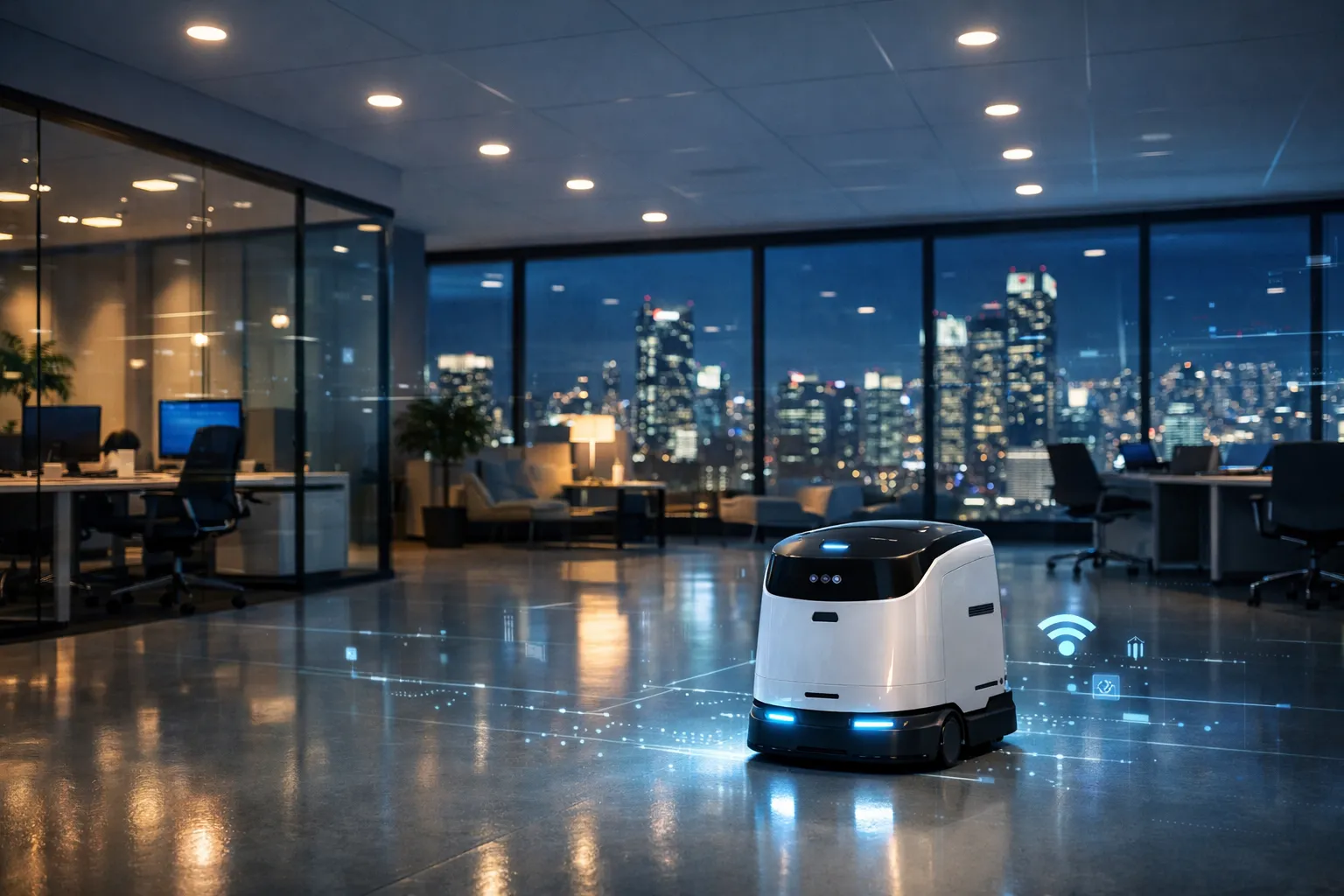
AI-powered cleaning robots have moved far beyond “robot vacuums that bump into things.” Modern commercial cleaning robots are built to operate in busy offices alongside people, using mapping and sensors to navigate safely and efficiently.
What today’s autonomous cleaning bots do well:
- Learn the space: Many robots map environments and follow planned routes, adapting when furniture moves or hallways are blocked. (LiDAR and vision sensors are commonly used in commercial robotics—often in combination.)
- Optimize cleaning coverage: Robots don’t get tired or skip areas. They’re good at repetitive floor work, freeing human teams for detail cleaning and restocking.
- Produce proof-of-performance data: Instead of “we cleaned,” you get run history, coverage logs, and productivity metrics that managers can review.
Example: Whiz (commercial robot vacuuming)
Whiz is positioned as a “cobot” (collaborative robot) designed to work alongside staff, and product materials commonly cite that it can clean up to 15,000 sq. ft. per charge and notify operators when it’s done.
SoftBank’s Whiz product page also emphasizes that it frees up staff time for deeper work (positioned as “gain more time for deep cleaning”).
Why this matters for offices (not just cleaning companies):
- More consistent floor care (especially in hallways, open office areas, lobbies)
- Better allocation of labor (humans focus on restrooms, touchpoints, kitchens, spills, detail work)
- More transparency (easy reporting for operations leaders, property managers, or tenants)
Where robots typically deliver the most ROI:
- Large, repetitive floor areas (carpeted corridors, open-plan zones)
- Buildings with limited staff and high foot traffic
- Sites that need visible cleaning during business hours
2. Predictive Cleaning Using IoT + AI
One of the biggest changes in 2026 is the move from “clean everything every night” to clean what’s actually being used. Predictive cleaning combines:
- IoT sensors (occupancy/foot traffic, door counters, restroom dispensers, air quality)
- AI or analytics (to identify patterns, forecast peaks, and trigger tasks)
What predictive cleaning systems can do:
- Monitor usage in near real time (e.g., restrooms, kitchens, meeting rooms)
- Trigger cleaning or restocking when spaces hit a usage threshold
- Reduce unnecessary labor (fewer “check-and-leave” walkthroughs)
- Help management adjust staffing to match actual building occupancy
There’s research and industry reporting showing that occupancy-rate sensors can enable more targeted, “data-responsive” cleaning planning and better resource utilization. And vendors focused on occupancy data for facilities describe using that data to reduce wasted labor and improve outcomes.
Real-world style example (what this looks like operationally):
- Restroom occupancy and dispenser sensors detect heavy usage mid-morning
- The system flags a task: “Restock + spot clean sinks + trash”
- The team responds only when needed, rather than checking on a fixed timer
A concrete case study signal (cost + labor alignment):
One occupancy-monitoring case study describes a company reallocating cleaning labor based on usage and renegotiating contracts—reporting $1M in cleaning cost savings and an 11X ROI after shifting to real-time occupancy-based labor allocation.
(That’s a specific case, not a universal promise—but it shows what’s possible when cleaning contracts and schedules reflect actual usage.)
3. AI-Driven Sustainability in Cleaning
Sustainability used to rely on policies (“use less chemical,” “switch to green products”). In 2026, AI helps make it measurable and enforceable—so teams can reduce waste without sacrificing hygiene standards.
What AI is doing behind the scenes
1) Chemical usage tracking (to prevent overuse and reduce cost)
Instead of eyeballing dilution ratios or guessing how much product is being used, many operations now track dispensing and consumption data digitally—making it easier to spot overuse, leakage, or inconsistent practices. Some chemical dispensing systems and inventory-monitoring platforms are designed to provide live usage reports and track usage by time/user/location.
2) Water optimization for mopping and sanitation workflows
AI-enabled equipment and connected workflows can reduce water waste indirectly by:
- Standardizing procedures (so crews don’t re-mop areas unnecessarily)
- Optimizing routes (less repeat passes)
- Timing cleans based on actual traffic (less “just-in-case” cleaning)
3) Smarter product substitution (eco-friendly where it actually works)
AI can help flag where eco-friendly alternatives are low-risk substitutions (glass cleaner, general-purpose surfaces) versus areas that may require specific chemistries (certain disinfectants, food-service areas, healthcare-type requirements). Think of it as evidence-based standardization, not just “swap everything to green.”
4) Carbon and ESG reporting that’s more continuous, not once-a-year
Some sustainability platforms position AI as a way to continuously collect/validate emissions data and monitor carbon footprint more “real time” (or near real time) rather than static, spreadsheet-driven reporting.
That matters because cleaning has a footprint: chemicals, transport, equipment energy use, consumables, and waste.
Practical takeaway: AI doesn’t magically make cleaning “green”—it makes sustainability trackable, so teams can set targets and prove progress.
4. AI-Powered Quality Assurance
Traditional QA relies on checklists and random inspections. That’s fine, but it’s inconsistent—and it often catches problems after occupants complain. In 2026, AI-driven QA is pushing cleaning toward continuous verification.
How AI QA works in the real world
1) Computer vision-assisted inspection
Cameras + AI models can be trained to identify visual issues like:
- streaks or smudges (glass, stainless surfaces)
- debris in corners or along edges
- visible trash overflow or missed zones
Computer vision is widely used for quality inspection in other industries because it can automatically create structured inspection records and operate continuously.
Cleaning is adopting the same logic: use visual proof + consistent standards.
2) Real-time alerts when something’s missed
Instead of discovering a missed area hours later, systems can flag issues quickly—especially in high-visibility zones (lobbies, conference rooms, restrooms).
3) Instant feedback and training recommendations
This is the underrated part: AI QA isn’t only “gotcha” enforcement. It can highlight repeat misses and recommend targeted coaching (e.g., edges, glass technique, cross-contamination practices).
About the “95%+ accuracy” claim
In computer vision quality inspection more broadly, some vendors and case discussions cite very high detection accuracy in controlled environments.
For office cleaning QA specifically, accuracy depends heavily on lighting, camera placement, surface type, and what “clean” is defined to mean—so it’s best framed as: high potential accuracy with the right setup, not a universal guarantee.
Pro tip: If you’re evaluating AI QA, ask what they do about false positives (e.g., reflections on glass) and how they calibrate “clean” standards for your site.
5. Data-Driven Facility Management
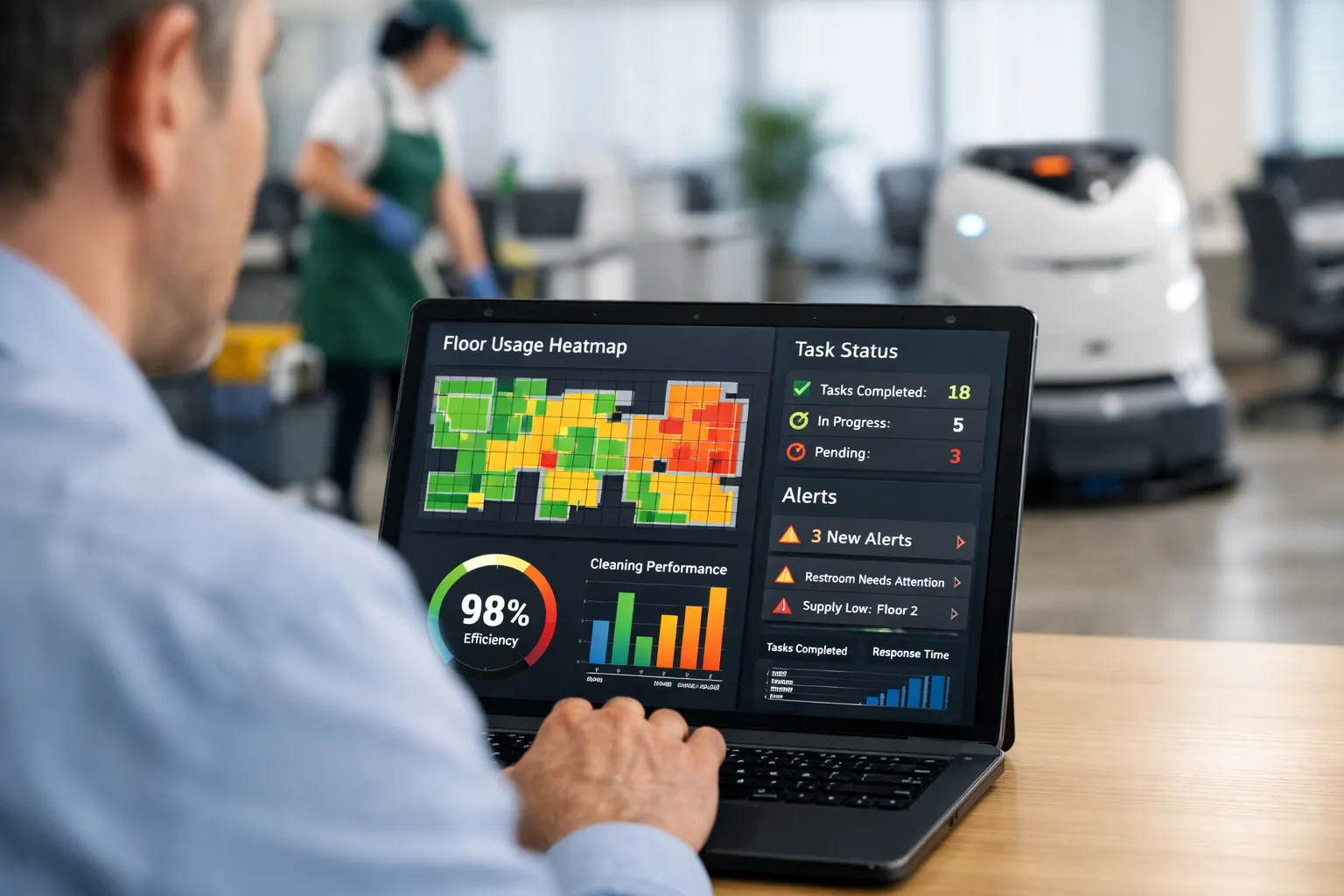
In 2026, facility management is shifting from “manage schedules” to “manage signals.” AI dashboards bring cleaning into the same operational mindset as energy and security: measure → predict → optimize.
What an AI facility dashboard typically integrates
1) Cleaning schedules + completion proof
- Who cleaned what, when
- Coverage history (especially when robots or digital checklists are used)
2) Occupancy patterns and traffic signals
- Conference rooms that spike on certain weekdays
- Kitchens that need midday touch-ups
- Restrooms that peak during events or shift changes
3) Supply management and automated reordering
Smart restroom and dispenser systems can monitor supply levels (soap, paper towels, toilet paper) and send alerts at thresholds, helping teams restock before shortages hit.
Some solutions also market “smart restock” or automatic reorder workflows to reduce stockouts.
4) Energy usage context (optional but increasingly common)
When you pair cleaning/occupancy data with energy patterns, you can coordinate:
- after-hours deep cleans only when areas were heavily used
- reduced servicing for lightly used floors
- better staffing allocation on partial occupancy days
What AI analytics helps you do
- Deploy staff where it matters (high-traffic zones, complaint hotspots)
- Reduce wasted labor (fewer “check-and-leave” rounds)
- Maintain higher perceived cleanliness (restrooms + kitchens always “ready”)
- Create measurable service standards (especially helpful for multi-tenant offices)
Pro tip: If you want quick wins, start with restroom supplies + occupancy-driven tasking. It’s one of the easiest areas to measure improvement because stockouts and restroom condition are so visible.
6. Improved Security and Access Control
Office cleaning is uniquely sensitive from a security standpoint: cleaning crews often work after hours, move through multiple zones, and may need access to spaces with confidential materials (HR, finance, IT rooms, executive offices). As AI tools spread across facilities management, security is shifting from “trust + keys” to verified identity + least-privilege access + audit trails.
How AI is tightening security in cleaning operations
1) Digital identity instead of shared keys
More sites are moving toward digital credentials (IDs tied to a specific person) rather than physical keys that can be copied or shared. This supports accountability and makes it easier to revoke access quickly if staffing changes.
2) Facial recognition and biometric verification (with caveats)
Facial recognition can be used as a form of identity verification at entrances or secure zones, reducing “badge sharing” and enabling contactless access. But it comes with major privacy, legal, and ethical considerations—especially in workplaces. Industry security and governance groups continue to highlight these concerns and the need for safeguards.
Best-practice framing: facial recognition is most defensible when it’s optional, limited to high-security areas, and paired with strong governance (retention limits, consent where required, and robust security for biometric data).
3) Smart access control with “least privilege” rules
Instead of giving a cleaner access to an entire floor or building, smart systems can enforce:
- Time-based access (only during a scheduled window)
- Zone-based access (only the areas they’re assigned)
- Event-based access (unlock only when a task is active)
This approach reduces risk without slowing down operations—especially when integrated with cleaning schedules and work orders. (This is a common theme across AI-enabled facilities/security discussions.)
4) Activity logging for accountability
Activity logs help answer the “what happened?” questions quickly:
- Who entered which area
- When they entered/exited
- Whether access attempts were denied
- Which tasks were completed during the access window
This is valuable not only for security incidents, but also for dispute resolution (“Was that room serviced?”) and operational improvement.
Pro tip: security that doesn’t alienate staff
If you’re writing this as an article, it’s worth adding a short note that security tech works best when it’s transparent and fair:
- explain what’s being tracked and why
- collect the minimum data needed
- keep policies consistent across employees and contractors
- prioritize privacy-first approaches (especially with biometrics)
Future Outlook: What’s Next?
AI in office cleaning is moving from single tools to connected systems—robots, sensors, training, and dashboards working together.
1) Voice-activated cleaning commands (hands-free ops)
Expect more voice interfaces for supervisors and on-site leads, such as:
- “Start a spot clean in Conference Room B.”
- “Which restrooms are due for restocking?”
- “Show missed zones from last night.”
Voice becomes especially useful in cleaning because teams are mobile, wearing gloves, and working with equipment—hands-free control is practical.
2) AI + AR training programs for cleaners
AR training is already being positioned as a way to standardize skills, reduce turnover pain, and validate performance. One concrete example in the cleaning industry is Inspire AR powered by ISSA, launched as an AR training platform for cleaning professionals with goals like improving training consistency and efficiency.
More broadly, AR training is increasingly used to overlay step-by-step instructions and safety protocols in realistic environments.
What this changes: training becomes less dependent on one supervisor’s time and more repeatable across sites and shifts.
3) Fully autonomous cleaning fleets for large campuses
The next step after “one robot on one floor” is fleet management: coordinating many robots across large facilities with centralized monitoring, reporting, and optimization.
You’re already seeing real-world fleet deployments described at scale—Aramark, for example, reported deploying a fleet of autonomous floor-cleaning robots across multiple facility types and cleaning tens of millions of square feet annually.
On the technology side, vendors like Brain Corp emphasize enterprise fleet tools, remote deployment, rerouting, performance tracking, and reporting for autonomous operations in large/complex environments.
And robot makers are still showcasing new lineups at major 2026 events (e.g., NRF 2026), which signals the pace of iteration isn’t slowing.
What “fully autonomous fleets” will likely mean in practice:
Not “no humans,” but fewer humans doing repetitive floor work and more humans doing:
- detail cleaning and sanitation
- restocking
- QA and exception handling
- customer-facing service and rapid response
Final Thoughts
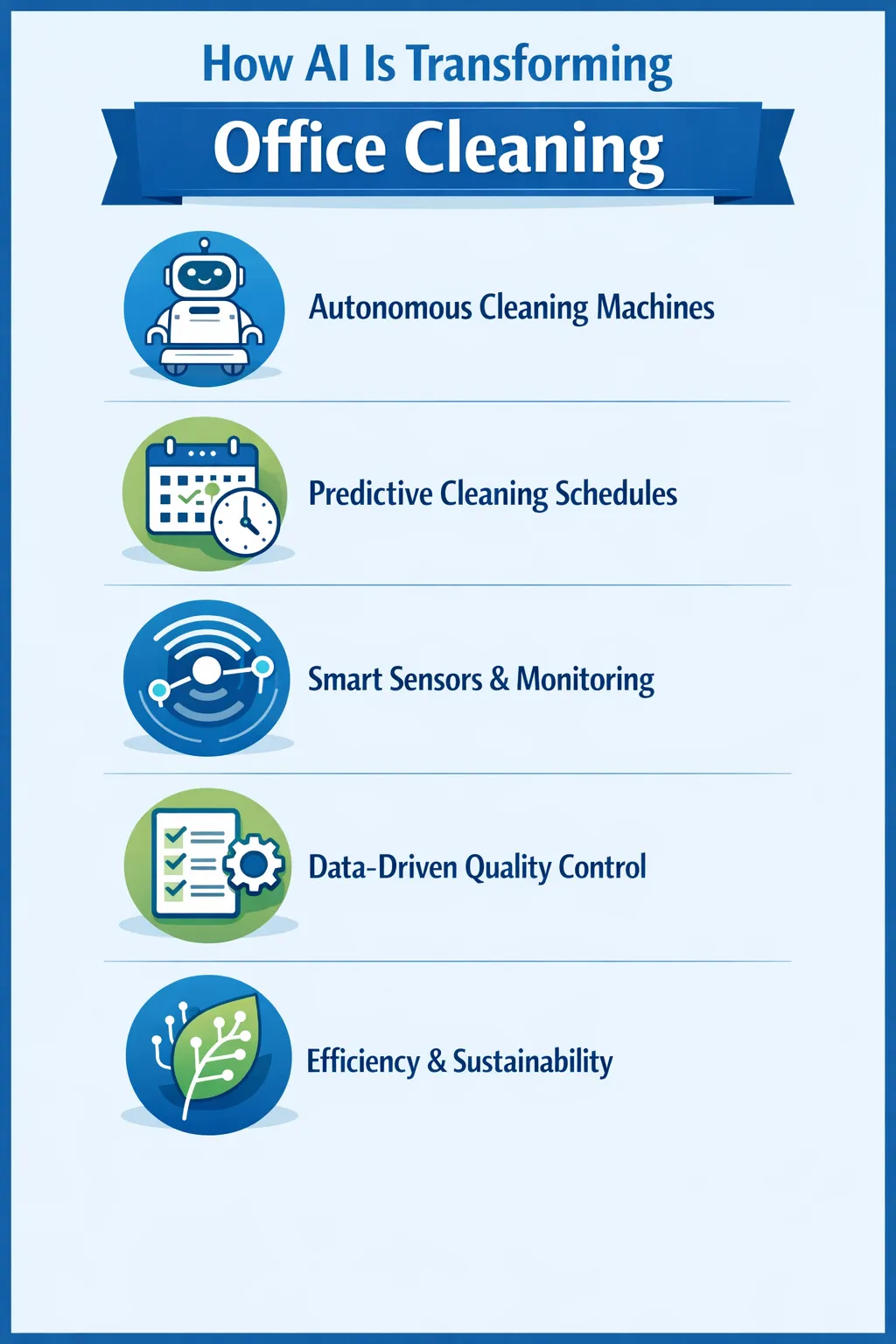
AI is changing office cleaning in a very practical way: it’s making cleaning more targeted, more measurable, and easier to manage at scale. Robots handle repetitive floor work, IoT + AI triggers cleaning based on real usage, sustainability becomes trackable instead of aspirational, QA moves from random inspections to continuous verification, and access control becomes more accountable through digital identity and audit logs.
The companies that adopt AI-driven cleaning systems in 2026 aren’t just chasing cost savings—they’re building healthier workplaces, more consistent standards, and better occupant satisfaction while making sustainability goals easier to prove.
Ready to Experience AI-Enhanced Office Cleaning
At CorpClean, we're not just keeping up with the future of cleaning—we're leading it. Our team leverages the latest in AI-driven technology to deliver smarter, safer, and more sustainable office cleaning solutions across Australia. Whether you're looking to streamline your facility management or enhance hygiene standards, we have the tools and expertise to help. Contact us today and discover how modern cleaning technology can transform your workspace.