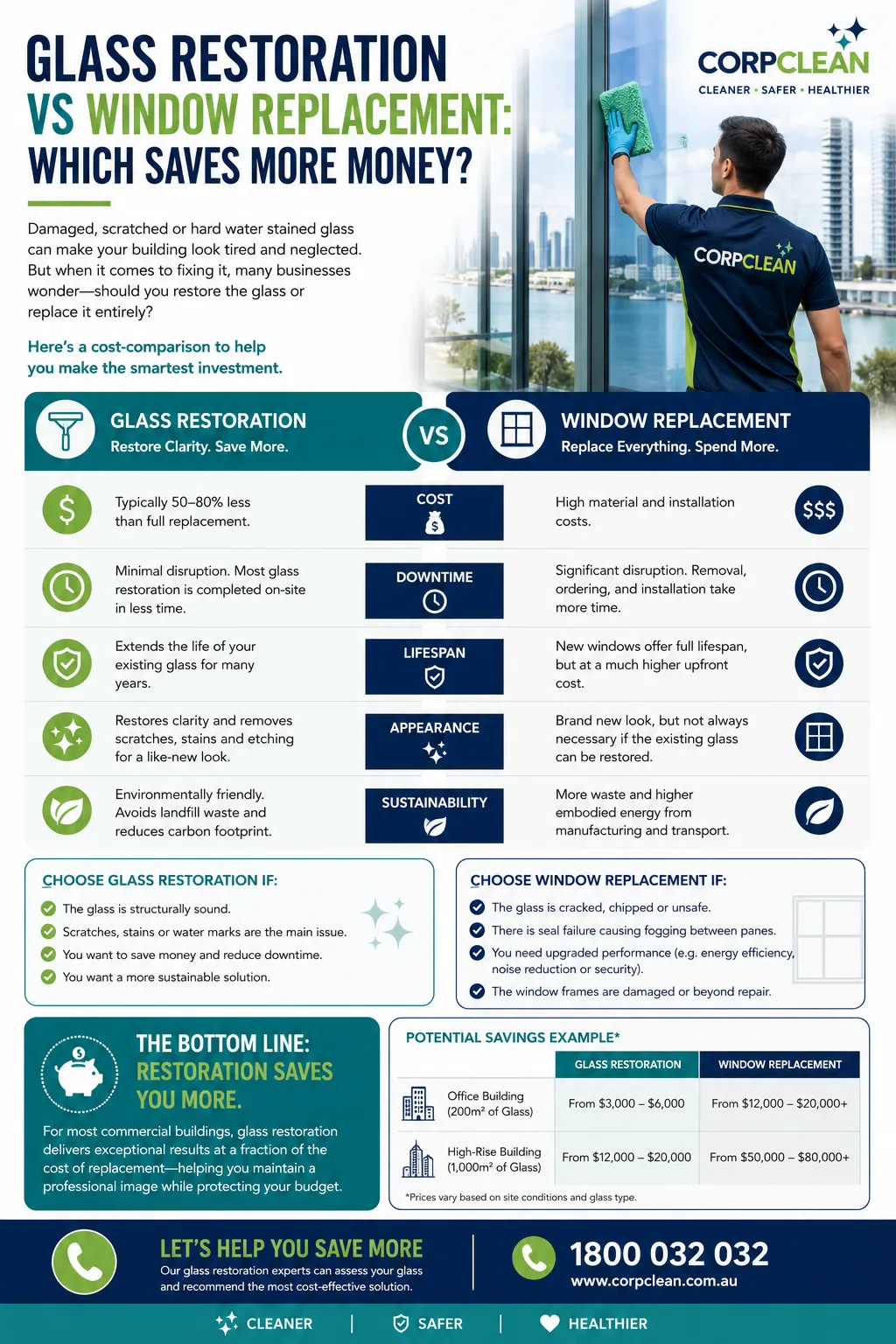
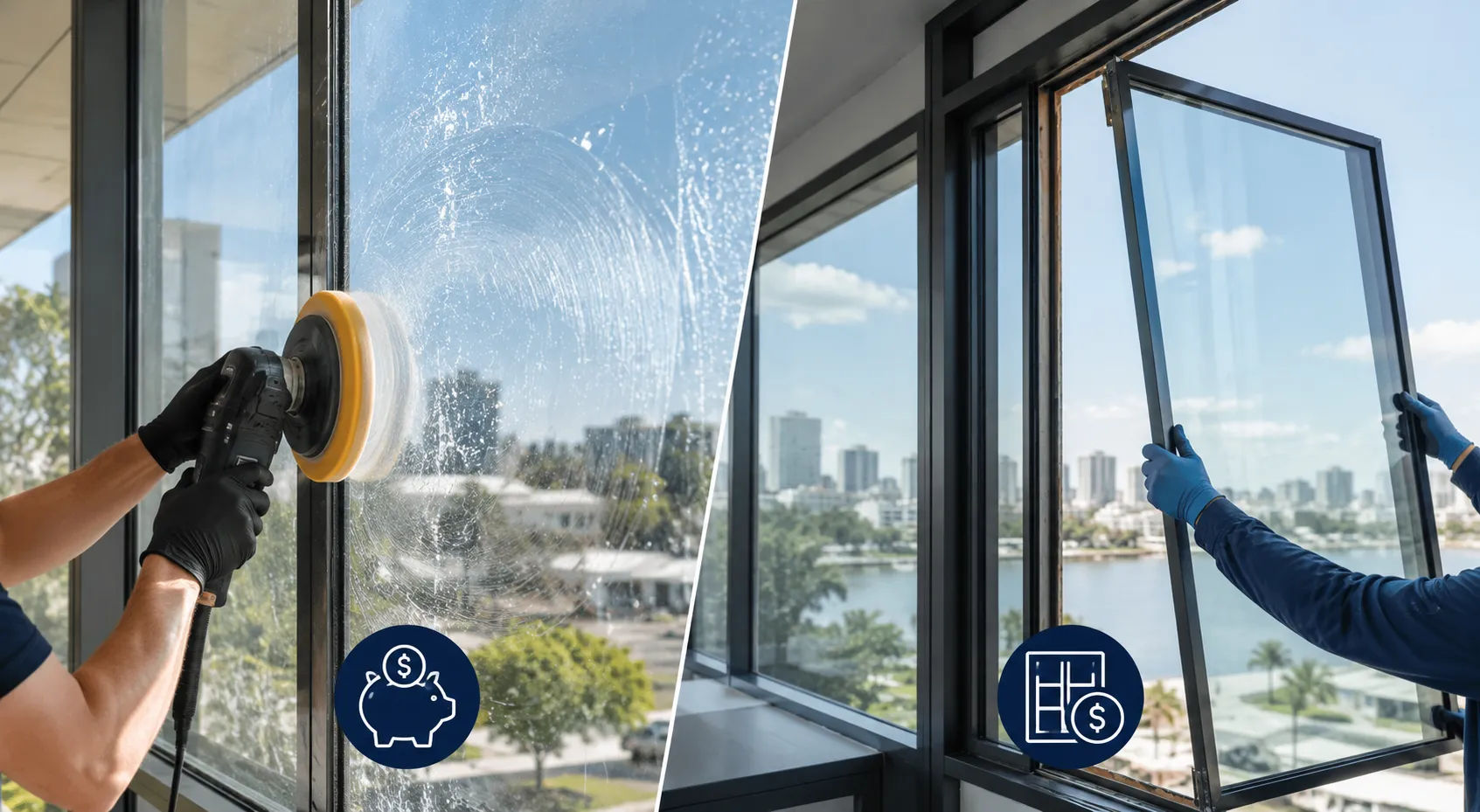
Glass Restoration vs Window Replacement: Which Saves More Money?
6th May 2026
Damaged, cloudy or scratched windows can affect a property's appearance, natural light, professional presentation and overall value. When glass begins to look worn, many homeowners, facility managers and commercial property owners assume that complete window replacement is the only practical option.
In many cases, professional glass restoration can reduce surface damage and improve clarity without replacing the existing pane. Retaining suitable glass may reduce labour, materials, disposal requirements and installation disruption while extending the window's useful life.
The most cost-effective option depends on the type of damage, the condition of the frame and seals, the performance of the window unit and the result you want to achieve. This guide compares glass restoration with window replacement to help you make an informed decision.
Quick Answer
Glass restoration usually saves more money when damage is limited to scratches, mineral deposits, hard water stains, surface haze, construction residue or minor etching. It retains the existing glass, reduces labour and waste and generally causes less disruption. Window replacement is usually the better investment when glass is cracked, seals have failed, frames are damaged or the window no longer performs safely or efficiently.
What Is Glass Restoration?
Glass restoration is a specialist process used to improve damaged or deteriorated glass without removing and replacing the entire pane.
Depending on the condition of the surface, technicians may use professional polishing equipment, abrasives, cleaning compounds and controlled restoration methods to reduce or remove visible imperfections.
Glass restoration may be suitable for:
- Light or moderate scratches
- Hard water stains
- Mineral deposits
- Surface haze
- Construction residue
- Paint overspray
- Environmental staining
- Minor surface etching
- Oxidation around exposed glass surfaces
The objective is to restore clarity while retaining the existing glass, frames, fittings and surrounding finishes.
What Is Window Replacement?
Window replacement involves removing damaged glass, replacing an insulated glass unit or installing an entirely new window system.
The scope depends on the condition of the glass and frame. Some properties may only require a replacement pane, while others may need complete frame removal, new seals, hardware, flashing and repairs to surrounding finishes.
Replacement is commonly required when there is:
- Cracked or shattered glass
- Significant impact damage
- Severe chips affecting safety
- A failed insulated glass unit
- Persistent condensation between panes
- A damaged, corroded or rotten frame
- Structural movement
- Water leakage caused by window failure
- Poor sealing that cannot be repaired
Although replacement provides a new pane or window system, it usually involves higher material, labour and installation costs.
Glass Restoration vs Window Replacement at a Glance
| Factor | Glass Restoration | Window Replacement |
|---|---|---|
| Best suited to | Cosmetic and surface damage | Structural, safety, seal or performance failure |
| Existing glass retained | Yes | No |
| Labour requirements | Usually lower | Usually higher |
| Property disruption | Often minimal | Moderate to significant |
| Material waste | Low | Higher |
| Custom manufacturing | Usually not required | May be required |
| Completion time | Often faster | May involve manufacturing and installation delays |
| Energy performance improvement | Limited if the existing unit remains functional | Potentially significant with upgraded glazing |
| Typical cost position | Lower | Higher |
| Long-term suitability | Good for restorable surface damage | Better for failed or unsafe window systems |
Which Option Usually Costs Less?
Glass restoration is generally less expensive because it avoids many of the costs associated with manufacturing, removing and installing a new pane or window system.
Why Glass Restoration Can Cost Less
Restoration may reduce project costs because:
- The existing glass remains in place
- Frames do not usually need to be removed
- Fewer replacement materials are required
- Labour time may be lower
- Waste and disposal requirements are reduced
- Surrounding walls and finishes are less likely to be disturbed
- Custom glass may not need to be ordered
For commercial properties with multiple affected panes, restoring suitable glass may produce significant savings compared with replacing every window.
Why Window Replacement Costs More
Window replacement costs may include:
- New glass
- New frames or insulated glass units
- Site measurement
- Custom manufacturing
- Removal of the existing window
- Installation labour
- Access equipment
- Waste disposal
- Sealant and finishing work
- Repairs to surrounding surfaces
- Repainting or touch-up work
The total cost may increase further when windows are above ground level, require specialist access or use non-standard glass.
When Glass Restoration Makes Financial Sense
Glass restoration is worth considering when the pane remains structurally sound and the damage is primarily cosmetic or limited to the exposed surface.
Scratched Glass
Light and moderate scratches may result from construction work, unsuitable cleaning tools, abrasive debris or contact with metal objects.
Professional polishing may reduce or remove these marks without replacing the pane. However, the expected result depends on scratch depth, glass thickness, location and any existing surface coatings.
Hard Water Stains
Sprinklers, rainwater runoff and repeated exposure to mineral-rich water can leave stubborn deposits on exterior glass.
Routine commercial window cleaning may remove surface dirt, but deeply bonded mineral deposits may require specialist restoration methods.
Construction Residue
New developments, fit-outs and renovation projects can leave glass affected by:
- Cement splatter
- Render residue
- Adhesive
- Paint overspray
- Sealant marks
- Fine construction debris
A professional assessment should be completed before attempting to scrape or polish construction residue. Incorrect techniques can scratch the glass or damage surface coatings.
Environmental Staining
Salt exposure, pollution, dirt and airborne contaminants can gradually dull exterior glass. This is particularly relevant for coastal properties, high-rise buildings, shopping centres and commercial premises near busy roads.
Surface Haze
Some windows develop a cloudy or hazy appearance even though the pane is not cracked or structurally damaged.
Where the problem is limited to the exterior or interior surface, professional treatment may improve clarity without requiring replacement.
When Window Replacement Is the Better Investment
The lowest upfront cost is not always the best long-term choice. Replacement is usually more appropriate when the glass or surrounding window system cannot be restored safely or effectively.
Cracked or Shattered Glass
Cracked glass can create a safety risk and may continue to deteriorate. Surface polishing cannot repair a structural fracture, so the damaged pane should be assessed for replacement.
Failed Double-Glazing Seals
Fogging or moisture trapped between double-glazed panes commonly indicates a failed insulated glass unit.
Because the moisture is inside the sealed unit, cleaning or restoring the exposed surfaces will not correct the underlying problem.
Damaged Window Frames
Even clear glass will not perform properly if the surrounding frame is:
- Rotten
- Corroded
- Distorted
- Loose
- Structurally damaged
- Allowing water penetration
In these situations, repairing or replacing the frame or complete window system may offer better long-term value.
Poor Energy Performance
Older windows may allow excessive heat transfer, drafts or air leakage. If the main objective is to improve thermal performance rather than appearance, replacing the existing unit with higher-performing glazing may be more appropriate.
Safety or Compliance Concerns
Some older glass may not be suitable for its location or intended use. Replacement may be required where safety glass, laminated glass or another compliant glazing product is necessary.
A qualified glazing professional should assess safety, structural or compliance concerns.
Cost Comparison Beyond the Initial Invoice
When comparing restoration and replacement, consider the total project cost rather than the quoted service price alone.
| Cost Factor | Glass Restoration | Window Replacement |
|---|---|---|
| Materials | Cleaning and polishing materials | New glass, frames, seals and hardware |
| Labour | On-site surface treatment | Removal, installation, sealing and finishing |
| Access equipment | May be required for elevated glass | May require longer or more complex access |
| Business disruption | Usually limited | May require restricted access and temporary closures |
| Waste disposal | Minimal | Old glass, frames and packaging may require disposal |
| Surrounding repairs | Rarely required | May include plaster, paint, sealant or façade repairs |
| Energy savings | No significant change to existing performance | Possible when upgrading to higher-performing glazing |
A cheaper immediate solution may not be economical if the complete window system is already failing. Likewise, replacing structurally sound glass may be unnecessary when restoration can achieve the required result.
Time and Convenience
Glass restoration is often faster and less disruptive than replacement, particularly when the existing glass can be treated in place.
What to Expect from Glass Restoration
Depending on the number of panes, accessibility and extent of damage, restoration may offer:
- On-site treatment
- Minimal disruption
- No frame removal
- Less noise
- Reduced waste
- Faster access to restored areas
- No manufacturing delay for replacement glass
This can be especially valuable for offices, retail premises, healthcare facilities, strata buildings and other occupied properties.
What to Expect from Window Replacement
- Site inspection and measurement
- Selection of a suitable glass or window unit
- Ordering and manufacturing
- Removal of the existing glass or window
- Installation of the replacement unit
- Sealing and finishing
- Disposal of removed materials
- Repair of surrounding areas where necessary
Businesses may need to restrict access to parts of the property while removal and installation are completed.
Energy-Efficiency Considerations
Surface staining or scratches do not necessarily mean a window has lost its thermal performance.
If the frame, seals, glazing system and insulated unit remain functional, restoring surface clarity may be sufficient to retain the window's existing performance.
Replacement should be considered where there is:
- Air leakage
- Damaged seals
- Failed double glazing
- Persistent condensation between panes
- Excessive heat transfer
- Poor frame performance
- Water penetration
Property owners should avoid replacing windows solely because of surface appearance without first confirming whether the existing units remain functional and restorable.
Environmental Benefits of Glass Restoration
Restoration may be a more sustainable option when the existing glass remains safe and usable.
Potential environmental benefits include:
- Reduced construction waste
- Less glass sent for disposal
- Lower demand for replacement materials
- Reduced transportation requirements
- Less product packaging
- Extended material lifespan
- Reduced disturbance to surrounding building materials
For organisations working towards waste reduction or environmental targets, restoration may support broader commercial property maintenance goals.
Appearance and Property Presentation
Clean, clear glass can improve the presentation of residential and commercial properties.
Restored or replaced windows may enhance:
- Street appeal
- Natural light
- Interior presentation
- Retail displays
- Client impressions
- Building appearance
- Workplace presentation
- Perceived property condition
Restoration can be particularly useful where scratched or stained glass affects entrances, shopfronts, reception areas, internal partitions or meeting rooms.
Glass Restoration for Commercial Properties
Commercial buildings often contain large areas of glazing, making complete replacement expensive and disruptive.
Professional glass restoration may be suitable for:
- Office buildings
- Hotels and accommodation properties
- Retail stores
- Shopping centres
- Schools and education facilities
- Healthcare facilities
- Strata properties
- Restaurants
- Showrooms
- Industrial facilities
- Construction sites
- Government buildings
Restoration may also be coordinated with routine window care, façade cleaning or broader commercial cleaning services.
Elevated glazing may require specialist access planning. Corporate Cleaning Services® also provides professional high-rise window cleaning for suitable commercial properties.
Common Mistakes to Avoid
Replacing Glass Without Requesting an Assessment
Why it happens: Replacement appears to be the most straightforward solution.
Potential consequence: Structurally sound glass may be discarded unnecessarily, increasing labour, material and disposal costs.
How to avoid it: Arrange a professional assessment to determine whether the damage is limited to a restorable surface.
Assuming Every Scratch Can Be Removed
Why it happens: Glass restoration is sometimes presented as a solution for all surface damage.
Potential consequence: Deep scratches may remain visible, or aggressive polishing may affect optical clarity.
How to avoid it: Ask the provider to assess the scratch depth, glass thickness, surface coating and expected result before work begins.
Ignoring the Condition of Frames and Seals
Why it happens: Attention is focused only on the visible pane.
Potential consequence: Restoring the glass will not correct leaks, drafts, corrosion or structural movement.
How to avoid it: Inspect the complete window system, including frames, seals, fittings and surrounding finishes.
Using Abrasive DIY Products
Why it happens: Property owners attempt to remove stains or scratches using household cleaners, blades or polishing pads.
Potential consequence: Incorrect products can worsen scratches, create optical distortion or damage protective coatings.
How to avoid it: Use non-abrasive routine cleaning methods and leave specialist restoration to trained professionals.
Choosing Based Only on the Upfront Price
Why it happens: The lowest quote appears to offer the greatest saving.
Potential consequence: The chosen option may not provide suitable safety, durability or long-term performance.
How to avoid it: Compare the expected lifespan, disruption, maintenance requirements, energy performance and complete project cost.
Benefits of Professional Glass Restoration
Lower Project Costs
Retaining the existing glass can reduce material, manufacturing, installation and disposal costs.
Minimal Disruption
Most suitable restoration work can be completed without removing the window or disturbing surrounding walls and finishes.
Improved Presentation
Reducing stains, haze and scratches can restore a clearer and more professional appearance.
Reduced Waste
Restoration extends the life of existing materials and avoids unnecessary disposal.
Faster Completion
Many restoration projects can be completed without waiting for custom replacement glass to be manufactured.
Preventative Property Maintenance
Addressing surface deterioration early can help preserve the appearance of glazing and reduce the likelihood of premature replacement.
Benefits of Window Replacement
Replacement offers important advantages when the existing glass or window system is no longer suitable.
- Improved thermal performance
- Better air and water sealing
- Enhanced safety
- Reduced leakage
- New frames and hardware
- Improved noise control
- Compliance with current requirements
- A longer service life for failed units
The key is to use replacement where it delivers a meaningful safety, structural or performance improvement rather than replacing suitable glass because of repairable cosmetic damage.
Questions to Ask Before Choosing
- Is the damage cosmetic or structural?
- Are there cracks or deep chips?
- Is the damage on the exposed surface or between the panes?
- Are the frames and seals still in good condition?
- Is water entering around the window?
- Is there persistent fogging between panes?
- Will restoration provide the finish you expect?
- How much disruption will each option cause?
- What is the expected lifespan of each solution?
- Are there safety or compliance requirements?
These questions help ensure the decision is based on safety, performance and long-term value rather than appearance alone.
Maintenance Tips for Restored Glass
After professional restoration, regular maintenance can help preserve the result.
- Clean glass regularly using non-abrasive products
- Avoid unapproved metal scrapers or abrasive pads
- Remove bird droppings, salt and mineral deposits promptly
- Redirect sprinklers away from windows
- Use clean microfibre cloths
- Avoid harsh chemicals on coated glass
- Schedule routine professional window cleaning
- Inspect seals and frames periodically
- Address water leaks promptly
- Arrange professional cleaning for difficult exterior glass
Commercial properties should include glazing inspections in their broader preventative cleaning and maintenance program.
Which Option Saves More Money?
| Choose Glass Restoration When | Choose Window Replacement When |
|---|---|
| The glass is structurally sound | The glass is cracked, chipped or unsafe |
| Damage is limited to the surface | The insulated glass unit has failed |
| Frames and seals remain functional | Frames or seals are damaged |
| The main goal is improved clarity and presentation | Water leakage or significant air leakage is present |
| Replacement would require costly access or installation | Energy performance requires a meaningful upgrade |
| The expected restoration result meets the property's needs | The window system has reached the end of its useful life |
Glass restoration usually saves more money when the pane is structurally sound and the damage is limited to a restorable surface. Window replacement generally offers better long-term value when the glazing, seals, frames or complete window system have failed.
A professional assessment is the most reliable way to determine which option is technically appropriate and likely to provide the best financial outcome.
Final Thoughts
Glass restoration can be a cost-effective alternative to window replacement when damage is limited to scratches, mineral deposits, surface haze, construction residue or environmental staining. It retains existing materials, reduces waste, limits disruption and can significantly improve the appearance of residential and commercial glass.
Replacement remains the better choice when windows are cracked, structurally damaged, leaking, poorly sealed or affected by failed insulated glass units. In these situations, investing in a new pane or complete window system may provide better safety, performance and long-term value.
Before approving replacement, arrange an assessment of the glass, frames, seals and surrounding window system. Understanding the source and severity of the damage can help you avoid unnecessary costs and select the option that provides the best balance of appearance, performance, durability and value.
Corporate Cleaning Services® provides professional window cleaning and exterior property maintenance for commercial facilities across Australia. To discuss stained or deteriorated commercial glass, arrange a site inspection or request a tailored cleaning quote.
Frequently Asked Questions
Is glass restoration cheaper than window replacement?
In many cases, yes. Glass restoration generally costs less because the existing pane and frame remain in place, reducing material, manufacturing, installation and disposal requirements. The actual saving depends on the extent of the damage, accessibility and the number and size of the affected windows.
Can scratched glass be fully restored?
Light and moderate scratches can often be reduced or removed. Deep scratches may remain visible or may not be suitable for restoration without affecting optical clarity. A technician should assess the depth, location, glass thickness and surface coating before confirming the expected result.
Can hard water stains be removed from windows?
Many hard water stains and mineral deposits can be reduced using professional cleaning or glass restoration methods. Results depend on how long the deposits have remained and whether they have etched the surface. Deep chemical damage may not be completely reversible.
Can cloudy double glazing be restored?
Cloudiness between double-glazed panes usually indicates moisture inside a failed sealed unit. Cleaning or polishing the exterior surfaces cannot remove condensation trapped between the panes. The insulated glass unit may need to be repaired or replaced by a qualified glazing professional.
How long does glass restoration take?
The timeframe depends on the number and size of the panes, the severity of the damage, accessibility and the restoration method. Surface restoration is generally faster than ordering and installing replacement windows, particularly when the existing glass can be treated in place.
Does glass restoration improve energy efficiency?
Glass restoration improves surface clarity but does not normally change the thermal performance of the window. If the seals, frames and glazing unit remain functional, the existing efficiency can be retained. Failed seals, air leakage or outdated glazing may require repair or replacement.
Is glass restoration suitable for commercial buildings?
Yes. Restoration may be suitable for offices, retail properties, hotels, strata buildings, schools, healthcare facilities and other commercial premises with scratched or stained glass. Suitability depends on the type of glass, the severity of the damage and the expected finish.
When should a window be replaced instead of restored?
Replacement is generally recommended when the glass is cracked, unsafe or structurally damaged, when seals or insulated units have failed or when frames allow water or air leakage. Restoration cannot correct structural failure or damage located between sealed panes.
Can I restore damaged glass myself?
DIY polishing products, abrasive pads and metal tools can worsen scratches, create distortion or damage glass coatings. Use routine non-abrasive cleaning for ordinary dirt, but arrange a professional assessment for significant scratches, staining, mineral deposits or etching.
How can businesses prevent future glass damage?
Schedule regular cleaning, use suitable tools and chemicals, remove mineral deposits and salt residue promptly and direct sprinklers away from windows. Construction teams should also protect nearby glazing from cement, paint, sealants and abrasive debris during building work.