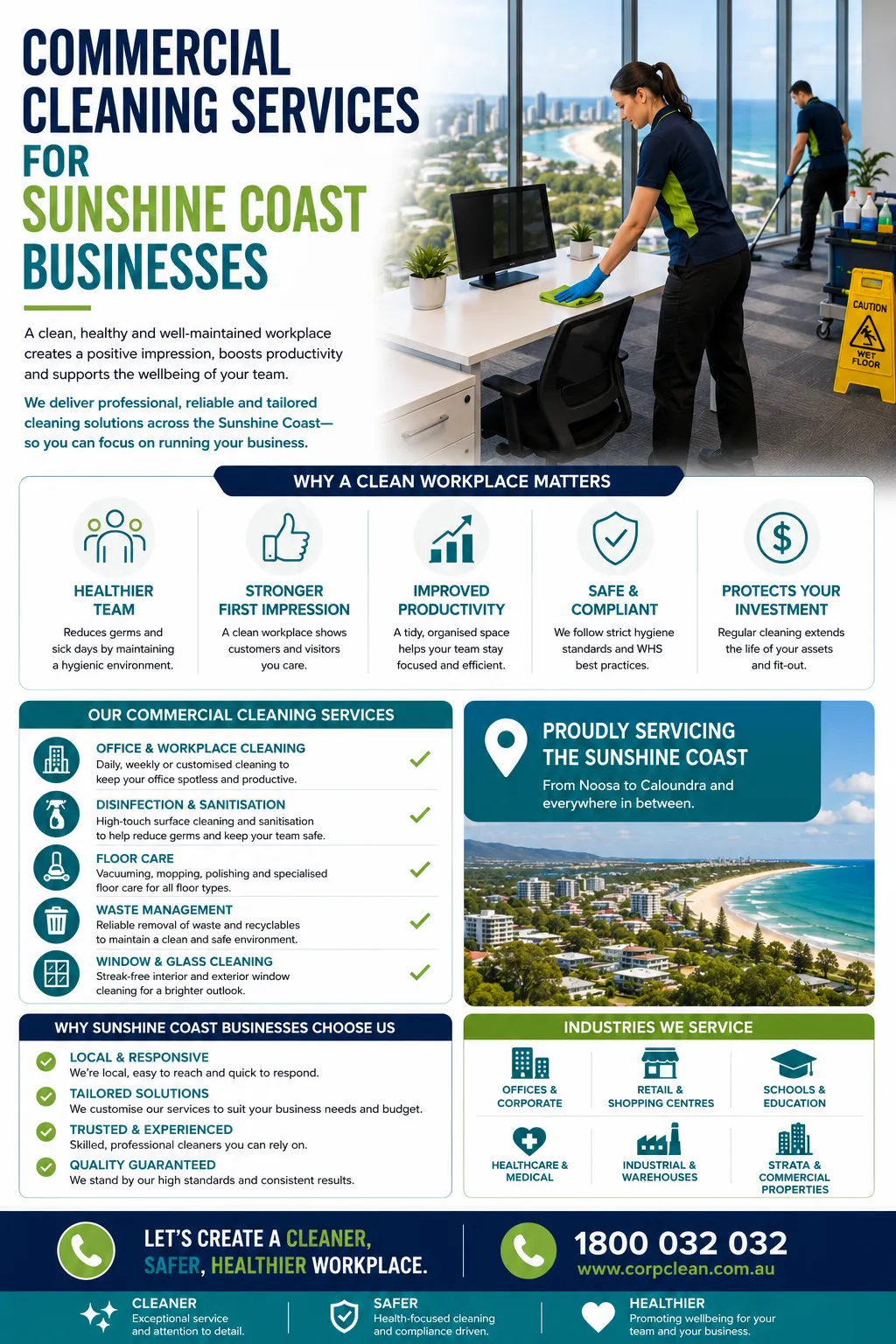
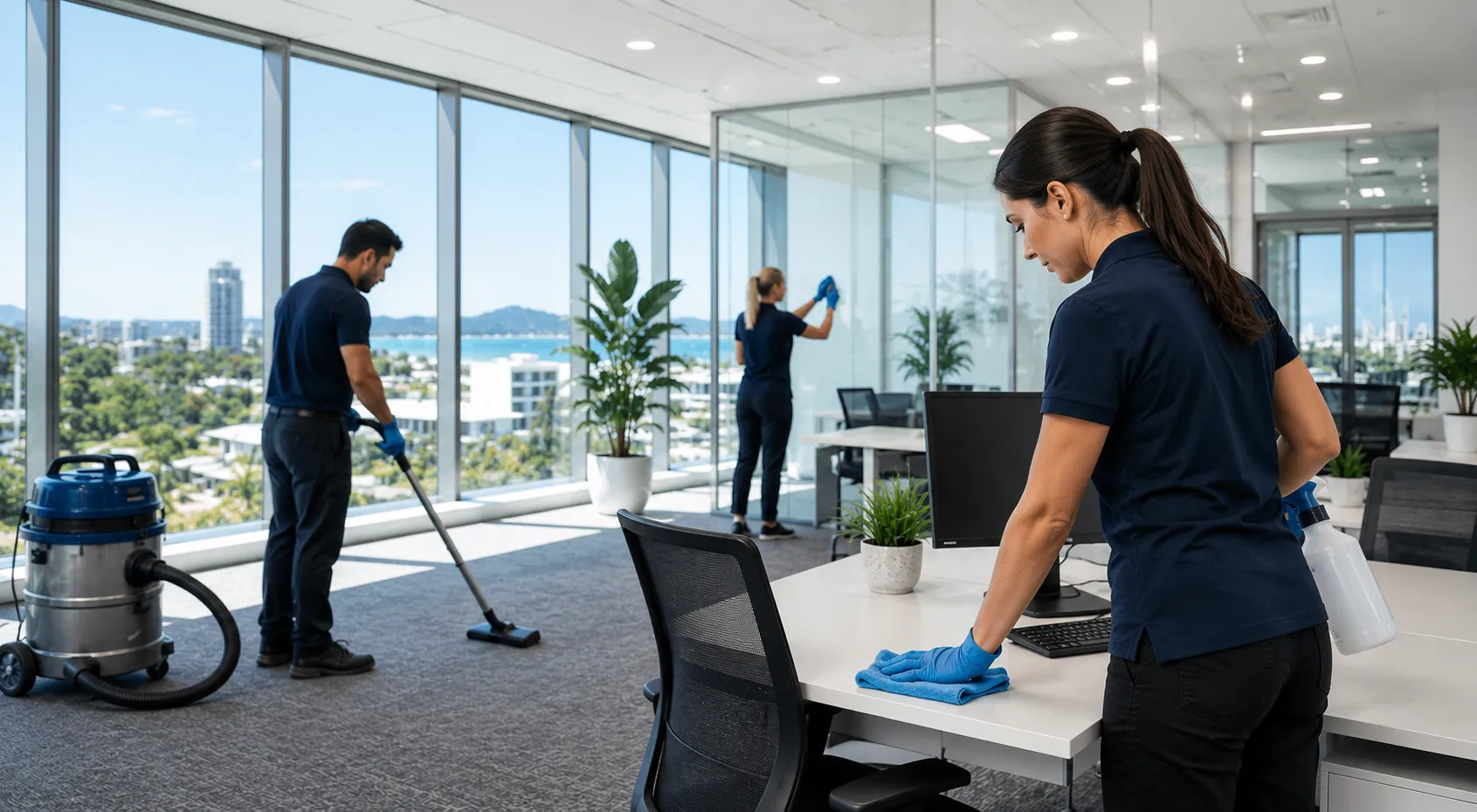
Commercial Cleaning Services for Sunshine Coast Businesses
13th May 2026
A clean and well-maintained workplace supports more than appearances. It contributes to employee wellbeing, creates a welcoming environment for customers and helps businesses maintain their premises, flooring, furniture and shared facilities.
For Sunshine Coast businesses, professional commercial cleaning provides a structured and reliable way to manage workplace cleanliness without expecting employees to complete major cleaning tasks alongside their usual responsibilities.
Whether you operate an office, retail store, medical practice, school, hospitality venue, warehouse or industrial facility, the right cleaning program should reflect how the premises are used. This guide explains what commercial cleaning services commonly include, how often they may be required and what to consider when choosing a provider.
Quick Answer
Commercial cleaning services for Sunshine Coast businesses commonly include floor cleaning, dusting, rubbish removal, restroom sanitisation, kitchen cleaning and high-touch surface disinfection. Businesses may also arrange carpet cleaning, window cleaning, pressure cleaning, hard floor maintenance and post-construction cleaning. The most effective program is tailored to the property's size, industry, visitor numbers, operating hours and hygiene requirements.
Why Commercial Cleaning Matters
A workplace is often one of the first physical interactions a customer, visitor, employee or supplier has with a business. Dirty floors, dusty reception areas, overflowing bins or poorly maintained bathrooms can quickly affect how an organisation is perceived.
Regular commercial cleaning services help businesses maintain a consistent standard rather than reacting only when an area becomes visibly dirty.
Key benefits include:
- Improved workplace hygiene
- Cleaner shared facilities
- Reduced dust and surface contamination
- A more professional business presentation
- Better maintenance of carpets and flooring
- More comfortable conditions for employees
- Reduced pressure on internal staff
- Greater consistency across the premises
Professional cleaning also supports preventative property maintenance by addressing dirt, spills and build-up before they become more difficult or expensive to remove.
Which Businesses Benefit from Commercial Cleaning?
Commercial cleaning services can be adapted for many types of Sunshine Coast workplaces.
- Corporate offices
- Professional service firms
- Retail stores
- Shopping centres
- Medical and dental practices
- Allied health clinics
- Schools and education facilities
- Childcare centres
- Restaurants and cafés
- Accommodation and hospitality venues
- Gyms and fitness centres
- Real estate agencies
- Warehouses
- Workshops
- Industrial facilities
- Strata properties
- Government facilities
Each environment presents different cleaning challenges. An office may prioritise desks, meeting rooms, bathrooms and shared kitchens, while a retail business may require greater attention to entrances, floors, glass, fitting rooms and customer-facing areas.
Healthcare and education environments may also need more detailed procedures, greater attention to high-touch surfaces and carefully selected cleaning products.
What Is Included in Commercial Cleaning Services?
Commercial cleaning plans vary between businesses and providers. The scope should be documented clearly so both parties understand which tasks are included, how often they will be completed and whether any areas require specialist treatment.
General Workplace Cleaning
Routine business cleaning usually addresses the areas used most frequently by employees and visitors.
Typical tasks include:
- Vacuuming carpets and entrance mats
- Sweeping and mopping hard floors
- Dusting furniture and accessible surfaces
- Emptying rubbish and recycling bins
- Replacing bin liners
- Cleaning reception and waiting areas
- Tidying meeting rooms
- Spot-cleaning internal glass
- Wiping doors and partitions
- Cleaning agreed desks and workstations
The cleaning plan should clarify whether cleaners are permitted to move paperwork, personal items, equipment or confidential materials.
Restroom Cleaning and Sanitisation
Bathrooms require regular attention because they receive frequent use and strongly influence how people perceive the overall cleanliness of a workplace.
Restroom cleaning may include:
- Cleaning and sanitising toilets
- Cleaning urinals
- Wiping sinks and taps
- Polishing mirrors
- Disinfecting high-touch surfaces
- Mopping floors
- Emptying bins
- Restocking soap
- Restocking toilet paper and hand towels
- Reporting leaks, damage or supply shortages
Consumable products may be supplied by the business or managed as part of a hygiene services agreement.
Kitchen and Staff Room Cleaning
Shared kitchens, tea rooms and staff break areas can quickly accumulate food residue, spills, crumbs and unpleasant odours.
Regular cleaning may include:
- Wiping benches and tables
- Cleaning sinks and taps
- Sanitising shared surfaces
- Cleaning cupboard fronts
- Wiping appliance exteriors
- Spot-cleaning microwaves
- Emptying food waste bins
- Mopping floors
- Cleaning splashbacks
Internal refrigerator, microwave, oven or cupboard cleaning is not always included in a routine service, so these tasks should be specified in advance.
High-Touch Surface Cleaning
High-touch surfaces are handled repeatedly throughout the day and may require more frequent attention than general surfaces.
Common touchpoints include:
- Door handles
- Light switches
- Lift buttons
- Handrails
- Reception counters
- Shared desks
- Meeting room tables
- Kitchen appliance handles
- Bathroom fixtures
- Shared telephones
- Shared keyboards and office equipment
The cleaning method and frequency should suit the workplace. In some environments, routine wiping may be sufficient, while others may require more regular sanitisation.
Reception and Customer-Facing Areas
Reception areas, showrooms, waiting rooms and entrances contribute significantly to a customer's first impression.
Cleaning may involve:
- Vacuuming or mopping floors
- Removing fingerprints from glass
- Dusting reception desks
- Cleaning waiting room furniture
- Emptying bins
- Straightening chairs and reading materials
- Cleaning entry doors
- Spot-cleaning walls and partitions
These areas may need more frequent attention than staff-only spaces, particularly in high-traffic businesses.
Flexible Commercial Cleaning Schedules
The right cleaning schedule depends on how frequently the workplace is used and how quickly dirt, waste and surface contamination accumulate.
Commercial cleaning may be arranged:
- Daily
- Several times per week
- Weekly
- Fortnightly
- Early in the morning
- After business hours
- Overnight
- On weekends
- During shutdown periods
- Before or after events
Cleaning outside business hours can reduce disruption, but it requires appropriate access, security procedures, alarm instructions and key management.
How Often Should a Commercial Workplace Be Cleaned?
There is no single cleaning frequency that suits every business.
The schedule should consider:
- Number of employees
- Daily customer traffic
- Size of the premises
- Number of bathrooms
- Food preparation areas
- Type of flooring
- Waste volume
- Operating hours
- Industry requirements
- Seasonal conditions
- Shared equipment and facilities
- Existing internal cleaning responsibilities
| Workplace Type | Common Cleaning Frequency | Main Priorities |
|---|---|---|
| Small low-traffic office | Once or twice per week | Floors, bins, kitchen and bathrooms |
| Medium office | Two to five times per week | Workstations, meeting rooms, amenities and reception |
| Large corporate office | Daily | High-traffic areas and shared facilities |
| Retail premises | Several times per week or daily | Entrances, floors, glass and customer areas |
| Medical or allied health practice | Daily or according to site requirements | Treatment areas, waiting rooms and high-touch surfaces |
| School or childcare facility | Daily during operating periods | Classrooms, bathrooms, floors and shared equipment |
| Hospitality venue | Daily with task-specific cleaning throughout service | Dining areas, amenities, floors and waste |
| Warehouse or industrial facility | Based on site activity and risk | Dust, waste, floors, amenities and safety-sensitive areas |
These are general examples only. An on-site inspection provides a more reliable basis for determining cleaning frequency.
Specialised Commercial Cleaning Services
Routine cleaning focuses on everyday presentation and hygiene. Specialist cleaning addresses surfaces, equipment or areas requiring different techniques and commercial-grade machinery.
Carpet Cleaning
Vacuuming removes loose dirt, but it does not address all embedded soil, spills, stains and odours.
Professional carpet cleaning may involve:
- Hot water extraction
- Low-moisture cleaning
- Spot treatment
- Stain treatment
- Deodorising
- Scheduled preventative maintenance
The appropriate method depends on the carpet fibre, installation, condition, access and required drying time.
Window Cleaning
Regular window cleaning helps maintain natural light and a professional exterior appearance.
Services may include:
- Internal glass cleaning
- External glass cleaning
- Shopfront cleaning
- Partition glass cleaning
- Window track cleaning
- Water-fed pole cleaning
- High-access window cleaning where suitable
Frequency depends on location, weather exposure, salt, traffic pollution, fingerprints and customer visibility.
Hard Floor Maintenance
Hard floors require more than routine sweeping and mopping.
Periodic hard floor maintenance may include:
- Machine scrubbing
- Buffing
- Burnishing
- Stripping and resealing
- Grout cleaning
- Polishing
- Protective coating maintenance
A suitable maintenance plan helps protect the finish and reduces the risk of permanent staining or premature wear.
Pressure Cleaning
Pressure cleaning can help remove dirt, grime, mould and surface build-up from suitable outdoor areas.
Common applications include:
- Building entrances
- Paths
- Concrete surfaces
- Loading areas
- Courtyards
- Car parks
- Bin storage areas
- External walls
The pressure, equipment and cleaning method must be suitable for the surface to avoid damage.
Post-Construction Cleaning
Construction, refurbishment and fit-out projects may leave behind fine dust, packaging, adhesive residue, paint marks and building debris.
Post-construction cleaning may include:
- Fine dust removal
- Floor cleaning
- Internal window cleaning
- Cabinet and joinery cleaning
- Fixture cleaning
- Bathroom and kitchen cleaning
- Detailed edge and corner cleaning
- Final presentation cleaning before occupancy
Sites involving hazardous construction dust may require specialist controls and should not be treated as standard office cleaning.
End-of-Lease Commercial Cleaning
Businesses leaving a tenancy may need a more detailed service than routine cleaning.
An end-of-lease clean may address:
- Floors and carpets
- Bathrooms
- Kitchens
- Glass
- Walls and skirting boards
- Cupboards
- Fixtures
- Rubbish removal
- Agreed tenancy requirements
The scope should be compared with the lease, property manager's instructions and final inspection expectations.
Routine Cleaning vs Specialist Cleaning
| Service Type | Typical Tasks | Common Frequency |
|---|---|---|
| Routine commercial cleaning | Vacuuming, mopping, dusting, bins, bathrooms and kitchens | Daily to fortnightly |
| Carpet cleaning | Extraction, low-moisture cleaning and stain treatment | Periodic or as required |
| Window cleaning | Internal, external, shopfront and high-access glass | Monthly, quarterly or as required |
| Hard floor maintenance | Scrubbing, buffing, burnishing and resealing | Scheduled according to floor condition |
| Pressure cleaning | Outdoor concrete, paths, loading areas and external surfaces | Seasonally or as required |
| Post-construction cleaning | Fine dust, residue, fixtures, joinery and final presentation | After construction or fit-out work |
Benefits of Professional Commercial Cleaning
A Healthier Work Environment
Regular cleaning helps remove dust, allergens, food residue, waste and contaminants from frequently used areas.
While cleaning cannot prevent every illness, a well-managed program supports better workplace hygiene and encourages employees to maintain shared spaces.
A More Professional Business Image
Customers and visitors notice entrances, floors, bathrooms, reception areas and visible glass.
A consistently clean workplace communicates organisation, professionalism and attention to detail.
Improved Employee Comfort and Productivity
Cluttered, dusty or poorly maintained spaces can be distracting and uncomfortable.
Professional workplace cleaning allows employees to work in a more orderly environment without being expected to manage major cleaning tasks themselves.
Longer-Lasting Flooring and Furnishings
Dirt and abrasive particles can gradually damage carpet fibres, floor finishes, upholstered furniture and entrance surfaces.
Routine cleaning and scheduled deep cleaning can help extend the usable life of these assets.
More Consistent Cleaning Standards
Relying on employees to clean shared facilities often produces uneven results.
A professional cleaning company should use documented tasks, cleaning checklists, trained personnel, suitable products and quality assurance procedures to maintain a consistent standard.
Reduced Management Burden
Managing cleaning internally can involve purchasing chemicals, storing equipment, allocating staff, monitoring consumables and resolving missed tasks.
Outsourcing commercial cleaning allows managers and employees to focus on their main responsibilities while the provider manages the agreed program.
Long-Term Cost Control
Preventative cleaning can reduce the need for emergency stain removal, premature floor restoration, furniture replacement and major corrective deep cleaning.
A regular service also makes cleaning costs more predictable and easier to budget.
Eco-Friendly Commercial Cleaning
Many Sunshine Coast businesses want to reduce their environmental impact without compromising cleanliness.
An environmentally responsible cleaning program may include:
- Concentrated or refillable products
- Biodegradable products where suitable
- Low-toxicity cleaning chemicals
- Reusable microfibre systems
- Accurate chemical dilution
- Water-efficient equipment
- Waste separation
- Reduced single-use plastic
- Energy-efficient machinery
- Responsible product selection
A product being labelled environmentally friendly does not automatically mean it is suitable for every surface or hygiene requirement. Products should still be selected according to manufacturer instructions, surface compatibility, safety data and the task being completed.
How to Choose a Commercial Cleaning Company
The right provider should offer more than a general promise to keep the premises clean. Look for a company that takes time to understand the property, operating conditions and expected outcomes.
Relevant Commercial Cleaning Experience
Ask whether the provider has experience with properties similar to yours.
A cleaner experienced in small offices may not automatically have the equipment, staffing or procedures needed for a healthcare facility, school, industrial site or multi-storey building.
Trained and Supervised Cleaning Staff
Cleaning staff should understand:
- Correct chemical use
- Colour-coded cleaning systems
- Cross-contamination prevention
- Equipment operation
- Site security
- Manual handling
- Hazard reporting
- Workplace-specific procedures
There should also be a clear process for supervision, quality checks and replacement staff.
Appropriate Insurance
Confirm that the provider carries insurance appropriate to the services being performed.
The required cover may vary depending on the premises, access arrangements, equipment and scope of work.
A Customised Cleaning Plan
A good cleaning plan should identify:
- Areas to be cleaned
- Tasks in each area
- Cleaning frequency
- Excluded tasks
- Consumable responsibilities
- Access arrangements
- Specialist services
- Reporting procedures
- Quality inspection processes
- Contacts for service issues
Avoid relying on vague descriptions such as “general cleaning” without a detailed task schedule.
Clear Communication
Businesses should know who to contact when they need to:
- Report a missed task
- Update access instructions
- Add an area
- Request a deep clean
- Change the schedule
- Report damage
- Arrange extra services
Responsive communication is particularly important when cleaning occurs outside normal operating hours.
Quality Assurance Procedures
Ask how the provider checks its work.
Quality assurance may include:
- Supervisor inspections
- Site checklists
- Digital reporting
- Client review meetings
- Corrective action records
- Staff training reviews
- Periodic service audits
A clear process makes it easier to identify and resolve problems before they become recurring issues.
Transparent Pricing
A quote should explain what is included rather than providing only a single total price.
Check whether pricing covers:
- Labour
- Equipment
- Cleaning chemicals
- Consumables
- Travel
- Specialist services
- After-hours work
- Public holiday work
- Waste disposal
- Emergency call-outs
This makes it easier to compare providers fairly.
Signs Your Cleaning Service Needs Improvement
Your existing cleaning program may need to be reviewed if you notice:
- Dust returning quickly
- Dirty corners and skirting boards
- Unpleasant bathroom or kitchen odours
- Overflowing rubbish bins
- Sticky floors
- Frequent employee or customer complaints
- Smudged glass and doors
- Missed high-touch areas
- Inconsistent staffing
- Poor communication
- Declining carpet or floor condition
- Cleaning tasks regularly being completed by employees
One isolated issue may not require a complete provider change. Repeated problems, however, may indicate that the cleaning schedule, staffing level, task list or quality controls are inadequate.
Common Commercial Cleaning Mistakes to Avoid
Choosing a Provider Based Only on Price
Why it happens: Cleaning is treated as a basic overhead rather than an operational service.
Potential consequence: Important tasks may be excluded, insufficient time may be allocated and service quality may become inconsistent.
How to avoid it: Compare the scope, visit frequency, staffing, equipment, supervision and quality assurance process, not just the total quote.
Using a Generic Cleaning Plan
Why it happens: A standard task list is quicker to organise.
Potential consequence: High-use areas may be under-cleaned while low-priority areas receive unnecessary attention.
How to avoid it: Develop a cleaning checklist based on the actual property, occupancy and operating patterns.
Failing to Define Responsibilities
Why it happens: The business and cleaner each assume the other party will handle certain tasks.
Potential consequence: Consumables run out, bins are missed, appliances remain dirty or waste is handled incorrectly.
How to avoid it: Document who is responsible for consumables, dishes, personal desks, food waste, recycling, internal appliances and specialist tasks.
Ignoring Periodic Deep Cleaning
Why it happens: Routine cleaning keeps visible areas looking acceptable.
Potential consequence: Carpet soil, floor wear, grout discolouration, high-level dust and upholstery stains become progressively harder to address.
How to avoid it: Include carpet cleaning, hard floor maintenance, window cleaning and detailed cleaning in the annual maintenance schedule.
Setting the Wrong Cleaning Frequency
Why it happens: The schedule is based on budget or an old service agreement rather than current use.
Potential consequence: Bathrooms, bins, floors and kitchens deteriorate between visits.
How to avoid it: Review cleaning frequency when staff numbers, opening hours, visitor traffic or site use changes.
Failing to Monitor Results
Why it happens: Cleaning occurs after hours, so managers rarely see it being completed.
Potential consequence: Missed tasks continue for weeks before being reported.
How to avoid it: Conduct regular inspections and maintain a simple process for employees to report recurring concerns.
Maintenance Tips Between Professional Cleaning Visits
Employees do not need to replace professional cleaners, but simple workplace habits can help maintain results between visits.
Encourage staff to:
- Clean spills promptly
- Place waste in the correct bins
- Keep food in sealed containers
- Wipe shared kitchen surfaces after use
- Avoid leaving dishes in sinks
- Report leaks and damaged fixtures
- Keep floor areas free from clutter
- Use entrance mats during wet weather
- Store personal belongings neatly
- Report stains before they set
Businesses can also support the cleaning program by maintaining ventilation, replacing filters as recommended, keeping storage areas accessible and ensuring cleaners can reach the surfaces included in the service agreement.
Why Work with a Local Sunshine Coast Cleaning Provider?
A provider operating regularly across the Sunshine Coast may offer practical advantages, particularly for businesses requiring flexible scheduling or additional services.
Potential benefits include:
- Familiarity with local business areas
- Faster response to service requests
- Easier on-site assessments
- Flexible scheduling
- Access to local supervisors and support
- Cleaning plans suited to coastal conditions
- Ongoing relationships with local businesses
Local availability should not be the only selection criterion, but it can contribute to more responsive service when combined with suitable experience, staffing and quality controls.
Questions to Ask Before Accepting a Cleaning Quote
- What tasks are included in the quote?
- Which tasks are excluded?
- How many cleaning hours are allocated?
- Will the same cleaners attend regularly?
- How are replacement staff managed?
- Who supervises the cleaners?
- What insurance does the company hold?
- Are cleaning products and equipment included?
- Who supplies bathroom and kitchen consumables?
- How are service issues reported?
- How often are quality inspections completed?
- Can the cleaning schedule be adjusted?
- What specialist services are available?
- Are after-hours and weekend rates different?
- What notice is required to change or end the agreement?
Clear answers help businesses compare service quality and avoid unexpected costs.
What Should Be Included in a Cleaning Agreement?
| Agreement Section | What It Should Explain |
|---|---|
| Scope of work | Areas, tasks, exclusions and cleaning standards |
| Schedule | Service days, times, frequency and shutdown arrangements |
| Consumables | Who supplies soap, paper products, bin liners and related items |
| Access and security | Keys, alarms, restricted areas and authorised contacts |
| Quality assurance | Inspections, reporting, complaints and corrective action |
| Pricing | Regular fees, extra services, public holidays and call-outs |
| Agreement terms | Review dates, notice periods and change procedures |
Final Thoughts
Professional commercial cleaning helps Sunshine Coast businesses maintain cleaner, more presentable and easier-to-manage workplaces. The most effective services are not based on a generic checklist. They are built around the property's layout, occupancy, operating hours, surfaces, industry and day-to-day cleaning challenges.
Routine office cleaning, restroom sanitisation, floor care, rubbish removal and high-touch surface cleaning form the foundation of most programs. Periodic services such as carpet cleaning, window cleaning, hard floor maintenance, pressure cleaning and post-construction cleaning help protect the property over the longer term.
By choosing an experienced provider, documenting expectations clearly and reviewing the cleaning schedule as the business changes, organisations can maintain a reliable standard without placing unnecessary cleaning responsibilities on employees.
Corporate Cleaning Services® provides tailored workplace cleaning for offices, retail premises, healthcare facilities, education sites and other commercial properties. To discuss your Sunshine Coast premises, arrange a site inspection or request a customised cleaning quote.
Frequently Asked Questions
What does commercial cleaning include?
Commercial cleaning commonly includes vacuuming, mopping, dusting, rubbish removal, bathroom sanitisation, kitchen cleaning and high-touch surface cleaning. The exact tasks depend on the workplace and should be listed clearly in the agreed cleaning plan.
How often should a Sunshine Coast business be cleaned?
Cleaning frequency depends on the property size, employee numbers, visitor traffic, industry, bathroom use, waste levels and operating hours. Some small workplaces need weekly cleaning, while busy offices, healthcare sites and retail premises may require daily service.
Is commercial cleaning different from office cleaning?
Office cleaning is a type of commercial cleaning focused on workstations, meeting rooms, kitchens, bathrooms, reception areas and shared office facilities. Commercial cleaning also covers retail, healthcare, education, hospitality, strata and industrial properties.
Can cleaners work outside business hours?
Yes. Many providers offer early-morning, after-hours, overnight or weekend cleaning to minimise disruption. The business must arrange suitable access, keys, alarm procedures, security instructions and emergency contacts.
Are cleaning products and equipment included?
They are often included, but this varies between providers. The quote should clarify whether chemicals, machinery, bin liners, paper products, soap and other consumables are included or charged separately.
Do commercial cleaners provide carpet and window cleaning?
Many providers offer carpet cleaning and window cleaning as periodic specialist services. These tasks may be priced separately from regular workplace cleaning because they require different equipment, labour and scheduling.
Can a commercial cleaning plan be customised?
Yes. A customised plan should reflect the size, layout, operating hours, surfaces, high-traffic areas, hygiene priorities and budget of the business. Different areas may also be cleaned at different frequencies.
What should I look for in a commercial cleaning company?
Look for relevant experience, trained staff, appropriate insurance, transparent pricing, documented cleaning tasks, clear communication, flexible scheduling and reliable quality assurance procedures.
Are eco-friendly commercial cleaning options available?
Many providers offer environmentally responsible products and cleaning methods. Product suitability should still be assessed according to the surface, task, hygiene requirements, safety information and manufacturer instructions.
When should a business schedule deep cleaning?
Deep cleaning may be required periodically, after construction, before reopening, at the end of a lease or when carpets, floors, glass, upholstery and detailed areas can no longer be maintained through routine cleaning alone.