Quick Answer: What Are the Cleaning Requirements for Pathology and Medical Laboratories?
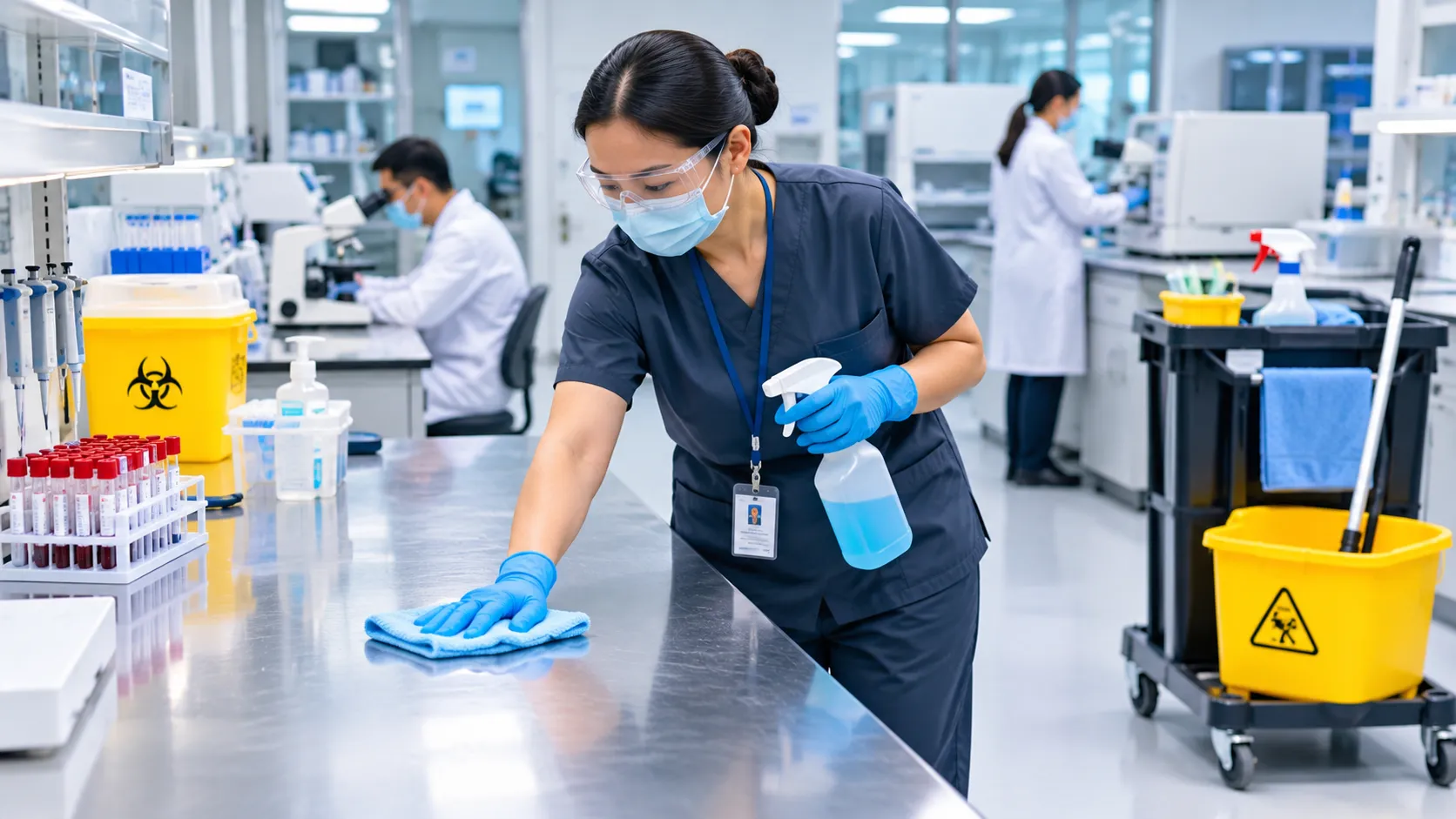
Pathology and medical laboratories require documented, risk-based cleaning and decontamination programmes that address laboratory work surfaces, floors, high-touch areas, specimen collection rooms, approved equipment exteriors and waste handling areas.
Essential laboratory cleaning requirements include:
- Facility-approved cleaning schedules and standard operating procedures.
- Appropriate cleaning products and disinfectants.
- Designated cleaning equipment to prevent cross-contamination.
- Trained and authorised cleaning personnel.
- Risk-based personal protective equipment requirements.
- Defined procedures for biological and chemical contamination incidents.
- Appropriate clinical waste segregation and handling.
- Documented cleaning activities and quality assurance inspections.
Cleaning frequencies and methods must reflect the activities performed, contamination risks, surface materials and applicable Australian workplace safety and pathology requirements.
Pathology and medical laboratories are hygiene-sensitive environments where cleanliness directly supports employee safety, infection prevention, specimen integrity and reliable diagnostic operations.
Unlike ordinary commercial properties, laboratories may contain biological specimens, blood, body fluids, microorganisms, chemicals, diagnostic instruments and other potentially hazardous materials. These conditions require more controlled cleaning practices than those used in general offices or retail facilities.
Effective laboratory cleaning involves more than maintaining an attractive appearance. It requires coordination between laboratory managers, infection-control professionals, scientific personnel and authorised environmental cleaning teams.
Professional medical and healthcare cleaning services can support this process through structured environmental cleaning programmes tailored to the facility's layout, operating hours and agreed hygiene requirements.
Why Cleaning Is Critical in Pathology and Medical Laboratories
Medical laboratories play an essential role in healthcare by supporting disease diagnosis, monitoring patient conditions and providing information that informs clinical decisions.
Inadequate environmental cleaning can increase contamination risks, create occupational hazards and interfere with the controlled conditions needed for laboratory operations.
| Cleaning Objective | Importance in Medical Laboratories |
|---|---|
| Infection Prevention | Helps reduce opportunities for infectious materials to spread through approved environmental surfaces. |
| Staff Safety | Supports the management of exposure risks associated with contaminated environments. |
| Specimen Integrity | Helps maintain environmental conditions that reduce unintended contamination. |
| Equipment Protection | Supports appropriate maintenance of approved external surfaces without damaging sensitive instruments. |
| Regulatory Support | Contributes to documented workplace safety and facility quality management processes. |
| Operational Continuity | Reduces avoidable disruptions associated with uncontrolled environmental contamination. |
| Patient Confidence | Maintains professional presentation in collection rooms, reception and waiting areas. |
| Quality Assurance | Provides documented evidence that assigned environmental cleaning activities have been completed. |
Cleaning is one component of a broader laboratory safety system and should complement rather than replace engineering controls, containment measures, staff training and laboratory-specific biosafety procedures.
1. Understand Australian Laboratory Cleaning Standards and Requirements
Australian pathology laboratories operate within a framework of accreditation, workplace health and safety obligations, infection prevention requirements and facility-specific quality management systems.
Laboratory managers should identify which standards and regulatory requirements apply to their facility before developing or outsourcing cleaning activities.
| Standard or Framework | Primary Focus | Relevance to Laboratory Cleaning |
|---|---|---|
| ISO 15189 | Medical laboratory quality and competence | Supports appropriate environmental conditions, quality management and documented processes. |
| NPAAC Pathology Standards | Australian pathology service requirements | Supports safe pathology operations, clinical governance and risk management. |
| NATA Accreditation | Independent laboratory accreditation | Assesses laboratory compliance with relevant accreditation requirements. |
| AS/NZS 2243.3 | Microbiological safety and containment | Relevant to applicable laboratory biosafety and contamination controls. |
| Work Health and Safety Legislation | Occupational health and workplace safety | Requires appropriate management of workplace hazards and exposure risks under applicable legislation. |
| Australian Guidelines for the Prevention and Control of Infection in Healthcare | Healthcare infection prevention | Provides guidance relevant to applicable environmental cleaning and infection-control practices. |
| State and Territory Waste Requirements | Clinical, chemical and regulated waste management | Establishes applicable waste segregation, storage and disposal obligations. |
| ISO 9001 | Quality management systems | Supports structured service delivery, documentation and continuous improvement. |
The Australian pathology standards provide an important reference for accredited pathology services. The specific requirements applicable to a laboratory depend on its activities, accreditation category and regulatory obligations.
Corporate Cleaning Services® operates under an ISO 9001 quality management system, supporting structured cleaning service delivery, workplace risk assessment and ongoing quality improvement.
Important: ISO 9001 certification for a cleaning provider is different from ISO 15189 accreditation for a medical laboratory. Outsourcing environmental cleaning does not transfer the laboratory's responsibility for accreditation, clinical governance or biosafety compliance.
2. Establish Risk-Based Laboratory Cleaning Zones
Not every area within a pathology facility presents the same contamination risk. A reception area, specimen collection room and microbiology laboratory require different cleaning arrangements.
Establishing clearly defined cleaning zones helps laboratory managers determine appropriate cleaning frequencies, approved products, personnel access and equipment requirements.
Example Laboratory Cleaning Zones
| Laboratory Area | Indicative Risk Profile | Cleaning Consideration |
|---|---|---|
| Administrative Offices | Lower | Routine environmental cleaning unless contamination is identified. |
| Reception Areas | Variable | Regular cleaning of public-facing and frequently touched surfaces. |
| Waiting Rooms | Variable | Healthcare environmental cleaning based on patient traffic and infection risk. |
| Staff Amenities | Variable | Routine hygiene cleaning with appropriate equipment separation. |
| Specimen Collection Rooms | Elevated | Facility-approved clinical cleaning and contamination-response procedures. |
| Specimen Reception and Processing | Elevated | Controlled access and laboratory-specific cleaning responsibilities. |
| Diagnostic Testing Areas | Activity Dependent | Cleaning coordinated with testing schedules and instrument requirements. |
| Microbiology Laboratories | Activity and Containment Dependent | Laboratory-approved biosafety procedures and authorised personnel. |
| Clinical Waste Holding Areas | Elevated | Specific waste-management and environmental cleaning controls. |
| Biological Safety Cabinet Interiors | Specialised | Restricted to appropriately trained and authorised personnel. |
These classifications are illustrative and do not replace formal laboratory risk assessments or physical containment classifications.
Administrative areas that are separated from laboratory activities may be maintained through an appropriate office cleaning programme, provided cleaning equipment and staff movements are managed according to facility procedures.
3. Understand the Difference Between Cleaning, Disinfection and Sterilisation
Cleaning, disinfection and sterilisation are distinct processes. Understanding their differences helps prevent inappropriate product use and unrealistic expectations about routine environmental cleaning.
| Process | Purpose | Typical Application |
|---|---|---|
| Cleaning | Removes dirt, organic matter and unwanted material from surfaces. | Floors, furniture and approved environmental surfaces. |
| Disinfection | Inactivates relevant microorganisms to the required level under specified conditions. | Approved clinical surfaces and areas identified by risk assessment. |
| Decontamination | Reduces or removes contamination to make an item or area suitable for its intended handling or use. | Laboratory-specific contamination management. |
| Sterilisation | Uses a validated process to eliminate viable microorganisms, including bacterial spores. | Specified laboratory equipment, instruments and materials requiring sterilisation. |
Visible cleanliness does not establish that a surface is microbiologically safe or sterile. Laboratory management should specify the required outcome for each cleaning task.
Routine environmental cleaning does not replace validated sterilisation processes or specialist laboratory decontamination.
4. Develop a Documented Laboratory Cleaning Programme
A written cleaning programme provides an agreed framework for consistent service delivery and helps avoid confusion between laboratory employees and external cleaners.
The programme should be developed in consultation with the laboratory's designated management, safety and infection-control personnel.
Essential Components of a Laboratory Cleaning Plan
| Programme Component | Information to Document |
|---|---|
| Cleaning Scope | Specific rooms, surfaces and tasks included or excluded. |
| Cleaning Frequency | Agreed schedules based on activities, occupancy and contamination risk. |
| Personnel Responsibilities | Tasks assigned to laboratory staff, cleaners and specialist contractors. |
| Approved Products | Cleaning agents and disinfectants authorised for each application. |
| Product Instructions | Applicable preparation, contact time, compatibility and safety requirements. |
| Cleaning Equipment | Approved tools and arrangements for separating cleaning zones. |
| PPE Requirements | Task-specific personal protective equipment determined by risk assessment. |
| Access Restrictions | Authorised rooms, working times and restricted areas. |
| Incident Escalation | Reporting and response requirements for spills, exposures and unexpected hazards. |
| Waste Management | Permitted waste-handling tasks and excluded waste streams. |
| Quality Assurance | Inspection criteria, recordkeeping and corrective action requirements. |
A controlled cleaning programme also supports consistent service delivery when staff change, new equipment is installed or laboratory operating hours are modified.
5. How Often Should Pathology Laboratories Be Cleaned?
There is no universal cleaning frequency suitable for every pathology laboratory surface. The appropriate schedule depends on the work performed, patient traffic, surface contact, contamination risks and facility-specific requirements.
Some environmental surfaces may require routine daily cleaning, while others require attention between procedures, following contamination or at more frequent intervals.
Example Risk-Based Laboratory Cleaning Schedule
| Area or Surface | Illustrative Cleaning Frequency | Responsible Personnel |
|---|---|---|
| Reception Counters | Daily or more frequently according to use. | Authorised cleaning personnel. |
| Waiting Room Seating | Routine scheduled cleaning and when visibly soiled. | Authorised cleaning personnel. |
| Door Handles and Shared Touch Points | Regular intervals based on contact frequency. | Authorised cleaning personnel. |
| General Office Floors | Daily or according to occupancy and site requirements. | Cleaning personnel. |
| Laboratory Floors | According to the facility's approved cleaning schedule. | Authorised and inducted personnel. |
| Specimen Collection Chairs | According to patient-contact and contamination procedures. | Designated clinical or cleaning personnel. |
| Laboratory Benches | According to laboratory procedures and contamination events. | Laboratory staff or specifically authorised personnel. |
| Laboratory Instruments | According to manufacturer instructions and laboratory procedures. | Authorised laboratory personnel. |
| Biological Safety Cabinets | According to laboratory biosafety and equipment procedures. | Appropriately trained personnel. |
| Staff Washrooms | Daily or more frequently according to use. | Cleaning personnel. |
| Waste Holding Areas | According to the approved waste-management schedule. | Authorised personnel. |
| Biological or Chemical Spills | Incident-driven response under approved laboratory procedures. | Designated spill-response personnel. |
Cleaning schedules should be reviewed whenever laboratory activities, occupancy, contamination risks or equipment arrangements change.
6. Maintain Laboratory Work Surfaces and Specimen Processing Areas
Laboratory work surfaces may come into contact with specimens, laboratory consumables, reagents and diagnostic equipment. These surfaces require cleaning arrangements that reflect their intended use and potential contamination.
Laboratory management should establish clear boundaries between routine environmental cleaning and specialist work-surface decontamination.
Common Work Surface Cleaning Considerations
- Laboratory benches and designated testing workstations.
- Approved specimen reception surfaces.
- Accessible laboratory trolley surfaces.
- Work trays and equipment support surfaces.
- Approved cupboard and drawer exteriors.
- Laboratory sink surrounds.
- Accessible handles and equipment interfaces.
Cleaning personnel should not move specimens, reagents, scientific documents, testing consumables or laboratory equipment without authorisation.
If a work surface contains unidentified materials or suspected contamination, cleaners should report the concern to the designated laboratory supervisor rather than independently determining how to remove it.
7. Prioritise High-Touch Surface Cleaning
Frequently touched surfaces can contribute to contamination transfer between staff, patients and shared work areas.
A targeted high-touch cleaning programme helps ensure these surfaces receive attention appropriate to their use and risk profile.
| High-Touch Surface | Cleaning Consideration |
|---|---|
| Door Handles | Frequent contact between different rooms and work zones. |
| Light Switches | Repeated shared contact throughout operating hours. |
| Tap Handles | Frequent contact around sinks and handwashing stations. |
| Reception Counters | Regular contact by staff, patients and visitors. |
| Waiting Room Armrests | Repeated patient and visitor use. |
| Drawer and Cupboard Handles | Frequent contact during laboratory activities. |
| Trolley Handles | Potential movement between different operational areas. |
| Shared Keyboards and Phones | Require approved cleaning methods compatible with electronics. |
| Equipment Control Panels | May require manufacturer-specific cleaning procedures. |
| Lift Buttons and Access Controls | Repeated contact along shared access routes. |
High-touch cleaning frequencies should reflect the number of people using the surface, its location and the potential consequences of contamination.
8. Select Appropriate Cleaning Products and Disinfectants
Medical laboratories require cleaning products that are suitable for the intended application and compatible with the surfaces or equipment being treated.
Using a product simply because it is marketed as a hospital-grade disinfectant does not establish that it is appropriate for every laboratory hazard or instrument.
| Selection Factor | Why It Matters |
|---|---|
| Intended Application | Products must be appropriate for the specific surface and cleaning task. |
| Antimicrobial Claims | The product must be suitable for the organisms or contamination risks identified by the facility. |
| Contact Time | Disinfectant effectiveness depends on meeting applicable product instructions. |
| Surface Compatibility | Inappropriate chemicals may damage finishes, plastics, seals or instruments. |
| Organic Contamination | Organic material may interfere with the performance of some disinfectants. |
| Occupational Safety | Cleaning products may introduce chemical exposure risks. |
| Safety Data Sheets | Provide relevant hazard, handling, storage and emergency response information. |
| Regulatory Suitability | Check applicable Australian regulatory requirements and approved product claims. |
| Laboratory Authorisation | Products should be approved through the facility's established procedures. |
Cleaning products should not be substituted without approval from the laboratory or designated facility representative. Cleaning chemicals should never be mixed unless explicitly permitted by the manufacturer and facility procedure.
9. Establish Clear Spill and Contamination Response Procedures
Blood, body fluids, chemical reagents and unidentified laboratory materials require different incident-response arrangements from ordinary food or drink spills.
Routine environmental cleaners should understand how to recognise potential hazards, report incidents and avoid disturbing contaminated materials outside their authorised scope.
| Incident Type | Appropriate Management Responsibility |
|---|---|
| Ordinary Non-Hazardous Spill | Authorised cleaning personnel following the facility's routine procedure. |
| Blood or Body Fluid Spill | Designated personnel trained under the clinical spill-response procedure. |
| Unidentified Laboratory Liquid | Laboratory supervisor or designated safety personnel. |
| Chemical Spill | Personnel authorised under the laboratory's chemical incident-response plan. |
| Broken Contaminated Glass | Designated personnel following laboratory sharps and contamination procedures. |
| Suspected Biological Exposure | Laboratory management and designated occupational health or safety personnel. |
| Containment Equipment Incident | Authorised laboratory or biosafety specialists. |
Facilities should maintain documented incident-response arrangements, appropriate reporting channels and clear access restrictions for affected areas.
External cleaning personnel should not undertake biological or chemical spill remediation unless they are specifically trained, equipped and authorised for the relevant hazard.
10. Protect Sensitive Laboratory Equipment During Cleaning
Pathology laboratories contain instruments that may be sensitive to moisture, particular chemicals, physical movement and environmental changes.
Improper cleaning can damage equipment, interrupt testing operations or compromise the conditions required for reliable analytical performance.
| Equipment Type | Cleaning Consideration | Typical Responsibility |
|---|---|---|
| Diagnostic Analysers | Manufacturer-approved methods and laboratory procedures. | Authorised laboratory personnel. |
| Microscopes | Optical surfaces and sensitive components require specific care. | Trained laboratory personnel. |
| Centrifuges | Internal components and contamination require equipment-specific procedures. | Authorised laboratory personnel. |
| Laboratory Refrigerators | Protect stored specimens, reagents and temperature-sensitive materials. | Laboratory personnel, with approved external cleaning where agreed. |
| Biological Safety Cabinets | Specialised containment and decontamination requirements. | Trained and authorised personnel. |
| Chemical Fume Cupboards | Potential chemical residues and specialised safety controls. | Authorised laboratory or specialist personnel. |
| Computers and Touchscreens | Surface-compatible cleaning methods. | Designated personnel according to approved scope. |
| External Equipment Housings | Cleaning only where specifically approved. | Authorised cleaning or laboratory personnel. |
General cleaning personnel should not dismantle instruments, disconnect equipment, open diagnostic compartments or clean internal laboratory equipment components without explicit authorisation.
11. Apply Appropriate Laboratory Floor Cleaning Practices
Laboratory floors can accumulate dust, ordinary dirt and contaminants associated with daily operations. Floor cleaning must therefore reflect the activities performed and the environmental conditions of each zone.
Common laboratory flooring materials include seamless vinyl, epoxy coatings, sealed concrete and other surfaces selected for durability and cleanability.
| Flooring Type | Cleaning Consideration |
|---|---|
| Seamless Vinyl | Use approved products that protect flooring and seam integrity. |
| Epoxy Flooring | Confirm compatibility with coatings and manufacturer recommendations. |
| Sealed Concrete | Use methods appropriate to the surface finish and contamination assessment. |
| Ceramic Tiles | Address accessible floor surfaces and joints according to site procedures. |
| Safety Flooring | Maintain surface condition without compromising slip-resistant properties. |
| Administrative Carpet | Use suitable routine cleaning methods in approved non-laboratory areas. |
Floor-cleaning equipment should be approved for the relevant zone. Methods that unnecessarily disperse dust or potentially contaminated material should be avoided in controlled laboratory environments.
Any unexpected contamination, damaged flooring or obstructed access routes should be reported through the facility's established procedures.
12. Prevent Cross-Contamination Between Laboratory Areas
Cross-contamination occurs when unwanted material is transferred from one surface, object or location to another.
Within medical laboratories, contamination may be transferred through cleaning tools, footwear, gloves, frequently touched equipment or inappropriate movement between work zones.
Cross-Contamination Prevention Measures
| Control Measure | Purpose |
|---|---|
| Designated Cleaning Equipment | Prevents uncontrolled movement of cleaning tools between zones. |
| Colour-Coded Cleaning Systems | Helps personnel distinguish equipment assigned to different areas. |
| Approved Cleaning Sequence | Supports consistent movement through designated cleaning zones. |
| Hand Hygiene | Reduces contamination transfer associated with hand contact. |
| Task-Specific PPE | Supports protection against identified occupational hazards. |
| Controlled Equipment Storage | Maintains separation between clean and used equipment. |
| Access Restrictions | Prevents unauthorised entry into controlled laboratory spaces. |
| Waste Segregation | Reduces inappropriate contact with hazardous waste streams. |
| Staff Training | Ensures personnel understand site-specific contamination controls. |
Colour coding can be an effective organisational tool, but laboratories should establish their own approved system rather than assume a universal colour assignment applies to every facility.
13. Manage Cleaning Equipment and Consumables
Cleaning equipment must be maintained and stored appropriately so it does not become a source of environmental contamination.
| Cleaning Equipment | Management Requirement |
|---|---|
| Cleaning Cloths | Assign to approved areas and manage replacement or reprocessing appropriately. |
| Mop Heads | Maintain designated equipment arrangements for different cleaning zones. |
| Buckets | Clean, maintain and store according to facility procedures. |
| Cleaning Trolleys | Maintain organisation and separation of clean and used supplies. |
| Vacuum Cleaners | Use only equipment approved for the relevant environment. |
| Product Containers | Maintain correct identification, storage and product information. |
| Waste Containers | Use containers appropriate to the facility's approved waste segregation system. |
| Personal Protective Equipment | Maintain suitable availability and condition for assigned tasks. |
Laboratory management should identify whether cleaning equipment must remain within specific controlled areas or undergo approved procedures before being transferred elsewhere.
14. Separate Clinical, Biological and General Laboratory Waste
Pathology laboratories may generate multiple waste streams that require different handling and disposal arrangements.
General rubbish should not be treated as interchangeable with clinical, infectious, chemical or other regulated waste.
| Waste Stream | Examples | Management Consideration |
|---|---|---|
| General Waste | Uncontaminated office and packaging waste. | Manage under the approved general waste procedure. |
| Recyclable Waste | Approved uncontaminated recyclable materials. | Follow the facility's recycling arrangements. |
| Clinical or Infectious Waste | Materials classified as potentially infectious. | Use the designated regulated waste system. |
| Sharps Waste | Needles and other designated sharp items. | Restrict handling to authorised personnel and approved containers. |
| Specimen Waste | Discarded diagnostic materials and specimens. | Follow laboratory-specific procedures. |
| Chemical Waste | Reagents, solvents and other classified chemical waste. | Manage according to chemical safety and disposal requirements. |
| Contaminated PPE | Used protective equipment classified as contaminated. | Segregate according to the identified waste classification. |
| Broken Laboratory Glass | Damaged glassware and laboratory containers. | Apply appropriate sharps, chemical or biological waste procedures. |
Cleaning personnel should never manually reach into waste containers, compress unidentified laboratory waste or transfer materials between designated waste streams without authorisation.
Clinical and other regulated waste collection should be arranged through appropriate providers according to applicable state or territory requirements.
15. Establish Personal Protective Equipment Requirements
Personal protective equipment requirements should be determined through the laboratory's task-specific risk assessments rather than applying the same PPE to every cleaning activity.
| PPE Type | Purpose |
|---|---|
| Protective Gloves | Supports hand protection against identified biological or chemical hazards. |
| Protective Clothing | Helps protect personal clothing and skin where required. |
| Eye Protection | Provides protection against identified splash or exposure risks. |
| Face Protection | May be required for specific tasks involving splash hazards. |
| Protective Footwear | Supports protection against identified workplace hazards. |
| Respiratory Protection | Used only where required by risk assessment and the facility's approved respiratory protection arrangements. |
PPE is one part of a broader workplace safety system. It does not replace appropriate containment, safe work procedures, staff competency, engineering controls or incident management.
16. Define Responsibilities Between Laboratory Staff and Professional Cleaners
Clearly defined cleaning responsibilities help prevent unauthorised activities and ensure critical tasks are not overlooked.
Laboratory staff and environmental cleaners may have different competencies, training and responsibilities.
| Cleaning Activity | Environmental Cleaning Personnel | Laboratory or Specialist Personnel |
|---|---|---|
| Reception Cleaning | Generally Included | Not Normally Required |
| Administrative Offices | Generally Included | Not Normally Required |
| Staff Amenities | Generally Included | Not Normally Required |
| Approved Laboratory Floors | Subject to Authorisation | According to Site Requirements |
| Approved High-Touch Surfaces | Subject to Agreed Scope | As Assigned |
| Laboratory Workbenches | Only Where Specifically Authorised | Commonly Responsible |
| Diagnostic Instrument Interiors | Generally Excluded | Authorised Personnel Required |
| Biological Safety Cabinet Interiors | Excluded from Routine Cleaning | Trained and Authorised Personnel |
| Biological Spill Response | Only If Specifically Trained and Authorised | Designated Response Personnel |
| Clinical Waste Processing | Excluded Unless Specifically Authorised | Designated Laboratory or Waste Personnel |
| Instrument Sterilisation | Generally Excluded | Appropriately Trained Personnel |
The final division of responsibilities should be documented in the cleaning contract, laboratory standard operating procedures and induction materials.
17. Provide Site-Specific Training for Laboratory Cleaning Personnel
Cleaning staff working within pathology and medical facilities require training appropriate to their assigned duties and potential workplace exposure.
Relevant training and induction topics may include:
- Healthcare environmental cleaning principles.
- Site-specific infection prevention requirements.
- Laboratory hazard awareness.
- Cleaning zone classifications and access restrictions.
- Approved cleaning products and equipment.
- Cleaning and disinfection responsibilities.
- Hand hygiene and personal protective equipment.
- Waste segregation and permitted waste-handling tasks.
- Recognition and reporting of spills or unidentified substances.
- Sharps awareness and incident reporting.
- Emergency evacuation procedures.
- Protection of laboratory equipment and specimens.
- Patient confidentiality and information security.
- Cleaning documentation and quality assurance requirements.
Training should be reviewed when site conditions change, new hazards are identified or cleaning personnel are assigned different responsibilities.
18. Coordinate Cleaning With Laboratory Operating Hours
Pathology laboratories may operate extended hours, process urgent specimens or conduct diagnostic testing continuously.
Cleaning schedules should accommodate these activities rather than interrupt critical laboratory processes.
| Operating Environment | Recommended Scheduling Consideration |
|---|---|
| Daytime Pathology Collection Centre | Schedule routine cleaning around patient appointments and collection activities. |
| Extended-Hours Medical Laboratory | Coordinate cleaning with laboratory managers and suitable access windows. |
| Hospital-Based Laboratory | Maintain flexibility around urgent testing and departmental requirements. |
| High-Volume Diagnostic Facility | Use agreed zone-based cleaning schedules to minimise operational disruption. |
| Multi-Site Pathology Network | Maintain consistent documentation while adapting schedules to individual sites. |
| Restricted Laboratory Areas | Allow access only during approved periods and under applicable authorisation. |
A structured commercial cleaning programme can help coordinate approved cleaning activities across administrative, public-facing and healthcare areas while accommodating operational requirements.
19. Maintain Cleaning Records and Quality Assurance Documentation
Documented cleaning activities help establish accountability and provide information for service reviews, incident investigations and applicable accreditation processes.
Records should be proportionate to the cleaning activity and the laboratory's quality management requirements.
Recommended Cleaning Record Information
| Record Field | Purpose |
|---|---|
| Date and Time | Establishes when the cleaning activity occurred. |
| Room or Cleaning Zone | Identifies the location serviced. |
| Cleaning Task | Documents the assigned work completed. |
| Responsible Personnel | Establishes accountability for the task. |
| Approved Product | Supports product traceability where required. |
| Completion Status | Identifies completed, deferred or incomplete activities. |
| Hazards or Incidents | Documents matters requiring escalation. |
| Corrective Actions | Records how identified deficiencies were addressed. |
| Supervisor Verification | Supports inspection and oversight requirements. |
Cleaning completion records demonstrate that assigned work has been reported as completed. They do not independently establish sterility or the absence of microorganisms.
Any microbiological environmental monitoring or specialist validation should be determined by the laboratory's authorised quality and biosafety personnel.
20. Perform Regular Laboratory Cleaning Quality Audits
Quality audits help laboratory managers assess whether environmental cleaning activities meet the agreed specification.
An effective audit programme should identify deficiencies, document corrective actions and review recurring concerns.
| Audit Method | Purpose | Important Limitation |
|---|---|---|
| Visual Inspection | Identifies visible dirt, dust, residue and incomplete tasks. | Does not establish microbiological safety. |
| Cleaning Record Review | Checks documented task completion. | Depends on accurate recordkeeping. |
| Equipment Inspection | Checks cleaning equipment condition and storage arrangements. | Does not independently verify decontamination. |
| Staff Competency Review | Assesses understanding of assigned procedures and responsibilities. | Requires appropriate assessment criteria. |
| Incident Trend Review | Identifies recurring hazards, complaints and service deficiencies. | Depends on consistent incident reporting. |
| Approved Environmental Monitoring | Assesses specified environmental conditions where required. | Requires appropriate laboratory-defined methods and interpretation. |
Audit results should inform improvements to cleaning schedules, staff training, equipment management and service delivery.
21. Understand Common Laboratory Cleaning Mistakes
Applying ordinary commercial cleaning practices without considering laboratory-specific requirements can create unnecessary operational and safety risks.
| Common Mistake | Potential Consequence | Preventive Measure |
|---|---|---|
| Using the Same Equipment Across All Areas | Potential cross-contamination. | Establish approved zone-specific equipment arrangements. |
| Using Unapproved Cleaning Products | Surface damage or ineffective cleaning outcomes. | Maintain an authorised product list. |
| Cleaning Sensitive Instruments Without Approval | Equipment damage or operational disruption. | Define equipment cleaning exclusions. |
| Ignoring High-Touch Surfaces | Increased opportunities for contamination transfer. | Include high-touch points in the cleaning schedule. |
| Handling Unidentified Waste | Potential biological, chemical or sharps exposure. | Follow approved waste segregation and escalation procedures. |
| Entering Restricted Areas | Compromised access and safety controls. | Maintain clear authorisation requirements. |
| Inadequate Cleaning Documentation | Reduced accountability and traceability. | Maintain agreed cleaning completion records. |
| Cleaning During Sensitive Laboratory Processes | Potential testing interruptions. | Coordinate schedules with laboratory management. |
| Assuming Visible Cleanliness Means Sterility | Misleading assessment of contamination risks. | Distinguish environmental cleaning from specialist validation. |
22. Laboratory Cleaning Requirements Checklist
Laboratory managers and healthcare facility operators can use the following checklist as a planning framework when reviewing environmental cleaning arrangements.
| Cleaning Requirement | Verification Status |
|---|---|
| Facility-specific cleaning risk assessment completed. | ? |
| Cleaning zones clearly identified. | ? |
| Written cleaning schedules established. | ? |
| Cleaning responsibilities clearly assigned. | ? |
| Approved cleaning products documented. | ? |
| Safety data sheets accessible. | ? |
| Cleaning equipment separation arrangements established. | ? |
| High-touch surfaces included in the cleaning schedule. | ? |
| Laboratory floor cleaning requirements documented. | ? |
| Restricted equipment and surfaces clearly identified. | ? |
| Cleaning personnel trained and inducted. | ? |
| PPE requirements established for assigned tasks. | ? |
| Spill reporting and escalation procedures communicated. | ? |
| Waste segregation responsibilities documented. | ? |
| Cleaning schedules coordinated with laboratory operations. | ? |
| Cleaning completion records maintained. | ? |
| Supervisor inspections scheduled. | ? |
| Corrective action procedures established. | ? |
| Cleaning programme periodically reviewed. | ? |
This checklist is a general planning resource and should be adapted to the laboratory's activities, applicable standards and approved safety procedures.
23. What Determines the Cost of Medical Laboratory Cleaning?
The cost of environmental cleaning for pathology and medical facilities depends on several operational factors rather than floor area alone.
| Cost Factor | Impact on Cleaning Requirements |
|---|---|
| Facility Size | Larger facilities generally require more cleaning time and resources. |
| Cleaning Frequency | More frequent servicing increases ongoing labour requirements. |
| Laboratory Risk Profile | Additional access, training and environmental controls may be required. |
| Site-Specific Training | Induction and competency requirements influence staffing arrangements. |
| Specialised Cleaning Products | Approved products may affect consumable costs. |
| Equipment Separation | Dedicated equipment arrangements may increase resource requirements. |
| Operating Hours | After-hours or restricted cleaning windows can affect scheduling. |
| Quality Assurance Requirements | Additional reporting and supervision may be required. |
| Number of Locations | Multi-site operations require coordinated staffing and service oversight. |
| Agreed Service Scope | Costs depend on the environmental cleaning tasks included in the contract. |
A site-specific quotation provides a more accurate assessment than a standard cleaning rate that does not consider the laboratory's operating conditions.
24. Choosing a Professional Medical and Laboratory Cleaning Provider
Selecting a cleaning provider for a pathology or medical facility requires careful consideration of the provider's capabilities, staff training and ability to follow facility-specific procedures.
| Question to Ask | Why It Matters |
|---|---|
| Does your team have healthcare cleaning experience? | Helps establish relevant environmental cleaning capabilities. |
| Can staff complete our laboratory induction? | Ensures personnel understand site-specific requirements. |
| Can you follow our approved cleaning procedures? | Supports integration with the laboratory's safety system. |
| How do you prevent cross-contamination? | Establishes equipment management and cleaning zone practices. |
| How are cleaning products approved? | Supports product suitability and surface compatibility. |
| How do staff report hazards and incidents? | Supports timely escalation of unexpected contamination. |
| Can you provide cleaning completion records? | Supports documentation and accountability. |
| How do you manage service quality? | Establishes inspection and corrective action procedures. |
| Can cleaning be coordinated around laboratory operations? | Reduces unnecessary disruption to diagnostic activities. |
| Which laboratory tasks are excluded from your scope? | Clarifies the boundary between environmental cleaning and specialist laboratory work. |
A suitable provider should work within the laboratory's established safety and quality management framework rather than independently determine specialist decontamination procedures.
How Corporate Cleaning Services® Supports Healthcare Environmental Cleaning
Corporate Cleaning Services® provides professional medical cleaning solutions for healthcare facilities across Australia, with cleaning programmes tailored to operational requirements and hygiene-sensitive environments.
Our medical cleaning approach includes:
- Site assessments and cleaning scope development.
- Trained cleaning teams and site-specific induction where required.
- Approved cleaning products and equipment.
- Colour-coded cleaning systems.
- Targeted high-touch surface cleaning.
- Routine environmental cleaning and washroom hygiene.
- Flexible cleaning schedules.
- Regular inspections and performance monitoring.
- Structured quality management and reporting.
For pathology collection centres and medical laboratory facilities, environmental cleaning requirements should be assessed individually to establish which areas and activities can be safely included in the contracted cleaning scope.
Specialist laboratory decontamination, instrument sterilisation, containment equipment servicing and regulated waste activities require separate confirmation of suitable competencies and authorisation.
Professional Cleaning for Pathology and Medical Facilities
Maintain a cleaner, professionally managed healthcare environment with a cleaning programme tailored to your facility's operational needs.
Talk to Corporate Cleaning Services® about your pathology collection centre, diagnostic facility or medical laboratory's environmental cleaning requirements.
Request a Free Cleaning QuoteCall us today on 1800 032 032
Frequently Asked Questions About Pathology and Medical Laboratory Cleaning
What are the basic cleaning requirements for a pathology laboratory?
Pathology laboratories require documented cleaning schedules, approved products, trained personnel, appropriate equipment management, defined cleaning responsibilities and risk-based contamination controls. Cleaning arrangements must reflect the laboratory's activities, hazards and applicable standards.
How often should a medical laboratory be cleaned?
Cleaning frequency depends on the laboratory area, activities performed, contamination risk and surface usage. General environmental areas may require daily cleaning, while high-touch or potentially contaminated surfaces may require more frequent attention under facility-approved procedures.
What Australian standards apply to pathology laboratories?
Australian pathology laboratories may be subject to ISO 15189, relevant NPAAC Pathology Standards, applicable NATA accreditation requirements, workplace safety legislation and other standards relevant to their activities and containment arrangements.
Do pathology laboratories need specialist cleaning?
Pathology facilities require cleaning practices appropriate to their environmental risks. General areas may be suitable for trained healthcare cleaners, while controlled laboratories, instruments and specialist containment areas may require specifically authorised personnel.
Can commercial cleaners clean medical laboratories?
Yes, where the cleaning tasks are within their training, competency and authorised scope. Laboratory management should define permitted access, cleaning products, equipment and responsibilities before work begins.
What is the difference between medical cleaning and ordinary commercial cleaning?
Medical cleaning places greater emphasis on infection prevention, contamination control, approved products, staff training and documented procedures. Ordinary commercial cleaning primarily focuses on general workplace cleanliness, hygiene and presentation.
Do laboratory benches need daily cleaning and disinfection?
Laboratory benches should be maintained according to approved laboratory procedures. Cleaning and disinfection requirements depend on the activities performed, potential contamination and the risks associated with the work surface.
What disinfectants should be used in medical laboratories?
Laboratories should use disinfectants approved by their management or infection-control personnel for the intended application. Product selection should consider relevant antimicrobial claims, surface compatibility, contact time, occupational safety and applicable Australian regulatory requirements.
Are hospital-grade disinfectants suitable for every laboratory surface?
No. A hospital-grade product may not be suitable for particular organisms, sensitive instruments or surface materials. The laboratory should confirm product suitability and manufacturer compatibility before use.
How can cross-contamination be prevented during laboratory cleaning?
Cross-contamination risks can be managed through designated cleaning equipment, approved cleaning sequences, staff training, hand hygiene, appropriate PPE, waste segregation and controlled access between laboratory zones.
Should laboratory cleaning equipment be colour-coded?
Colour coding can help distinguish equipment assigned to different cleaning zones. The specific colour assignments should follow the facility's approved cleaning system and risk assessment.
Can cleaning contractors clean diagnostic laboratory equipment?
Cleaning contractors should only clean equipment surfaces specifically included within their authorised scope. Sensitive internal components, diagnostic instruments and specialist containment equipment should be managed by appropriately trained personnel.
Who should manage blood or biological spills in a pathology laboratory?
Blood and biological spills should be managed by personnel designated and trained under the laboratory's approved incident-response procedures. Routine cleaners should report incidents and avoid undertaking activities outside their authorised scope.
Should laboratory floors be disinfected every day?
Not necessarily. Floor-cleaning and disinfection requirements should reflect the activities performed, identified contamination risks and facility procedures. Different laboratory areas may require different treatments.
Can clinical waste be placed in ordinary rubbish bins?
No. Waste classified as clinical, infectious, chemical or otherwise regulated must be segregated and managed according to applicable requirements. Laboratory waste should not be treated as ordinary rubbish unless its classification permits this.
Why are laboratory cleaning records important?
Cleaning records provide accountability and traceability for completed environmental cleaning tasks. They can support quality assurance reviews, corrective actions and applicable accreditation processes.
Is a visibly clean laboratory necessarily free from contamination?
No. Visual cleanliness does not establish microbial safety or sterility. Specialist assessment or validated decontamination processes may be required depending on the laboratory activity and intended outcome.
Can laboratory cleaning be performed after hours?
Yes, where approved by laboratory management. After-hours cleaning may reduce operational disruption, but restricted access, security and site-specific safety requirements must still be maintained.
How much does medical laboratory cleaning cost in Australia?
Costs depend on facility size, cleaning frequency, site-specific training, access restrictions, environmental cleaning requirements and quality reporting arrangements. A tailored quotation is recommended to establish accurate pricing.
Does ISO 9001 certification mean a cleaning company is accredited under ISO 15189?
No. ISO 9001 relates to quality management systems, while ISO 15189 addresses medical laboratory quality and competence. They serve different purposes, and a cleaning provider's ISO 9001 certification does not replace laboratory accreditation requirements.
Does Corporate Cleaning Services® provide medical facility cleaning?
Yes. Corporate Cleaning Services® provides professional medical and healthcare cleaning services. Environmental cleaning for pathology and laboratory facilities should be discussed with our team to confirm the appropriate scope, access arrangements and site-specific requirements.
Final Thoughts
Cleaning pathology and medical laboratories requires a structured approach that combines risk-based environmental cleaning, appropriate products, trained personnel, documented responsibilities and effective quality management.
By defining laboratory cleaning zones, establishing clear schedules and coordinating environmental cleaning with laboratory operations, healthcare facilities can support safer working conditions and more consistent hygiene standards.
Professional cleaning should complement the laboratory's existing infection prevention, biosafety and accreditation arrangements, with specialist procedures remaining under the control of appropriately authorised personnel.
Contact Corporate Cleaning Services® on 1800 032 032 to discuss a customised environmental cleaning programme for your medical or healthcare facility.