Quick Answer: How Are High-Security Government Facilities Cleaned?
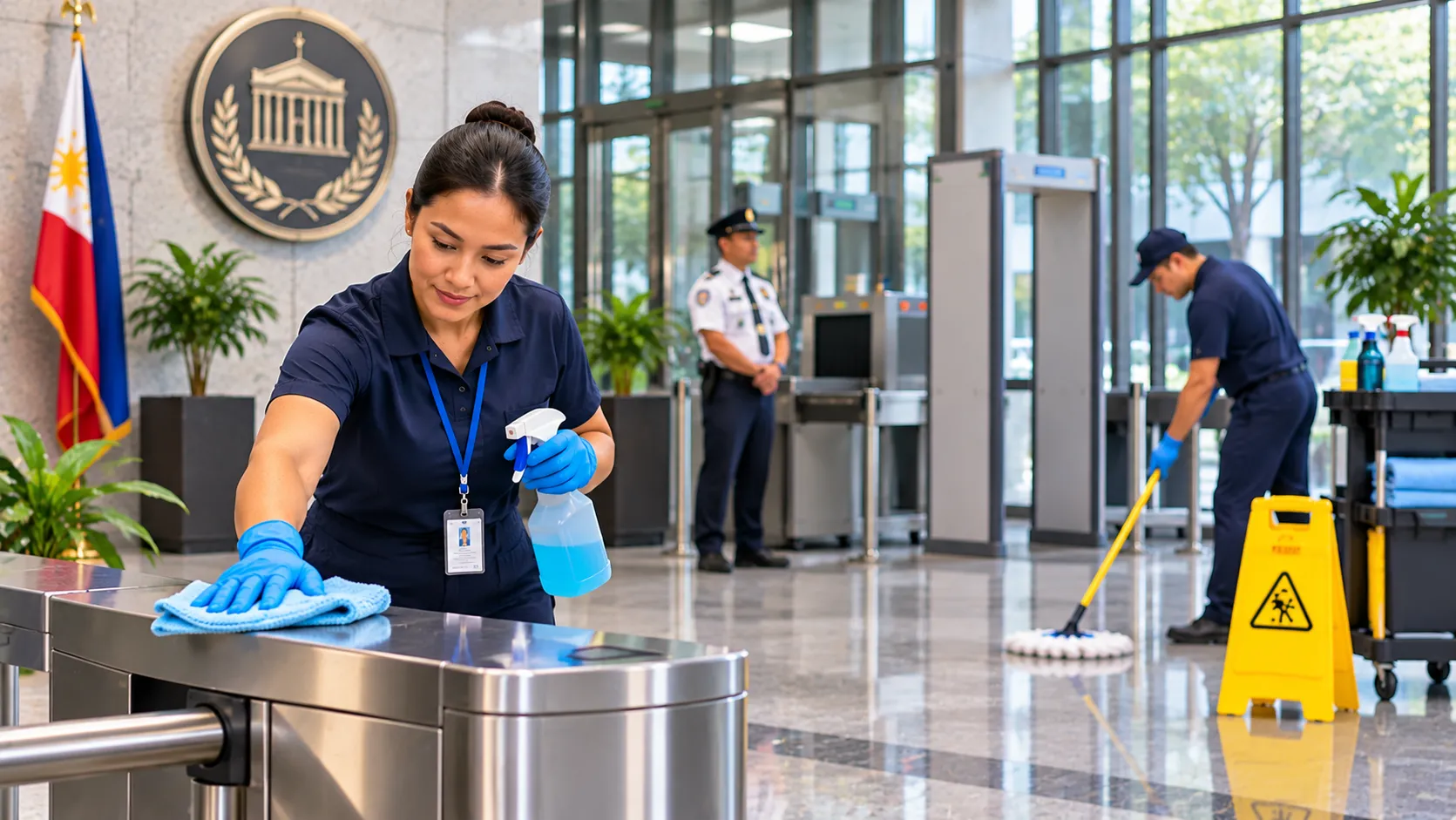
High-security government facilities are cleaned through controlled, site-specific cleaning programs that combine authorised personnel, approved equipment, restricted-access procedures, confidentiality protection, safe waste management and documented quality assurance.
Unlike standard commercial cleaning, every cleaning activity must remain within the facility's approved operational and protective security requirements.
A comprehensive high-security government cleaning program typically includes:
- Contractor and personnel authorisation before service commencement.
- Security screening and government clearances where required.
- Site-specific cleaning specifications.
- Approved access arrangements and supervision.
- Reliable staffing and authorised replacement personnel.
- Protection of sensitive documents and government assets.
- Approved cleaning equipment and chemical management.
- Controlled waste handling procedures.
- Workplace health and safety management.
- Documented quality inspections and incident reporting.
- Business continuity and service review procedures.
In Australia, the applicable requirements depend on the responsible government agency, facility classification, contractual obligations and relevant protective security policies. No single cleaning procedure applies to every high-security government building.
High-security government facilities require a carefully managed approach to environmental cleaning. These buildings may support essential public services, government administration, critical infrastructure, regulatory activities and sensitive operations.
While the fundamental cleaning requirements remain similar to those of commercial workplaces, the manner in which services are delivered can differ considerably.
Cleaning contractors must maintain hygienic environments without interfering with government operations, sensitive information, controlled equipment or established security arrangements.
Professional government cleaning services help facility managers establish reliable cleaning programs that accommodate these additional responsibilities.
1. Why High-Security Government Cleaning Requires a Different Approach
Standard commercial cleaning programs are primarily designed around hygiene, presentation, workplace safety and operational efficiency. High-security government cleaning must address these objectives while also operating within a controlled security environment.
| Service Consideration | Standard Commercial Cleaning | High-Security Government Cleaning |
|---|---|---|
| Staff Assignment | Based on availability and cleaning competency. | Based on competency and applicable personnel authorisation. |
| Site Access | Standard workplace access arrangements. | Agency-approved access conditions. |
| Staff Replacement | Alternative trained cleaners may be assigned. | Replacement staff must satisfy applicable security requirements. |
| Cleaning Equipment | Selected according to cleaning requirements. | Selected according to cleaning and site approval requirements. |
| Waste Management | Routine waste and recycling collection. | Additional controls for sensitive and regulated waste. |
| Cleaning Records | Standard task completion records. | Documented service and contractual accountability. |
| Supervision | Cleaning supervisor oversight. | Cleaning supervision and additional agency oversight where required. |
| Service Changes | Managed through routine operational arrangements. | Subject to applicable change approval requirements. |
The cleaning provider must adapt its service delivery model to the facility rather than expecting the government agency to modify its security arrangements for cleaning convenience.
2. Understand Australian High-Security Government Cleaning Requirements
Australian government cleaning contracts may incorporate protective security, procurement, information management, workplace safety and agency-specific requirements.
The applicable obligations should be identified during contract planning and confirmed before services begin.
| Australian Framework | Relevance to Cleaning Contractors |
|---|---|
| Protective Security Policy Framework (PSPF) | Establishes protective security requirements for applicable Commonwealth entities. |
| Government Security Vetting Requirements | Defines applicable personnel clearance and suitability requirements. |
| Commonwealth Procurement Rules | Supports procurement governance, value for money and contractual accountability where applicable. |
| Work Health and Safety Legislation | Addresses workplace hazards, chemical management, manual handling and worker protection. |
| Privacy Act 1988 | Establishes applicable obligations for protecting personal information. |
| Government Records Management Requirements | Supports appropriate information retention and authorised disposal. |
| State and Territory Requirements | May impose additional security, safety and procurement obligations. |
| Agency-Specific Contract Conditions | Defines the cleaning contractor's individual responsibilities. |
| ISO 9001 Quality Management | Supports documented service delivery and continual improvement. |
Government cleaning contractors should familiarise themselves with the Australian Government Protective Security Policy Framework where relevant to their contractual responsibilities.
Important: Security classifications, access permissions and operational procedures must be determined by the responsible government agency. Commercial cleaning qualifications or ISO certification do not automatically authorise access to restricted government facilities.
3. Plan Contractor Mobilisation Before Cleaning Begins
Mobilisation is the process of preparing personnel, equipment, documentation and service arrangements before a new cleaning contract commences.
For high-security government facilities, this preparation is particularly important because unresolved personnel or equipment approvals may delay service commencement.
| Mobilisation Stage | Key Deliverable |
|---|---|
| Contract Review | Confirmed cleaning responsibilities and contractual requirements. |
| Facility Consultation | Agreed service expectations and operational constraints. |
| Personnel Preparation | Appropriately screened and authorised cleaning personnel. |
| Cleaning Specification | Documented tasks, service standards and frequencies. |
| Equipment Preparation | Suitable cleaning equipment meeting applicable approvals. |
| Chemical Assessment | Approved products and relevant safety documentation. |
| Training and Induction | Personnel prepared for assigned responsibilities. |
| Quality Assurance Planning | Agreed inspection and reporting arrangements. |
| Service Readiness Review | Confirmation that required prerequisites have been satisfied. |
| Contract Commencement | Cleaning delivery within the approved service scope. |
A structured mobilisation process reduces avoidable service interruptions and helps ensure cleaning activities are properly aligned with government requirements from the beginning of the contract.
4. Establish a Site-Specific Cleaning Specification
A cleaning specification defines what the cleaning company is responsible for delivering. In sensitive government environments, it should also identify activities that require separate approval or fall outside routine cleaning responsibilities.
| Specification Component | What It Should Establish |
|---|---|
| Service Scope | Approved environmental cleaning activities. |
| Cleaning Frequencies | Routine, periodic and supplementary service requirements. |
| Personnel Requirements | Applicable competency, screening and authorisation conditions. |
| Equipment Requirements | Permitted cleaning equipment and maintenance standards. |
| Chemical Requirements | Approved products and safe application methods. |
| Information Protection | Responsibilities relating to confidential materials. |
| Waste Management | Approved waste collection responsibilities. |
| Service Exclusions | Activities requiring specialist contractors or government personnel. |
| Performance Standards | Expected cleaning quality and service outcomes. |
| Reporting Requirements | Approved communication and documentation arrangements. |
| Change Management | Process for approving variations to the cleaning service. |
The cleaning specification should be reviewed whenever contractual requirements, facility operations or applicable security procedures change.
5. Assign Appropriately Screened and Authorised Cleaners
Personnel suitability is one of the most important considerations when delivering cleaning services in high-security government environments.
Cleaning contractors should confirm applicable agency requirements before employees are assigned to a facility.
| Personnel Requirement | Purpose |
|---|---|
| Identity Verification | Confirms the identity of assigned personnel. |
| Employment Eligibility | Supports lawful employment arrangements. |
| Police Checks | Provides criminal history information where legally required or permitted. |
| Employment References | Supports personnel suitability assessments. |
| Confidentiality Agreements | Communicates information protection responsibilities. |
| Government Security Clearance | Provides additional personnel assurance where required. |
| Cleaning Competency | Confirms workers can perform assigned cleaning activities. |
| Site Induction | Communicates applicable facility procedures. |
| Role Authorisation | Confirms personnel are approved for their assigned responsibilities. |
Not every government cleaner requires a national security clearance. Screening requirements depend on the agency's assessment, the contracted role and the resources associated with that role.
Where a government security clearance is required, the contractor must follow the applicable sponsorship and vetting arrangements.
6. Maintain an Authorised Relief Staffing Program
Employee leave, illness, training commitments and unexpected absences can create challenges for any commercial cleaning contract.
In a high-security government facility, assigning an ordinary replacement cleaner may not be permitted unless the worker already satisfies the applicable authorisation requirements.
| Staffing Challenge | Recommended Management Approach |
|---|---|
| Unexpected Employee Absence | Use an approved relief staffing arrangement. |
| Annual Leave | Coordinate authorised service coverage in advance. |
| Employee Resignation | Manage replacement recruitment and required authorisation. |
| Increased Cleaning Demand | Review approved staffing resources with the client. |
| Training Requirements | Coordinate training without compromising service coverage. |
| Personnel Authorisation Changes | Follow government-approved personnel management procedures. |
| Contract Expansion | Prepare additional personnel before introducing new services. |
Reliable staffing requires more than recruiting sufficient cleaners. It requires maintaining an appropriately trained and authorised workforce capable of supporting the agreed government cleaning specification.
7. Integrate Cleaning With Government Security Procedures
Cleaning personnel must operate within the facility's existing protective security framework.
The cleaning schedule establishes service expectations, but it does not independently grant permission to enter government workspaces or undertake restricted activities.
Facility managers and cleaning contractors should agree on responsibilities relating to:
- Personnel authorisation.
- Approved access arrangements.
- Credential accountability.
- Supervision requirements.
- Information protection.
- Equipment approval.
- Service changes.
- Security incident reporting.
Where a scheduled cleaning activity cannot be completed under the approved conditions, the contractor should report the service limitation and coordinate an authorised alternative with the facility manager.
Detailed facility access arrangements should remain within the government's controlled operational documentation.
8. Develop Cleaning Programs According to Facility Function
Government facilities may contain different working environments, each with distinct environmental hygiene and operational requirements.
Cleaning specifications should recognise these differences rather than applying an identical service program throughout the building.
| Facility Function | Cleaning Focus | Service Consideration |
|---|---|---|
| Administrative Workplaces | Approved office surfaces, flooring and amenities. | Confidentiality and information protection. |
| Public Service Areas | Reception, seating, floors and public amenities. | Occupancy and visitor traffic. |
| Meeting and Training Facilities | Furniture, floors and shared environmental surfaces. | Room usage and operational requirements. |
| Records Management Facilities | Approved environmental cleaning. | Protection of records and preservation requirements. |
| Technical Facilities | Specialist or expressly approved cleaning. | Equipment compatibility and technical instructions. |
| Staff Amenities | Bathroom, kitchen and communal area hygiene. | Cross-contamination prevention. |
| Sensitive Operational Facilities | Contractually authorised environmental cleaning. | Agency-defined operational restrictions. |
Cleaning contractors should only perform tasks that fall within their approved service responsibilities.
9. Clean Public-Facing Government Facilities Effectively
Public reception areas and government service centres can experience significant foot traffic, particularly during periods of high community demand.
Cleaning should maintain professional presentation while supporting accessibility and environmental hygiene.
| Public Area | Cleaning Priorities |
|---|---|
| Building Entrances | Tracked-in dirt, moisture, accessible glass and entrance matting. |
| Reception Counters | Approved environmental surfaces and visible contamination. |
| Waiting Areas | Seating, flooring and general waste removal. |
| Public Bathrooms | Sanitary fixtures, consumables, floors and waste containers. |
| Public Corridors | Floor hygiene, handrails and unobstructed access. |
| Lift Areas | Approved touchpoints and environmental surfaces. |
| Public Meeting Rooms | Approved furniture, flooring and communal surfaces. |
| Accessible Amenities | Hygiene and safe, unobstructed use. |
Cleaning frequencies should reflect actual occupancy, weather conditions and facility usage rather than relying exclusively on a predetermined routine.
10. Protect Confidential Information During Office Cleaning
Government offices may contain personal information, confidential documents, working papers and sensitive electronic assets.
Cleaning personnel are responsible for environmental cleaning, not managing or examining government information.
| Office Surface or Asset | Appropriate Cleaning Approach |
|---|---|
| Clear Workstations | Clean approved surfaces using suitable products. |
| Desks Containing Documents | Follow the facility's information protection requirements. |
| Filing Cabinets | Clean approved external surfaces only. |
| Computer Equipment | Perform only authorised external cleaning. |
| Whiteboards | Do not erase information without authorisation. |
| Meeting Room Materials | Avoid unnecessary handling of documents and equipment. |
| Unidentified Materials | Refer concerns to designated facility personnel. |
| Government Records | Leave handling and disposal to authorised personnel. |
A clearly defined cleaning scope helps prevent accidental document disposal, damage to government property and inappropriate handling of sensitive information.
11. Manage Cleaning Around Technical and Electronic Equipment
Government facilities may contain specialist electronic equipment that requires controlled environmental conditions and approved maintenance procedures.
Routine office cleaning methods are not necessarily suitable for technical environments.
| Technical Cleaning Consideration | Recommended Approach |
|---|---|
| Equipment Compatibility | Follow manufacturer and facility-approved cleaning instructions. |
| Dust Management | Use approved environmental cleaning methods. |
| Moisture Control | Prevent inappropriate liquid exposure to electronic equipment. |
| Electrostatic Sensitivity | Refer specialist requirements to appropriately trained personnel. |
| Equipment Operation | Avoid operating, disconnecting or relocating government assets. |
| Specialist Surface Cleaning | Obtain technical approval before undertaking unfamiliar tasks. |
| Equipment Maintenance | Remain within agreed environmental cleaning responsibilities. |
Specialist technical cleaning should only be performed by personnel with the required competency and authorisation. Internal equipment maintenance should remain outside routine commercial cleaning unless specifically contracted.
12. Select Suitable Commercial Cleaning Equipment
Equipment selection should consider cleaning effectiveness, workplace safety, surface compatibility and the facility's approved operating requirements.
| Equipment | Typical Application | Selection Consideration |
|---|---|---|
| Commercial Vacuum Cleaner | Carpet and approved environmental surfaces. | Filtration, noise levels and flooring compatibility. |
| Microfibre Cloths | Routine surface cleaning. | Effective soil removal and contamination separation. |
| Commercial Mop System | Hard-floor cleaning. | Moisture management and flooring suitability. |
| Automatic Floor Scrubber | Compatible large hard-floor areas. | Operator competency and approved application. |
| Carpet Extraction Machine | Periodic carpet maintenance. | Material compatibility and drying requirements. |
| Cleaning Trolley | Transport of approved cleaning supplies. | Safe storage and contamination separation. |
| Glass Cleaning Equipment | Accessible windows and glass surfaces. | Safe application and surface protection. |
| Specialist Cleaning Equipment | Approved specialised tasks. | Additional technical and contractual requirements. |
Electronic or connected cleaning technologies should not be introduced without obtaining applicable facility approval.
13. Maintain Cleaning Equipment and Asset Accountability
Cleaning equipment should be maintained in good working condition throughout the contract.
Poorly maintained equipment can reduce cleaning effectiveness, damage government property, increase workplace hazards and disrupt service delivery.
| Equipment Management Activity | Benefit |
|---|---|
| Documented Equipment Inventory | Supports accountability for contractor assets. |
| Routine Equipment Inspection | Identifies defects before equipment is used. |
| Preventive Maintenance | Reduces unexpected breakdowns. |
| Filter Maintenance | Supports vacuum performance and dust management. |
| Cleaning of Reusable Tools | Reduces contamination transfer. |
| Electrical Safety Management | Supports safe equipment operation. |
| Approved Storage | Protects equipment and supports facility requirements. |
| Defect Reporting | Helps prevent continued use of unsafe equipment. |
| Replacement Equipment Approval | Ensures introduced equipment satisfies applicable requirements. |
14. Manage Cleaning Chemicals and Workplace Safety
Protective security requirements do not replace workplace health and safety obligations.
Cleaning chemicals must be selected, handled, labelled and stored according to their intended application, product instructions and applicable Australian safety requirements.
| Chemical Safety Requirement | Recommended Practice |
|---|---|
| Product Selection | Choose products appropriate to the surface and cleaning task. |
| Safety Data Sheets (SDS) | Maintain accessible documentation where required. |
| Product Labelling | Keep chemical containers appropriately identified. |
| Dilution | Follow manufacturer instructions. |
| Disinfectant Contact Time | Follow the specified application requirements. |
| Personal Protective Equipment | Use suitable protection based on the task and risk assessment. |
| Ventilation | Follow applicable product and workplace requirements. |
| Chemical Storage | Use appropriate storage arrangements and separate incompatible products. |
| Spill Management | Follow approved emergency and chemical safety procedures. |
| Disposal | Use appropriate chemical waste management arrangements. |
Safe Work Australia provides guidance on Safety Data Sheets and the management of hazardous chemicals in Australian workplaces.
Cleaning personnel should never mix incompatible chemicals, including bleach and ammonia-based products.
15. Prevent Cross-Contamination Throughout Government Facilities
Cleaning tools can transfer contamination between bathrooms, food preparation areas, offices and communal spaces when they are not managed correctly.
A designated equipment system helps maintain consistent cleaning practices across different environments.
Example Colour-Coded Cleaning System
| Example Colour | Designated Application | Purpose |
|---|---|---|
| Red | Toilets and designated sanitary areas. | Separates higher-contamination bathroom equipment. |
| Blue | General office and administrative areas. | Supports consistent routine cleaning. |
| Green | Staff kitchens and food-related areas. | Reduces contamination transfer into food areas. |
| Yellow | Designated higher-risk cleaning activities. | Supports additional contamination controls. |
These colour assignments are illustrative rather than mandatory government standards. Contractors should follow the colour-coding system approved for the particular facility.
Additional contamination control practices include cleaning from lower-contamination to higher-contamination surfaces, replacing soiled cloths, performing hand hygiene and maintaining reusable cleaning equipment appropriately.
16. Determine When Cleaning and Disinfection Are Required
Routine cleaning removes dirt, dust and organic material from environmental surfaces. Disinfection provides additional microorganism control when required by the contamination risk or intended use of a surface.
| Cleaning Process | Primary Purpose | Typical Application |
|---|---|---|
| Routine Cleaning | Removes visible soil and contamination. | Office furniture, floors and communal surfaces. |
| Disinfection | Inactivates relevant microorganisms under specified conditions. | Designated surfaces requiring additional infection controls. |
| Sanitising | Reduces microorganisms to levels suitable for the intended application. | Applicable food-contact surfaces. |
| Deep Cleaning | Addresses accumulated soil and detailed maintenance. | Carpets, flooring and approved environmental surfaces. |
| Enhanced Cleaning | Provides additional hygiene measures. | Identified contamination events or illness-related requirements. |
Government facilities should use a risk-based approach rather than automatically disinfecting every surface throughout the building.
17. Establish Appropriate Waste Management Responsibilities
Waste collection in high-security government facilities must distinguish routine cleaning responsibilities from information destruction, specialist disposal and records management activities.
| Waste Category | Cleaning Contractor Responsibility |
|---|---|
| General Waste | Collect through approved routine waste arrangements. |
| Recyclable Materials | Follow designated segregation requirements. |
| Confidential Paper | Follow expressly authorised handling procedures. |
| Government Records | Refer disposal decisions to authorised records personnel. |
| Electronic Media | Refer to approved electronic asset disposal arrangements. |
| Sanitary Waste | Use appropriate designated waste services. |
| Hazardous Waste | Refer to authorised specialist procedures. |
| Chemical Waste | Follow product and applicable regulatory requirements. |
| Unidentified Materials | Seek guidance rather than disposing of them without approval. |
Confidential waste and government records should never be treated as ordinary rubbish solely because they appear to have been discarded.
Cleaning contractors should not undertake secure destruction activities outside their authorised contractual responsibilities.
18. Maintain Government Bathrooms and Staff Amenities
Bathrooms and shared amenities require consistent environmental hygiene regardless of the facility's security classification.
Service frequency should reflect occupancy, visitor traffic and the condition of the facilities.
| Amenity | Cleaning Requirement |
|---|---|
| Toilets and Urinals | Remove contamination and disinfect where required. |
| Washbasins | Remove soap residue, watermarks and visible soil. |
| Taps and Handles | Include in routine touchpoint cleaning. |
| Mirrors | Remove marks and residues. |
| Bathroom Floors | Clean contamination and manage slip hazards. |
| Partitions | Clean accessible surfaces using suitable products. |
| Soap Dispensers | Clean and replenish according to the contract. |
| Paper Supplies | Monitor and replenish where included in the service. |
| Staff Kitchen Benches | Use surface-appropriate cleaning methods. |
| Staff Room Tables | Remove food residues and routine contamination. |
| Waste Containers | Empty and clean according to approved procedures. |
Dedicated bathroom and kitchen cleaning tools should be used to minimise cross-contamination between these environments.
19. Implement Surface-Specific Floor Maintenance
Government facilities often contain a combination of flooring materials selected for durability, presentation, accessibility and operational performance.
Using unsuitable chemicals or cleaning equipment can damage floor finishes, increase slip risks and shorten the useful life of flooring assets.
| Flooring Type | Routine Cleaning | Periodic Maintenance |
|---|---|---|
| Carpet | Vacuuming and appropriate spot cleaning. | Approved extraction cleaning. |
| Vinyl | Dust removal and suitable damp cleaning. | Compatible machine cleaning or finish maintenance. |
| Ceramic Tiles | Routine cleaning and soil removal. | Detailed grout maintenance. |
| Natural Stone | Stone-compatible cleaning. | Specialist surface maintenance. |
| Timber | Moisture-controlled cleaning. | Manufacturer-approved maintenance. |
| Concrete | Sweeping and suitable mechanical cleaning. | Detailed surface maintenance. |
| Entrance Matting | Regular dirt and moisture removal. | Deep cleaning or replacement as required. |
| Specialist Flooring | Approved surface-specific cleaning. | Technical or manufacturer-approved maintenance. |
Periodic floor maintenance should be coordinated with the facility manager to minimise disruption and maintain safe access.
20. Establish High-Touch Surface Cleaning Priorities
Frequently touched environmental surfaces can accumulate contamination throughout the working day.
A comprehensive cleaning program should consider contact frequency, occupancy, surface materials and approved cleaning responsibilities.
| Environmental Surface | Cleaning Consideration |
|---|---|
| Door Handles | Include approved surfaces in routine cleaning. |
| Handrails | Clean according to occupancy and contact frequency. |
| Reception Counters | Remove visible contamination and routine residues. |
| Shared Furniture | Use material-compatible cleaning products. |
| Bathroom Fixtures | Include in designated sanitary cleaning. |
| Staff Kitchen Handles | Maintain routine food-area hygiene. |
| Shared Tables | Clean according to usage and approved responsibilities. |
| Building Controls | Clean only authorised external surfaces using suitable methods. |
Specialist security and electronic equipment should be excluded from routine touchpoint cleaning unless the responsible facility has expressly approved the activity.
21. Create a Risk-Based Government Cleaning Schedule
Government cleaning schedules should prioritise building usage, environmental hygiene, service expectations and operational requirements.
The following frequencies illustrate how routine cleaning activities may be incorporated into a commercial cleaning specification. They are not mandatory government cleaning standards.
| Cleaning Activity | Indicative Frequency | Frequency Driver |
|---|---|---|
| Public Bathroom Cleaning | Daily and additional servicing as required. | Occupancy and hygiene requirements. |
| Reception Area Cleaning | Daily or according to use. | Visitor numbers and presentation. |
| General Office Cleaning | According to contractual schedule. | Occupancy and workplace requirements. |
| High-Touch Surface Cleaning | Risk-based routine schedule. | Contact frequency and contamination risks. |
| Staff Kitchen Cleaning | According to daily usage. | Food residues and shared use. |
| Internal Glass Cleaning | Scheduled and as required. | Visible marks and presentation. |
| Detailed Carpet Cleaning | Periodic. | Soiling, traffic and manufacturer guidance. |
| Hard-Floor Maintenance | Periodic. | Floor condition and surface requirements. |
| Detailed Environmental Cleaning | Contractually scheduled. | Accumulated soil and facility needs. |
| Specialist Facility Cleaning | Agency-approved schedule. | Operational and technical requirements. |
Actual service schedules should be established with the government agency and maintained within its approved operational documentation.
22. Coordinate Cleaning Around Essential Government Operations
Government facilities may need to maintain uninterrupted public services, administrative functions and critical operations.
Cleaning activities should be coordinated to minimise noise, disruption, temporary access restrictions and interference with government activities.
| Operational Consideration | Cleaning Management Approach |
|---|---|
| Public Service Continuity | Coordinate cleaning with normal facility operations. |
| Noise Management | Select appropriate equipment and approved service arrangements. |
| Wet Floor Risks | Use appropriate signage and safe cleaning methods. |
| Meeting and Administrative Activities | Coordinate cleaning according to approved room availability. |
| Essential Government Functions | Avoid interference with operational equipment and activities. |
| Periodic Maintenance | Agree maintenance activities with facility management. |
| Unexpected Operational Changes | Communicate service variations through approved channels. |
The objective is to maintain environmental hygiene without compromising the continuity of government services.
23. Manage After-Hours Cleaning Responsibly
After-hours cleaning may be suitable for certain government workplaces because it can reduce disruption to employees and public-facing operations.
However, after-hours service arrangements require agency approval and appropriate consideration of worker safety, supervision, emergency response and operational restrictions.
| Management Consideration | Required Planning |
|---|---|
| Agency Approval | Confirm that the proposed service arrangements are authorised. |
| Worker Safety | Assess risks associated with the working environment. |
| Supervision | Provide oversight according to contractual requirements. |
| Emergency Communication | Ensure workers understand approved emergency arrangements. |
| Cleaning Equipment | Maintain approved equipment availability. |
| Operational Continuity | Coordinate cleaning with the facility's ongoing responsibilities. |
| Completion Reporting | Document contracted service outcomes. |
After-hours cleaning must never be treated as an exemption from ordinary government security or personnel authorisation requirements.
24. Maintain a Comprehensive Workplace Safety Program
High-security government cleaning introduces many of the same occupational hazards found in other commercial cleaning environments.
A documented safety program should address these hazards while respecting the facility's operational requirements.
| Workplace Hazard | Risk Management Approach |
|---|---|
| Slips and Trips | Manage wet surfaces, equipment placement and pedestrian access. |
| Manual Handling | Use appropriate handling techniques and suitable equipment. |
| Chemical Exposure | Follow product instructions, SDS information and risk controls. |
| Electrical Equipment | Maintain equipment in safe working condition. |
| Repetitive Tasks | Review work methods and ergonomic risks. |
| Working Alone | Maintain appropriate risk management and communication arrangements. |
| Hazardous Contamination | Refer specialist risks to appropriately trained personnel. |
| Emergency Situations | Follow approved facility emergency procedures. |
| Damaged Equipment | Remove unsafe equipment from service and report defects. |
Contractors and government facility managers should cooperate on workplace safety matters and review risk controls whenever service conditions change.
25. Establish Clear Incident Reporting Responsibilities
Cleaning personnel may identify safety, maintenance, service quality or security concerns during their work.
The cleaning company's responsibility is to recognise and report issues through approved procedures, rather than independently investigate matters outside its authority.
| Incident Category | Appropriate Response |
|---|---|
| Potential Security Concern | Notify designated government security personnel. |
| Information Protection Concern | Avoid unnecessary handling and follow approved reporting procedures. |
| Credential Concern | Follow the facility's incident reporting requirements. |
| Chemical Spill | Apply approved workplace emergency procedures. |
| Workplace Injury | Follow first aid and safety reporting requirements. |
| Equipment Failure | Report the defect and prevent unsafe continued use. |
| Property Damage | Notify the designated facility representative. |
| Cleaning Service Deficiency | Document the concern and coordinate corrective action. |
| Unidentified Hazard | Seek guidance from authorised personnel. |
Incident reporting should be reinforced during staff induction and refresher training.
26. Train Cleaning Staff for High-Security Government Environments
Cleaning competency alone is not sufficient for every sensitive government cleaning contract.
Personnel should receive training relevant to their approved responsibilities and facility requirements.
| Training Module | Learning Outcome |
|---|---|
| Government Site Induction | Understand applicable contractual and facility procedures. |
| Protective Security Awareness | Recognise individual security responsibilities. |
| Information Protection | Maintain confidentiality and appropriate information boundaries. |
| Access Compliance | Understand the limits of personnel authorisation. |
| Cleaning Techniques | Deliver appropriate environmental cleaning outcomes. |
| Cross-Contamination Prevention | Reduce unnecessary contamination transfer. |
| Chemical Safety | Use, handle and store cleaning products safely. |
| Equipment Operation | Operate approved cleaning equipment competently. |
| Waste Management | Understand designated waste responsibilities. |
| Workplace Safety | Identify and manage cleaning-related hazards. |
| Incident Reporting | Escalate concerns through appropriate channels. |
| Emergency Procedures | Respond according to approved facility arrangements. |
| Quality Assurance | Understand service standards and completion requirements. |
Training completion should be documented, with refresher instruction provided when procedures, equipment or contractual responsibilities change.
27. Establish Quality Control and Inspection Procedures
Cleaning quality should be measurable and consistently maintained throughout the contract.
A formal quality management program helps facility managers verify service delivery and identify areas requiring improvement.
| Quality Control Activity | Purpose |
|---|---|
| Cleaning Checklists | Defines agreed tasks and completion expectations. |
| Supervisor Inspections | Verifies environmental cleaning standards. |
| Service Completion Records | Supports accountability for contracted activities. |
| Client Feedback | Identifies service concerns and improvement opportunities. |
| Corrective Action Records | Tracks resolution of identified deficiencies. |
| Equipment Reviews | Checks equipment suitability and maintenance. |
| Training Reviews | Confirms required staff competency. |
| Contract Performance Reviews | Assesses ongoing alignment with client requirements. |
| Continual Improvement | Addresses recurring service issues and operational changes. |
Corporate Cleaning Services® operates an ISO 9001-certified quality management system, supporting documented procedures, risk assessment and continual improvement.
Inspection methods and associated documentation must also comply with the government's information protection and facility requirements.
28. Establish Measurable Government Cleaning Performance Indicators
Performance indicators help government facility managers assess whether cleaning services are meeting agreed specifications.
| Key Performance Indicator | What It Measures |
|---|---|
| Scheduled Task Completion | Delivery of agreed cleaning activities. |
| Cleaning Inspection Results | Environmental cleaning quality. |
| Personnel Authorisation | Compliance with applicable staffing requirements. |
| Training Completion | Currency of required employee training. |
| Service Continuity | Reliability of contracted cleaning coverage. |
| Complaint Resolution | Responsiveness to reported cleaning concerns. |
| Corrective Action Completion | Resolution of documented service deficiencies. |
| Equipment Availability | Availability of suitable and approved cleaning equipment. |
| Safety Performance | Effectiveness of workplace risk management. |
| Contractual Compliance | Adherence to agreed service responsibilities. |
Performance targets should be agreed during procurement or contract reviews rather than applying unsupported universal benchmarks.
29. Maintain Appropriate Cleaning Documentation
Documentation supports government contract accountability and allows the cleaning provider to demonstrate service delivery.
| Documentation | Purpose |
|---|---|
| Cleaning Specification | Defines approved service responsibilities. |
| Cleaning Schedules | Records agreed service arrangements. |
| Personnel Approval Records | Supports workforce authorisation requirements. |
| Training Records | Demonstrates relevant employee competency. |
| Equipment Registers | Documents equipment accountability. |
| Maintenance Records | Supports equipment reliability and safety. |
| Chemical Registers | Supports hazardous chemical management. |
| Safety Data Sheets | Provides relevant chemical hazard information. |
| Inspection Reports | Records cleaning quality outcomes. |
| Incident Reports | Documents relevant safety and service concerns. |
| Corrective Action Records | Tracks improvements and issue resolution. |
| Contract Review Records | Documents agreed changes and service performance. |
Cleaning documentation should be retained, protected and disposed of according to applicable contractual, privacy and government records management requirements.
Sensitive operational information should only be recorded or shared through authorised systems.
30. Develop a Business Continuity Plan for Government Cleaning
Government facilities require dependable cleaning services even when unexpected events affect normal contractor operations.
A business continuity plan should establish how the cleaning provider maintains essential contracted services during disruption.
| Potential Disruption | Continuity Planning Consideration |
|---|---|
| Employee Absence | Maintain appropriately authorised relief staffing arrangements. |
| Equipment Breakdown | Arrange suitable approved replacement equipment. |
| Cleaning Product Shortage | Coordinate approved alternative products. |
| Unexpected Facility Closure | Review service requirements with the government agency. |
| Increased Hygiene Demand | Assess additional authorised staffing and resources. |
| Severe Weather | Coordinate safe service delivery and operational priorities. |
| Supplier Disruption | Maintain appropriate procurement and supply arrangements. |
| Contractual Changes | Manage approved variations to service delivery. |
| Emergency Events | Follow government-approved emergency and continuity procedures. |
Continuity arrangements must maintain the same personnel, equipment, safety and security requirements that apply to ordinary cleaning operations.
31. Support Sustainable Government Cleaning Procurement
Government cleaning contracts may include sustainability objectives covering chemical consumption, water efficiency, waste reduction and responsible procurement.
Cleaning providers can support these objectives without compromising hygiene, workplace safety or facility-specific requirements.
| Sustainable Cleaning Practice | Potential Benefit |
|---|---|
| Reusable Microfibre Systems | May reduce disposable material consumption. |
| Controlled Chemical Dilution | Reduces unnecessary chemical usage. |
| Water-Efficient Cleaning | Supports responsible water consumption. |
| Suitable Environmentally Preferable Products | Supports applicable sustainable procurement objectives. |
| Efficient Equipment | May reduce resource consumption during cleaning. |
| Preventive Floor Maintenance | May extend the useful life of flooring assets. |
| Waste Segregation | Supports approved recycling programs. |
| Inventory Management | Reduces unnecessary procurement and product wastage. |
| Staff Training | Encourages consistent and responsible resource use. |
Any environmental performance claims should be supported by appropriate product information or documented service outcomes.
32. High-Security Government Facility Cleaning Readiness Checklist
Government facility managers can use the following checklist when preparing, reviewing or renewing a cleaning contract.
| Contract Readiness Requirement | Complete |
|---|---|
| Cleaning contract and responsibilities reviewed. | ? |
| Applicable protective security requirements identified. | ? |
| Cleaning specification approved. | ? |
| Personnel screening completed where required. | ? |
| Required security clearances verified. | ? |
| Assigned personnel appropriately authorised. | ? |
| Relief staffing arrangements established. | ? |
| Staff induction completed. | ? |
| Confidentiality requirements communicated. | ? |
| Cleaning equipment approved where required. | ? |
| Equipment maintenance arrangements established. | ? |
| Cleaning chemicals assessed. | ? |
| Safety Data Sheets available where required. | ? |
| Workplace safety risks assessed. | ? |
| Waste management responsibilities agreed. | ? |
| Specialist cleaning exclusions documented. | ? |
| Cleaning frequencies agreed. | ? |
| Cross-contamination controls established. | ? |
| Emergency procedures communicated. | ? |
| Incident reporting requirements established. | ? |
| Quality inspection arrangements agreed. | ? |
| Performance indicators established. | ? |
| Business continuity arrangements reviewed. | ? |
| Service reporting responsibilities confirmed. | ? |
| Contract review arrangements established. | ? |
This checklist provides a general contract management framework. Individual government agencies may require additional assessments, approvals and supporting documentation.
33. Common High-Security Government Cleaning Mistakes to Avoid
| Common Mistake | Potential Consequence | Better Approach |
|---|---|---|
| Starting Without Complete Mobilisation | Service delays and unresolved contractual requirements. | Confirm readiness before commencement. |
| Assigning Unapproved Employees | Personnel compliance concerns. | Verify authorisation before assignment. |
| Insufficient Relief Staffing | Missed cleaning services during absences. | Maintain approved continuity arrangements. |
| Unclear Cleaning Scope | Missed tasks or inappropriate activities. | Use documented cleaning specifications. |
| Unnecessary Document Handling | Potential confidentiality or records management concerns. | Respect approved information protection procedures. |
| Introducing Unapproved Equipment | Operational or contractual non-compliance. | Confirm applicable equipment requirements. |
| Incorrect Chemical Selection | Surface damage or safety risks. | Use suitable approved cleaning products. |
| Inappropriate Waste Disposal | Information protection or environmental concerns. | Follow designated waste procedures. |
| Inadequate Staff Training | Inconsistent cleaning and procedural errors. | Maintain documented competency programs. |
| Incomplete Quality Inspections | Recurring cleaning deficiencies. | Implement structured inspection procedures. |
| Ignoring Contract Changes | Misalignment with current facility requirements. | Review and approve service variations. |
| Overlooking Business Continuity | Cleaning service interruptions. | Maintain authorised contingency resources. |
34. What Determines the Cost of High-Security Government Cleaning?
High-security government cleaning costs depend on more than the size of the building. Personnel requirements, additional training, equipment approvals, supervision and contractual documentation can all influence the overall service cost.
| Cost Factor | Impact on Contract Pricing |
|---|---|
| Facility Size | Determines the total cleaning area and labour requirements. |
| Building Occupancy | Influences cleaning frequency and consumable usage. |
| Personnel Screening | May increase recruitment and administration requirements. |
| Government Security Clearances | May affect workforce availability and preparation requirements. |
| Contract Mobilisation | Requires initial planning, induction and equipment preparation. |
| Relief Staffing | Supports continuity during authorised personnel absences. |
| Equipment Requirements | Influences approved equipment procurement and maintenance costs. |
| Specialist Cleaning | May require additional competency and resources. |
| Quality Assurance | Requires inspections, supervision and corrective action management. |
| Documentation | Influences service administration and reporting requirements. |
| Periodic Maintenance | Adds scheduled carpet, flooring and detailed cleaning services. |
| Multi-Site Coordination | Requires appropriate workforce and contract management resources. |
A site-specific quotation provides a more meaningful estimate than a standard commercial cleaning rate because it accounts for the actual contract requirements.
35. How to Choose a High-Security Government Cleaning Contractor
Selecting a cleaning provider for a sensitive government facility requires evaluating its operational capability, personnel management, quality systems and ability to meet contractual responsibilities.
| Contractor Selection Criteria | What to Verify |
|---|---|
| Government Sector Experience | Relevant experience with government cleaning contracts. |
| Personnel Screening | Documented processes appropriate to the contract. |
| Security Clearance Capability | Ability to satisfy applicable agency requirements. |
| Contract Mobilisation | Structured preparation before service commencement. |
| Staffing Reliability | Suitable workforce and authorised relief arrangements. |
| Quality Management | Documented inspections and continual improvement procedures. |
| Workplace Safety | Risk assessments, training and safe work practices. |
| Equipment Management | Suitable equipment and maintenance arrangements. |
| Chemical Management | Appropriate product selection and safety documentation. |
| Confidentiality Management | Clear information protection responsibilities. |
| Insurance Coverage | Appropriate insurance for the contracted activities. |
| Business Continuity | Ability to maintain authorised service coverage during disruptions. |
| Service Reporting | Transparent documentation and communication. |
| Contract Accountability | Clearly defined responsibilities and performance review procedures. |
Government procurement decisions should consider overall service value, capability, reliability and compliance rather than relying exclusively on the lowest quoted hourly cleaning rate.
Professional High-Security Government Cleaning Services Across Australia
Corporate Cleaning Services® provides government cleaning solutions designed around the operational requirements of government departments, administrative facilities and controlled environments.
Our government cleaning experience includes services for state and federal government clients and key infrastructure facilities.
Our service approach incorporates:
- Site-specific cleaning programs.
- Personnel screening and vetting arrangements.
- Confidentiality management.
- Documented operational procedures.
- Workplace health and safety practices.
- ISO 9001-certified quality management.
- Routine environmental cleaning.
- Public area and administrative workplace cleaning.
- Bathroom and staff amenity maintenance.
- Commercial floor cleaning and maintenance.
- Cleaning inspections and service reporting.
- Cleaning arrangements tailored to contractual requirements.
Services for restricted environments remain subject to the relevant agency's personnel, security, equipment and operational approval requirements.
By combining structured quality management with professional cleaning expertise, Corporate Cleaning Services® helps government facility managers maintain consistent environmental hygiene while respecting their existing security framework.
Need a Reliable Cleaning Partner for a High-Security Government Facility?
Maintain professional cleaning standards, operational continuity and service accountability with a cleaning program tailored to your facility's requirements.
Corporate Cleaning Services® provides government cleaning solutions supported by documented quality management, personnel screening and site-specific service planning.
Request a Government Cleaning QuoteCall our team on 1800 032 032
Frequently Asked Questions About High-Security Government Cleaning
What is high-security government cleaning?
High-security government cleaning is a controlled commercial cleaning service delivered within a government facility's approved protective security, personnel, operational and c