
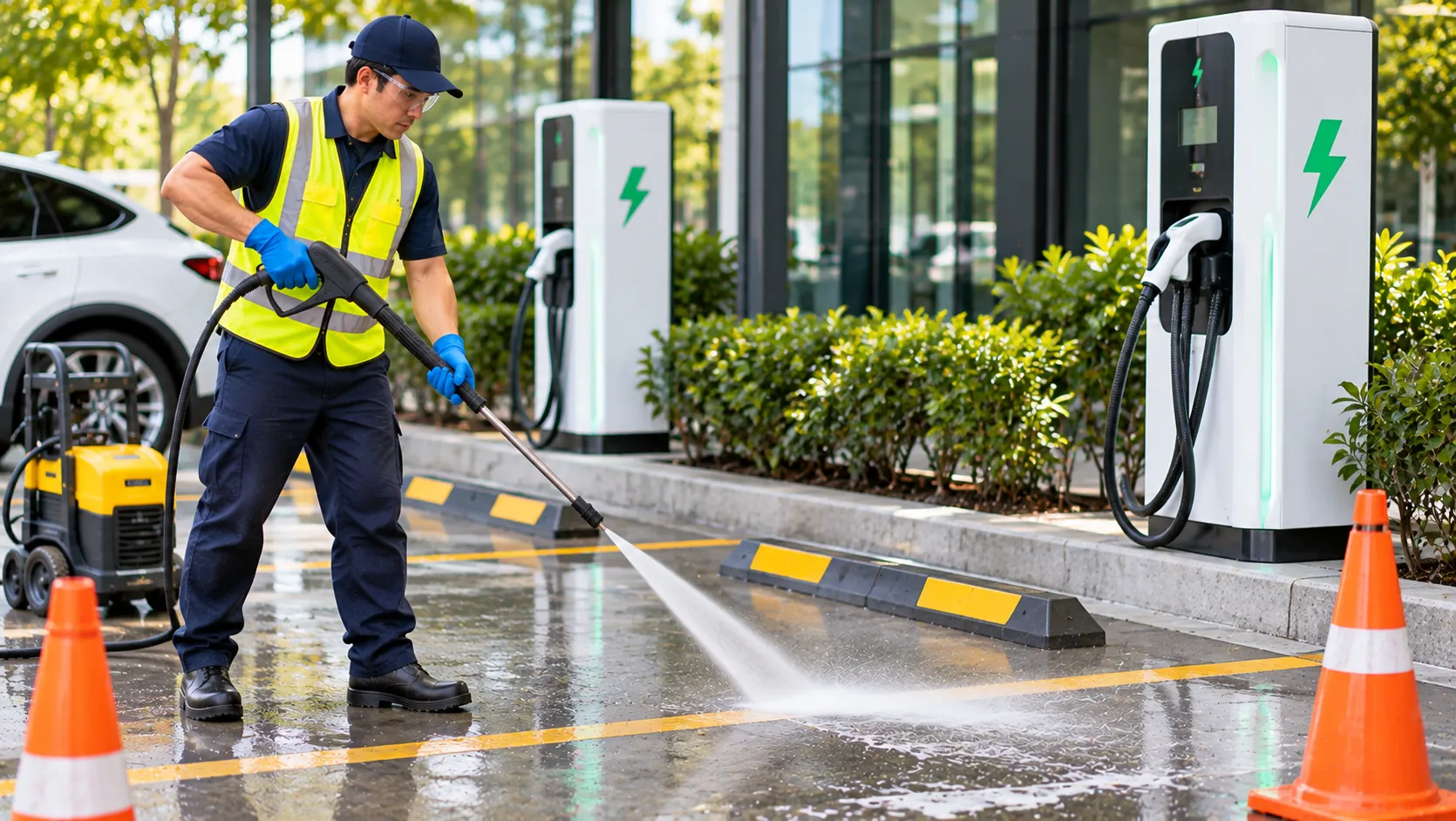
Quick Answer: How Do You Clean Around EV Charging Stations Safely?
Cleaning around electric vehicle (EV) charging stations safely requires controlling moisture, avoiding electrical components, using compatible cleaning products, managing vehicle and pedestrian access, and following the charging equipment manufacturer's instructions.
Commercial cleaning teams should focus on maintaining surrounding pavement, parking bays, pedestrian areas, protective bollards and other approved external surfaces without interfering with charging connections or electrical infrastructure.
Essential precautions include:
- Inspect charging areas for visible damage before cleaning.
- Never direct pressure washers, hoses or water spray towards charging equipment.
- Do not touch damaged cables, connectors or electrical enclosures.
- Use dry cleaning methods near electrical infrastructure wherever suitable.
- Follow manufacturer-approved procedures for external charger surfaces.
- Prevent cleaning water from pooling around charging stations.
- Separate cleaning activities from vehicles and pedestrians.
- Coordinate temporary charging bay closures with the charging network operator.
- Report electrical faults, damaged equipment and suspected water ingress immediately.
- Leave electrical testing, repairs and isolation requiring electrical expertise to appropriately qualified personnel.
A planned maintenance program helps commercial properties maintain clean, accessible and professionally presented EV charging facilities while controlling avoidable electrical and operational hazards.
Electric vehicle charging stations are becoming an increasingly important feature of commercial properties across Australia. Shopping centres, office buildings, hotels, industrial facilities and public parking structures are incorporating EV charging infrastructure to support employees, customers, tenants and fleet operators.
However, cleaning an EV charging bay requires a different approach from cleaning an ordinary parking space. Charging equipment introduces electrical connections, sensitive electronic components, charging cables and additional access requirements that must be considered before maintenance begins.
Incorrect cleaning methods can expose workers and visitors to electrical hazards, damage expensive charging infrastructure and interrupt charging services.
Integrating EV charging areas into a professional commercial car park cleaning program helps facility managers maintain surrounding surfaces without compromising the operation of electrical equipment.
1. Why EV Charging Stations Require Special Cleaning Precautions
Traditional parking bays primarily require debris removal, stain treatment, pavement maintenance and traffic management. EV charging stations introduce additional risks because they contain permanently installed electrical equipment that may remain energised even when a vehicle is not connected.
Charging infrastructure may include screens, cables, connectors, ventilation openings, payment terminals, electrical cabinets and communication systems. Cleaning methods suitable for ordinary concrete surfaces may be unsuitable for these components.
| Cleaning Consideration | Traditional Parking Bay | EV Charging Bay |
|---|---|---|
| Electrical Infrastructure | Generally limited within the bay | Dedicated charging equipment |
| Water-Based Cleaning | Subject to surface and drainage requirements | Additional electrical and moisture restrictions |
| Pressure Cleaning | Common for compatible pavement | Restricted near charging infrastructure |
| Cleaning Products | Selected according to pavement type | Additional equipment compatibility requirements |
| Cable Management | Usually limited | Charging cables create additional hazards |
| Equipment Damage | Primarily pavement and fixtures | Potential damage to electrical and electronic components |
| Operational Access | Vehicle and pedestrian coordination | Additional charging session coordination |
| Fault Reporting | General property maintenance | Charging operator and electrical maintenance escalation |
Cleaning personnel must understand these differences before servicing areas containing EV charging infrastructure.
2. Understanding the Components of an EV Charging Station
Identifying electrical and non-electrical components helps cleaning teams understand which surfaces are within their authorised cleaning scope.
| Charging Station Component | Primary Function | Cleaning Consideration |
|---|---|---|
| Charging Unit Enclosure | Protects internal electrical equipment | Manufacturer-approved external cleaning only |
| Charging Cable | Transfers electricity to the vehicle | Do not manipulate or clean without an approved procedure |
| Charging Connector | Connects charging equipment to the vehicle | Never introduce water or cleaning chemicals into contacts |
| Connector Holder | Stores the connector when not in use | Avoid interference with electrical connections |
| Display Screen | Shows charging information | Use only manufacturer-approved cleaning methods |
| Payment Terminal | Processes user payments | Protect electronics from moisture and chemicals |
| Ventilation Openings | Support equipment temperature management | Do not insert cleaning tools or spray liquids |
| Mounting Pedestal | Supports charging equipment | Prevent impacts and moisture accumulation |
| Electrical Cabinet | Contains electrical distribution equipment | Restricted access for authorised personnel |
| Protective Bollards | Reduce vehicle impact risks | Clean compatible external surfaces carefully |
| Parking Bay Surface | Provides vehicle access | Use methods that protect nearby electrical infrastructure |
| Directional Signage | Provides charging and access information | Maintain visibility and legibility |
Important electrical safety precaution: A charging station may remain energised while idle, displaying an error message or appearing switched off. The absence of a connected vehicle does not confirm electrical isolation. Cleaning personnel must never assume that equipment is safe to touch based on its display status.
3. AC vs DC Charging Stations: Cleaning Considerations
Commercial EV charging facilities may contain alternating current (AC) chargers, direct current (DC) fast chargers or a combination of both.
The charging technology affects equipment configuration, cable weight, enclosure design and servicing requirements. Cleaning procedures must be based on the specific equipment rather than charging technology alone.
| Comparison Factor | AC Charging Stations | DC Fast Charging Stations |
|---|---|---|
| Common Applications | Offices, hotels and longer-stay parking | Retail centres, fleet hubs and public charging locations |
| Equipment Configuration | Wall-mounted or pedestal units | Often larger charging cabinets and dispensers |
| Cable Configuration | Tethered or user-supplied cables, depending on model | Frequently integrated charging cables |
| Cooling Requirements | Model-dependent | May include more complex cooling arrangements |
| External Cleaning | Manufacturer-approved methods | Manufacturer-approved methods |
| Water Exposure | Must remain within equipment specifications | Must remain within equipment specifications |
| Electrical Maintenance | Qualified and authorised personnel | Qualified and authorised personnel |
Both AC and DC chargers present electrical hazards if damaged, incorrectly maintained or exposed to unsuitable cleaning methods.
4. Common Contaminants Around EV Charging Stations
Charging areas experience many of the same contaminants found throughout commercial car parks. Their location near electrical equipment, however, requires more careful removal methods.
| Contaminant | Common Source | Recommended Cleaning Approach |
|---|---|---|
| Loose Dust | Traffic and airborne particles | Suitable dry collection away from sensitive components |
| Sand and Grit | Vehicle tyres and weather exposure | Controlled sweeping |
| Leaves | Surrounding landscaping | Manual or mechanical collection |
| Food Packaging | Customer litter | Routine waste removal |
| Chewing Gum | Pedestrian activity | Approved localised surface treatment |
| Oil and Vehicle Fluid Residue | Vehicle leaks | Assessed spill recovery and compatible treatment |
| Tyre Marks | Vehicle movement | Controlled surface cleaning away from equipment |
| Fingerprints | Contact with approved external surfaces | Manufacturer-approved wiping procedures |
| Bird Droppings | Outdoor exposure | Risk-assessed localised removal |
| Algae and Organic Growth | Damp pavement conditions | Compatible treatment with moisture controls |
| Standing Water | Rainfall or drainage problems | Assess electrical risks and arrange safe drainage correction |
| Graffiti | Vandalism | Surface-approved specialist treatment |
Unidentified liquids, damaged vehicle components and suspected hazardous contamination should be reported rather than treated as ordinary cleaning waste.
5. Main Safety Risks When Cleaning Around EV Chargers
Electrical hazards are not the only concern in EV charging areas. Cleaning teams must also manage vehicle movement, charging cables, wet surfaces and possible equipment damage.
| Hazard | Potential Consequence | Recommended Control |
|---|---|---|
| Water Entering Electrical Equipment | Electrical faults, shock or equipment damage | Avoid direct water application |
| Damaged Charging Cables | Potential exposure to electrical hazards | Do not touch; restrict access and report |
| Cracked Equipment Enclosures | Loss of protective enclosure integrity | Stop nearby cleaning and escalate |
| Moving Vehicles | Collision with cleaning workers or equipment | Implement traffic separation |
| Trailing Charging Cables | Trip hazards and equipment damage | Avoid interference and notify the operator |
| Wet Pavement | Slips and possible electrical exposure | Control moisture and restrict affected areas |
| Unsuitable Chemicals | Damage to seals, plastics and protective finishes | Use approved compatible products |
| Mechanical Cleaning Equipment | Impact damage to chargers or bollards | Maintain approved clearances |
| Suspected Electrical Fault | Serious injury, fire or service interruption | Stop work and follow emergency procedures |
| Uncontrolled Wastewater | Environmental contamination and moisture hazards | Use approved containment and recovery methods |
6. Australian Workplace Safety Requirements for EV Charging Area Cleaning
Commercial properties must manage electrical and other workplace hazards under applicable Australian work health and safety or occupational health and safety legislation.
Safe Work Australia identifies wet environments, outdoor conditions and damaged electrical equipment as circumstances that can increase electrical risk.
Property managers, charging infrastructure operators and cleaning contractors should coordinate their responsibilities before cleaning commences.
| Safety Responsibility | Practical Application |
|---|---|
| Hazard Identification | Identify electrical equipment, water exposure and traffic risks |
| Risk Assessment | Assess cleaning methods against site and equipment conditions |
| Consultation | Coordinate responsibilities between relevant businesses and workers |
| Worker Training | Ensure cleaners understand authorised tasks and reporting procedures |
| Equipment Suitability | Select cleaning machinery appropriate for the environment |
| Electrical Fault Management | Prevent access to unsafe equipment and arrange qualified assessment |
| Traffic Management | Separate cleaning workers from moving vehicles where required |
| Incident Reporting | Document and escalate hazards, damage and incidents |
| Emergency Planning | Establish clear procedures for electrical incidents and emergencies |
Further guidance is available from Safe Work Australia and its Model Code of Practice: Managing Electrical Risks in the Workplace.
Facility managers should also confirm applicable requirements with their state or territory safety and electrical regulators.
7. Cleaning Responsibilities: Cleaners vs EV Charging Technicians
A clearly defined cleaning scope helps prevent workers from performing tasks that require electrical qualifications, specialist training or equipment-specific authorisation.
| Maintenance Task | Commercial Cleaning Team | Authorised Technician or Electrical Personnel |
|---|---|---|
| Removing General Litter | Yes, within approved areas | Not normally required |
| Sweeping Surrounding Pavement | Yes, subject to safety controls | Not normally required |
| Cleaning Protective Bollards | Yes, where approved | Not normally required |
| Cleaning Charger Enclosures | Only under manufacturer-approved procedures | Where specialist access is required |
| Cleaning Charging Connectors | Not part of general cleaning | As required by approved maintenance procedures |
| Opening Electrical Cabinets | No | Authorised and appropriately qualified personnel only |
| Inspecting Internal Components | No | Yes, within authorised scope |
| Electrical Testing | No | Appropriately qualified personnel |
| Replacing Charging Cables | No | Authorised specialist personnel |
| Electrical Isolation and Verification | No, as a general cleaning duty | According to approved electrical procedures |
| Resetting Electrical Protection Devices | No | Authorised personnel following fault assessment |
| Reporting Visible Equipment Damage | Yes | Assess and arrange appropriate corrective action |
Visual observations by cleaning personnel do not replace formal electrical inspections, diagnostic testing or equipment servicing.
8. Pre-Cleaning Inspection of EV Charging Areas
Before starting work, cleaning personnel should undertake a visual assessment from a safe position to identify obvious hazards.
The inspection should consider the condition of surrounding surfaces, accessibility, charging activity and visible equipment damage.
| Inspection Area | What to Look For | Required Response |
|---|---|---|
| Charger Enclosure | Cracks, impact damage or missing covers | Stop nearby cleaning and report |
| Charging Cable | Visible cuts, exposed material or crushing damage | Do not touch; escalate immediately |
| Charging Connector | Visible damage or contamination | Refer to the charging operator |
| Parking Surface | Loose debris, stains and unidentified liquids | Select an approved treatment after assessment |
| Drainage Areas | Blocked grates or water accumulation | Report and assess safe access |
| Protective Bollards | Loose, bent or damaged protection | Report to property management |
| Charging Bays | Connected vehicles and active users | Coordinate access before cleaning |
| Electrical Warning Signs | Missing or damaged signage | Report for replacement |
| Equipment Status | Visible error indicators or unusual conditions | Notify the charging network operator |
9. Establishing Safe Cleaning Zones Around EV Chargers
Dividing the charging area into maintenance zones helps cleaning teams select appropriate methods and avoid unnecessary interaction with electrical equipment.
| Cleaning Zone | Typical Area | Cleaning Approach |
|---|---|---|
| Equipment Protection Zone | Charger, connectors, cables and electrical cabinets | Restricted cleaning under approved procedures |
| Immediate Surrounding Zone | Pavement adjacent to charging equipment | Controlled dry cleaning where suitable |
| Parking Bay Zone | Vehicle parking surface | Approved sweeping and localised treatment |
| Pedestrian Access Zone | Walkways and accessible access routes | Routine cleaning with pedestrian controls |
| Traffic Zone | Vehicle circulation lanes | Mechanical cleaning with traffic separation |
| Drainage Zone | Grates and surface drainage pathways | Controlled debris removal where safe |
There is no universal cleaning clearance distance suitable for every EV charging installation. Boundaries should be established through equipment manufacturer instructions, site-specific risk assessments and consultation with the charging operator.
10. Recommended Cleaning Methods Around EV Charging Stations
Cleaning methods should be selected according to the location, surface material, contamination type and proximity to electrical equipment.
Dry Sweeping
Dry sweeping is generally preferable for collecting ordinary loose debris from accessible pavement near charging infrastructure, provided dust and equipment movement are appropriately controlled.
Mechanical Sweeping
Powered sweeping equipment may be suitable for surrounding parking areas and vehicle routes where adequate clearance, traffic separation and surface compatibility can be maintained.
Approved External Surface Wiping
Charger housings, display screens and user interfaces should only be cleaned when the manufacturer permits the proposed method and the charging operator has authorised the task.
Localised Spot Cleaning
Targeted cleaning can address small areas of contamination while reducing unnecessary water use. Liquid application and recovery must remain within approved site controls.
Controlled Floor Scrubbing
Mechanical scrubbing may be appropriate for designated pavement areas away from charging equipment where cleaning solution and wastewater can be safely controlled.
| Cleaning Method | Suitable Application | Key Limitation |
|---|---|---|
| Manual Sweeping | Accessible surrounding pavement | Control dust and avoid charging cables |
| Mechanical Sweeping | Parking bays and vehicle routes | Maintain approved equipment clearances |
| Litter Collection | General rubbish in safe access areas | Avoid reaching into electrical components |
| Microfibre Wiping | Approved external equipment surfaces | Follow manufacturer instructions |
| Spot Cleaning | Localised pavement contamination | Prevent liquid migration |
| Mechanical Scrubbing | Suitable designated hard-floor areas | Control cleaning solution and water recovery |
| Pressure Cleaning | Approved remote pavement areas only | No spray exposure to charging equipment |
| Steam Cleaning | Selected non-electrical surfaces | Keep heat, steam and moisture away from chargers |
11. Can You Pressure Wash Around EV Charging Stations?
Pressure washing can be effective for removing embedded dirt, tyre marks and treated residues from compatible commercial pavement. However, it presents additional hazards around electrical charging infrastructure.
High-pressure water can enter vulnerable openings, damage protective seals, affect electronic components and create uncontrolled moisture around electrical installations.
Pressure washing must never be directed towards:
- EV charging units.
- Charging cables and connectors.
- Electrical cabinets and distribution equipment.
- Equipment ventilation openings.
- Display screens and payment terminals.
- Electrical cable entry points.
- Damaged equipment enclosures.
- Connected vehicles or active charging interfaces.
| Surface or Component | Pressure Cleaning Suitability |
|---|---|
| Charging Unit Enclosure | Do not pressure wash |
| Charging Connector | Do not pressure wash |
| Charging Cable | Do not pressure wash |
| Electrical Cabinet | Do not pressure wash |
| Immediate Charger Surroundings | Use safer approved alternatives |
| Remote Concrete Parking Surface | May be suitable following risk assessment |
| Vehicle Circulation Lanes | May be suitable with spray and runoff controls |
| External Pedestrian Pavement | Subject to separation and surface compatibility |
Where deep cleaning is required in separate paved areas, professional commercial pressure cleaning services can form part of the broader property maintenance program.
Work must be planned to prevent overspray, runoff and mist from reaching charging infrastructure. Where these risks cannot be adequately controlled, alternative cleaning methods should be used.
12. Understanding EV Charger IP Ratings and Water Resistance
Electric vehicle charging equipment may carry an ingress protection rating, commonly referred to as an IP rating. This rating describes specified protection against solid particles and water under defined test conditions.
However, a charger designed for outdoor operation is not automatically suitable for pressure washing, steam cleaning or unrestricted chemical application.
| IP Rating Example | General Protection Description | Cleaning Implication |
|---|---|---|
| IP44 | Protection against specified solid objects and splashing water | Does not authorise direct water cleaning |
| IP54 | Dust-protected and protected against splashing water | Avoid unapproved spray and liquid exposure |
| IP55 | Dust-protected and resistant to specified water jets | Does not establish pressure washing suitability |
| IP65 | Dust-tight and resistant to specified water jets | Follow equipment-specific cleaning instructions |
| IP66 | Dust-tight and resistant to specified powerful water jets | Not automatic permission for commercial pressure cleaning |
Remember: IP ratings apply under defined conditions to the rated enclosure. Damaged seals, open connectors, incorrect installation and equipment deterioration can affect actual protection. Always follow the manufacturer's cleaning instructions rather than relying on the IP rating alone.
13. Choosing Suitable Cleaning Products Around EV Chargers
Commercial cleaning products may contain ingredients that damage plastics, electronic displays, protective coatings and sealing materials.
Products used on surrounding pavement should also be selected to prevent chemical migration towards charging equipment.
| Cleaning Product | Potential Application | Important Consideration |
|---|---|---|
| Neutral Detergent | Compatible non-electrical surfaces | Equipment surfaces require manufacturer approval |
| Mild Surface Cleaner | Approved external surfaces | Confirm material compatibility |
| Commercial Degreaser | Selected contaminated pavement | Control runoff and chemical exposure |
| Glass Cleaner | Approved non-electrical glazing | Do not assume suitability for charger screens |
| Disinfectant | Approved high-touch surfaces where required | Confirm product and application compatibility |
| Acidic Cleaner | Specialist surface treatment | Avoid exposure to charging components |
| Strong Alkaline Cleaner | Selected industrial contamination | May damage sensitive materials |
| Solvent-Based Cleaner | Specialist applications | May damage plastics, seals and coatings |
| Abrasive Cleaning Product | Limited specialist applications | Generally unsuitable for screens and sensitive finishes |
Cleaning contractors should maintain access to relevant safety data sheets, product instructions and manufacturer-approved cleaning procedures.
14. Cleaning Charger Screens and High-Touch Surfaces
Public charging stations may contain touchscreens, payment interfaces and other user-operated surfaces that accumulate fingerprints, dust and visible marks.
Cleaning these components requires greater care than cleaning standard commercial furniture or building fixtures.
Where external cleaning is expressly permitted, workers should follow the manufacturer's instructions concerning:
- Whether equipment must be taken out of service.
- Approved cleaning products.
- Approved cloth materials.
- Permitted moisture levels.
- Sensitive openings and interfaces.
- Screen coating compatibility.
- Restrictions on disinfectant application.
Do not spray products directly onto charging equipment or attempt to clean electrical contacts. If equipment-specific procedures are unavailable, refer the task to the charging operator.
15. Safe Mechanical Sweeping Around EV Charging Bays
Mechanical sweeping can improve cleaning productivity across commercial parking facilities. However, proximity to charging equipment introduces additional restrictions.
Cleaning operators must prevent rotating brushes, machine bodies and collection equipment from contacting charging cables, pedestals or protective fixtures.
| Sweeping Area | Recommended Approach |
|---|---|
| Open EV Parking Bays | Mechanical sweeping where access and clearance allow |
| Immediate Charger Surroundings | Controlled manual cleaning within approved boundaries |
| Protective Bollards | Manual detailing where safe |
| Charging Cable Areas | Avoid contact and coordinate access with the operator |
| Vehicle Traffic Lanes | Mechanical sweeping with traffic controls |
| Pedestrian Walkways | Suitable sweeping equipment with access management |
| Drainage Grate Surroundings | Remove accessible loose debris where safe |
A combined mechanical and manual cleaning program provides efficient coverage without requiring machinery to enter restricted areas.
16. Removing Oil Stains and Vehicle Fluid Spills Near EV Chargers
Although electric vehicles do not use conventional engine oil in the same way as combustion-engine vehicles, EV charging areas can still accumulate contamination from other vehicles, lubricants, hydraulic fluids and unidentified leaks.
Any spill near electrical infrastructure should be assessed before cleaning begins.
| Spill Type | Potential Concern | Recommended Response |
|---|---|---|
| Small Identified Oil Spill | Slip hazard and pavement contamination | Approved recovery where electrical risks are controlled |
| Vehicle Coolant | Chemical exposure and surface contamination | Follow appropriate spill procedures and product guidance |
| Unidentified Vehicle Fluid | Unknown chemical or electrical risk | Restrict access and arrange assessment |
| Liquid Beneath Damaged Charger | Possible equipment fault or internal leakage | Do not approach; notify the operator |
| Suspected Battery Leakage | Potential hazardous chemical exposure | Keep clear and obtain specialist assistance |
| Fuel Spill | Fire and environmental hazards | Follow site emergency spill procedures |
| Water Around Electrical Equipment | Potential electrical exposure | Restrict access and arrange safe assessment |
Do not use pressure washing to disperse spills. Contamination should be contained and recovered under approved procedures without entering stormwater drains or electrical equipment areas.
17. Managing Water and Wastewater Around EV Charging Stations
Water management is particularly important when cleaning commercial properties containing electrical charging infrastructure.
Even when cleaning takes place away from charging units, wastewater can migrate across sloped surfaces or accumulate around mounting pedestals.
Before wet cleaning, facility managers and contractors should assess:
- Pavement gradients and drainage directions.
- Distance from electrical equipment.
- Potential for overspray and mist.
- Existing drainage defects.
- Water collection and recovery arrangements.
- Weather conditions.
- Potential migration of chemical residues.
- Applicable environmental and wastewater disposal requirements.
| Water Management Issue | Potential Risk | Preventative Measure |
|---|---|---|
| Uncontrolled Runoff | Water reaching chargers | Use approved containment methods |
| Standing Water | Slip and potential electrical hazards | Address drainage problems |
| Blocked Drains | Localised flooding | Routine inspection and appropriate maintenance |
| Pressure Washer Overspray | Moisture exposure to electrical equipment | Use alternative methods or approved separation |
| Chemical Wastewater | Environmental contamination | Recover and dispose through approved arrangements |
| Wet Access Routes | Pedestrian slipping | Restrict access until safe |
Cleaning wastewater must be managed according to relevant local environmental, drainage and trade waste requirements. Stormwater drains should not be used as a default disposal method.
18. Cleaning Outdoor vs Indoor EV Charging Stations
Indoor and outdoor charging installations have different environmental conditions that influence cleaning requirements.
| Maintenance Factor | Outdoor Charging Stations | Indoor and Basement Charging Stations |
|---|---|---|
| Weather Exposure | Rain, sunlight, wind and seasonal debris | Generally more sheltered |
| Typical Contamination | Leaves, dust, bird droppings and sediment | Traffic dust, tyre residue and tracked-in dirt |
| Drainage Requirements | Stormwater and surface runoff management | Local drainage and water recovery considerations |
| Ventilation | Generally open-air | May require specific ventilation controls |
| Cleaning Equipment | Outdoor-compatible machinery | Equipment suitable for enclosed environments |
| Moisture Management | Weather and cleaning water coordination | Greater attention to pooling and drying |
| Traffic Management | Vehicle and pedestrian segregation | Additional restricted visibility and access considerations |
| Cleaning Schedule | Weather and usage dependent | Occupancy and operating-hour dependent |
19. Maintaining Accessible EV Charging Bays
EV charging facilities should remain accessible to their intended users. Poor housekeeping can create unnecessary barriers around charging equipment, designated access aisles and pedestrian approaches.
Cleaning teams should pay particular attention to:
- Accessible parking bay surfaces.
- Designated access aisles.
- Pedestrian kerb ramps.
- Paths connecting charging bays to buildings.
- Clear approaches to charging interfaces.
- Accumulated litter or loose gravel.
- Water pooling on walking surfaces.
- Visibility of accessibility markings.
Cleaning machinery, waste containers and temporary barriers should not obstruct required accessible routes. Where an area must be closed, alternative access arrangements should be coordinated with property management.
20. Cleaning EV Charging Stations Without Interrupting Operations
Charging facilities may operate continuously, making it difficult to close an entire charging area for maintenance.
A coordinated cleaning schedule can reduce interruptions while allowing workers to maintain safe separation from vehicles and electrical infrastructure.
| Cleaning Arrangement | Suitable Application | Operational Benefit |
|---|---|---|
| Early Morning Cleaning | Retail and commercial properties | Reduced customer traffic |
| After-Hours Cleaning | Office and employee charging facilities | Improved bay availability |
| Sequential Bay Cleaning | Multi-bay public charging locations | Limits closures to designated bays |
| Operator-Scheduled Maintenance | Network-managed charging facilities | Coordinates cleaning with planned servicing |
| Condition-Based Cleaning | Variable-use charging areas | Targets maintenance requirements efficiently |
| Combined Car Park Servicing | Large commercial parking facilities | Coordinates cleaning resources across the property |
Cleaning workers must not interrupt an active charging session, unplug customer vehicles or independently disable charging equipment. Any required temporary closure should be arranged through authorised site personnel.
21. Steam Cleaning Near EV Charging Equipment
Steam cleaning is sometimes used to remove chewing gum and persistent contamination from suitable commercial pavement. However, steam combines heat and moisture, making it unsuitable for direct application to electrical charging equipment.
Steam should not be directed towards charging units, connectors, cable entry points, electrical cabinets or electronic interfaces.
Where gum removal or another steam-based treatment is considered for surrounding pavement, the contractor must ensure that heat, condensation and moisture cannot affect charging equipment.
If this cannot be reliably achieved, a manufacturer-compatible alternative cleaning method should be selected.
22. Protecting EV Charging Infrastructure from Cleaning Damage
Charging infrastructure represents a significant investment for commercial property owners and network operators. Incorrect cleaning methods can contribute to premature component deterioration, service interruptions and avoidable repair costs.
| Cleaning-Related Damage | Potential Financial Impact | Preventative Measure |
|---|---|---|
| Scratched Display Screen | Reduced usability and possible replacement costs | Use approved cleaning materials |
| Damaged Protective Seals | Reduced enclosure protection | Avoid unsuitable chemicals and pressure washing |
| Water Ingress | Equipment faults and specialist repairs | Control moisture and prevent direct spray |
| Damaged Cable | Charger downtime and component replacement | Keep cleaning machinery clear |
| Pedestal Impact | Structural or electrical assessment requirements | Maintain equipment clearance |
| Coating Damage | Appearance deterioration and refinishing | Use material-compatible products |
| Obstructed Ventilation Openings | Potential cooling and operational problems | Avoid introducing debris or cleaning materials |
| Damaged Signage | Replacement costs and reduced user information | Use compatible external cleaning methods |
Preventative cleaning supports asset protection, but it does not replace the charging manufacturer's recommended technical maintenance program.
23. Warning Signs That Require Immediate Escalation
Cleaning personnel should be trained to recognise circumstances where routine cleaning must stop and specialist assessment is required.
| Warning Sign | Potential Concern | Cleaning Team Response |
|---|---|---|
| Exposed Electrical Material | Possible live electrical hazard | Keep clear, stop work and report immediately |
| Burn Marks | Possible overheating or electrical fault | Do not touch equipment; notify authorised personnel |
| Smoke | Possible fire or equipment failure | Evacuate and follow emergency procedures |
| Unusual Electrical Sounds | Possible electrical fault | Move away and report |
| Burning Smell | Possible overheating | Stop cleaning and escalate immediately |
| Cracked Charger Housing | Compromised enclosure protection | Restrict access from a safe position |
| Standing Water Near Damaged Equipment | Potential electrical exposure | Do not enter or touch the affected area |
| Loose Charging Pedestal | Structural and electrical damage | Keep clear and report |
| Damaged Charging Connector | Possible electrical contact hazard | Do not handle; refer to the operator |
| Vehicle Impact Damage | Hidden electrical or structural damage | Stop nearby work and arrange specialist assessment |
| Unidentified Leaking Fluid | Potential chemical or equipment hazard | Restrict access and obtain specialist assistance |
Emergency response: If an EV charging station or vehicle shows signs of fire, smoke, arcing or an immediate threat to safety, workers should move to a safe location, follow the site's emergency procedures and call Triple Zero (000) where emergency assistance is required. Do not touch damaged electrical equipment, attempt repairs or approach potentially energised standing water.
24. How Often Should EV Charging Areas Be Cleaned?
Cleaning frequency should be based on charging activity, customer traffic, outdoor exposure, surface condition and site-specific maintenance requirements.
| Property Type | Illustrative Inspection Frequency | Suggested Routine Cleaning Frequency |
|---|---|---|
| Busy Shopping Centre | Daily | Daily or several times weekly |
| Commercial Office Building | Daily to weekly | Weekly or as required |
| Public Fast Charging Hub | Daily | Daily to several times weekly |
| Hotel Charging Facility | Daily | Several times weekly |
| Strata Parking Facility | Weekly | Weekly or fortnightly |
| Warehouse Fleet Charging Area | Each operating day | According to operational conditions |
| Hospital Charging Facility | Daily | According to site maintenance requirements |
| Low-Traffic Charging Location | Weekly | Weekly to monthly, based on condition |
| Outdoor Charging Facility | Regularly and after significant weather events | Condition-based |
These intervals are illustrative maintenance planning recommendations, not mandatory Australian EV charging station cleaning standards. Electrical inspections and technical maintenance must follow separate equipment-specific requirements.
25. Example Preventative EV Charging Area Maintenance Schedule
| Maintenance Interval | Cleaning or Inspection Task | Maintenance Objective |
|---|---|---|
| Daily | Observe accessible areas for visible hazards | Identify urgent safety concerns |
| Daily | Remove general litter from approved areas | Maintain customer presentation |
| Daily or Weekly | Sweep accessible parking surfaces | Control loose debris |
| Weekly | Clean approved non-electrical protective fixtures | Maintain property appearance |
| Weekly | Inspect drainage surroundings | Identify surface runoff concerns |
| Weekly or As Required | Clean approved external touchpoints | Remove visible contamination |
| Monthly | Review recurring contamination hotspots | Improve cleaning resource allocation |
| Monthly | Review pavement and bay markings | Identify maintenance requirements |
| Quarterly | Assess separate pavement deep-cleaning needs | Prevent excessive grime accumulation |
| Manufacturer-Defined Interval | Technical charging equipment servicing | Support equipment maintenance and reliability |
| After Severe Weather | Arrange safe inspection of affected areas | Identify changed conditions or damage |
| Annually | Review cleaning procedures and service performance | Improve preventative maintenance planning |
26. Common Cleaning Mistakes Around EV Charging Stations
| Common Mistake | Potential Consequence | Better Approach |
|---|---|---|
| Pressure Washing Charging Equipment | Moisture ingress and equipment damage | Follow approved external cleaning methods |
| Assuming Idle Chargers Are De-Energised | Electrical exposure | Treat equipment as energised unless properly confirmed otherwise |
| Spraying Chemicals Directly onto Screens | Display and electronic component damage | Use approved application procedures |
| Moving Charging Cables During Sweeping | Cable damage or electrical exposure | Coordinate safe access with the operator |
| Cleaning Around Connected Vehicles | Interference with charging and vehicle movement | Schedule cleaning during available bay periods |
| Using Excessive Water | Pooling and moisture exposure | Select low-moisture alternatives |
| Ignoring Damaged Charging Equipment | Escalating safety risks | Stop work and report immediately |
| Using Abrasive Cloths on Screens | Permanent surface damage | Use manufacturer-approved materials |
| Opening Electrical Panels | Serious electrical hazards | Restrict access to authorised personnel |
| Allowing Wastewater Into Drains | Environmental contamination | Follow approved recovery and disposal procedures |
| Blocking Accessible Charging Routes | Reduced access and additional hazards | Maintain clear designated routes |
| Resetting Faulted Charging Equipment | Potential exposure to unresolved electrical faults | Refer to the charging operator |
27. How EV Charging Area Cleaning Supports Commercial Property Presentation
Electric vehicle charging stations are highly visible amenities that can influence how visitors perceive a commercial property.
Dirty parking surfaces, overflowing rubbish bins, stained pavement and damaged signage may undermine the professional appearance of otherwise modern charging facilities.
Routine maintenance helps support:
- Positive customer and tenant impressions.
- Clear and identifiable charging bays.
- Cleaner pedestrian access routes.
- Improved visibility of charging signage.
- Consistent property presentation standards.
- Reduced accumulation of loose contaminants.
- Better coordination of property maintenance activities.
- Early identification of visible equipment damage.
- More predictable cleaning expenditure.
EV charging area cleaning should form part of the property's wider presentation and preventative maintenance strategy rather than being treated as an isolated task.
28. Integrating EV Charging Areas into Commercial Cleaning Programs
EV charging facilities are frequently located within broader commercial environments that already require scheduled cleaning and maintenance.
Coordinating charging area cleaning with existing commercial cleaning services can help property managers establish more consistent service schedules, documentation and maintenance responsibilities.
| Commercial Property Area | Routine Maintenance | Additional Consideration |
|---|---|---|
| EV Charging Bays | Debris removal and pavement maintenance | Electrical equipment protection |
| General Parking Bays | Mechanical sweeping | Vehicle access management |
| Pedestrian Walkways | Routine surface cleaning | Accessibility and slip risk controls |
| Building Entrances | Floor and entrance mat cleaning | Control tracked-in external contamination |
| Loading Docks | Debris removal and compatible deep cleaning | Vehicle and operational coordination |
| Industrial Hardstands | Mechanical cleaning and surface maintenance | Assess fleet and electrical infrastructure risks |
| External Signage | Approved surface cleaning | Maintain legibility and material compatibility |
| Drainage Areas | Accessible debris removal | Prevent uncontrolled wastewater discharge |
Industrial properties operating electric fleet vehicles may also benefit from integrating charging bay maintenance into their broader industrial cleaning programs.
29. What Determines EV Charging Area Cleaning Costs?
Cleaning costs depend on the number of charging bays, property layout, safety requirements and approved cleaning scope.
| Pricing Factor | Influence on Cleaning Cost |
|---|---|
| Number of Charging Bays | Determines routine maintenance coverage |
| Total Surrounding Pavement Area | Influences cleaning labour and equipment needs |
| Charging Station Layout | Affects access and cleaning efficiency |
| Equipment Restrictions | May require additional manual cleaning |
| Cleaning Frequency | Determines recurring maintenance expenditure |
| Contamination Levels | Influences treatment and disposal requirements |
| Operating Hours | May require after-hours servicing |
| Traffic Management | May require additional safety arrangements |
| Wastewater Recovery | May increase equipment and handling requirements |
| Specialist Stain Treatment | Can require additional compatible cleaning methods |
| Multi-Site Servicing | Influences travel and scheduling efficiency |
A site-specific quotation should clearly distinguish routine environmental cleaning from specialist electrical equipment maintenance.
30. Measuring EV Charging Area Cleaning Performance
Property managers can use documented performance indicators to assess cleaning quality, service efficiency and hazard reporting.
| Performance Indicator | Measurement Method | Management Benefit |
|---|---|---|
| Cleaning Completion Rate | Completed visits compared with scheduled services | Measures service reliability |
| Parking Bay Cleanliness | Documented surface inspections | Maintains presentation standards |
| Hazard Reporting | Recorded observations and escalation times | Supports prompt corrective assessment |
| Cleaning-Related Damage | Incident and equipment damage records | Identifies unsuitable cleaning practices |
| Access Obstructions | Inspection of pedestrian and charging routes | Supports accessibility |
| Water Management | Checks for residual pooling and runoff | Assesses moisture control |
| Charging Bay Closure Duration | Recorded maintenance access restrictions | Supports operational scheduling |
| Recurring Cleaning Costs | Review of actual service expenditure | Improves maintenance budgeting |
| Customer Complaints | Recorded cleanliness and access feedback | Identifies recurring presentation issues |
31. EV Charging Station Cleaning Safety Checklist
Facility managers and cleaning supervisors can use this checklist when developing site-specific maintenance procedures.
| Safety and Maintenance Requirement | Complete |
|---|---|
| Identify all EV charging locations within the property. | ? |
| Identify the charging infrastructure owner or operator. | ? |
| Obtain relevant manufacturer cleaning instructions. | ? |
| Define the authorised commercial cleaning scope. | ? |
| Identify restricted electrical equipment areas. | ? |
| Complete a site-specific cleaning risk assessment. | ? |
| Establish approved equipment clearance requirements. | ? |
| Train workers in electrical hazard recognition. | ? |
| Establish charging operator escalation procedures. | ? |
| Coordinate safe charging bay access. | ? |
| Establish vehicle and pedestrian traffic controls. | ? |
| Inspect the area from a safe position before cleaning. | ? |
| Report visibly damaged charging equipment. | ? |
| Confirm cleaning products are compatible with intended surfaces. | ? |
| Review applicable safety data sheets. | ? |
| Select suitable cleaning machinery. | ? |
| Prevent machinery contact with charging cables and pedestals. | ? |
| Avoid direct water spray towards electrical infrastructure. | ? |
| Assess pavement drainage and runoff directions. | ? |
| Establish approved wastewater recovery arrangements. | ? |
| Maintain clear accessible pedestrian routes. | ? |
| Remove ordinary litter and loose debris safely. | ? |
| Report unidentified spills and suspected hazardous contamination. | ? |
| Inspect cleaning results before reopening affected areas. | ? |
| Record completed cleaning tasks. | ? |
| Document damage, incidents and unresolved hazards. | ? |
| Review cleaning frequency and service requirements. | ? |
| Confirm technical maintenance remains separately managed. | ? |
| Review emergency response procedures regularly. | ? |
| Update cleaning procedures when equipment or site conditions change. | ? |
32. Choosing a Commercial Cleaning Contractor for Properties with EV Chargers
When selecting a commercial cleaning contractor, property managers should confirm that the proposed cleaning procedures address the additional risks associated with EV charging infrastructure.
| Selection Criteria | What Property Managers Should Verify |
|---|---|
| Commercial Car Park Experience | Experience maintaining comparable parking environments |
| Electrical Hazard Awareness | Worker understanding of electrical equipment restrictions |
| Site-Specific Risk Assessment | Documented assessment of cleaning-related hazards |
| Equipment Suitability | Machinery compatible with the property layout |
| Cleaning Product Compatibility | Appropriate products and application procedures |
| Traffic Management | Safe coordination with vehicles and pedestrians |
| Water Management | Appropriate moisture and wastewater controls |
| Operator Coordination | Defined communication with charging infrastructure operators |
| Hazard Reporting | Clear escalation procedures for equipment damage |
| Insurance | Relevant and current insurance coverage |
| Quality Assurance | Documented service inspections and corrective processes |
| Service Scope | Clear distinction between cleaning and electrical maintenance |
Cleaning contractors should not be selected on price alone. An appropriately defined maintenance scope can help prevent equipment damage, unsafe cleaning practices and avoidable operational interruptions.
Frequently Asked Questions About Cleaning Around EV Charging Stations
How do you clean around an EV charging station safely?
Use approved cleaning methods for surrounding surfaces, control moisture, avoid electrical components, establish safe access arrangements and follow equipment-specific manufacturer instructions.
Can you pressure wash an EV charging station?
No. Commercial pressure washers should not be directed towards EV charging equipment, cables, connectors, electrical cabinets or electronic interfaces.
Can you pressure wash the pavement near an EV charger?
Only where a site-specific assessment confirms that electrical equipment can be protected from spray, mist and runoff. Alternative methods should be used if these risks cannot be adequately controlled.
Are EV charging stations waterproof?
Charging equipment may have specified water resistance ratings, but these do not mean the equipment is waterproof under all conditions or suitable for unrestricted wet cleaning.
Can EV charging stations be cleaned while they are operating?
Routine cleaning of separate surrounding areas may be possible where approved safety controls are in place. Cleaning electrical equipment itself requires manufacturer-approved procedures and operator authorisation.
Does an EV charger need to be switched off before cleaning?
Requirements depend on the equipment and cleaning task. Where electrical isolation is necessary, it must be arranged through authorised and appropriately qualified personnel under approved procedures.
Can commercial cleaners touch charging cables?
Charging cables should not be handled unnecessarily. Damaged cables must not be touched, and any required cleaning or handling must follow approved equipment-specific procedures.
What happens if water enters an EV charger?
Water ingress may damage electrical components or create serious electrical hazards. Suspected water ingress should be reported immediately, and the equipment should not be used until appropriately assessed.
What cleaning products are safe for EV charging stations?
Only products approved for the specific equipment and surface should be used on charger components. Surrounding pavement requires compatible products with appropriate runoff controls.
Can alcohol wipes be used on EV charging screens?
Not unless the manufacturer specifically permits them. Alcohol-based products may affect screen coatings, plastics or protective materials.
Can steam cleaning be used around EV chargers?
Steam cleaning must not be directed towards charging equipment. Selected non-electrical surfaces may be treated only where heat, condensation and moisture risks are adequately controlled.
How often should EV charging bays be cleaned?
Frequency depends on traffic, weather exposure, property presentation standards and contamination levels. Busy commercial locations may benefit from daily inspections and regular scheduled cleaning.
Can mechanical sweepers be used near EV charging stations?
Yes, in approved surrounding areas where equipment clearance, traffic separation and cable protection requirements can be maintained.
How should oil stains near EV chargers be removed?
Identified spills should be assessed and recovered using approved procedures and compatible cleaning products. Cleaning liquids must not migrate towards electrical equipment or stormwater drains.
Who is responsible for cleaning EV charging stations?
Responsibilities depend on property ownership, charging operator agreements and service contracts. General environmental cleaning should be clearly distinguished from technical equipment maintenance.
Can cleaners repair damaged EV charging cables?
No. Charging equipment repairs must be referred to appropriately qualified and authorised personnel.
What should cleaners do if an EV charger displays an error?
Report the condition to the charging operator or designated property representative. Do not attempt to reset electrical protection devices or investigate internal components.
Is there a standard cleaning distance around EV chargers?
There is no universal distance appropriate for every installation. Safe cleaning boundaries depend on equipment instructions, site conditions and the approved risk assessment.
How should standing water around an EV charger be handled?
If there is a possible electrical hazard, avoid entering or touching the affected area. Restrict access from a safe position and arrange appropriate assessment.
Can EV charging stations be cleaned after hours?
Yes, subject to charging facility access, operator coordination, safety arrangements and contractor availability.
Are indoor EV charging areas more difficult to clean?
Indoor installations may introduce additional ventilation, restricted access, drainage and moisture management considerations. Cleaning procedures should address the specific environment.
Does cleaning help extend the lifespan of EV charging equipment?
Approved external maintenance can help reduce unnecessary contamination and protect equipment finishes. Actual equipment lifespan also depends on installation, operation, environmental exposure and technical servicing.
Can cleaning contractors clean charger ventilation openings?
General cleaners should not insert tools into or introduce liquids through ventilation openings. Any required maintenance should fo