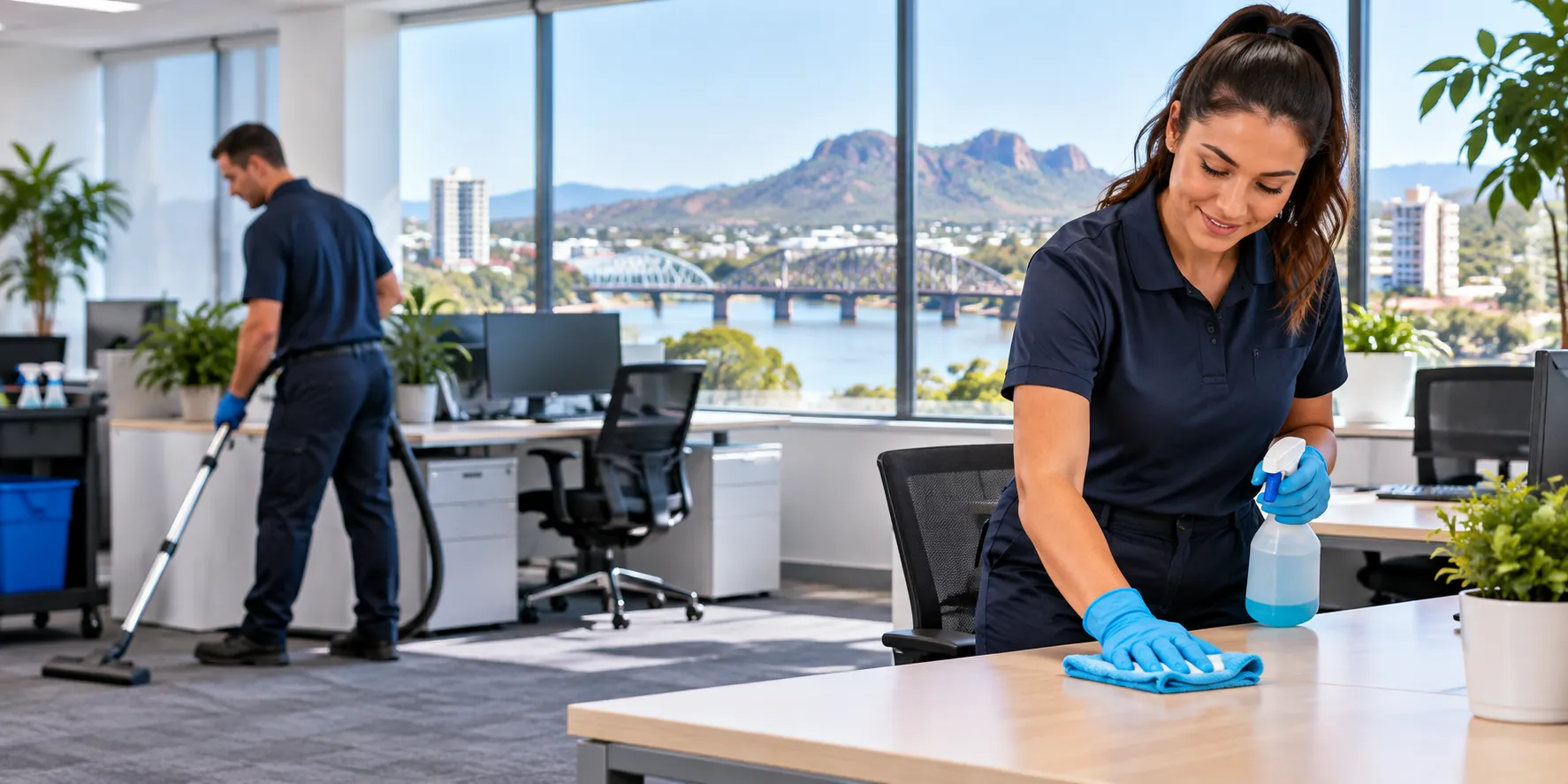
Benefits of Outsourcing Office Cleaning in Rockhampton
8th July 2026
Keeping an office clean involves more than emptying bins and vacuuming floors at the end of the day. Workstations, kitchens, bathrooms, meeting rooms, reception areas and frequently touched surfaces all require regular attention.
For businesses in Rockhampton, managing these responsibilities internally can also require staff time, cleaning supplies, equipment, scheduling and ongoing supervision.
Outsourcing office cleaning provides an alternative. Instead of relying on employees to manage cleaning alongside their normal responsibilities, businesses can engage a professional commercial cleaning provider to work to an agreed scope and schedule.
But is outsourcing right for every workplace? Understanding the potential benefits can help Rockhampton businesses decide which approach best suits their operations.
Quick Answer: What Are the Benefits of Outsourcing Office Cleaning?
Outsourcing office cleaning can help Rockhampton businesses establish a more structured and consistent approach to workplace cleaning. Potential benefits include access to professional cleaners, scheduled services, reduced cleaning responsibilities for employees, defined cleaning standards, access to commercial cleaning equipment and greater flexibility as workplace requirements change.
The value of outsourcing depends on choosing an appropriate cleaning provider and establishing a clear scope covering the areas, tasks and cleaning frequencies required.
Businesses considering professional cleaning can explore commercial cleaning services in Rockhampton.
1. More Consistent Office Cleaning
Consistency is one of the main reasons businesses choose to outsource their office cleaning.
When cleaning is handled informally by employees, tasks can sometimes depend on who has time available.
A professional cleaning arrangement can instead establish a documented schedule covering tasks such as:
- Vacuuming and mopping
- Bin emptying
- Bathroom cleaning
- Kitchen and break-room cleaning
- Reception-area cleaning
- Meeting-room cleaning
- Dusting agreed surfaces
- Cleaning frequently touched surfaces
The cleaning provider and business can agree on what is required and how frequently individual tasks should be completed.
This provides a clearer standard against which the cleaning service can be assessed.
2. Employees Can Focus on Their Primary Roles
Employees are generally hired for responsibilities unrelated to cleaning.
Asking office personnel to regularly vacuum floors, clean bathrooms, empty communal bins or maintain shared spaces can take time away from their primary work.
Even relatively small cleaning tasks can accumulate across a team.
Outsourcing allows routine cleaning responsibilities to be allocated to cleaners while employees remain responsible for reasonable personal tasks such as maintaining their own workspaces.
This separation can be particularly useful for businesses that do not want office cleaning to become an informal shared responsibility with no clear ownership.
3. A Cleaning Schedule Designed Around the Workplace
Not every Rockhampton office needs the same cleaning schedule.
A small professional office used by a handful of employees may have very different requirements from a large workplace with frequent visitors, multiple bathrooms and a busy staff kitchen.
Professional cleaning services can be scheduled according to factors including:
- Number of employees
- Office size
- Visitor numbers
- Operating hours
- Floor surfaces
- Number of bathrooms
- Kitchen usage
- High-traffic areas
- Business requirements
For example, a busy bathroom might require more frequent attention than a meeting room that is only occasionally used.
A tailored approach can help direct cleaning resources towards the areas that actually need them.
Learn more about CorpClean's broader commercial cleaning services.
4. Access to Professional Cleaning Equipment
Managing cleaning internally means somebody within the business also needs to consider equipment and supplies.
Depending on the workplace, this could involve:
- Vacuum cleaners
- Mops and buckets
- Cleaning cloths
- Floor-cleaning equipment
- Cleaning chemicals
- PPE
- Other consumables
Equipment also needs to be stored, maintained and replaced when required.
A professional cleaning company typically manages the commercial cleaning equipment necessary to deliver its agreed services.
Businesses should confirm exactly what equipment, products and consumables are included when comparing cleaning proposals.
5. Less Internal Management of Cleaning Supplies
Cleaning products need to be purchased, stored and monitored.
Without clear responsibility, an office can discover that an essential product has run out only when somebody needs it.
Depending on the service agreement, outsourcing can transfer some of these purchasing and inventory responsibilities to the cleaning provider.
The contract should clearly establish which party supplies:
- Cleaning chemicals
- Cleaning equipment
- Bin liners
- Hand soap
- Paper products
- Other washroom consumables
Defining these responsibilities from the beginning helps prevent gaps or misunderstandings.
6. Cleaning Can Be Scheduled Around Business Hours
Cleaning does not necessarily need to occur while employees and customers are using the workplace.
Depending on the provider and office requirements, services may be scheduled before work, after hours or at other agreed times.
This can reduce disruption associated with vacuuming, mopping and other routine cleaning tasks.
However, some high-use spaces may benefit from servicing during business hours as well.
The appropriate arrangement depends on the workplace.
When planning a schedule, consider:
- Opening and closing times
- Customer or visitor traffic
- Employee working patterns
- Security requirements
- Building access
- Noise-sensitive periods
- High-use areas
Rockhampton businesses can discuss site-specific scheduling requirements with a local commercial cleaning provider in Rockhampton.
7. Clearer Cleaning Responsibilities
One common problem with informal office cleaning is uncertainty about responsibility.
Who cleans the kitchen?
Who notices when bathrooms require attention?
Who empties communal bins?
Who vacuums shared spaces?
A professional cleaning agreement can answer these questions.
A detailed scope of work can identify:
- Areas included
- Tasks performed
- Cleaning frequencies
- Responsibilities of cleaners
- Responsibilities of employees
- Excluded tasks
- Consumable responsibilities
- Reporting procedures
This helps reduce assumptions and creates clearer accountability.
8. Professional Attention to High-Traffic Areas
Not every part of an office experiences the same amount of use.
Reception areas, kitchens, bathrooms, entrances and corridors can receive considerably more traffic than private offices or storage rooms.
A professional cleaning program can identify these areas and assign appropriate frequencies.
For example, an office might schedule:
Daily or frequent attention:
Bathrooms, kitchens, bins and high-traffic floors.
Regular scheduled attention:
Work areas, meeting rooms and general floors.
Periodic cleaning:
Less frequently used spaces and detailed cleaning tasks.
The actual frequencies should be based on the workplace rather than a generic schedule.
9. Better Management of Workplace Kitchens and Break Rooms
Office kitchens can quickly become difficult to manage when many employees share the same facilities.
Food preparation, coffee, dishes and regular employee traffic can create ongoing cleaning requirements.
Depending on the agreed scope, professional cleaners may maintain:
- Benchtops
- Sinks
- Tables
- Floors
- Bins
- External appliance surfaces
- Frequently touched surfaces
It is still important to establish reasonable employee responsibilities.
For example, cleaning contractors may maintain general kitchen surfaces while employees remain responsible for their own dishes, food and personal items.
Clearly defining this distinction helps keep expectations realistic.
10. Regular Bathroom Cleaning
Bathrooms are another shared area where consistency matters.
A professional office cleaning schedule can include:
- Toilets
- Basins
- Taps
- Mirrors
- Floors
- Door handles
- Bins
- Frequently touched surfaces
- Agreed consumable replenishment
The required frequency should reflect employee numbers, visitor traffic and the number of facilities available.
A larger workplace may require more frequent servicing than a small office.
11. A More Professional Workplace Presentation
The appearance of an office can influence how employees, clients, customers and other visitors perceive the workplace.
Reception areas, meeting rooms and common spaces are particularly visible.
Regular cleaning can help maintain:
- Presentable entrance areas
- Cleaner floors
- Tidy shared spaces
- Maintained meeting rooms
- Cleaner bathrooms
- Presentable kitchens and break areas
Professional cleaning does not replace good workplace habits, but it provides a scheduled foundation for maintaining the premises.
12. Easier Quality Monitoring
Outsourcing does not mean a business should stop monitoring cleaning quality.
In fact, a documented commercial cleaning arrangement can make performance easier to assess because expectations are established beforehand.
Quality monitoring can include:
- Cleaning checklists
- Scheduled inspections
- Service reporting
- Feedback processes
- Issue escalation
- Periodic service reviews
If the same issue repeatedly occurs, it can be identified and discussed with the provider rather than simply becoming part of the office routine.
Businesses can learn more about Corporate Cleaning Services® and its approach to commercial cleaning on the About Us page.
13. Greater Flexibility as the Business Changes
Office cleaning requirements can change over time.
A business may:
- Employ more people
- Move into additional office space
- Extend operating hours
- Increase customer traffic
- Add new facilities
- Change office layouts
- Reduce or expand its premises
A cleaning schedule that was appropriate two years ago may no longer reflect the current workplace.
With an outsourced arrangement, the cleaning scope can be reviewed when business requirements change, subject to the provider's capabilities and service agreement.
This can be particularly useful for growing businesses that do not want to continually redesign an internal cleaning system.
14. Access to a Broader Range of Cleaning Services
Routine office cleaning may not address every cleaning requirement a workplace encounters.
From time to time, businesses may need additional or periodic services.
Depending on the provider, these could include more detailed floor care, window cleaning, deep cleaning or other commercial cleaning services.
Working with an established provider may make it easier to coordinate additional services rather than sourcing a different contractor for every requirement.
The services required should still be assessed individually, as not every cleaning task will necessarily form part of a standard office cleaning contract.
15. Reduced Need to Recruit and Manage Cleaning Staff Directly
Businesses that employ cleaners internally take on responsibilities associated with managing that function.
Outsourcing can change the management model by making the cleaning company responsible for supplying personnel under the commercial service arrangement.
For the client business, this can reduce the amount of internal administration specifically associated with organising routine cleaning personnel.
However, businesses should still conduct appropriate due diligence when choosing a contractor and establish clear expectations regarding service delivery.
Is Outsourcing Office Cleaning Always the Better Option?
Not necessarily.
The right approach depends on the business.
A very small office with limited cleaning requirements may decide that an internal arrangement is sufficient.
Larger or busier workplaces may find outsourcing more practical because their cleaning requirements involve multiple areas, regular schedules and greater management.
The decision should consider:
- Workplace size
- Employee numbers
- Cleaning frequency
- Internal resources
- Required cleaning standard
- Equipment requirements
- Operating hours
- Budget
- Management time
Rather than assuming outsourcing is automatically cheaper or better, businesses should compare the full requirements of each option.
In-House vs Outsourced Office Cleaning
When comparing the two approaches, consider more than the headline cost.
In-House Cleaning
The business may need to manage:
- Cleaning personnel or employee responsibilities
- Cleaning equipment
- Products
- Storage
- Scheduling
- Supervision
- Quality monitoring
Outsourced Cleaning
The business generally establishes:
- Service scope
- Cleaning frequency
- Access requirements
- Performance expectations
- Reporting procedures
- Agreed commercial terms
The cleaning provider then manages the delivery of the contracted cleaning service.
The better model depends on the complexity and requirements of the workplace.
How to Choose an Office Cleaning Company in Rockhampton
If outsourcing appears suitable, choosing the right provider is important.
Request a Site Assessment
A walkthrough helps a cleaning company understand the workplace before preparing its proposal.
The provider can review:
- Office size
- Floor types
- Bathrooms
- Kitchens
- Meeting rooms
- High-traffic areas
- Access requirements
- Cleaning frequencies
Ask for a Detailed Scope
Avoid relying solely on broad descriptions such as "weekly office cleaning."
The proposal should make it clear which areas and tasks are included.
Discuss Quality Control
Ask how the provider monitors cleaning quality and how problems are reported and resolved.
Confirm Scheduling
Determine whether cleaning can be performed at times suitable for your workplace.
Check Business Requirements
Businesses should conduct appropriate checks regarding insurance, safety procedures and other contractor requirements relevant to their premises.
Questions to Ask Before Outsourcing Office Cleaning
Before choosing a cleaning company, consider asking:
- What is included in the cleaning service?
- How often will each area be cleaned?
- Who supplies cleaning products and equipment?
- Are washroom consumables included?
- How are cleaners trained?
- How is cleaning quality monitored?
- What happens if a scheduled cleaner is unavailable?
- Can the schedule change if our office grows?
- How are additional cleaning requests handled?
- Who should we contact if there is a problem?
Answers to these questions can make it easier to compare providers on more than price.
Frequently Asked Questions About Outsourcing Office Cleaning
What does outsourced office cleaning include?
The scope varies according to the workplace and contract. Typical services can include vacuuming, mopping, bin removal, bathroom cleaning, kitchen cleaning, reception areas, meeting rooms and agreed surfaces.
How often should a Rockhampton office be professionally cleaned?
There is no universal frequency. It depends on office size, employee numbers, visitor traffic, bathrooms, kitchen usage and other workplace factors. Some offices may require frequent cleaning, while smaller workplaces may need a less intensive schedule.
Can office cleaning be done after business hours?
Depending on the cleaning provider and building access arrangements, cleaning can often be scheduled outside normal working hours. This should be discussed when developing the service schedule.
Is outsourcing office cleaning cheaper than hiring internally?
Not always. Cost depends on the workplace, required hours, service frequency, equipment and other factors. Businesses should compare the total cost and management requirements of each approach rather than assuming one model is always cheaper.
Do professional cleaners provide their own equipment?
Commercial cleaning providers generally use professional cleaning equipment for their services, but businesses should confirm exactly what equipment, chemicals and consumables are included in the proposed agreement.
Can cleaning services change as our business grows?
Cleaning requirements can generally be reviewed as workplace conditions change, subject to the provider's availability and commercial agreement. Growing businesses should discuss flexibility when selecting a contractor.
What should be included in an office cleaning contract?
The agreement should clearly identify areas to be cleaned, tasks, frequencies, access arrangements, responsibilities, exclusions, pricing and processes for reporting or resolving service issues.
Is Outsourcing Office Cleaning Right for Your Rockhampton Business?
Outsourcing office cleaning can offer Rockhampton businesses a more structured way to manage routine workplace cleaning.
Instead of relying on informal arrangements, businesses can establish defined tasks, cleaning frequencies, responsibilities and quality expectations with a professional provider.
The key is choosing a cleaning arrangement that reflects how the workplace actually operates.
Office size, employee numbers, visitor traffic, bathrooms, kitchens, floor surfaces and operating hours should all influence the cleaning plan.
For businesses considering their options, a site assessment can help determine the appropriate scope and cleaning frequency.
Learn more about commercial cleaning services in Rockhampton or visit Corporate Cleaning Services® for more information.